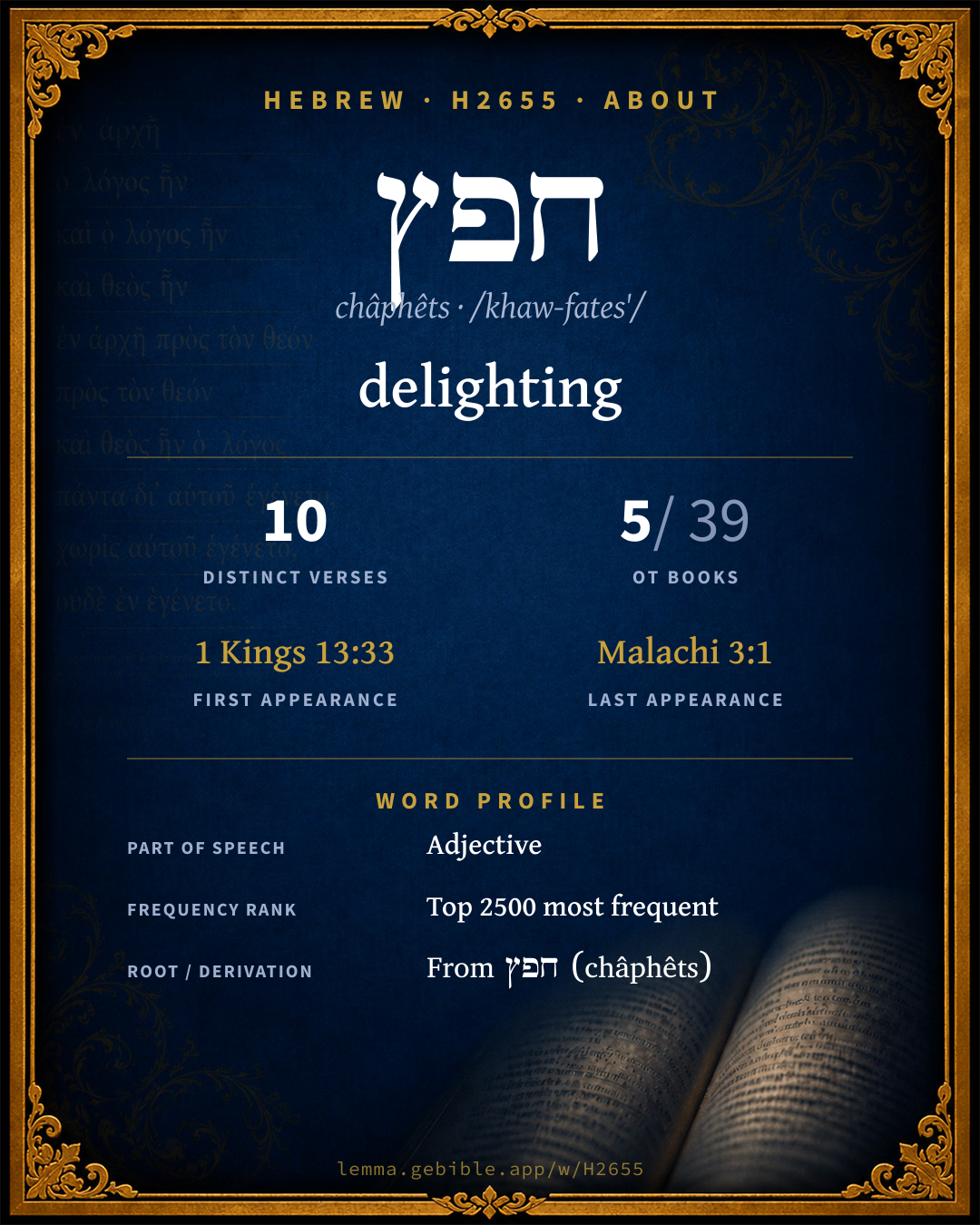
חָפֵץ
delighting
Full lexicon entry — Brown-Driver-Briggs (BDB)
From Brown-Driver-Briggs (BDB)
Where this word appears
See every Construct-state word in the Hebrew Bible →
Grammar key — what these labels mean
Part of speech
- Adjective
- A word that describes or qualifies a noun.
State
- Construct
- A noun bound to a following noun in a possessive / “of” relationship (the construct chain).
- Absolute
- The independent form of a noun, not bound to a following word.
Gender
- Masculine
- Grammatically masculine.
- Feminine
- Grammatically feminine.
Number
- Plural
- More than one (in Hebrew, generally three or more).
- Singular
- One.
Every verse where H2655 appears in the Book of Psalms — 5 distinct verses. Click any verse to open its interlinear word-by-word view. Verse text shown in the World English Bible for context — . Each verse’s Hebrew form is shown with its reference; the English is not keyword-highlighted, since the data carries no word-level English alignment. Use “Compare translations” on any verse to read it across multiple English versions. This concordance covers the Hebrew Bible; Septuagint (Greek Old Testament) occurrences are not indexed here.
Psalms
- Psalms 5:4 חָפֵ֘ץ adj Adjective ms cs For you are not a God who has pleasure in wickedness. Evil can't live with you.
- Psalms 34:12 הֶ/חָפֵ֣ץ ptcl def.art + Adjective Adjective ms Who is someone who desires life, And loves many days, that he may see good?
- Psalms 35:27 חֲפֵצֵ֪י הֶ֝/חָפֵ֗ץ adj Adjective mp cs ptcl def.art + Adjective Adjective ms Let them shout for joy and be glad, who favor my righteous cause. Yes, let them say continually, "Yahweh be magnified, Who has pleasure in the prosperity of his servant!"
- Psalms 40:14 חֲ֝פֵצֵ֗י adj Adjective mp cs Let them be disappointed and confounded together who seek after my soul to destroy it. Let them be turned backward and brought to dishonor who delight in my hurt.
- Psalms 70:2 חֲ֝פֵצֵ֗י adj Adjective mp cs Let them be disappointed and confounded who seek my soul. Let those who desire my ruin be turned back in disgrace.
About this entry
At a glance — auto-summarized from this page’s data, not written by a person. Every figure links to its source below. This summary describes the numbers; it doesn’t interpret them.
At its core, חפץ (châphêts) means “delighting.” Its uses cluster heavily in Psalms (50% of all occurrences). Spanning 10 verses in 5 books, it ranks among the uncommon words of the Hebrew Bible. It first appears in 1 Kings 13:33. Sharing its root, it stands alongside חפץ and חפץ. Dig into 10-verse concordance and the renderings breakdown below.
Gloss history
Strong's 1890 vs modern scholarship

About this word
Strong's H2655 catalogs a Hebrew word from the Hebrew Old Testament.
These counts are not copied from any lexicon or concordance. They are computed here, from the morphology-tagged Hebrew Old Testament. What Lemma adds →
- 10
- distinct verses
- The word appears in 10 distinct verses.
- 5 / 39
- OT books
- The word appears in 5 of 39 Old Testament books.
- #2,210
- by frequency
- Top 2500 most frequent Hebrew words (rank 2,210 of 8,640 Hebrew words by occurrence).
View all 10 occurrences in the concordance →
Most concentrated in
- Psalms 5 verses 50%
- 1 Kings 2 verses 20%
- 1 Chronicles 1 verse 10%
By section of the Old Testament
By traditional corpus
Conventional, traditional groupings — biblical authorship is debated, so this is a traditional corpus grouping, not an authorship claim. Each share is this word’s portion of its verses in that division of the Hebrew canon. Each figure is a share of the word’s 10 distinct verses.
- Writings (Ketuvim) 7 verses · 70%
- Prophets (Nevi'im) 3 verses · 30%
How translations render this word
Counts come from each version’s own published word-to-Strong’s tagging or interlinear alignment — an approximate guide to how each version renders this word, not a word-level alignment the data otherwise carries. Because each total is that version’s own tagged count, the per-version totals vary from one another and need not match the appearance or distinct-verse counts above. These counts may also differ from a printed concordance because Lemma counts each distinctly tagged rendering and does not collapse phrase taggings into a single head-word total. This is a fixed set of word-tagged versions (KJV, ASV, BSB, ULT) and does not change with the reading translation you choose elsewhere. Each version’s license is shown beside its name below (and on Sources).
BDB lists this Strong’s number as 2 distinct words (homographs). Each count above pools all of them and is not split by sense — see the Senses section below. A low-frequency rendering may belong to a different one of those words, not the primary meaning.
- King James Version†: Desire 2×, Hath pleasure 2×
- American Standard Version†: Delight 3×, Hath pleasure 2×
- Berean Standard Bible†: Delights 3×, Delight 2×, May those who wish me 2×
- unfoldingWord Literal Text†: Are desiring 2×, One desiring 2×, Pleased with 2×
King James Version Public Domain
Renders H2655 across 11† tagged occurrences — most commonly:
Plus 7 renderings that appear only once — usually multi-word phrases or single function words the recovered tagging swept in, not distinct renderings.
American Standard Version Public Domain
Renders H2655 across 11† tagged occurrences — most commonly:
Plus 6 renderings that appear only once — usually multi-word phrases or single function words the recovered tagging swept in, not distinct renderings.
Berean Standard Bible Public Domain
Renders H2655 across 12† tagged occurrences — most commonly:
Plus 5 renderings that appear only once — usually multi-word phrases or single function words the recovered tagging swept in, not distinct renderings.
unfoldingWord Literal Text CC BY-SA 4.0
Renders H2655 across 13† tagged occurrences — most commonly:
Plus 5 renderings that appear only once — usually multi-word phrases or single function words the recovered tagging swept in, not distinct renderings.
11 senses and sub-senses in the full BDB
What do BDB’s symbols mean?
BDB uses these scholarly abbreviations:
| Symbol | Meaning |
|---|---|
| 𝔊 | the Septuagint (the ancient Greek translation, LXX) |
| 𝔙 | the Vulgate (the Latin translation) |
| 𝔖 | the Syriac version (the Peshitta) |
| 𝔗 | the Targum (the Aramaic translation) |
| ψ | the Psalms |
| √ | root (the underlying root or stem) |
| ‖ | parallel passage (a synonymous or contrasted parallel) |
| † | the dagger: every passage where the word occurs is cited |
The 11 senses and sub-senses the full Brown-Driver-Briggs lexicon distinguishes for this word, in lexicon order (not ranked by frequency), with BDB’s own verbatim wording and sub-sense lettering. Shown in Hebrew script with BDB’s own scholarly abbreviations. The condensed entry is in the Lexicon Entry tab. See also the Forms in the corpus table below.
חפץ I
Qal
- Pf. ח׳ Gn 34:19 + 28 times; f. חָפֵ֑צָה Is 66:3; 2 m. חָפַצְתָּ Dt 21:14 + 4 times; חָפָ֫צְנוּ Jb 21:14, etc., + 14 times Pf.; Impf. יַחְפֹּץ Dt 25:7 + 7 times; יֶחְפָּ֑ץ ψ 37:23; 147:10; pl. יַחְפְּצוּ Is 13:17; Je 6:10; יֶחְפָּ֑צוּ ψ 68:31; יֶחְפָּצוּ֑ן Is 58:2(×2) etc. + 9 times Impf.; Inf. abs. חָפֹץ Ez 18:23; on Pt. חָפֵץ = adj. verb., v. infr.;— e.g. Genesis 34:19
- 1. of men:
- a. take pleasure in, delight in, c. בְּ, a woman Gn 34:19 (J), Dt 21:14; Est 2:14; a man 1 S 18:22; 19:1 2 S 20:11; in matters and things 2 S 24:3; Is 13:17; 66:3; Je 6:10 ψ 109:17; 112:1; 119:35; Pr 18:2; Est 6:6, 7, 9(×2), 11; c. acc. ψ 68:31 Is 58:2; Ec 8:3; implic. obj. ψ 73:25. e.g. Genesis 34:19
- b. delight, desire, be pleased to do a thing, would do it Dt 25:7, 8 1 K 9:1; Est 6:6 Ru 3:13 ψ 40:9; Jb 9:3; 13:3; 21:14; 33:32; Is 58:2; Je 42:22. e.g. Deuteronomy 25:7
- c. abs. עַד שֶׁתֶּחְפָּ֑ץ until it please (of love) Ct 2:7; 3:5; 8:4. e.g. Song of Solomon 2:7
- 2. of God:
- a. delight in, have pleasure in, c. בְּ, persons Nu 14:8 (J), 2 S 15:26; 22:20 = ψ 18:20, 1 K 10:9 = 2 Ch 9:8, ψ 22:9; 41:12; Is 62:4; not in the strength of a horse ψ 147:10; in doing evil Mal 2:17; in the death of the sinner Ez 18:32; 33:11; but in mercy, justice, and righteousness Je 9:23; בחר באשׁר (לא) חפצתי Is 56:4; 65:12; 66:4; not with (acc.) the blood of bullocks Is 1:11; זבח(ים) ψ 40:7; 51:18, 21, or the death of the sinner Ex 18:23(×2); but with חסד Ho 6:6 Mi 7:18, אמת ψ 51:8; with the way of a man ψ 37:23; כל אשׁר חפץ ψ 115:3; 135:6 Pr 21:1; אשׁר חפץ Is 55:11; Jon 1:14. e.g. Numbers 14:8
- b. pleased to do a thing c. inf. Ju 13:23 1 S 2:25; Is 53:10. e.g. Judges 13:23
- c. with impf. subj. (Ges§ 142(3)c) י׳ חָפֵץ יגדיל תּורה Yahweh was pleased to magnify teaching Is 42:21.—On Jb 40:17 v. חָפַץ. e.g. Isaiah 42:21
חפץ II verb. delighting in, having pleasure in
- 1. of man, c. acc. ψ 34:13; 35:27 Mal 3:1; c. inf. Ne 1:11; abs. הֶחָפֵץ whosoever would 1 K 13:33; אם חפץ אתה if thou pleasest 1 K 21:6; נֶפֶשׁ חֲפֵצָה willing soul 1 Ch 28:9; pl. cstr. before nouns abs. ψ 35:22; 40:15 = 70:3; דְּרוּשִׁים לְכָל־חֶפְצֵיהֶם studied of all who take pleasure in them ψ 111:2. e.g. Psalms 34:13
- 2. of God, לֹא אֵל־חָפֵץ רֶשַׁע אַתָּה thou art not a God taking pleasure in wickedness ψ 5:5. e.g. Psalms 5:5
Senses from the full Brown-Driver-Briggs lexicon (Brown, Driver, Briggs; Oxford 1906 — public domain), digitized via Sefaria, supplemented by the OpenScriptures HebrewLexicon (CC BY 4.0). Full attribution on Sources.
Word origin
I. vb. delight in (cf. Arabic حَفِظَ be mindful of, attentive to, keep, protect, Aramaic ܚܦܛ whence ܚܦܺܝܛ eager, zealous, Arabic حَفِيظَةٌ anger (excitement), أَحْفَظَ enrage (Aramaic and Arabic of excited attention, Heb. of delighted attention), Dl Pr 168 Nö ZMG 1886, 742; NH חֵפֶץ weakened to thing, v. De Ec. Gloss., Ph. in n.pr. חפצבעל);—
II. adj. verb. delighting in, having pleasure in;—ח׳ ψ 5:5 + 4 times; pl. חֲפֵצִים Mal 3:1 Ne 1:11; cstr. חֲפֵצֵי ψ 35:27 + 2 times; sf. חֶפְצֵיהֶם ψ 111:2; f. חֲפֵצָ֑ה 1 Ch 28:9;—
— Brown-Driver-Briggs (Oxford 1906, public domain), digitized via Sefaria, supplemented by the OpenScriptures HebrewLexicon (CC BY 4.0). See Sources.
Derived from חפץ (châphêts) (H2654) — to delight in.
Jastrow Dictionary
A second Hebrew/Aramaic lexicon for comparison, covering Aramaic and post-biblical (Talmudic, Targumic, Midrashic) usage that the biblical-Hebrew BDB does not. Matched by lemma rather than by Strong’s number, so a lemma may carry more than one Jastrow headword (shown separately below), and the entries cover usage well beyond the Bible.
חָפַץ
- 1. to bend (v. Job XL, 17); חָפֵץ to be busy with, to be anxious, desire.—Pesik. Haḥod. p. 47ᵇ הוא ח׳ לגאול אתכם He is anxious to redeem you; ib. ח׳ בגאולתכם; Pesik. R. s. 15 ה׳ לגאולתכם; Cant. R. to II, 8; a. e.—[ e.g. Job 40:17
- 2. to hold in one’s hand, cmp. חָפַן; v. next w.]
חֵפֶץ
- preced.)
- 1. thing (held in hand), object. B. Mets. IV, 10 בכמה ח׳ זה how much is this worth? Cant. R. to I, 4 כל ח׳ טוב any good thing; a. fr.
- 2. concern, business; desire, desirable object. Ib.; Pesik. Sos, p. 147ᵃ אין לי ח׳ טוב ממך I have nothing more desirable than thyself. Koh. R. to V, 7 נעשה חֶפְצוֹ his desire was fulfilled. Num. R. s. 19 אל תחזירני מן חֶפְצִי וכ׳ do not turn me off from (refuse) my desire which &c.; a. fr.—Pl. חֲפָצִים. M. Kat. 9ᵇ (ref. to Prov. III, 15, a. VIII, 11) הא חֶפְצֵי שמים but heavenly affairs (religious deeds) are equal to it (the study of the Law). Y. Peah I, 15ᵈ bot. (ref. to Prov. l. c.) חפצים וכ׳ ‘desirable things’, that means jewels and pearls, ‘thy desirable things’, that means &c. Ib. חֲפָצֶיךָ וחֲפָצַי וכ׳ thy treasures and my treasures cannot compare to what I sent you; Gen. R. s. 35, end.—Sabb. 113ᵃ (ref. to Is. LVIII, 13) חֲפָצֶיךָ אסורין ח׳ שמים וכ׳ thy pursuits are forbidden (on the Sabbath), but heavenly affairs (consultation about public welfare, education &c.) are permitted; ib. 150ᵃ; a. fr. e.g. Proverbs 3:15
A Dictionary of the Targumim, the Talmud Babli and Yerushalmi, and the Midrashic Literature (Marcus Jastrow; London, Luzac, 1903) — Public Domain. Digitized via Sefaria. Digitized via Sefaria. Full attribution on Sources.
Forms in the corpus
The 10 distinct written forms H2655 takes in the Hebrew Bible, most frequent first — each parse links to that state’s occurrences in the concordance. Hebrew forms include their vowel points and cantillation, so a single lemma takes many written forms.
| Form | Parsing | Example | Uses |
|---|---|---|---|
| חֲ֝פֵצֵ֗י | Adjective, Adjective, Masculine, Plural, Construct | Psalms 40:14 | 2 |
| הֶ/חָפֵ֣ץ | Adjective, Adjective, Masculine, Singular, Absolute | Psalms 34:12 | 1 |
| הֶ֝/חָפֵ֗ץ | Adjective, Adjective, Masculine, Singular, Absolute | Psalms 35:27 | 1 |
| הֶֽ/חָפֵץ֙ | Adjective, Adjective, Masculine, Singular, Absolute | 1 Kings 13:33 | 1 |
| הַֽ/חֲפֵצִים֙ | Adjective, Adjective, Masculine, Plural, Absolute | Nehemiah 1:11 | 1 |
| חֲפֵצִים֙ | Adjective, Adjective, Masculine, Plural, Absolute | Malachi 3:1 | 1 |
| חֲפֵצֵ֪י | Adjective, Adjective, Masculine, Plural, Construct | Psalms 35:27 | 1 |
| חֲפֵצָ֔ה | Adjective, Adjective, Feminine, Singular, Absolute | 1 Chronicles 28:9 | 1 |
| חָפֵ֘ץ | Adjective, Adjective, Masculine, Singular, Construct | Psalms 5:4 | 1 |
| חָפֵ֣ץ | Adjective, Adjective, Masculine, Singular, Absolute | 1 Kings 21:6 | 1 |
Same root — word family
Other BDB entries built from the same root as H2655, grouped by Strong’s listed origin. These share a root / origin per the lexicon — not necessarily a shared meaning. Each links to that word’s own entry.
Derives from
Shares the same root
Compare all same-root words → They share a root, not necessarily a meaning.
Septuagint verse parallels
This word appears in 8 verses that also exist in the Greek Old Testament (Septuagint), out of the 10 Hebrew verses it occurs in. You can read those verses in Greek by switching the Old Testament edition to the Septuagint.
Read these verses in the Septuagint
This is a verse-level parallel only — the same verses exist in both the Hebrew and Greek Old Testaments. No word-level Hebrew↔Greek correspondence is claimed: the data carries no such alignment, so no Greek word is shown as this Hebrew word’s translation. Coverage is not total — the Septuagint omits the deuterocanon and renumbers the Psalms, so some Hebrew verses have no direct Greek parallel.