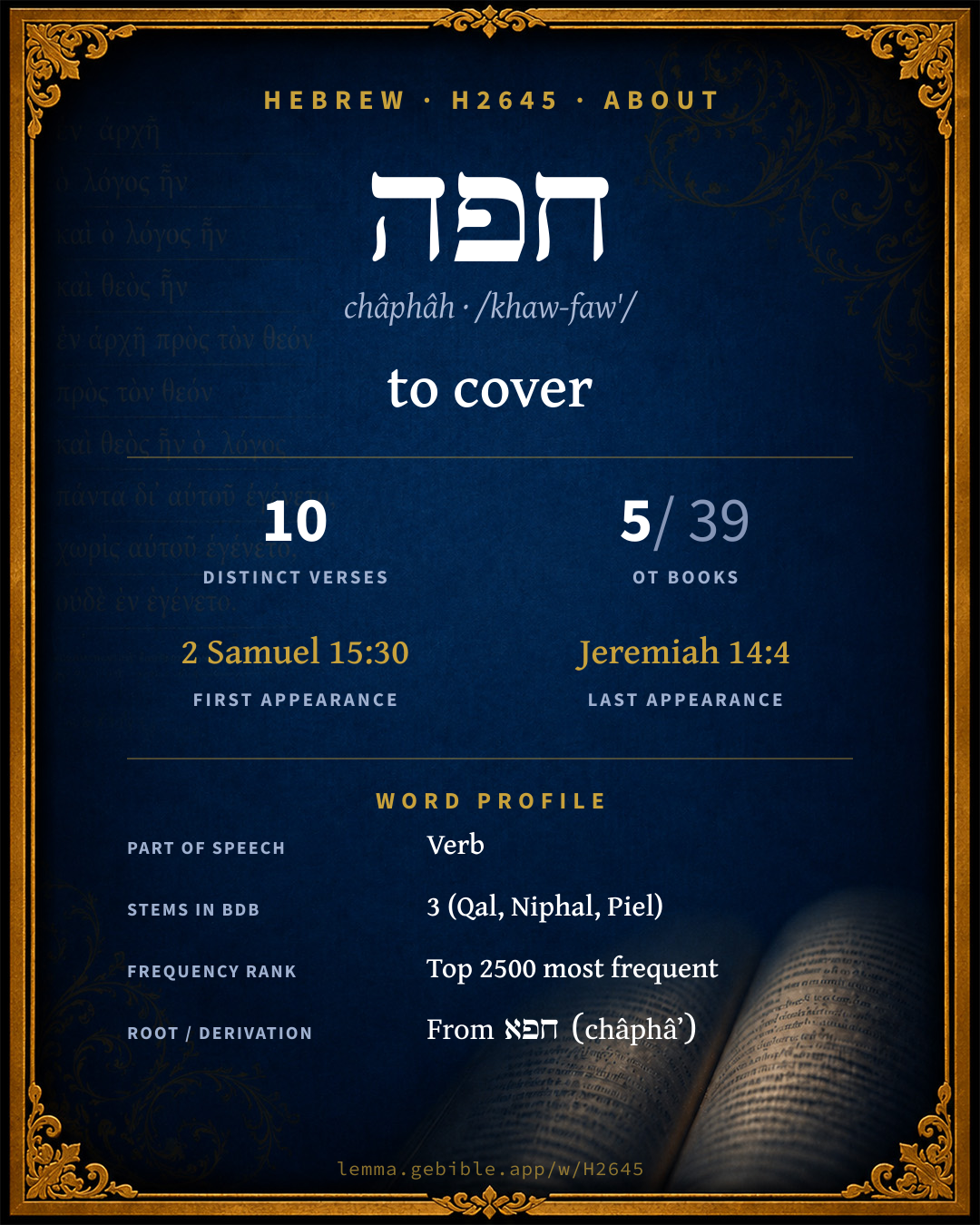
חָפָה
to cover
also: overlay, wainscotted fuller range ↓
Full lexicon entry — Brown-Driver-Briggs (BDB)
From Brown-Driver-Briggs (BDB)
Where this word appears
See every Qal verb in the Hebrew Bible →
Grammar key — what these labels mean
Part of speech
- Verb
- An action or state-of-being word.
Stem
- Qal
- The basic, simple active stem — the plain form of the verb (“he wrote”).
- Piel
- An intensive or resultative active stem.
- Niphal
- Usually the simple passive or reflexive of the Qal (“he was written”).
Form
- Perfect
- A completed action or state — Hebrew marks aspect (completeness) more than strict tense (“he wrote”).
- Sequential Imperfect
- An imperfect with prefixed waw — the standard past-narrative form (waw-consecutive imperfect).
- Participle Passive
- A verbal adjective expressing action received (“written”).
- Participle Active
- A verbal adjective expressing ongoing or characteristic action (“writing / one who writes”).
State
- Construct
- A noun bound to a following noun in a possessive / “of” relationship (the construct chain).
- Absolute
- The independent form of a noun, not bound to a following word.
Person
- 3rd Person
- The one spoken about (“he / she / it / they”).
Gender
- Common
- Either gender — not distinguished for this form.
- Masculine
- Grammatically masculine.
- Feminine
- Grammatically feminine.
Number
- Plural
- More than one (in Hebrew, generally three or more).
- Singular
- One.
4 distinct verses where H2645 appears in the Piel stem, across 1 book. Filtered view — show all forms. Click any verse to open its interlinear word-by-word view. Verse text shown in the World English Bible for context — . Each verse’s Hebrew form is shown with its reference; the English is not keyword-highlighted, since the data carries no word-level English alignment. Use “Compare translations” on any verse to read it across multiple English versions. This concordance covers the Hebrew Bible; Septuagint (Greek Old Testament) occurrences are not indexed here.
2 Chronicles 4 verses
- 2 Chronicles 3:5 חִפָּה֙ וַ/יְחַפֵּ֖/הוּ Piel pf 3ms conj + Piel wimpf 3ms + sfx pers 3ms The greater house he made a ceiling with fir-wood, which he overlaid with fine gold, and worked thereon palm trees and chains.
- 2 Chronicles 3:7 וַ/יְחַ֨ף conj + Piel wimpf 3ms He overlaid also the house, the beams, the thresholds, and the walls of it, and the doors of it, with gold; and engraved cherubim on the walls.
- 2 Chronicles 3:8 וַ/יְחַפֵּ֨/הוּ֙ conj + Piel wimpf 3ms + sfx pers 3ms He made the most holy house: the length of it, according to the breadth of the house, was twenty cubits, and the breadth of it twenty cubits; and he overlaid it with fine gold, amounting to six hundred talents.
- 2 Chronicles 3:9 חִפָּ֥ה Piel pf 3ms The weight of the nails was fifty shekels of gold. He overlaid the upper chambers with gold.
About this entry
At a glance — auto-summarized from this page’s data, not written by a person. Every figure links to its source below. This summary describes the numbers; it doesn’t interpret them.
חפה (châphâh) is a Hebrew verb most often rendered “to cover.” It first appears in 2 Samuel 15:30. It turns up in 10 verses across 5 books, an uncommon footprint. It concentrates in 2 Chronicles, which alone accounts for 40% of its uses. Different stems carry different senses — BDB groups them under 3 stems, among them Qal and Niphal. The sections below give every sense, occurrence, and version rendering.
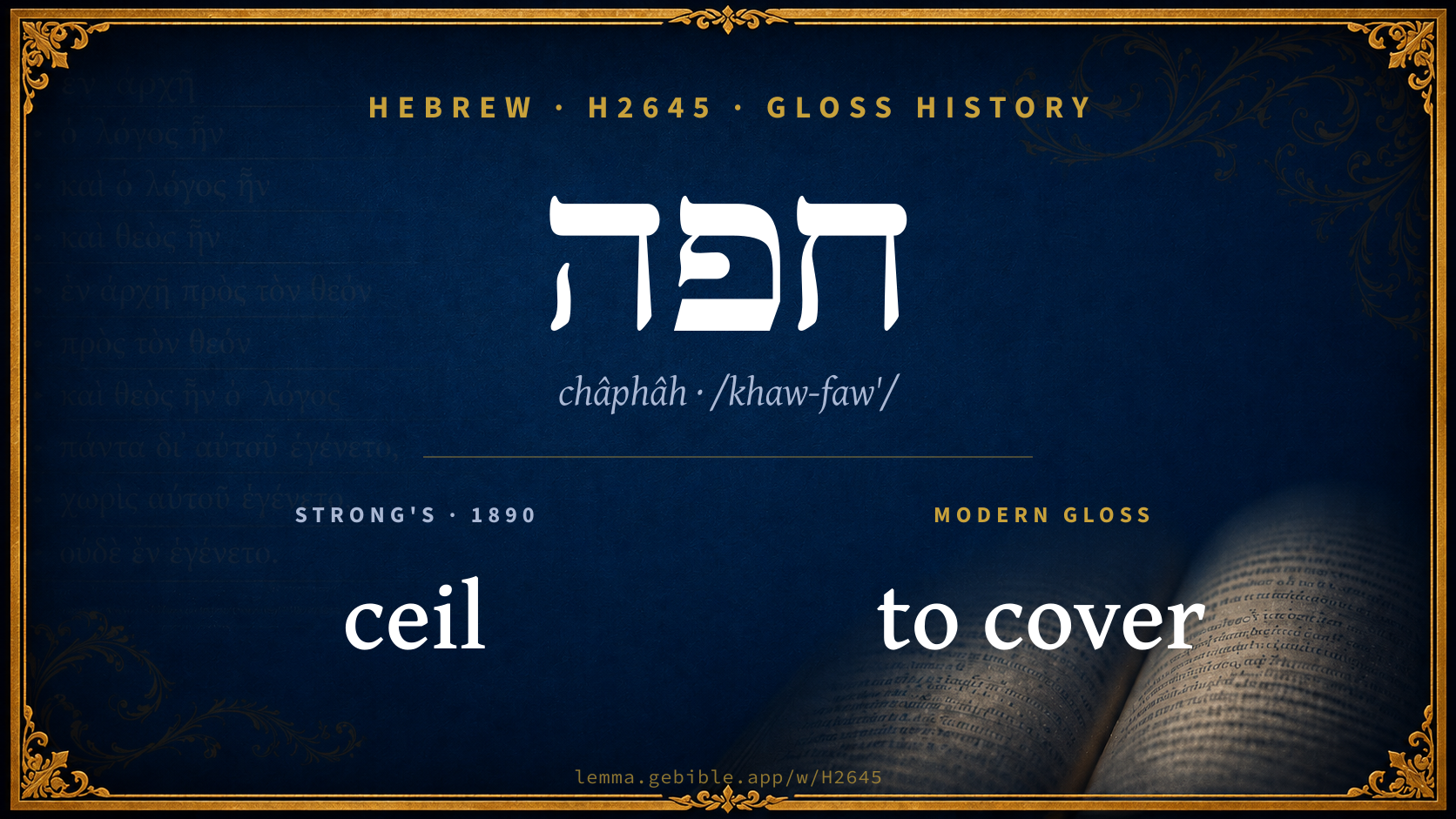
Gloss history
Strong's 1890 vs modern scholarship
About this word
Strong's H2645 catalogs a Hebrew word from the Hebrew Old Testament.
These counts are not copied from any lexicon or concordance. They are computed here, from the morphology-tagged Hebrew Old Testament. What Lemma adds →
- 10
- distinct verses
- The word appears in 10 distinct verses.
- 5 / 39
- OT books
- The word appears in 5 of 39 Old Testament books.
- #2,101
- by frequency
- Top 2500 most frequent Hebrew words (rank 2,101 of 8,640 Hebrew words by occurrence).
View all 10 occurrences in the concordance →
Most concentrated in
- 2 Chronicles 4 verses 40%
- Esther 2 verses 20%
- Jeremiah 2 verses 20%
By section of the Old Testament
By traditional corpus
Conventional, traditional groupings — biblical authorship is debated, so this is a traditional corpus grouping, not an authorship claim. Each share is this word’s portion of its verses in that division of the Hebrew canon. Each figure is a share of the word’s 10 distinct verses.
- Writings (Ketuvim) 7 verses · 70%
- Prophets (Nevi'im) 3 verses · 30%
How translations render this word
Counts come from each version’s own published word-to-Strong’s tagging or interlinear alignment — an approximate guide to how each version renders this word, not a word-level alignment the data otherwise carries. Because each total is that version’s own tagged count, the per-version totals vary from one another and need not match the appearance or distinct-verse counts above. These counts may also differ from a printed concordance because Lemma counts each distinctly tagged rendering and does not collapse phrase taggings into a single head-word total. This is a fixed set of word-tagged versions (KJV, ASV, BSB, ULT) and does not change with the reading translation you choose elsewhere. Each version’s license is shown beside its name below (and on Sources).
- King James Version: Covered 4×, He overlaid 4×, They covered 2×
- American Standard Version: He overlaid 4×, Covered 3×
- Berean Standard Bible: He overlaid 3×, Covered 2×, They cover 2×
- unfoldingWord Literal Text: Covered 2×, He overlaid it with 2×, He overlaid with 2×
King James Version Public Domain
Renders H2645 across 12 tagged occurrences — most commonly:
Plus 2 renderings that appear only once — usually multi-word phrases or single function words the recovered tagging swept in, not distinct renderings.
American Standard Version Public Domain
Renders H2645 across 12 tagged occurrences — most commonly:
Plus 5 renderings that appear only once — usually multi-word phrases or single function words the recovered tagging swept in, not distinct renderings.
Berean Standard Bible Public Domain
Renders H2645 across 12 tagged occurrences — most commonly:
Plus 5 renderings that appear only once — usually multi-word phrases or single function words the recovered tagging swept in, not distinct renderings.
unfoldingWord Literal Text CC BY-SA 4.0
Renders H2645 across 13 tagged occurrences — most commonly:
Plus 5 renderings that appear only once — usually multi-word phrases or single function words the recovered tagging swept in, not distinct renderings.
Senses in the full BDB
Hebrew verbs can shift meaning by stem (binyan): Qal is the basic action, Niphal is often passive or reflexive, Piel often intensifies or makes it factitive, and Hiphil is typically causative. The senses below are grouped under the stem BDB assigns to each.
What do BDB’s symbols mean?
BDB uses these scholarly abbreviations:
| Symbol | Meaning |
|---|---|
| 𝔊 | the Septuagint (the ancient Greek translation, LXX) |
| 𝔙 | the Vulgate (the Latin translation) |
| 𝔖 | the Syriac version (the Peshitta) |
| 𝔗 | the Targum (the Aramaic translation) |
| ψ | the Psalms |
| √ | root (the underlying root or stem) |
| ‖ | parallel passage (a synonymous or contrasted parallel) |
| † | the dagger: every passage where the word occurs is cited |
The 3 senses and sub-senses the full Brown-Driver-Briggs lexicon distinguishes for this word, in lexicon order (not ranked by frequency), with BDB’s own verbatim wording and sub-sense lettering. Shown in Hebrew script with BDB’s own scholarly abbreviations. The condensed entry is in the Lexicon Entry tab. See also the Forms in the corpus table below.
Qal
- Pf. חָפוּ 2 S 15:30 + 3 times; Pt. חָפוּי 2 S 15:30; cstr. חֲפוּי Est 6:12;—cover the head (רֹאשׁ), in token of grief 2 S 15:30 Je 14:3, 4; pt. agrees with ר׳ 2 S 15:30; חֲפוּי רֹאשׁ (‖ אָבֵל) Est 6:12; in token of sentence of death Est 7:8. e.g. 2 Samuel 15:30
Niphal
- Pt. f. נֶחְפָּה ψ 68:14 (כנפי יונה נ׳), c. בְּ of material. e.g. Psalms 68:14
Piel
- Pf. (late) חִפָּה 2 Ch 3:5, 9; Impf. וַיְחַף 2 Ch 3:7; sf. וַיְחַפֵּהוּ 2 Ch 3:5, 8; overlay sq. 2 acc. (one of material) 2 Ch 3:5(×2), 7, 8, 9. e.g. 2 Chronicles 3:5
Senses from the full Brown-Driver-Briggs lexicon (Brown, Driver, Briggs; Oxford 1906 — public domain), digitized via Sefaria, supplemented by the OpenScriptures HebrewLexicon (CC BY 4.0). Full attribution on Sources.
Word origin
vb. cover (NH id., especially Pi.; Aramaic חֲפָא, ܚܦܳܐ (especially Pa.); Arabic خَفِىَ be hidden, خَفَى hide)—
— Brown-Driver-Briggs (Oxford 1906, public domain), digitized via Sefaria, supplemented by the OpenScriptures HebrewLexicon (CC BY 4.0). See Sources.
Derived from חפא (châphâʼ) (H2644) — to cover.
Jastrow Dictionary
A second Hebrew/Aramaic lexicon for comparison, covering Aramaic and post-biblical (Talmudic, Targumic, Midrashic) usage that the biblical-Hebrew BDB does not. Matched by lemma rather than by Strong’s number, so a lemma may carry more than one Jastrow headword (shown separately below), and the entries cover usage well beyond the Bible.
חֵפָה
- , v. חֵפֶת
חָפָה
- , v. חפי
חפי
- 1. to cover, spread over. Ḥull. III, 7 וכנפיו חוֹפִין וכ׳ and whose wings cover the largest portion of its body. Sot. IX, 15 (49ᵃ) וחָפוּ ראשם and covered their heads (in shame).—Part. pass. חָפוּי. Esth. R. to VI, 12 וחֲפוּי ראש וכ׳ and his head covered (in shame) over what had happened to him; Meg. 16ᵃ
- 2. to bend, curve. Yoma 47ᵃ חוֹפֶה שלש וכ׳ he bends three of his fingers (grasping with them) up to &c.; cmp. חָפַן.
- 1. to cover, strew over. Tosef. Kil. I, 15 המְחַפֶּה who covers up (mixed seeds with earth); M. Kat. 2ᵇ; Macc. 21ᵇ. Ib. החופה ed. (Ms. M. המח׳). Y. Kil. VII, 31ᵇ לא במחפה is it not because in plowing over he covers the seeds up? Shebi. IV, 5 לא יְהַפֵּהוּ בעפר he must not cover it (the cut) with loose ground, opp. to (כסה) covering with stones. Y. Taan. II, beg. 65ᵃ אבותינו חִיפּוּ … חִיפִּינוּ וכ׳ our ancestors covered it (the reader’s desk) with gold, and we with dust. Nidd. 16ᵃ ותְחַפֶּנָּהּ וכ׳ and semen virile may have covered it up; a. e.
- 2. to cover over, to protect from justice, to be partial. Shebu. 39ᵃ מפני שמְחַפִּין עליו because they (the publican’s or robber’s relations) protect him. Ex. R. s. 30 היו מְחַפִּין אותו tried to protect him; a. e.
- 3. (cmp. גָּבַב) [to heap up words,] to invent fictions (v. II Kings XVII, 9). Gen. R. s. 94 (play on הפים, ib. XLVI, 21) שחִיפּוּ עליו דברים וכ׳ about whom they invented a fiction (Gen. XXXVII, 3). e.g. 2 Kings 17:9
חֵפֶת
- (חפף I, v. חִיפָּא) border of a garment (limbus), a kind of front bosom in which things can be hidden. Sabb. X, 3 (92ᵃ) ובח׳ חלוקו Ms. M. (v. Rabb. D. S. a. l. note, ed. ובשפת) in the bosom of his shirt. Yoma 77ᵇ ובלבד … מח׳ חלוקו Ms. M. (ed. מתחת ח׳) provided he takes not his hand out of the bosom of his shirt (to throw his cloak over his shoulder). Sabb. 96ᵇ, v. חִיפָּא.—Denom.
A Dictionary of the Targumim, the Talmud Babli and Yerushalmi, and the Midrashic Literature (Marcus Jastrow; London, Luzac, 1903) — Public Domain. Digitized via Sefaria. Digitized via Sefaria. Full attribution on Sources.
Forms in the corpus
The 12 distinct written forms H2645 takes in the Hebrew Bible, most frequent first — each parse links to that stem’s occurrences in the concordance. Hebrew forms include their vowel points and cantillation, so a single lemma takes many written forms.
Same root — word family
Other BDB entries built from the same root as H2645, grouped by Strong’s listed origin. These share a root / origin per the lexicon — not necessarily a shared meaning. Each links to that word’s own entry.
Derives from
Derived from this word
Compare all same-root words → They share a root, not necessarily a meaning.
Septuagint verse parallels
This word appears in 10 verses that also exist in the Greek Old Testament (Septuagint), out of the 10 Hebrew verses it occurs in. You can read those verses in Greek by switching the Old Testament edition to the Septuagint.
Read these verses in the Septuagint
This is a verse-level parallel only — the same verses exist in both the Hebrew and Greek Old Testaments. No word-level Hebrew↔Greek correspondence is claimed: the data carries no such alignment, so no Greek word is shown as this Hebrew word’s translation. Coverage is not total — the Septuagint omits the deuterocanon and renumbers the Psalms, so some Hebrew verses have no direct Greek parallel.