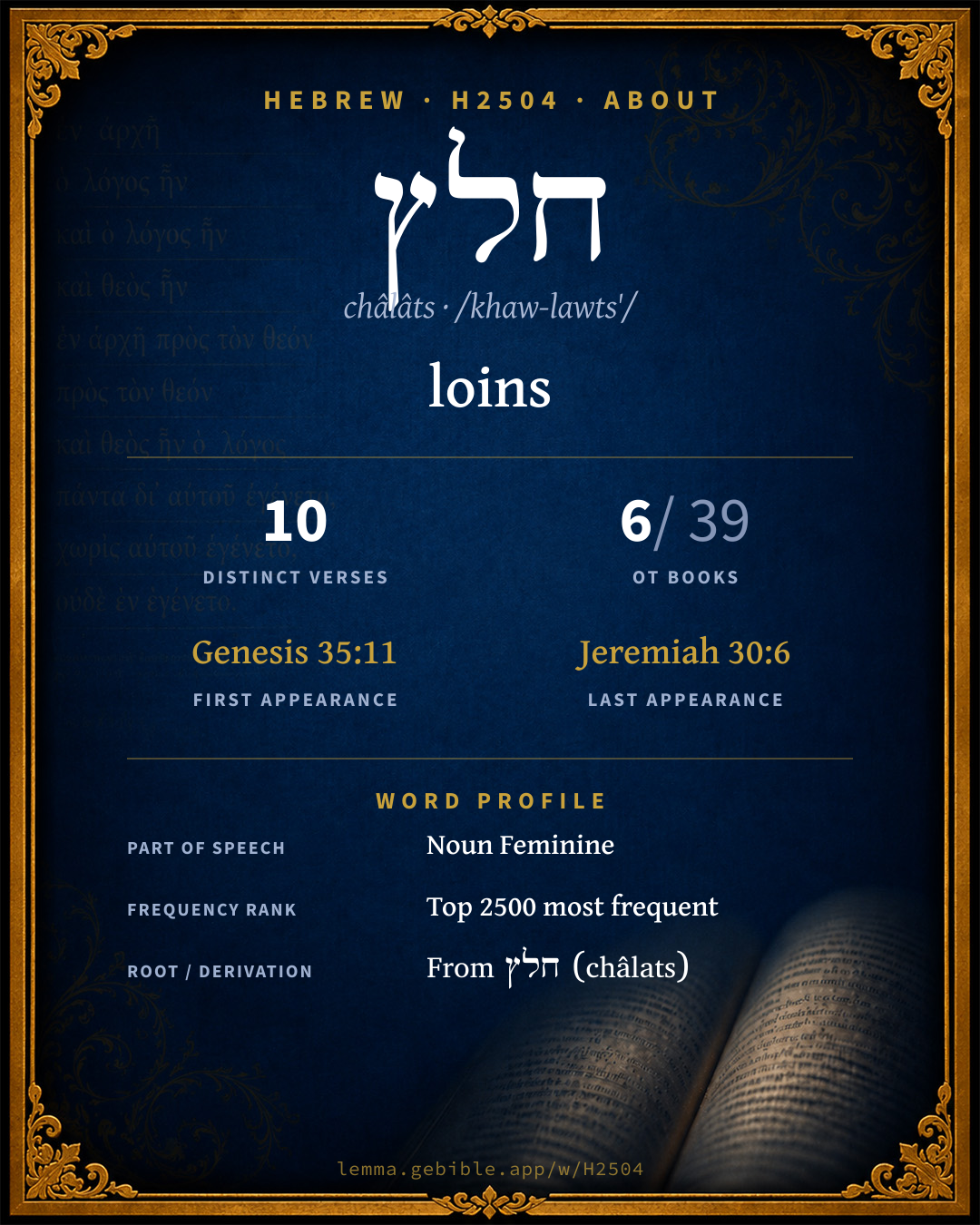
חָלָץ
loins
‘loins’ is one of 4 main senses fuller range ↓
Full lexicon entry — Brown-Driver-Briggs (BDB)
From Brown-Driver-Briggs (BDB)
Where this word appears
Grammar key — what these labels mean
Part of speech
- Noun
- A naming word — a person, place, thing, or idea.
Noun type
- Common
- A common noun — a general class of person, place, or thing (“king,” “city,” “water”), not a specific name.
State
- Construct
- A noun bound to a following noun in a possessive / “of” relationship (the construct chain).
- Absolute
- The independent form of a noun, not bound to a following word.
Gender
- Both
- Attested as both masculine and feminine.
Number
- Dual
- Exactly two — for natural pairs and some measures of time.
Every verse where H2504 appears in the Book of 1 Kings — 1 distinct verse. Click any verse to open its interlinear word-by-word view. Verse text shown in the World English Bible for context — . Each verse’s Hebrew form is shown with its reference; the English is not keyword-highlighted, since the data carries no word-level English alignment. Use “Compare translations” on any verse to read it across multiple English versions. This concordance covers the Hebrew Bible; Septuagint (Greek Old Testament) occurrences are not indexed here.
1 Kings
About this entry
At a glance — auto-summarized from this page’s data, not written by a person. Every figure links to its source below. This summary describes the numbers; it doesn’t interpret them.
At its core, חלץ (châlâts) means “loins.” Carrying more than one sense, it rewards its full sense range. With 10 verses in 6 books, it is an uncommon word in the Hebrew Bible. Its uses concentrate in Job (30% of all occurrences). First canonically at Genesis 35:11, it enters the text early. Dig into 10-verse concordance and the renderings breakdown below.
Gloss history
Strong's 1890 vs modern scholarship
About this word
Strong's H2504 catalogs a Hebrew word from the Hebrew Old Testament.
These counts are not copied from any lexicon or concordance. They are computed here, from the morphology-tagged Hebrew Old Testament. What Lemma adds →
- 10
- distinct verses
- The word appears in 10 distinct verses.
- 6 / 39
- OT books
- The word appears in 6 of 39 Old Testament books.
- #2,210
- by frequency
- Top 2500 most frequent Hebrew words (rank 2,210 of 8,640 Hebrew words by occurrence).
View all 10 occurrences in the concordance →
By section of the Old Testament
By traditional corpus
Conventional, traditional groupings — biblical authorship is debated, so this is a traditional corpus grouping, not an authorship claim. Each share is this word’s portion of its verses in that division of the Hebrew canon. Each figure is a share of the word’s 10 distinct verses.
- Prophets (Nevi'im) 5 verses · 50%
- Writings (Ketuvim) 4 verses · 40%
- Torah (Pentateuch) 1 verse · 10%
How translations render this word
Counts come from each version’s own published word-to-Strong’s tagging or interlinear alignment — an approximate guide to how each version renders this word, not a word-level alignment the data otherwise carries. Because each total is that version’s own tagged count, the per-version totals vary from one another and need not match the appearance or distinct-verse counts above. These counts may also differ from a printed concordance because Lemma counts each distinctly tagged rendering and does not collapse phrase taggings into a single head-word total. This is a fixed set of word-tagged versions (KJV, ASV, BSB, ULT) and does not change with the reading translation you choose elsewhere. Each version’s license is shown beside its name below (and on Sources).
- King James Version: Loins 7×
- American Standard Version: Loins 7×
- Berean Standard Bible: Yourself 2×
- unfoldingWord Literal Text: Loins 8×
King James Version Public Domain
Renders H2504 across 10 tagged occurrences — most commonly:
Plus 3 renderings that appear only once — usually multi-word phrases or single function words the recovered tagging swept in, not distinct renderings.
American Standard Version Public Domain
Renders H2504 across 9 tagged occurrences — most commonly:
Plus 2 renderings that appear only once — usually multi-word phrases or single function words the recovered tagging swept in, not distinct renderings.
Berean Standard Bible Public Domain
Renders H2504 across 7 tagged occurrences — most commonly:
Plus 5 renderings that appear only once — usually multi-word phrases or single function words the recovered tagging swept in, not distinct renderings. Not rendered by a distinct English word in 3 further occurrences.
unfoldingWord Literal Text CC BY-SA 4.0
Renders H2504 across 9 tagged occurrences — most commonly:
Plus 1 rendering that appears only once — usually multi-word phrases or single function words the recovered tagging swept in, not distinct renderings.
Senses in the full BDB
What do BDB’s symbols mean?
BDB uses these scholarly abbreviations:
| Symbol | Meaning |
|---|---|
| 𝔊 | the Septuagint (the ancient Greek translation, LXX) |
| 𝔙 | the Vulgate (the Latin translation) |
| 𝔖 | the Syriac version (the Peshitta) |
| 𝔗 | the Targum (the Aramaic translation) |
| ψ | the Psalms |
| √ | root (the underlying root or stem) |
| ‖ | parallel passage (a synonymous or contrasted parallel) |
| † | the dagger: every passage where the word occurs is cited |
The 3 senses and sub-senses the full Brown-Driver-Briggs lexicon distinguishes for this word, in lexicon order (not ranked by frequency), with BDB’s own verbatim wording and sub-sense lettering. Shown in Hebrew script with BDB’s own scholarly abbreviations. The condensed entry is in the Lexicon Entry tab. See also the Forms in the corpus table below.
- 1. as seat of virility
- 2. as girded
- 3. as seat of pains, like a woman in travail
Senses from the full Brown-Driver-Briggs lexicon (Brown, Driver, Briggs; Oxford 1906 — public domain), digitized via Sefaria, supplemented by the OpenScriptures HebrewLexicon (CC BY 4.0). Full attribution on Sources.
Word origin
[ חָלָץ ] n.[f.] only dual, loins
— Brown-Driver-Briggs (Oxford 1906, public domain), digitized via Sefaria, supplemented by the OpenScriptures HebrewLexicon (CC BY 4.0). See Sources.
Derived from חלץ (châlats) (H2502) — to arm.
Jastrow Dictionary
A second Hebrew/Aramaic lexicon for comparison, covering Aramaic and post-biblical (Talmudic, Targumic, Midrashic) usage that the biblical-Hebrew BDB does not. Matched by lemma rather than by Strong’s number, so a lemma may carry more than one Jastrow headword (shown separately below), and the entries cover usage well beyond the Bible.
חָלַץ
- v. Ges. H. Dict.10 s. v. חלץ I, II)
- 1. to surround, fortify; to gird, arm. Yalk. Gen. 133 (fr. Midr. Vayis‛u) חָלְצוּ עצמם they armed themselves, v. Pi. a. Hif.
- 2. to untie, loosen, tear out; to strip, lay bare. M. Kat. 22ᵇ חוֹלֵץ one bares the shoulder (in mourning). Ib. IV, 7 (24ᵇ) חוֹלְצִין. B. Mets. 59ᵇ וח׳ מנעליו and took his shoes off. Y. M. Kat. III, 82ᵇ חוֹלְצָן he takes them (the T’fillin) off; Ber. 23ᵃ; Y. ib. II, 4ᶜ.—Pes. 4ᵃ; M. Kat. 20ᵇ חֲלוֹץ לי מנעלי take my shoes off. Ḥull. 90ᵇ חוֹלְצוֹ לתפוח he takes the sinew out and puts it on the pile &c. Tosef. Neg. VI, 10 בזמן שחוא חוֹלֵץ when he has to tear out (a leprous stone), v. נָתַץ.—Y. Ab. Zar. II, end, 42ᵃ; Tosef. ib. IV (V), 8 כדי שיהו חוֹלְצִין את גלעיניהן in order to loosen the stones (of the olives); a. fr.—Part. pass. חָלוּץ, f. חֲלוּצָה, pl. חֲלוּצִים, f. חֲלוּצוֹת. Y. Sot. I, beg. 16ᵇ וזרועותיה ח׳ her arms bared.—Sabb. 137ᵃ, a. e. חֲלָצַתּוֹ חמה the fever left him.—Esp. to perform the ceremony of taking off the Yabam’s shoe (v. יָבָם); ח׳ ביבמה to arrange the Ḥălitsah, to act as judge; ח׳ ל־ to have the shoe taken off for refusing the leviratical marriage; ח׳ מ־ to take the shoe off. Yeb. 102ᵃ כלום ראית שח׳ וכ׳ did you ever see him act as a judge at a Ḥălitsah? Ib. IV, 1 החוֹלֵץ ליבמתו וכ׳ if one gave ḥălitsah to his sister-in-law, and it was found out afterwards &c. Ib. III, 1 חוֹלְצוֹת ולא מתיבמות they must be released by ḥăl., but must not be married by the yabam. Ib. XII, 1 חָלְצָה במנעל if she performed the ceremony with a leather shoe. Ib. 102ᵃ חוֹלְצִין במנעל you may have the ceremony performed with &c. Ib. 102ᵇ שמא חָלְצָה סנדל לאחד וכ׳ perhaps she has performed the ceremony of ḥal. on one of the brothers. Ib. החוֹלֶצֶת מן וכ׳ if one performed the ceremony on an adult … Ib. (ref. to Hos. V, 6) מי כתיב ח׳ להם ה׳ מהם וכ׳ is it written, He had his shoe taken off by them (the Lord being the rejecting party)? It is written, He took their shoe off &c., v. next w.; a. v. fr.—חֲלוּצָה a woman released from leviratical marriage by ḥălitsah. Ib. VII, 1. Ib. IV, 12 חֲלוּצָתוֹ his rejected sister-in-law; a. fr. e.g. Hosea 5:6
- to be peeled off. Y. Sabb. XX, 17ᶜ bot. ועורו נ׳ and his skin will peel itself off.
- 1. to extract, loosen, to deliver.
- 2. to gird, strengthen. Yeb. 102ᵇ (in a discussion about the meaning of וחלצה, Deut. XXV, 9) והכתיב יְחַלּץ עני but do we not read (Job XXXVI, 15), He girds the poor? Answ. יְחַלְּצוֹ מדינה וכ׳ It means, He will deliver him from the judgment &c. Ib. (after ref. to יחליץ, Is. LVIII, 11) the root חלץ means both (girding and loosening), but here (Deut. l. c.), if it meant tying on, it would read וחלצה נעלו ברגלו she shall tie his shoe on his foot. e.g. Deuteronomy 25:9
- 1. to loosen, untie;
- 2. to gird, arm;
- 3. to deliver;
- 4. to smoothen, give ease of mind. Lev. R. s. 34 (ref. to יחליץ, Is. l. c.) יזיין (Ar. ישלוף) ישמוט ישזיב ויניח (which means) He shall loosen as in Deut. l. c., gird as ib. III, 18, deliver as in Ps. CXL, 2, and give ease as in the Sabbath prayer after meal רצה והַחֲלִיצֵנוּ be pleased to give us ease of mind. V. חִלּוּץ. e.g. Psalms 140:2
חֲלַץ
- 1. to take off, undress. Part. pass. חָלִיץ. Targ. II Sam. VI, 20.—Lam. R. introd (R. Joh. 1) חֲלִיצֵי מסאני without shoes. M. Kat. 22ᵇ למִיחֲלַץ to bare their shoulders.
- 2. to withdraw. Yeb. 102ᵇ עמא דח׳ ליה … מיניה a people from which its lord has withdrawn (with ref. to חלץ מהם, Hos. V, 6). e.g. Hosea 5:6
- 3. to perform the rite of ḥălitsah; v. infra.
- 1. to perform or arrange the rite of ḥălitsah. Ib. לה אחין וכ׳ (or דחלְצוּ) ואילו יבמה דחַלְּצוּ suppose brothers would untie the shoe of their sister-in-law, would this be of any legal consequence? Ib.ᵃ אנא לא הואי חַלִּיצְנָא וכ׳ I should not have allowed a ḥălitsah except &c.; a. fr.
- 2. to undress, strip. Targ. I Sam. XXXI, 9. Ib. 8 (h. text לפשט); Targ. I Kings XI, 15 (h. text לקבר!).
A Dictionary of the Targumim, the Talmud Babli and Yerushalmi, and the Midrashic Literature (Marcus Jastrow; London, Luzac, 1903) — Public Domain. Digitized via Sefaria. Digitized via Sefaria. Full attribution on Sources.
Forms in the corpus
The 10 distinct written forms H2504 takes in the Hebrew Bible, most frequent first — each parse links to that state’s occurrences in the concordance. Hebrew forms include their vowel points and cantillation, so a single lemma takes many written forms.
| Form | Parsing | Example | Uses |
|---|---|---|---|
| חֲלָצֶ֑י/ךָ | Noun, Common, Both, Dual, Construct | Job 38:3 | 2 |
| חֲלָצָ֑י/ו | Noun, Common, Both, Dual, Construct | Job 31:20 | 1 |
| חֲלָצָ֔י/ו | Noun, Common, Both, Dual, Construct | Isaiah 5:27 | 1 |
| חֲלָצָֽי/ו | Noun, Common, Both, Dual, Construct | Isaiah 11:5 | 1 |
| חֲלָצָֽיִם | Noun, Common, Both, Dual, Absolute | Isaiah 32:11 | 1 |
| חֲלָצָי/ו֙ | Noun, Common, Both, Dual, Construct | Jeremiah 30:6 | 1 |
| חלצ/ו | Noun, Common, Both, Dual, Construct | Job 31:20 | 1 |
| מֵ/חֲלָצֶ֔י/ךָ | Noun, Common, Both, Dual, Construct | 1 Kings 8:19 | 1 |
| מֵ/חֲלָצֶ֥י/ךָ | Noun, Common, Both, Dual, Construct | Genesis 35:11 | 1 |
| מֵֽ/חֲלָצֶ֔י/ךָ | Noun, Common, Both, Dual, Construct | 2 Chronicles 6:9 | 1 |
Same root — word family
Other BDB entries built from the same root as H2504, grouped by Strong’s listed origin. These share a root / origin per the lexicon — not necessarily a shared meaning. Each links to that word’s own entry.
Derives from
Shares the same root
Proper names from this root
People and places named from this root — a name, not an additional meaning of the word.
Compare all same-root words → 1 of the same-root words is a proper name (a person or place). They share a root, not necessarily a meaning.
Septuagint verse parallels
This word appears in 10 verses that also exist in the Greek Old Testament (Septuagint), out of the 10 Hebrew verses it occurs in. You can read those verses in Greek by switching the Old Testament edition to the Septuagint.
Read these verses in the Septuagint
This is a verse-level parallel only — the same verses exist in both the Hebrew and Greek Old Testaments. No word-level Hebrew↔Greek correspondence is claimed: the data carries no such alignment, so no Greek word is shown as this Hebrew word’s translation. Coverage is not total — the Septuagint omits the deuterocanon and renumbers the Psalms, so some Hebrew verses have no direct Greek parallel.