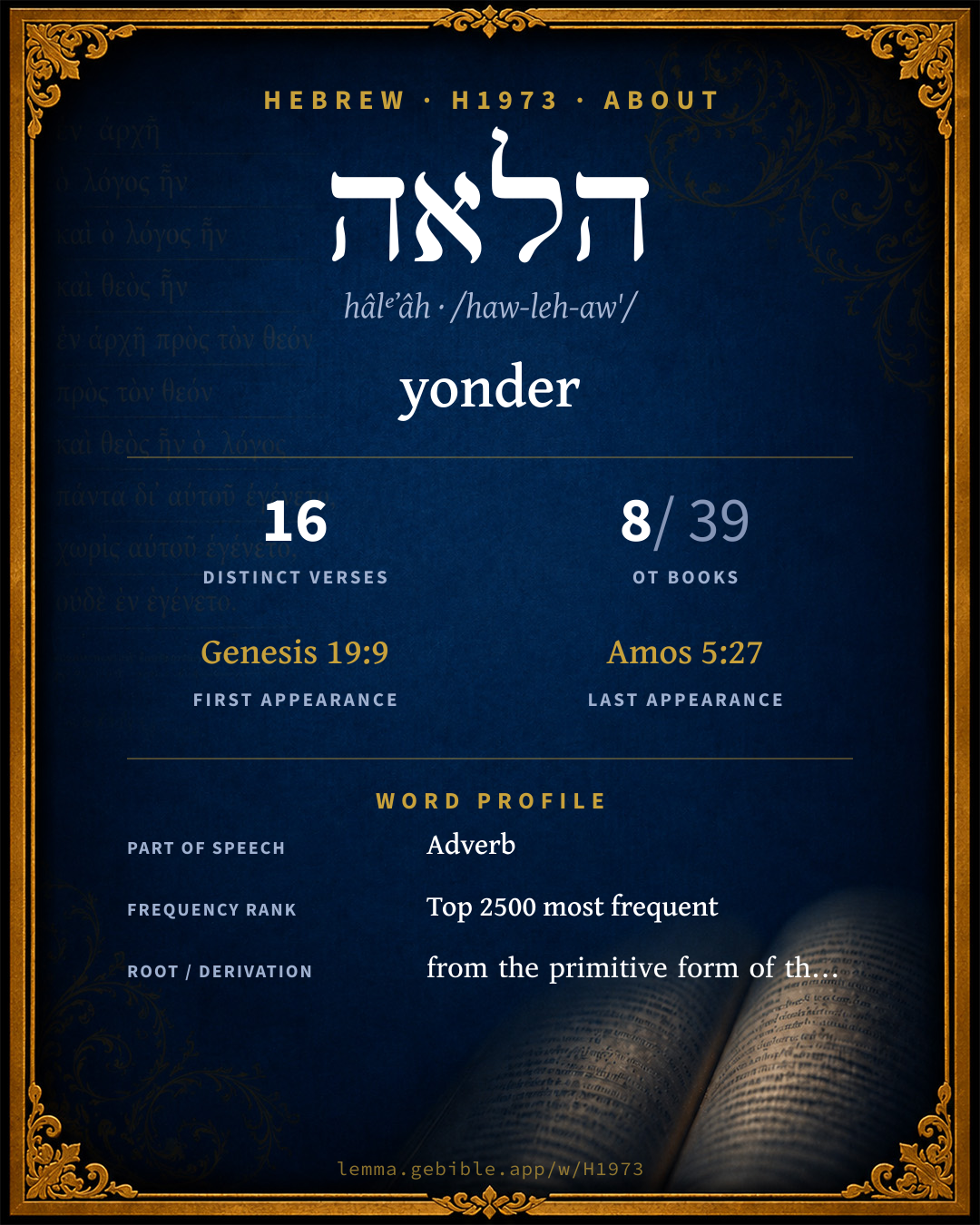
הָֽ֫לְאָה
yonder
‘yonder’ is one of 3 main senses fuller range ↓
Full lexicon entry — Brown-Driver-Briggs (BDB)
From Brown-Driver-Briggs (BDB)
Where this word appears
Grammar key — what these labels mean
Part of speech
- Adverb
- A word that modifies a verb, adjective, or other adverb.
Every verse where H1973 appears in the Book of Genesis — 2 distinct verses. Click any verse to open its interlinear word-by-word view. Verse text shown in the World English Bible for context — . Each verse’s Hebrew form is shown with its reference; the English is not keyword-highlighted, since the data carries no word-level English alignment. Use “Compare translations” on any verse to read it across multiple English versions. This concordance covers the Hebrew Bible; Septuagint (Greek Old Testament) occurrences are not indexed here.
Genesis
- Genesis 19:9 הָ֗לְאָה adv They said, "Stand back!" They said, "This one fellow came in to live as a foreigner, and he appoints himself a judge. Now will we deal worse with you, than with them!" They pressed hard on the man, even Lot, and drew near to break the door.
- Genesis 35:21 מֵ/הָ֖לְאָה prep + adv Israel traveled, and spread his tent beyond the tower of Eder.
About this entry
At a glance — auto-summarized from this page’s data, not written by a person. Every figure links to its source below. This summary describes the numbers; it doesn’t interpret them.
הלאה — transliterated hâlᵉʼâh — is a Hebrew verb carrying the sense “yonder.” Debuting at Genesis 19:9, it then recurs through the corpus. Spanning 16 verses in 8 books, it ranks among the uncommon words of the Hebrew Bible. Its uses concentrate in 1 Samuel (25% of all occurrences). It is not a single-sense word — see its full sense range. See the sense tree, 16-verse concordance, and the renderings breakdown below.
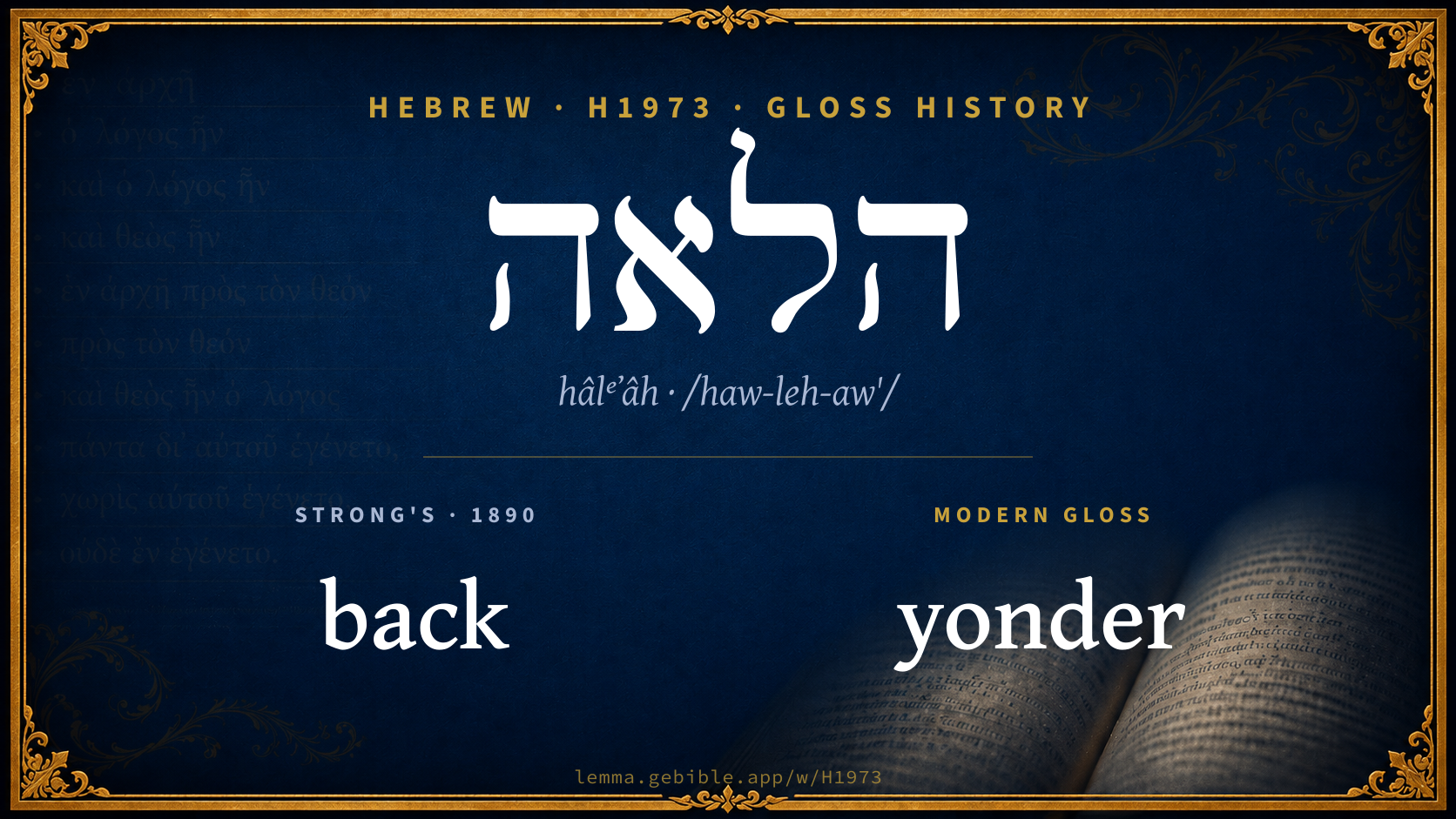
Gloss history
Strong's 1890 vs modern scholarship
About this word
Strong's H1973 catalogs a Hebrew word from the Hebrew Old Testament.
These counts are not copied from any lexicon or concordance. They are computed here, from the morphology-tagged Hebrew Old Testament. What Lemma adds →
- 16
- distinct verses
- The word appears in 16 distinct verses.
- 8 / 39
- OT books
- The word appears in 8 of 39 Old Testament books.
- #1,752
- by frequency
- Top 2500 most frequent Hebrew words (rank 1,752 of 8,640 Hebrew words by occurrence).
View all 16 occurrences in the concordance →
By section of the Old Testament
By traditional corpus
Conventional, traditional groupings — biblical authorship is debated, so this is a traditional corpus grouping, not an authorship claim. Each share is this word’s portion of its verses in that division of the Hebrew canon. Each figure is a share of the word’s 16 distinct verses.
- Prophets (Nevi'im) 10 verses · 63%
- Torah (Pentateuch) 6 verses · 38%
How translations render this word
Counts come from each version’s own published word-to-Strong’s tagging or interlinear alignment — an approximate guide to how each version renders this word, not a word-level alignment the data otherwise carries. Because each total is that version’s own tagged count, the per-version totals vary from one another and need not match the appearance or distinct-verse counts above. These counts may also differ from a printed concordance because Lemma counts each distinctly tagged rendering and does not collapse phrase taggings into a single head-word total. This is a fixed set of word-tagged versions (KJV, ASV, BSB, ULT) and does not change with the reading translation you choose elsewhere. Each version’s license is shown beside its name below (and on Sources).
BDB lists this Strong’s number as 3 distinct words (homographs). Each count above pools all of them and is not split by sense — see the Senses section below. A low-frequency rendering may belong to a different one of those words, not the primary meaning.
- King James Version†: Beyond 4×, Forward 4×, Beginning hitherto 2×
- American Standard Version†: Forward 5×, Beyond 3×, Beginning onward 2×
- Berean Standard Bible†: Beyond 3×, On 3×, Forward 2×
- unfoldingWord Literal Text†: Beyond 12×, Onward 2×
King James Version Public Domain
Renders H1973 across 16† tagged occurrences — most commonly:
Plus 6 renderings that appear only once — usually multi-word phrases or single function words the recovered tagging swept in, not distinct renderings.
American Standard Version Public Domain
Renders H1973 across 15† tagged occurrences — most commonly:
Plus 5 renderings that appear only once — usually multi-word phrases or single function words the recovered tagging swept in, not distinct renderings.
Berean Standard Bible Public Domain
Renders H1973 across 12† tagged occurrences — most commonly:
Plus 4 renderings that appear only once — usually multi-word phrases or single function words the recovered tagging swept in, not distinct renderings. Not rendered by a distinct English word in 4 further occurrences.
unfoldingWord Literal Text CC BY-SA 4.0
Renders H1973 across 16† tagged occurrences — most commonly:
Plus 2 renderings that appear only once — usually multi-word phrases or single function words the recovered tagging swept in, not distinct renderings.
Senses in the full BDB
What do BDB’s symbols mean?
BDB uses these scholarly abbreviations:
| Symbol | Meaning |
|---|---|
| 𝔊 | the Septuagint (the ancient Greek translation, LXX) |
| 𝔙 | the Vulgate (the Latin translation) |
| 𝔖 | the Syriac version (the Peshitta) |
| 𝔗 | the Targum (the Aramaic translation) |
| ψ | the Psalms |
| √ | root (the underlying root or stem) |
| ‖ | parallel passage (a synonymous or contrasted parallel) |
| † | the dagger: every passage where the word occurs is cited |
The 2 senses and sub-senses the full Brown-Driver-Briggs lexicon distinguishes for this word, in lexicon order (not ranked by frequency), with BDB’s own verbatim wording and sub-sense lettering. Shown in Hebrew script with BDB’s own scholarly abbreviations. The condensed entry is in the Lexicon Entry tab. See also the Forms in the corpus table below.
- a. of place Gn 19:9 גֶּשׁ־הָֽלְאָה approach out there! i.e. make way, get back (𝔊 ἀπόστα ἐκεῖ: 𝔙 recede illuc), Nu 17:2 and the fire זְרֵה־הָֽלְאָה scatter yonder; מֵהָֽלְאָה לְ beyond (lit. off the yonder side of; v. מִן 4 c Gn 35:21 Je 22:19 Am 5:27 beyond Damascus: וָהָֽלְאָה attached to an indication of place, to mark direction, 1 S 10:3 and thou shalt pass on מִשָּׁם וָהָֽלְאָה thence and onwards; 20:22 מִמְּךָ וָהָֽלְאָה from thee and onwards i.e. beyond thee (opp. to מִמְּךָ וָהֵ֫נָּה v 21), v 37 Nu 32:19 on the side of Jordan forwards (opp. to ‘on the side of Jordan eastwards’). e.g. Genesis 19:9
- b. of time, Lv 22:27 from the 8th day וָהָֽלְאָה and onwards, Nu 15:23 1 S 18:9 מהיום ההוא והלאה from that day and onwards, Ez 39:22; 43:27 Is 18:2, 7. Hence e.g. Leviticus 22:27
Senses from the full Brown-Driver-Briggs lexicon (Brown, Driver, Briggs; Oxford 1906 — public domain), digitized via Sefaria, supplemented by the OpenScriptures HebrewLexicon (CC BY 4.0). Full attribution on Sources.
Word origin
I. Dt 32:6 הַל יְהֹוָה תִּגְמְלוּ־זֹאת (so V. d. H and other edd.) The reading here became early a subject of dispute, and MSS. and edd. vary accordingly. Some follow the school of Nehardea, and read הַל יְהֹוָה; others (so Norzi) follow the school of Sora, and read הַ לְיהֹוָה; others (so Hahn) have הַלְיהֹוָה. Were הַל original, it would be an interrog. part. = Arabic هَلْ, for which elsewhere הֲ is always found. The other punctuations would also each be highly irregular. The true reading is undoubtedly הֲלַיהֹוָה (הַלְיַהְוֶה). (Cf. De Rossi Var. Lect. ad loc.; and on the possible origin of the anomaly, GeiJüd. Ztschr. 1864–65, p. 89 f.
II. Dt 32:6 v. sub הֲ p. 210 supr.
I. (i.e. hā-leʾāh, the final -āh, the ה locale, being toneless), adv. out there, onwards, further (𝔗 הָלָא, always with לְ or מֵ prefixed; Syriac ܠܗܰܠ, ܘܰܠܗܰܠ PS 1009 id.; Arabic هَلَا forward! on! FlKl.Schr. i. 355)—
— Brown-Driver-Briggs (Oxford 1906, public domain), digitized via Sefaria, supplemented by the OpenScriptures HebrewLexicon (CC BY 4.0). See Sources.
Origin: from the primitive form of the article [hal]
Forms in the corpus
The 9 distinct written forms H1973 takes in the Hebrew Bible, most frequent first — each parse links to that state’s occurrences in the concordance. Hebrew forms include their vowel points and cantillation, so a single lemma takes many written forms.
| Form | Parsing | Example | Uses |
|---|---|---|---|
| וָ/הָ֑לְאָה | Adverb | 1 Samuel 20:22 | 4 |
| וָ/הָֽלְאָה | Adverb | Ezekiel 39:22 | 3 |
| וָ/הָ֗לְאָה | Adverb | Ezekiel 43:27 | 2 |
| מֵ/הָ֖לְאָה | Adverb | Genesis 35:21 | 2 |
| הָ֑לְאָה | Adverb | Numbers 16:37 | 1 |
| הָ֗לְאָה | Adverb | Genesis 19:9 | 1 |
| וָ/הָ֔לְאָה | Adverb | Leviticus 22:27 | 1 |
| וָ/הָ֖לְאָה | Adverb | Numbers 15:23 | 1 |
| מֵ/הָ֣לְאָה | Adverb | Amos 5:27 | 1 |
Same root — word family
Other BDB entries built from the same root as H1973, grouped by Strong’s listed origin. These share a root / origin per the lexicon — not necessarily a shared meaning. Each links to that word’s own entry.
Derived from this word
Compare all same-root words → They share a root, not necessarily a meaning.
Septuagint verse parallels
This word appears in 14 verses that also exist in the Greek Old Testament (Septuagint), out of the 16 Hebrew verses it occurs in. You can read those verses in Greek by switching the Old Testament edition to the Septuagint.
Read these verses in the Septuagint
- Genesis 19:9
- Leviticus 22:27
- Numbers 15:23
- 1 Samuel 10:3
- Isaiah 18:2
- Jeremiah 22:19
- Ezekiel 39:22
- Amos 5:27
This is a verse-level parallel only — the same verses exist in both the Hebrew and Greek Old Testaments. No word-level Hebrew↔Greek correspondence is claimed: the data carries no such alignment, so no Greek word is shown as this Hebrew word’s translation. Coverage is not total — the Septuagint omits the deuterocanon and renumbers the Psalms, so some Hebrew verses have no direct Greek parallel.