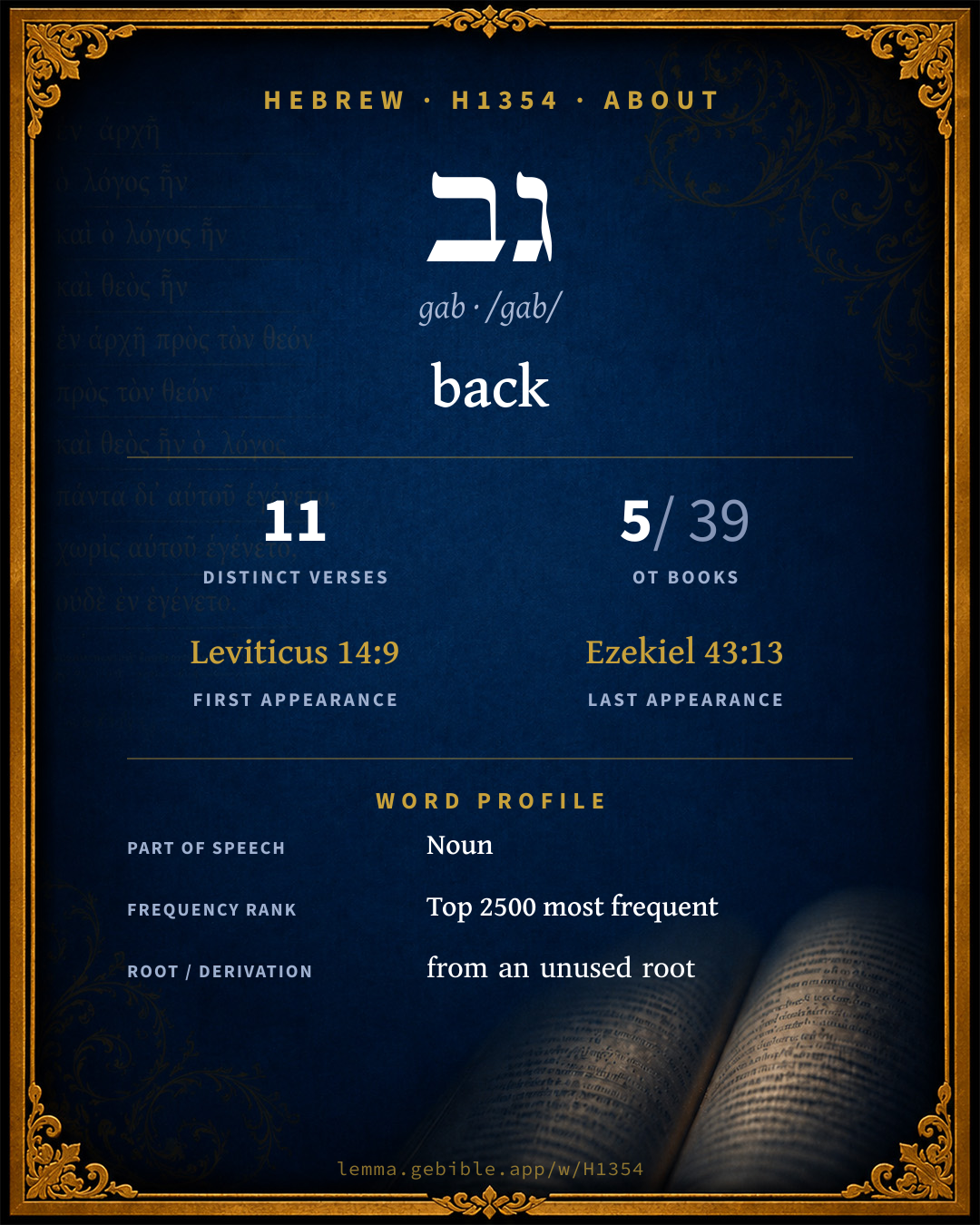
גַּב
back
‘back’ is one of 7 main senses fuller range ↓
Full lexicon entry — Brown-Driver-Briggs (BDB)
From Brown-Driver-Briggs (BDB)
Where this word appears
Grammar key — what these labels mean
Part of speech
- Noun
- A naming word — a person, place, thing, or idea.
Noun type
- Common
- A common noun — a general class of person, place, or thing (“king,” “city,” “water”), not a specific name.
State
- Construct
- A noun bound to a following noun in a possessive / “of” relationship (the construct chain).
- Absolute
- The independent form of a noun, not bound to a following word.
Gender
- Both
- Attested as both masculine and feminine.
Number
- Plural
- More than one (in Hebrew, generally three or more).
- Singular
- One.
Every verse where H1354 appears in the Book of Leviticus — 1 distinct verse. Click any verse to open its interlinear word-by-word view. Verse text shown in the World English Bible for context — . Each verse’s Hebrew form is shown with its reference; the English is not keyword-highlighted, since the data carries no word-level English alignment. Use “Compare translations” on any verse to read it across multiple English versions. This concordance covers the Hebrew Bible; Septuagint (Greek Old Testament) occurrences are not indexed here.
Leviticus
About this entry
At a glance — auto-summarized from this page’s data, not written by a person. Every figure links to its source below. This summary describes the numbers; it doesn’t interpret them.
“back” is the headline sense of the Hebrew noun גב (gab). It clusters heavily in Ezekiel, which alone accounts for 55% of its uses. It turns up in 11 verses across 5 books, an uncommon footprint. Its earliest occurrence is Leviticus 14:9. Its meaning spans more than one sense — see its full sense range. The sections below give every sense, occurrence, and version rendering.
Gloss history
Strong's 1890 vs modern scholarship
About this word
Strong's H1354 catalogs a Hebrew word from the Hebrew Old Testament.
These counts are not copied from any lexicon or concordance. They are computed here, from the morphology-tagged Hebrew Old Testament. What Lemma adds →
- 11
- distinct verses
- The word appears in 11 distinct verses.
- 5 / 39
- OT books
- The word appears in 5 of 39 Old Testament books.
- #2,001
- by frequency
- Top 2500 most frequent Hebrew words (rank 2,001 of 8,640 Hebrew words by occurrence).
View all 11 occurrences in the concordance →
By section of the Old Testament
By traditional corpus
Conventional, traditional groupings — biblical authorship is debated, so this is a traditional corpus grouping, not an authorship claim. Each share is this word’s portion of its verses in that division of the Hebrew canon. Each figure is a share of the word’s 11 distinct verses.
- Prophets (Nevi'im) 7 verses · 64%
- Writings (Ketuvim) 3 verses · 27%
- Torah (Pentateuch) 1 verse · 9%
How translations render this word
Counts come from each version’s own published word-to-Strong’s tagging or interlinear alignment — an approximate guide to how each version renders this word, not a word-level alignment the data otherwise carries. Because each total is that version’s own tagged count, the per-version totals vary from one another and need not match the appearance or distinct-verse counts above. These counts may also differ from a printed concordance because Lemma counts each distinctly tagged rendering and does not collapse phrase taggings into a single head-word total. This is a fixed set of word-tagged versions (KJV, ASV, BSB, ULT) and does not change with the reading translation you choose elsewhere. Each version’s license is shown beside its name below (and on Sources).
BDB lists this Strong’s number as 2 distinct words (homographs). Each count above pools all of them and is not split by sense — see the Senses section below. A low-frequency rendering may belong to a different one of those words, not the primary meaning.
- King James Version†: Bodies 2×, Eminent place 2×, Rings 2×
- American Standard Version†: Vaulted place 2×
- Berean Standard Bible†: Rims 3×, Mounds 2×
- unfoldingWord Literal Text†: Rims 3×
King James Version Public Domain
Renders H1354 across 13† tagged occurrences — most commonly:
Plus 7 renderings that appear only once — usually multi-word phrases or single function words the recovered tagging swept in, not distinct renderings.
American Standard Version Public Domain
Renders H1354 across 13† tagged occurrences — most commonly:
Plus 11 renderings that appear only once — usually multi-word phrases or single function words the recovered tagging swept in, not distinct renderings.
Berean Standard Bible Public Domain
Renders H1354 across 13† tagged occurrences — most commonly:
Plus 8 renderings that appear only once — usually multi-word phrases or single function words the recovered tagging swept in, not distinct renderings.
unfoldingWord Literal Text CC BY-SA 4.0
Renders H1354 across 15† tagged occurrences — most commonly:
Plus 12 renderings that appear only once — usually multi-word phrases or single function words the recovered tagging swept in, not distinct renderings.
Senses in the full BDB
What do BDB’s symbols mean?
BDB uses these scholarly abbreviations:
| Symbol | Meaning |
|---|---|
| 𝔊 | the Septuagint (the ancient Greek translation, LXX) |
| 𝔙 | the Vulgate (the Latin translation) |
| 𝔖 | the Syriac version (the Peshitta) |
| 𝔗 | the Targum (the Aramaic translation) |
| ψ | the Psalms |
| √ | root (the underlying root or stem) |
| ‖ | parallel passage (a synonymous or contrasted parallel) |
| † | the dagger: every passage where the word occurs is cited |
The 6 senses and sub-senses the full Brown-Driver-Briggs lexicon distinguishes for this word, in lexicon order (not ranked by frequency), with BDB’s own verbatim wording and sub-sense lettering. Shown in Hebrew script with BDB’s own scholarly abbreviations. The condensed entry is in the Lexicon Entry tab. See also the Forms in the corpus table below.
גב I back, etc., v. sub גבב.
גב II ? cf. Ez 43
- 1. back, of man (fig. of Isr.) ψ 129:3; appar. of cherubim Ez 10:12, but Hi Sm emend v. so that גּ׳ ref. to wheels, rim v. 6 infr. e.g. Psalms 129:3
- 2. mound, for illicit worship Ez 16:24, 34, 39 (all ‖ רמה); 𝔊 𝔙 lupanar, brothel, after analogy of fornix, but this without sufficient proof, & needless. e.g. Ezekiel 16:24
- 3. boss, or convex projection, of shield Jb 15:26 (fig.) he runneth against him … with the stout bosses of his shields (i.e. wicked against י׳); so ظهر in Arabic in similar phrase; cf. also Arabic جَوْبٌ, shield; also French bouclier from boucle. e.g. Job 15:26
- 4. bulwarks, breastworks, fig. for arguments לְגַבֵּי־חֹמֶר גַּבֵּיכֶם Jb 13:12 breastworks of clay are your breastworks. e.g. Job 13:12
- 5. brow, only גַּבֹּת עֵינָיו Lv 14:9 his eyebrows. e.g. Leviticus 14:9
- 6. rim of wheel, felloe 1 K 7:33; Ez 1:18(×2); so perhaps 10:12 v. 1 supr.—Ez 43:13; elevation, i.e. basement of altar, Da after MT., but v. גֹּבַהּ, cf. supr. e.g. 1 Kings 7:33
Senses from the full Brown-Driver-Briggs lexicon (Brown, Driver, Briggs; Oxford 1906 — public domain), digitized via Sefaria, supplemented by the OpenScriptures HebrewLexicon (CC BY 4.0). Full attribution on Sources.
Word origin
I. back, etc., v. sub גבב.
II. n.m.? cf. Ez 43:13 (f. Ez 1:18) anything convex, curved, gibbous, e.g. back, chiefly late;—abs. גָּ֑ב Ez 16:24; cstr. גַּב Ez 43:13 (read גֹּבַהּ 𝔊 Ew Sm Co); sf. גַּבִּי ψ 129:3, גַּבֵּךְ Ez 16:31, 39; pl. cstr. גַּבֹּת Lv 14:9, גַּבֵּי Jb 13:12; 15:26; sf. גַּבֵּיהֶם 1 K 7:33, גַּבֵּהֶם Ez 10:12, גַּבֵּיהֶן Ez 1:18, גַּבֹּתָם Ez 1:18;—
— Brown-Driver-Briggs (Oxford 1906, public domain), digitized via Sefaria, supplemented by the OpenScriptures HebrewLexicon (CC BY 4.0). See Sources.
Origin: from an unused root
Jastrow Dictionary
A second Hebrew/Aramaic lexicon for comparison, covering Aramaic and post-biblical (Talmudic, Targumic, Midrashic) usage that the biblical-Hebrew BDB does not. Matched by lemma rather than by Strong’s number, so a lemma may carry more than one Jastrow headword (shown separately below), and the entries cover usage well beyond the Bible.
גֵּב
- , v. גֶּבֶא
גֹּב
- , v. גּוּבָּא
גַּב
- convex, arched, whence
- 1. the exterior or upper part of a thing, a) body, esp. back (of an animal’s body, usu. אָחוֹר). Gen. R. s. 8, beg. he split the double-faced body (v. פרצוף) ועשאו גַּבַּיִים ג׳ לכאן וכ׳ and gave it two backs, one back on this side &c.—גַּב יָד, גַּב רֶגֶל a swelling on the hand, on the foot. Ab. Zar. 28ᵃ; Sabb. 109ᵃ.—b) eye-brow (b. h.), the elevation around genitals &c. Nidd. 52ᵇ א׳ בגַבָּהּ one hair on the lower surrounding of her genitals, opp. בכריסה, v. כֶּרֶס; B. Bath. 56ᵇ; Snh. 30ᵇ; B. Kam. 70ᵇ, [Rashi: on her finger joints].—c) (also גַּבָּה) גַּבַּת הַזָּקֵן, pl. גַּבּוֹת, chin. Nidd. 23ᵇ; Y. ib. III, 50ᶜ bot. גומות הזקן (dimples).—*d) a low fence. Tosef. B. Mets. XI, 22 (ed. Zuck. גַּג).—Du. גַּבַּיִים, גַּבַּיִין. Kel. XXV, 5 outsides of vessels (usu. אֲחוֹרַיִים). Gen. R. s. 8, v. supra.—Pl. גַּבִּים, גַּבִּין, גַּבּוֹת. Bekh. VII, 2 שני ג׳ וכ׳ double back and double spine (explain. גִּבֵּן, Lev. XXI, 20); Nidd. 24ᵃ sq.; Ḥull. 60ᵇ.—Nidd. 23ᵇ ג׳ הזקן, v. supra.—עַל גַּב, עַל גַּבֵּי (abbr. ע"ג) on, upon, by the side of (cmp. עַל in b. h.). Ḥull. 3ᵃ, a. fr. עומד על גַּבָּיו standing by him, superintending. Nidd. 66ᵃ על גב הנהר by the river-side; Makhsh. I, 4 (v. גֵּיף). Succ. IV, 4 על גב איצטבא (Talm. ed. 42ᵇ גבי), v. אִיסְטְבָא.—Trnsf. on the basis, on the principle. אף על גב, v. אַף I.—Y. Ḥag. II, 78ᵇ bot. חולין שנעשו על גב הקדש (usu. על טהרת הקדש) layman’s food prepared on the principles of sacred food (as though it were sacred food). Bets. II, 3 (17ᵇ); Tosef. ib. II, 7 מטבילין מגב לגב you may (on a Holy Day) immerse vessels for the purpose of changing their use (literally: from principle to principle, from one על גב to another); expl. ibid. רצה לעשות גיתו ע"ג בדו ובדו ע"ג עיסתו הרי זה וכ׳ if one desires to work his wine press on the basis of his olive press, i.e. with vessels originally immersed for the use of the olive press, or his olive press on the basis of his dough, i.e. with vessels originally immersed to be used for kneading, he may immerse his vessels on the same day; Bets. 19ᵃ ע"ג בדו ובדו ע"ג גיתו עושה … Ms. M. a. Ar. (ed. incorr. כדו) if one wishes to change &c., he might have done so (even without another immersion and, therefore, may re-immerse his vessels on the Holy Day because he does not thereby create a new status).—Cmp. אַגַּב.—Tosef. Sabb. XII (XIII), 1; Y. ib. XIII, 14ᵃ top ע"ג הגס וכ׳ around, or adding to the border of a web &c.; Bab. ib. 105ᵃ על הגס. Hor. III, 3 אין על גַּבָּיו אלא וכ׳ none over him save the Lord his God.—בְּגַב in the back, behind. Y. Keth. XII, 35ᵇ top דברים בגב (Bab. ib. 111ᵃ בגו) there is something behind, i.e. there is a reason for it.—Cmp. כַּף. e.g. Leviticus 21:20
גַּב ²
- 1. back, body &c. Targ. Y. II, Ex. II, 3 ג׳ נהרא river-side (Y. I גֵּיף). Targ. Job XIII, 12 גב טינא a body (lump) of clay.—Ḥull. 47ᵇ אגבא on top, opp. מגואי inside, below. Sabb. 109ᵃ אג׳ דכרעיה on his foot. Yoma 78ᵃ ג׳ דכרעא הוה it was the back (dorsum) of the foot, cmp. preced. גב רגל; a. fr.—Pl. גַּבִּין, גַּבֵּי־. Targ. Y. Gen. XXXI, 10; a. e.—[גבייה. Gen. R. s. 8, some ed., read גביים, v. preced.].—עַל גַּב, עַל גַּבֵּי as preced. Targ. II Chr. XXI, 3 ע"ג קרקע, v. אַגַּב. Targ. Y. II, Lev. I, 17; a. e.—ע"ג ידא upon one’s hand; כע"ג י׳ (כד, כִּיד) as upon one’s hand, i.e. exposed to danger. Targ. Job. XIII, 14; a. fr.—Also ellipt. כעל גב. Targ. Jud. IX, 17; a. e.
- 2. (prep.) גַּב, גַּבֵּי towards, with &c. Targ. Y. II, Num. XXI, 9.—With suffix of pers. pron. Targ. Job XIX, 4; a. fr.—Gen. R. s. 33 יתיב גַּבֵּיה he sat with him. Ib. גַּבְּכוֹן in your country. Y. Ned. VI, 40ᵃ sent letters גבי ר׳ יצחק through R. &c. Ib. גַּבָּן (thus we read) in our country. Ber. 10ᵃ ליתי … גַּבָּאי let Ezekiel come to me. Gen. R. s. 35 מן גַּבֵּיה ועד גַּבִּי from those with him &c., from his generation to mine.—Bets. 25ᵇ זיל לגבי דר׳ וכ׳ go to see R. &c.; a. v. fr.
A Dictionary of the Targumim, the Talmud Babli and Yerushalmi, and the Midrashic Literature (Marcus Jastrow; London, Luzac, 1903) — Public Domain. Digitized via Sefaria. Digitized via Sefaria. Full attribution on Sources.
Forms in the corpus
The 13 distinct written forms H1354 takes in the Hebrew Bible, most frequent first — each parse links to that state’s occurrences in the concordance. Hebrew forms include their vowel points and cantillation, so a single lemma takes many written forms.
| Form | Parsing | Example | Uses |
|---|---|---|---|
| גַבֵּ/ךְ֙ | Noun, Common, Both, Singular, Construct | Ezekiel 16:39 | 1 |
| גֶּ֑ב | Noun, Common, Both, Singular, Absolute | Ezekiel 16:24 | 1 |
| גַּ֥ב | Noun, Common, Both, Singular, Construct | Ezekiel 43:13 | 1 |
| גַּ֭בִּ/י | Noun, Common, Both, Singular, Construct | Psalms 129:3 | 1 |
| גַּבֵּ/ךְ֙ | Noun, Common, Both, Singular, Construct | Ezekiel 16:31 | 1 |
| גַּבֵּ֥י | Noun, Common, Both, Plural, Construct | Job 15:26 | 1 |
| גַּבֵּי/כֶֽם | Noun, Common, Both, Plural, Construct | Job 13:12 | 1 |
| גַּבֹּ֣ת | Noun, Common, Both, Plural, Construct | Leviticus 14:9 | 1 |
| וְ/גַ֨בֵּי/הֶ֔ן | Noun, Common, Both, Plural, Construct | Ezekiel 1:18 | 1 |
| וְ/גַבֵּ/הֶ֔ם | Noun, Common, Both, Plural, Construct | Ezekiel 10:12 | 1 |
| וְ/גַבֵּי/הֶ֗ם | Noun, Common, Both, Plural, Construct | 1 Kings 7:33 | 1 |
| וְ/גַבֹּתָ֗/ם | Noun, Common, Both, Plural, Construct | Ezekiel 1:18 | 1 |
| לְ/גַבֵּי | Noun, Common, Both, Plural, Construct | Job 13:12 | 1 |
Same root — word family
Other BDB entries built from the same root as H1354, grouped by Strong’s listed origin. These share a root / origin per the lexicon — not necessarily a shared meaning. Each links to that word’s own entry.
Derived from this word
Proper names from this root
People and places named from this root — a name, not an additional meaning of the word.
Compare all same-root words → 1 of the same-root words is a proper name (a person or place). They share a root, not necessarily a meaning.
Septuagint verse parallels
This word appears in 10 verses that also exist in the Greek Old Testament (Septuagint), out of the 11 Hebrew verses it occurs in. You can read those verses in Greek by switching the Old Testament edition to the Septuagint.
Read these verses in the Septuagint
This is a verse-level parallel only — the same verses exist in both the Hebrew and Greek Old Testaments. No word-level Hebrew↔Greek correspondence is claimed: the data carries no such alignment, so no Greek word is shown as this Hebrew word’s translation. Coverage is not total — the Septuagint omits the deuterocanon and renumbers the Psalms, so some Hebrew verses have no direct Greek parallel.