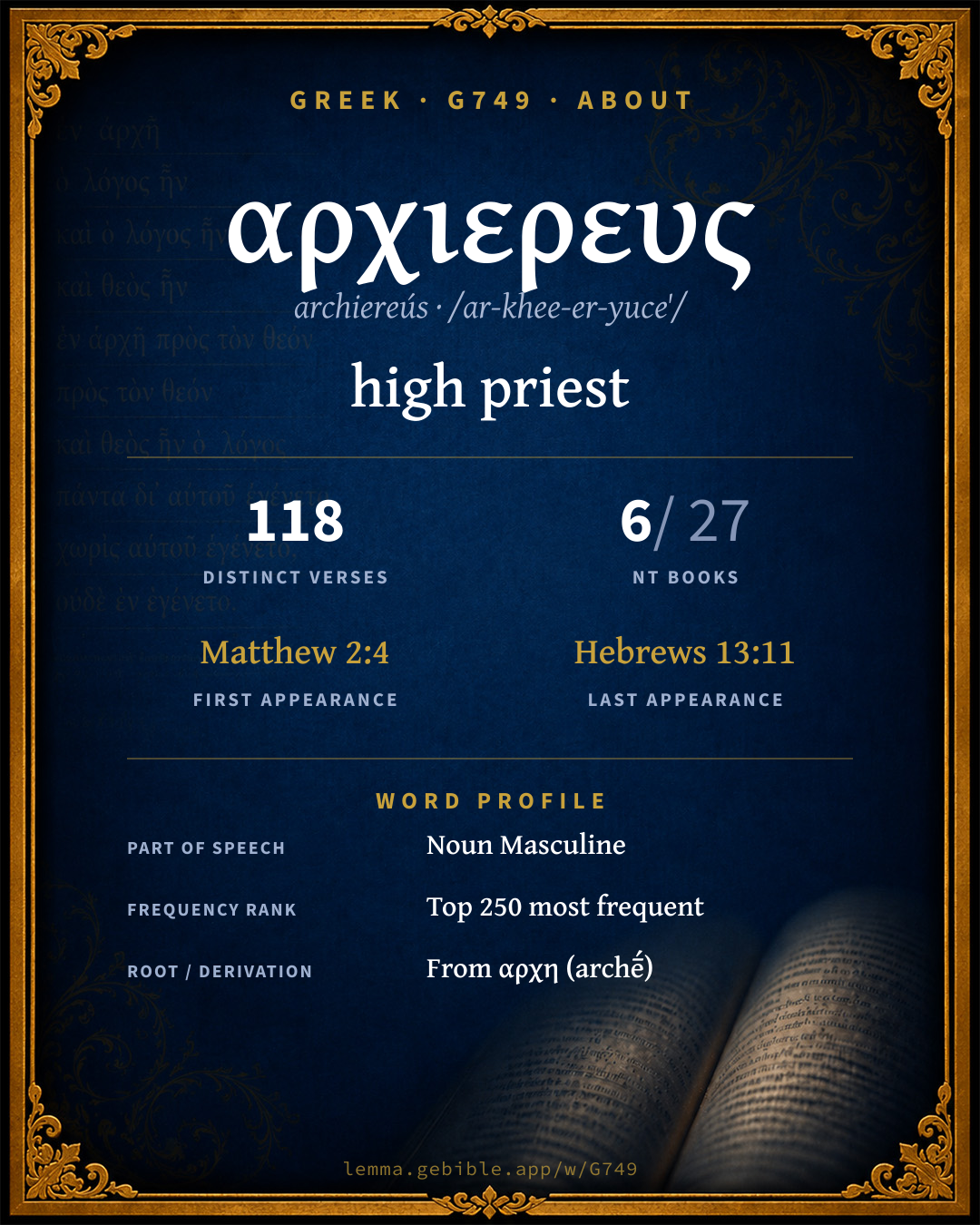
ἀρχιερεύς
high priest
Full lexicon entry — Thayer's Greek Lexicon
From Thayer's Greek Lexicon
Where this word appears
See every Nominative-case word in the Greek New Testament →
Grammar key — what these labels mean
Part of speech
- Noun
- A naming word — a person, place, thing, or idea.
Case
- Nominative
- The case of the subject (and the predicate nominative).
- Genitive
- The case of source, possession, or “of” — answers “whose / from what.”
- Accusative
- The case of the direct object and of extent.
- Dative
- The case of the indirect object, means, or location — “to / for / with / in.”
Gender
- Masculine
- Grammatically masculine.
Number
- Plural
- More than one.
- Singular
- One.
4 verses where G749 appears in the Genitive case in the Book of Acts. Filtered view — show all forms. Click any verse to open its interlinear word-by-word view. Verse text shown in the World English Bible for context — . Each verse’s Greek form is shown with its reference; the English is not keyword-highlighted, since the data carries no word-level English alignment. Use “Compare translations” on any verse to read it across multiple English versions. This concordance covers the Greek New Testament; Septuagint (Greek Old Testament) occurrences of this word are not indexed here.
Acts
- Acts 9:14 ἀρχιερέων n gen pl masc Here he has authority from the chief priests to bind all who call on your name."
- Acts 19:14 ἀρχιερέως n gen sg masc There were seven sons of one Sceva, a Jewish chief priest, who did this.
- Acts 26:10 ἀρχιερέων n gen pl masc This I also did in Jerusalem. I both shut up many of the saints in prisons, having received authority from the chief priests, and when they were put to death I gave my vote against them.
- Acts 26:12 ἀρχιερέων n gen pl masc "Whereupon as I traveled to Damascus with the authority and commission from the chief priests,
About this entry
At a glance — auto-summarized from this page’s data, not written by a person. Every figure links to its source below. This summary describes the numbers; it doesn’t interpret them.
At its core, αρχιερευς (archiereús) means “high priest.” First canonically at Matthew 2:4, it enters the text early. It appears 118 verses across 6 books of the Greek New Testament, among its common vocabulary. It shares a root with αρχη, αρχαιος and αρχηγος. Each statement above links to its evidence; the full detail follows below.
Gloss history
Strong's 1890 vs modern scholarship

About this word
Strong's G749 catalogs a Greek word from the Greek New Testament.
These counts are not copied from any lexicon or concordance. They are computed here, from the morphology-tagged Greek New Testament. What Lemma adds →
- 118
- distinct verses
- The word appears in 118 distinct verses.
- 6 / 27
- NT books
- The word appears in 6 of 27 New Testament books.
- #136
- by frequency
- Top 250 most frequent Greek words (rank 136 of 5,347 Greek words by occurrence).
View all 118 occurrences in the concordance →
By section of the New Testament
By traditional corpus
Conventional, traditional groupings — biblical authorship is debated, so this is a traditional corpus grouping, not an authorship claim. Some books belong to more than one corpus (Luke is in both the Gospels and the Lukan corpus, and so on), so these shares overlap and need not total 100%. Each figure is a share of the word’s 118 distinct verses.
- Gospels 79 verses · 67%
- Lukan (Luke–Acts) 36 verses · 31%
- Johannine 20 verses · 17%
- Hebrews 17 verses · 14%
How translations render this word
Counts come from each version’s own published word-to-Strong’s tagging or interlinear alignment — an approximate guide to how each version renders this word, not a word-level alignment the data otherwise carries. Because each total is that version’s own tagged count, the per-version totals vary from one another and need not match the appearance or distinct-verse counts above. These counts may also differ from a printed concordance because Lemma counts each distinctly tagged rendering and does not collapse phrase taggings into a single head-word total. This is a fixed set of word-tagged versions (KJV, ASV, BSB, ULT) and does not change with the reading translation you choose elsewhere. Each version’s license is shown beside its name below (and on Sources).
- King James Version: Chief priests 64×, High priest 50×, High priest's 4×
- American Standard Version: Chief priests 60×, High priest 52×, Chief priest 2×
- Berean Standard Bible: Chief priests 64×, High priest 52×, High priesthood 2×
- unfoldingWord Literal Text: Chief priests 64×, High priest 53×, A 3×
King James Version Public Domain
Renders G749 across 123 tagged occurrences — most commonly:
Plus 2 renderings that appear only once — usually multi-word phrases or single function words the recovered tagging swept in, not distinct renderings.
American Standard Version Public Domain
Renders G749 across 121 tagged occurrences — most commonly:
Plus 5 renderings that appear only once — usually multi-word phrases or single function words the recovered tagging swept in, not distinct renderings.
Berean Standard Bible Public Domain
Renders G749 across 122 tagged occurrences — most commonly:
Plus 2 renderings that appear only once — usually multi-word phrases or single function words the recovered tagging swept in, not distinct renderings.
unfoldingWord Literal Text CC BY-SA 4.0
Renders G749 across 125 tagged occurrences — most commonly:
Plus 1 rendering that appears only once — usually multi-word phrases or single function words the recovered tagging swept in, not distinct renderings.
Senses in Thayer's
The 1 sense Thayer's distinguishes for this word, in lexicon order (not ranked by frequency or importance). The full entry — with sub-senses — is in the Lexicon Entry tab.
- chief priest, high priest
Word origin
Derived from αρχη (archḗ) (G746) — beginning.
Forms in the corpus
The 8 distinct written forms G749 takes in the Greek New Testament, most frequent first — each parse links to that case’s occurrences in the concordance.
| Form | Parsing | Example | Uses |
|---|---|---|---|
| ἀρχιερεῖς archiereîs | Noun, Nominative, Plural, Masculine | Matthew 21:15 | 49 |
| ἀρχιερεὺς archiereùs | Noun, Nominative, Singular, Masculine | Matthew 26:62 | 24 |
| ἀρχιερέως archieréōs | Noun, Genitive, Singular, Masculine | Matthew 26:3 | 16 |
| ἀρχιερέων archieréōn | Noun, Genitive, Plural, Masculine | Matthew 16:21 | 10 |
| ἀρχιερέα archieréa | Noun, Accusative, Singular, Masculine | Matthew 26:57 | 9 |
| ἀρχιερεῦσιν archiereûsin | Noun, Dative, Plural, Masculine | Matthew 20:18 | 6 |
| ἀρχιερεύς archiereús | Noun, Nominative, Singular, Masculine | Acts 7:1 | 4 |
| ἀρχιερεῖ archiereî | Noun, Dative, Singular, Masculine | John 18:15 | 3 |
Same root — word family
Other Thayer's entries built from the same root as G749, grouped by Strong’s listed origin. These share a root / origin per the lexicon — not necessarily a shared meaning. Each links to that word’s own entry.
Derives from
Shares the same root
- αρχαιος archaîos G744 original
- αρχηγος archēgós G747 leader
- αρχιερατικος archieratikós G748 high priestly
- αρχιποιμην archipoímēn G750 chief shepherd
- αρχισυναγωγος archisynágōgos G752 synagogue ruler
- αρχιτεκτων architéktōn G753 architect
- αρχιτελωνης architelṓnēs G754 chief tax collector
- αρχιτρικλινος architríklinos G755 table master
Proper names from this root
People and places named from this root — a name, not an additional meaning of the word.
Compare all same-root words → Showing 4 of 11 — not the complete family. 1 of the same-root words is a proper name (a person or place). They share a root, not necessarily a meaning.
Septuagint usage
The same Greek word αρχιερευς appears 3 times in the Greek Old Testament (Septuagint), across 3 verses in 2 books.
- 3
- LXX occurrences
- Tagged occurrences of this Greek word in the Septuagint.
- 3
- verses
- Distinct Septuagint verses containing this word.
- 2 / 39
- OT books
- The word appears in 2 of the 39 Old Testament books.
Sample Septuagint occurrences
- Leviticus 4:3 ἀρχιερεύς
- Joshua 22:13 ἀρχιερεύς
Septuagint occurrences (same lexeme)
Every verse where the same Strong’s number (G749) appears in the Greek Septuagint. Verse text shown in the World English Bible for context; the Greek form is the matched word — the English is not keyword-highlighted.
- Leviticus 4:3 ἀρχιερεύς if the anointed priest sins so as to bring guilt on the people, then let him offer for his sin, which he has sinned, a young bull without blemish to Yahweh for a sin offering.
- Joshua 22:13 ἀρχιερεύς The children of Israel sent to the children of Reuben, and to the children of Gad, and to the half-tribe of Manasseh, into the land of Gilead, Phinehas the son of Eleazar the priest,
- Joshua 24:33 ἀρχιερεύς Eleazar the son of Aaron died; and they buried him in the hill of Phinehas his son, which was given him in the hill-country of Ephraim.
These are occurrences of the same Greek lexeme (G749) in the Septuagint — not a translation of any one Hebrew word. The store carries no word-level Hebrew↔Greek alignment, so no Hebrew original is asserted here. Counts come from the recovered LXX Strong's tagging — high-frequency vocabulary is well covered, while rare or late forms may be untagged — so they reflect tagged occurrences and may slightly undercount.