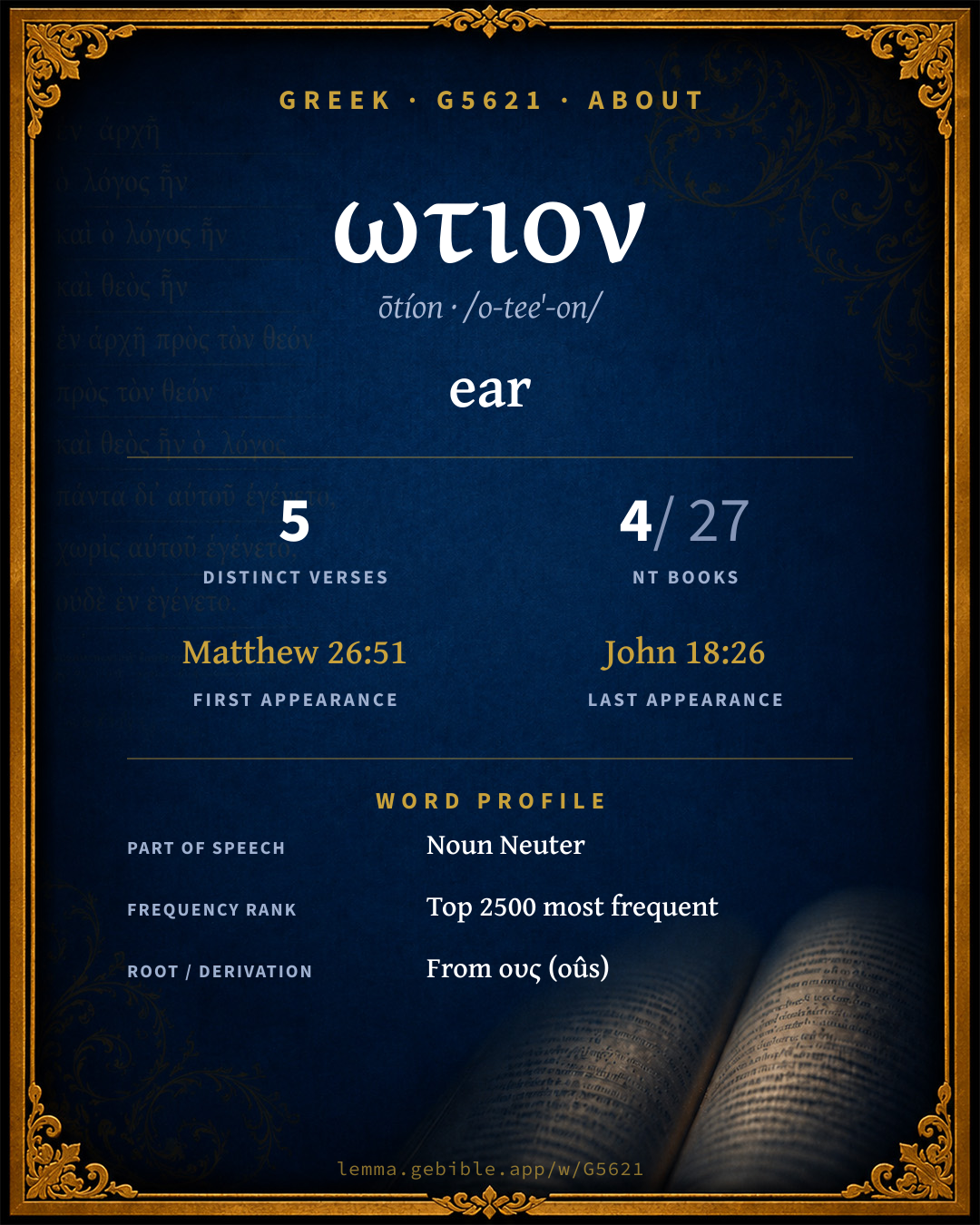
ὠτίον
ear
Full lexicon entry — Thayer's Greek Lexicon
From Thayer's Greek Lexicon
Where this word appears
See every Accusative-case word in the Greek New Testament →
Grammar key — what these labels mean
Part of speech
- Noun
- A naming word — a person, place, thing, or idea.
Case
- Accusative
- The case of the direct object and of extent.
- Genitive
- The case of source, possession, or “of” — answers “whose / from what.”
Gender
- Neuter
- Grammatically neuter.
Number
- Singular
- One.
Grammatical forms
- Noun, Accusative, Singular, Neuter 4 times (80%)
- Noun, Genitive, Singular, Neuter 1 time (20%)
Parsed forms decoded from the imported morphology (Robinson–Tischendorf, public domain), counted across 5 parsed occurrences — not distinct verses.
Every verse where G5621 appears — 5 distinct verses across 4 books. Click any verse to open its interlinear word-by-word view. Verse text shown in the World English Bible for context — . Each verse’s Greek form is shown with its reference; the English is not keyword-highlighted, since the data carries no word-level English alignment. Use “Compare translations” on any verse to read it across multiple English versions. This concordance covers the Greek New Testament; Septuagint (Greek Old Testament) occurrences of this word are not indexed here.
Matthew 1 verse
Mark 1 verse
Luke 1 verse
John 2 verses
- John 18:10 ὠτάριον n acc sg neut Simon Peter therefore, having a sword, drew it, and struck the high priest's servant, and cut off his right ear. The servant's name was Malchus.
- John 18:26 ὠτίον n acc sg neut One of the servants of the high priest, being a relative of him whose ear Peter had cut off, said, "Didn't I see you in the garden with him?"
About this entry
At a glance — auto-summarized from this page’s data, not written by a person. Every figure links to its source below. This summary describes the numbers; it doesn’t interpret them.
The Greek noun ωτιον centers on the idea of “ear.” A scarce word — 5 verses in all of the Greek New Testament. John dominates its distribution — 2 of 5 verses. Debuting at Matthew 26:51, it then recurs through the corpus. Dig into 5-verse concordance and the renderings breakdown below.
Gloss history
Strong's 1890 vs modern scholarship
About this word
Strong's G5621 catalogs a Greek word from the Greek New Testament.
These counts are not copied from any lexicon or concordance. They are computed here, from the morphology-tagged Greek New Testament. What Lemma adds →
- 5
- distinct verses
- The word appears in 5 distinct verses.
- 4 / 27
- NT books
- The word appears in 4 of 27 New Testament books.
- #1,648
- by frequency
- Top 2500 most frequent Greek words (rank 1,648 of 5,347 Greek words by occurrence).
View all 5 occurrences in the concordance →
By section of the New Testament
By traditional corpus
Conventional, traditional groupings — biblical authorship is debated, so this is a traditional corpus grouping, not an authorship claim. Some books belong to more than one corpus (Luke is in both the Gospels and the Lukan corpus, and so on), so these shares overlap and need not total 100%. Each figure is a share of the word’s 5 distinct verses.
- Gospels 5 verses · 100%
- Johannine 2 verses · 40%
- Lukan (Luke–Acts) 1 verse · 20%
How translations render this word
Counts come from each version’s own published word-to-Strong’s tagging or interlinear alignment — an approximate guide to how each version renders this word, not a word-level alignment the data otherwise carries. Because each total is that version’s own tagged count, the per-version totals vary from one another and need not match the appearance or distinct-verse counts above. These counts may also differ from a printed concordance because Lemma counts each distinctly tagged rendering and does not collapse phrase taggings into a single head-word total. This is a fixed set of word-tagged versions (KJV, ASV, BSB, ULT) and does not change with the reading translation you choose elsewhere. Each version’s license is shown beside its name below (and on Sources).
- King James Version: Ear 5×
- American Standard Version: Ear 4×
- Berean Standard Bible: Ear 5×
- unfoldingWord Literal Text: Ear 5×
King James Version Public Domain
Renders G5621 across 5 tagged occurrences — most commonly:
American Standard Version Public Domain
Renders G5621 across 4 tagged occurrences — most commonly:
Berean Standard Bible Public Domain
Renders G5621 across 5 tagged occurrences — most commonly:
unfoldingWord Literal Text CC BY-SA 4.0
Renders G5621 across 5 tagged occurrences — most commonly:
Senses in Thayer's
The 1 sense Thayer's distinguishes for this word, in lexicon order (not ranked by frequency or importance). The full entry — with sub-senses — is in the Lexicon Entry tab.
- the ear
Word origin
Derived from ους (oûs) (G3775) — ear.
Diminutive of G3775 ; an earlet that is one of the ears or perhaps the lobe of the ear : - ear.
— Strong’s Exhaustive Concordance (1890), public domain.
Forms in the corpus
The 3 distinct written forms G5621 takes in the Greek New Testament, most frequent first — each parse links to that case’s occurrences in the concordance.
| Form | Parsing | Example | Uses |
|---|---|---|---|
| ὠτάριον ōtárion | Noun, Accusative, Singular, Neuter | Mark 14:47 | 2 |
| ὠτίον ōtíon | Noun, Accusative, Singular, Neuter | Matthew 26:51 | 2 |
| ὠτίου ōtíou | Noun, Genitive, Singular, Neuter | Luke 22:51 | 1 |
Septuagint usage
The same Greek word ωτιον appears 14 times in the Greek Old Testament (Septuagint), across 13 verses in 6 books.
- 14
- LXX occurrences
- Tagged occurrences of this Greek word in the Septuagint.
- 13
- verses
- Distinct Septuagint verses containing this word.
- 6 / 39
- OT books
- The word appears in 6 of the 39 Old Testament books.
Sample Septuagint occurrences
- Deuteronomy 15:17 ὠτίον
- 1 Samuel 9:15 ὠτίον
- 2 Samuel 7:27 ὠτίον
- Psalms 17:45 ὠτίον
- Isaiah 50:4 ὠτίον
- Amos 3:12 ὠτίον
Septuagint occurrences (same lexeme)
Every verse where the same Strong’s number (G5621) appears in the Greek Septuagint. Verse text shown in the World English Bible for context; the Greek form is the matched word — the English is not keyword-highlighted.
- Deuteronomy 15:17 ὠτίον then you shall take an awl, and thrust it through his ear to the door, and he shall be your servant forever. Also to your maid-servant you shall do likewise.
- 1 Samuel 9:15 ὠτίον Now Yahweh had revealed to Samuel a day before Saul came, saying,
- 1 Samuel 20:2 ὠτίον He said to him, "Far from it; you shall not die: behold, my father does nothing either great or small, but that he discloses it to me; and why should my father hide this thing from me? It is not so."
- 1 Samuel 20:13 ὠτίον Yahweh do so to Jonathan, and more also, should it please my father to do you evil, if I don't disclose it to you, and send you away, that you may go in peace: and Yahweh be with you, as he has been with my father.
- 1 Samuel 22:8 ὠτίον that all of you have conspired against me, and there is none who discloses to me when my son makes a league with the son of Jesse, and there is none of you who is sorry for me, or discloses to me that my son has stirred up my servant against me, to lie in wait, as at this day?
- 1 Samuel 22:17 ὠτίον The king said to the guard who stood about him, Turn, and kill the priests of Yahweh; because their hand also is with David, and because they knew that he fled, and didn't disclose it to me. But the servants of the king wouldn't put forth their hand to fall on the priests of Yahweh.
- 2 Samuel 7:27 ὠτίον For you, Yahweh of Hosts, the God of Israel, have revealed to your servant, saying, I will build you a house: therefore has your servant found in his heart to pray this prayer to you.
- 2 Samuel 22:45 ὠτίον The foreigners shall submit themselves to me: As soon as they hear of me, they shall obey me.
- Psalms 17:45 ὠτίον
- Psalms 39:7 ὠτίον Now, Lord, what do I wait for? My hope is in you.
- Isaiah 50:4 ὠτίον The Lord Yahweh has given me the tongue of those who are taught, that I may know how to sustain with words him who is weary: he wakens morning by morning, he wakens my ear to hear as those who are taught.
- Isaiah 55:3 ὠτίον Turn your ear, and come to me; hear, and your soul shall live: and I will make an everlasting covenant with you, even the sure mercies of David.
- Amos 3:12 ὠτίον Thus says Yahweh: "As the shepherd rescues out of the mouth of the lion two legs, Or a piece of an ear, So shall the children of Israel be rescued who sit in Samaria on the corner of a couch, And on the silken cushions of a bed."
These are occurrences of the same Greek lexeme (G5621) in the Septuagint — not a translation of any one Hebrew word. The store carries no word-level Hebrew↔Greek alignment, so no Hebrew original is asserted here. Counts come from the recovered LXX Strong's tagging — high-frequency vocabulary is well covered, while rare or late forms may be untagged — so they reflect tagged occurrences and may slightly undercount.