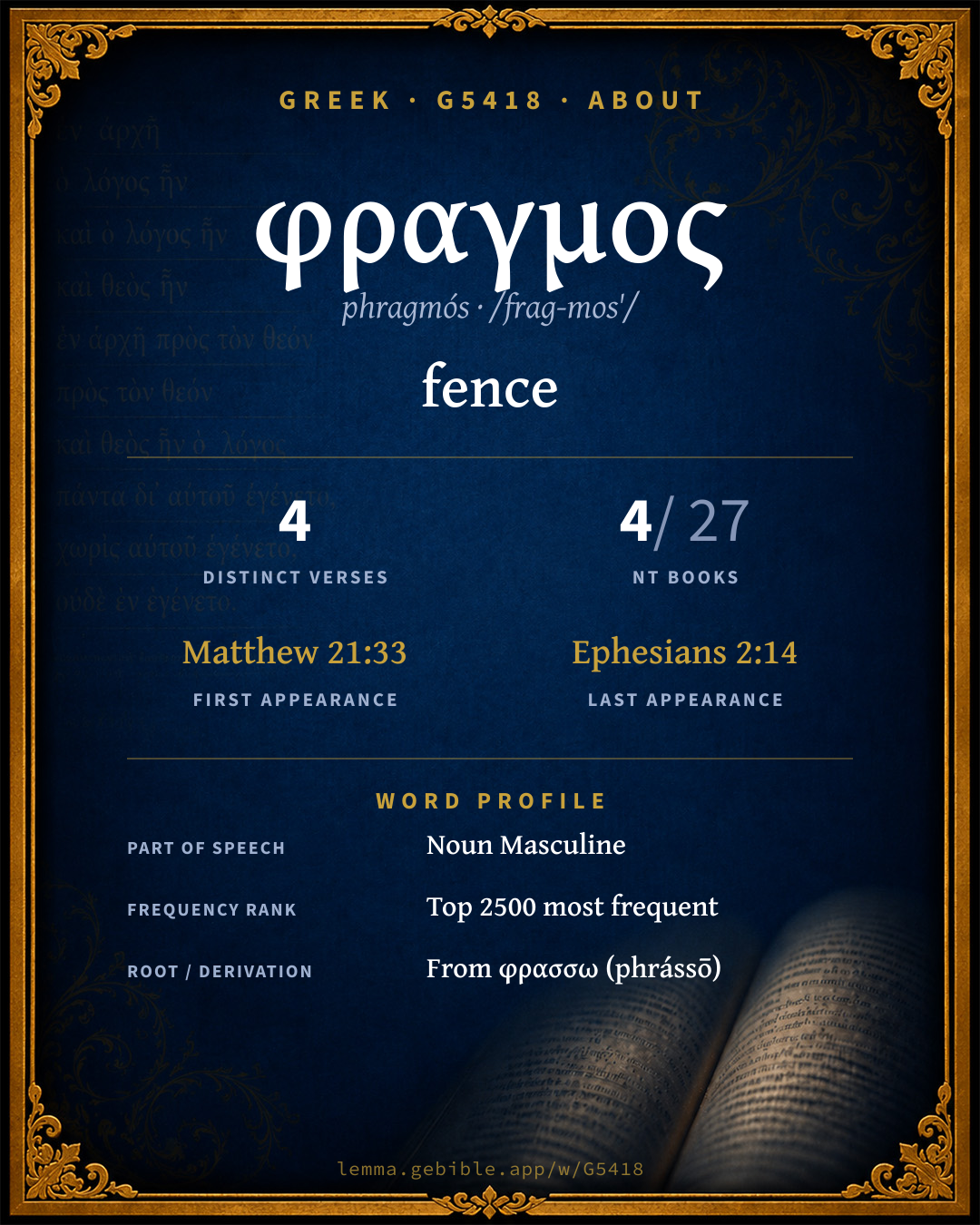
φραγμός
fence
‘fence’ is one of 2 main senses fuller range ↓
Full lexicon entry — Thayer's Greek Lexicon
From Thayer's Greek Lexicon
Where this word appears
Grammar key — what these labels mean
Part of speech
- Noun
- A naming word — a person, place, thing, or idea.
Case
- Accusative
- The case of the direct object and of extent.
- Genitive
- The case of source, possession, or “of” — answers “whose / from what.”
Gender
- Masculine
- Grammatically masculine.
Number
- Singular
- One.
- Plural
- More than one.
Every verse where G5418 appears in the Book of Mark — 1 distinct verse. Click any verse to open its interlinear word-by-word view. Verse text shown in the World English Bible for context — . Each verse’s Greek form is shown with its reference; the English is not keyword-highlighted, since the data carries no word-level English alignment. Use “Compare translations” on any verse to read it across multiple English versions. This concordance covers the Greek New Testament; Septuagint (Greek Old Testament) occurrences of this word are not indexed here.
Mark
About this entry
At a glance — auto-summarized from this page’s data, not written by a person. Every figure links to its source below. This summary describes the numbers; it doesn’t interpret them.
“fence” is the headline sense of the Greek noun φραγμος (phragmós). With only 4 verses it sits in the long tail of Greek New Testament vocabulary. It concentrates in Matthew, which alone accounts for 25% of its uses. First canonically at Matthew 21:33, it enters the text early. Catalogued under 2 senses, its meaning is not single-sense. The sections below give every sense, occurrence, and version rendering.
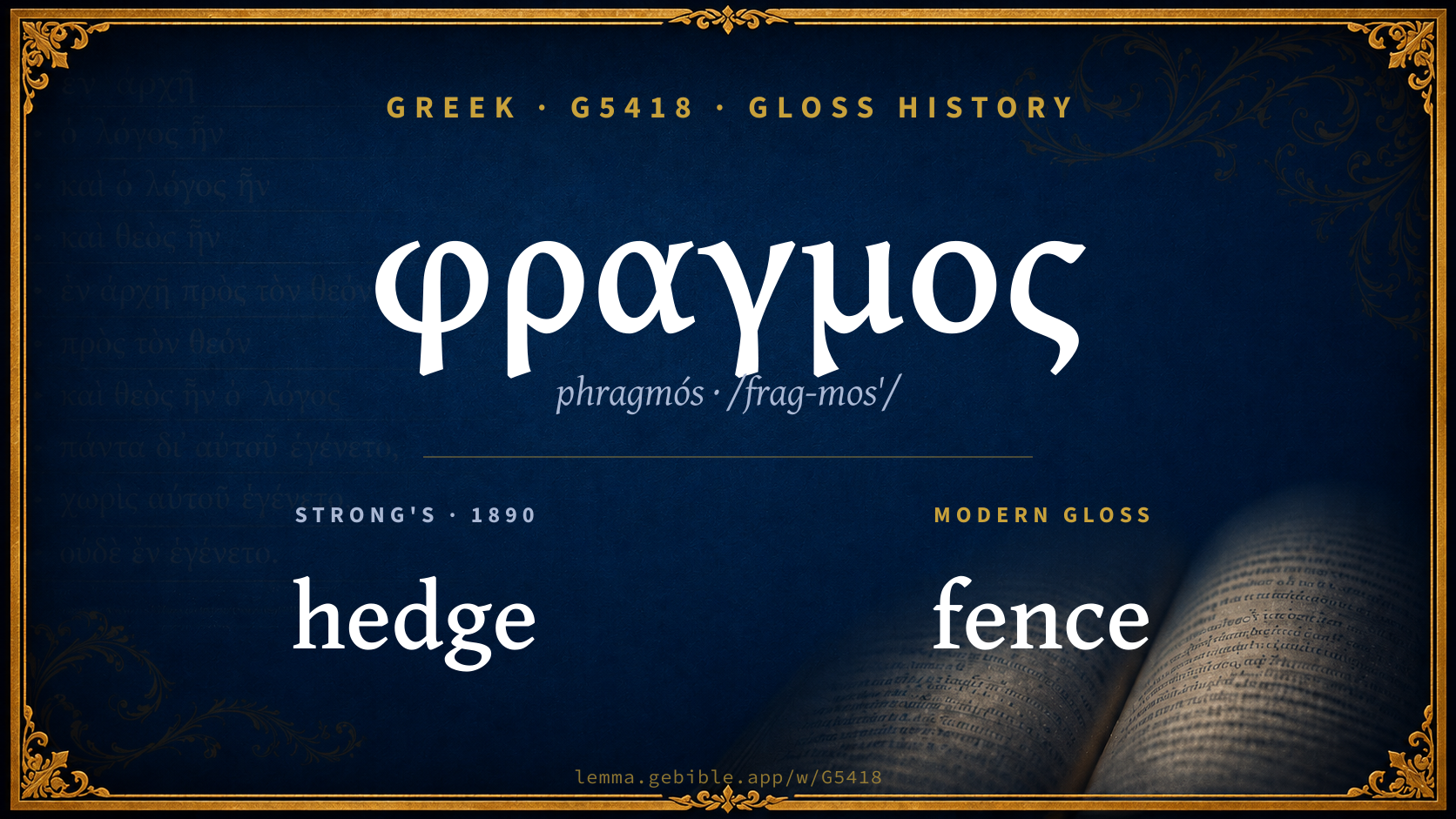
Gloss history
Strong's 1890 vs modern scholarship
About this word
Strong's G5418 catalogs a Greek word from the Greek New Testament.
These counts are not copied from any lexicon or concordance. They are computed here, from the morphology-tagged Greek New Testament. What Lemma adds →
- 4
- distinct verses
- The word appears in 4 distinct verses.
- 4 / 27
- NT books
- The word appears in 4 of 27 New Testament books.
- #1,877
- by frequency
- Top 2500 most frequent Greek words (rank 1,877 of 5,347 Greek words by occurrence).
View all 4 occurrences in the concordance →
By section of the New Testament
By traditional corpus
Conventional, traditional groupings — biblical authorship is debated, so this is a traditional corpus grouping, not an authorship claim. Some books belong to more than one corpus (Luke is in both the Gospels and the Lukan corpus, and so on), so these shares overlap and need not total 100%. Each figure is a share of the word’s 4 distinct verses.
- Gospels 3 verses · 75%
- Lukan (Luke–Acts) 1 verse · 25%
- Pauline corpus 1 verse · 25%
How translations render this word
Counts come from each version’s own published word-to-Strong’s tagging or interlinear alignment — an approximate guide to how each version renders this word, not a word-level alignment the data otherwise carries. Because each total is that version’s own tagged count, the per-version totals vary from one another and need not match the appearance or distinct-verse counts above. These counts may also differ from a printed concordance because Lemma counts each distinctly tagged rendering and does not collapse phrase taggings into a single head-word total. This is a fixed set of word-tagged versions (KJV, ASV, BSB, ULT) and does not change with the reading translation you choose elsewhere. Each version’s license is shown beside its name below (and on Sources).
- King James Version: Hedge about 1×, Hedged 1×, Hedges 1×
- American Standard Version: Hedge about 1×, Hedges 1×, Partition 1×
- Berean Standard Bible: Wall 2×
- unfoldingWord Literal Text: Hedge 2×
King James Version Public Domain
Renders G5418 across 4 tagged occurrences — most commonly:
American Standard Version Public Domain
Renders G5418 across 4 tagged occurrences — most commonly:
Berean Standard Bible Public Domain
Renders G5418 across 4 tagged occurrences — most commonly:
Plus 2 renderings that appear only once — usually multi-word phrases or single function words the recovered tagging swept in, not distinct renderings.
unfoldingWord Literal Text CC BY-SA 4.0
Renders G5418 across 4 tagged occurrences — most commonly:
Plus 2 renderings that appear only once — usually multi-word phrases or single function words the recovered tagging swept in, not distinct renderings.
Senses in Thayer's
The 2 senses Thayer's distinguishes for this word, in lexicon order (not ranked by frequency or importance). The full entry — with sub-senses — is in the Lexicon Entry tab.
- a hedge, a fence
- that which separates, prevents two from coming together
Word origin
Derived from φρασσω (phrássō) (G5420) — to block up.
From G5420 ; a fence or inclosing barrier (literally or figuratively): - hedge (+ round about) partition.
— Strong’s Exhaustive Concordance (1890), public domain.
Forms in the corpus
The 3 distinct written forms G5418 takes in the Greek New Testament, most frequent first — each parse links to that case’s occurrences in the concordance.
| Form | Parsing | Example | Uses |
|---|---|---|---|
| φραγμὸν phragmòn | Noun, Accusative, Singular, Masculine | Matthew 21:33 | 2 |
| φραγμοὺς phragmoùs | Noun, Accusative, Plural, Masculine | Luke 14:23 | 1 |
| φραγμοῦ phragmoû | Noun, Genitive, Singular, Masculine | Ephesians 2:14 | 1 |
Same root — word family
Other Thayer's entries built from the same root as G5418, grouped by Strong’s listed origin. These share a root / origin per the lexicon — not necessarily a shared meaning. Each links to that word’s own entry.
Derives from
Shares the same root
Compare all same-root words → Showing 4 of 5 — not the complete family. They share a root, not necessarily a meaning.
Septuagint usage
The same Greek word φραγμος appears 18 times in the Greek Old Testament (Septuagint), across 17 verses in 11 books.
- 18
- LXX occurrences
- Tagged occurrences of this Greek word in the Septuagint.
- 17
- verses
- Distinct Septuagint verses containing this word.
- 11 / 39
- OT books
- The word appears in 11 of the 39 Old Testament books.
Sample Septuagint occurrences
- Genesis 38:29 φραγμός
- Numbers 22:24 φραγμός
- 1 Kings 10:22 φραγμός
- Ezra 9:9 φραγμός
- Job 38:31 φραγμός
- Psalms 61:4 φραγμός
- Proverbs 24:31 φραγμός
- Ecclesiastes 10:8 φραγμός
- Isaiah 5:2 φραγμός
- Micah 4:14 φραγμός
- Nahum 3:17 φραγμός
Septuagint occurrences (same lexeme)
Every verse where the same Strong’s number (G5418) appears in the Greek Septuagint. Verse text shown in the World English Bible for context; the Greek form is the matched word — the English is not keyword-highlighted.
- Genesis 38:29 φραγμός It happened, as he drew back his hand, that behold, his brother came out, and she said, "Why have you made a breach for yourself?" Therefore his name was called Perez.
- Numbers 22:24 φραγμός Then the angel of Yahweh stood in a narrow path between the vineyards, a wall being on this side, and a wall on that side.
- 1 Kings 10:22 φραγμός For the king had at sea a navy of Tarshish with the navy of Hiram: once every three years came the navy of Tarshish, bringing gold, and silver, ivory, and apes, and peacocks.
- 1 Kings 11:27 φραγμός This was the reason why he lifted up his hand against the king: Solomon built Millo, and repaired the breach of the city of David his father.
- Ezra 9:9 φραγμός For we are bondservants; yet our God has not forsaken us in our bondage, but has extended loving kindness to us in the sight of the kings of Persia, to give us a reviving, to set up the house of our God, and to repair the ruins of it, and to give us a wall in Judah and in Jerusalem.
- Job 38:31 φραγμός "Can you bind the cluster of the Pleiades, Or loosen the cords of Orion?
- Psalms 61:4 φραγμός I will dwell in your tent forever. I will take refuge in the shelter of your wings. Selah.
- Psalms 79:13 φραγμός So we, your people and sheep of your pasture, Will give you thanks forever. We will praise you forever, to all generations.
- Psalms 88:41 φραγμός
- Psalms 143:14 φραγμός
- Proverbs 24:31 φραγμός Behold, it was all grown over with thorns. Its surface was covered with nettles, And its stone wall was broken down.
- Ecclesiastes 10:8 φραγμός He who digs a pit may fall into it; and whoever breaks through a wall may be bitten by a snake.
- Isaiah 5:2 φραγμός He dug it up, Gathered out its stones, Planted it with the choicest vine, Built a tower in its midst, And also cut out a winepress therein. He looked for it to yield grapes, But it yielded wild grapes.
- Isaiah 5:5 φραγμός Now I will tell you what I will do to my vineyard. I will take away its hedge, and it will be eaten up. I will break down its wall of it, and it will be trampled down.
- Isaiah 58:12 φραγμός Those who shall be of you shall build the old waste places; you shall raise up the foundations of many generations; and you shall be called The repairer of the breach, The restorer of paths to dwell in.
- Micah 4:14 φραγμός
- Nahum 3:17 φραγμός Your guards are like the locusts, and your officials like the swarms of locusts, which settle on the walls on a cold day, but when the sun appears, they flee away, and their place is not known where they are.
These are occurrences of the same Greek lexeme (G5418) in the Septuagint — not a translation of any one Hebrew word. The store carries no word-level Hebrew↔Greek alignment, so no Hebrew original is asserted here. Counts come from the recovered LXX Strong's tagging — high-frequency vocabulary is well covered, while rare or late forms may be untagged — so they reflect tagged occurrences and may slightly undercount.