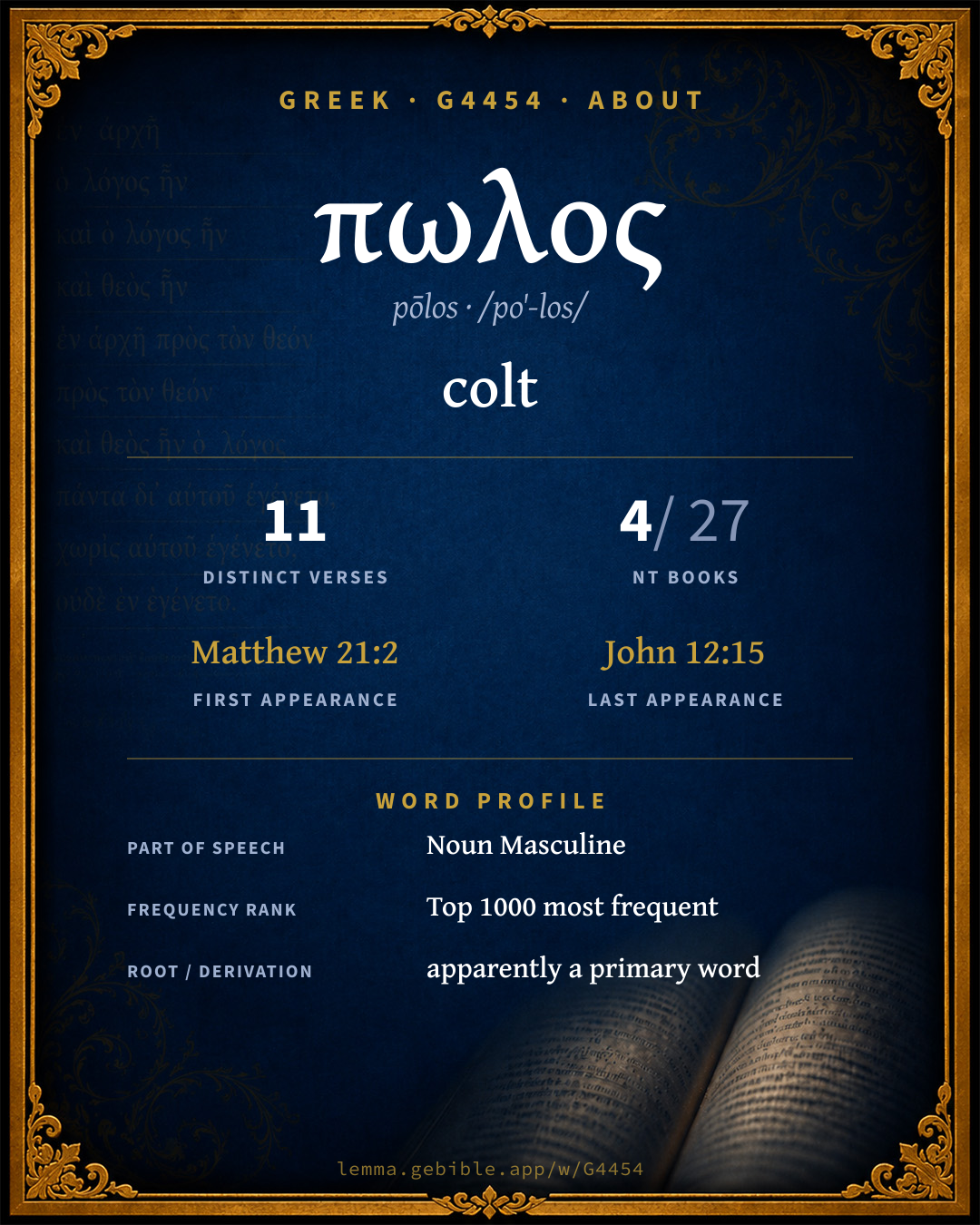
πῶλος
colt
‘colt’ is one of 3 main senses fuller range ↓
Full lexicon entry — Thayer's Greek Lexicon
From Thayer's Greek Lexicon
Where this word appears
Grammar key — what these labels mean
Part of speech
- Noun
- A naming word — a person, place, thing, or idea.
Case
- Accusative
- The case of the direct object and of extent.
Gender
- Masculine
- Grammatically masculine.
Number
- Singular
- One.
Every verse where G4454 appears — 11 distinct verses across 4 books. Click any verse to open its interlinear word-by-word view. Verse text shown in the World English Bible for context — . Each verse’s Greek form is shown with its reference; the English is not keyword-highlighted, since the data carries no word-level English alignment. Use “Compare translations” on any verse to read it across multiple English versions. This concordance covers the Greek New Testament; Septuagint (Greek Old Testament) occurrences of this word are not indexed here.
Matthew 3 verses
- Matthew 21:2 πῶλον n acc sg masc saying to them, "Go into the village that is opposite you, and immediately you will find a donkey tied, and a colt with her. Untie them, and bring them to me.
- Matthew 21:5 πῶλον n acc sg masc "Tell the daughter of Zion, Behold, your King comes to you, Humble, and riding on a donkey, On a colt, the foal of a donkey."
- Matthew 21:7 πῶλον n acc sg masc and brought the donkey and the colt, and laid their clothes on them; and he sat on them.
Mark 4 verses
- Mark 11:2 πῶλον n acc sg masc and said to them, "Go your way into the village that is opposite you. Immediately as you enter into it, you will find a young donkey tied, on which no one has sat. Untie him, and bring him.
- Mark 11:4 πῶλον n acc sg masc They went away, and found a young donkey tied at the door outside in the open street, and they untied him.
- Mark 11:5 πῶλον n acc sg masc Some of those who stood there asked them, "What are you doing, untying the young donkey?"
- Mark 11:7 πῶλον n acc sg masc They brought the young donkey to Jesus, and threw their garments on it, and Jesus sat on it.
Luke 3 verses
- Luke 19:30 πῶλον n acc sg masc saying, "Go your way into the village on the other side, in which, as you enter, you will find a colt tied, whereon no man ever yet sat. Untie it, and bring it.
- Luke 19:33 πῶλον πῶλον n acc sg masc n acc sg masc As they were untying the colt, the owners of it said to them, "Why are you untying the colt?"
- Luke 19:35 πῶλον n acc sg masc They brought it to Jesus. They threw their cloaks on the colt, and set Jesus on them.
John 1 verse
About this entry
At a glance — auto-summarized from this page’s data, not written by a person. Every figure links to its source below. This summary describes the numbers; it doesn’t interpret them.
πωλος — transliterated pōlos — is a Greek noun carrying the sense “colt.” Its earliest occurrence is Matthew 21:2. Spanning 11 verses in 4 books, it ranks among the uncommon words of the Greek New Testament. Its uses concentrate in Mark (36% of all occurrences). Thayer's distinguishes 3 senses for it. Each statement above links to its evidence; the full detail follows below.
Gloss history
Strong's 1890 vs modern scholarship
About this word
Strong's G4454 catalogs a Greek word from the Greek New Testament.
These counts are not copied from any lexicon or concordance. They are computed here, from the morphology-tagged Greek New Testament. What Lemma adds →
- 11
- distinct verses
- The word appears in 11 distinct verses.
- 4 / 27
- NT books
- The word appears in 4 of 27 New Testament books.
- #904
- by frequency
- Top 1000 most frequent Greek words (rank 904 of 5,347 Greek words by occurrence).
View all 11 occurrences in the concordance →
By section of the New Testament
By traditional corpus
Conventional, traditional groupings — biblical authorship is debated, so this is a traditional corpus grouping, not an authorship claim. Some books belong to more than one corpus (Luke is in both the Gospels and the Lukan corpus, and so on), so these shares overlap and need not total 100%. Each figure is a share of the word’s 11 distinct verses.
- Gospels 11 verses · 100%
- Lukan (Luke–Acts) 3 verses · 27%
- Johannine 1 verse · 9%
How translations render this word
Counts come from each version’s own published word-to-Strong’s tagging or interlinear alignment — an approximate guide to how each version renders this word, not a word-level alignment the data otherwise carries. Because each total is that version’s own tagged count, the per-version totals vary from one another and need not match the appearance or distinct-verse counts above. These counts may also differ from a printed concordance because Lemma counts each distinctly tagged rendering and does not collapse phrase taggings into a single head-word total. This is a fixed set of word-tagged versions (KJV, ASV, BSB, ULT) and does not change with the reading translation you choose elsewhere. Each version’s license is shown beside its name below (and on Sources).
- King James Version: Colt 12×
- American Standard Version: Colt 10×
- Berean Standard Bible: Colt 11×
- unfoldingWord Literal Text: Colt 12×
King James Version Public Domain
Renders G4454 across 12 tagged occurrences — most commonly:
American Standard Version Public Domain
Renders G4454 across 12 tagged occurrences — most commonly:
Plus 2 renderings that appear only once — usually multi-word phrases or single function words the recovered tagging swept in, not distinct renderings.
Berean Standard Bible Public Domain
Renders G4454 across 11 tagged occurrences — most commonly:
Not rendered by a distinct English word in 1 further occurrence.
unfoldingWord Literal Text CC BY-SA 4.0
Renders G4454 across 12 tagged occurrences — most commonly:
Senses in Thayer's
The 3 senses Thayer's distinguishes for this word, in lexicon order (not ranked by frequency or importance). The full entry — with sub-senses — is in the Lexicon Entry tab.
- a colt, the young of a horse
- of a young ass
- an ass's colt
Word origin
Origin: apparently a primary word
Apparently a primary word; a foal or filly that is (specifically) a young ass : - colt.
— Strong’s Exhaustive Concordance (1890), public domain.
Septuagint usage
The same Greek word πωλος appears 7 times in the Greek Old Testament (Septuagint), across 6 verses in 4 books.
- 7
- LXX occurrences
- Tagged occurrences of this Greek word in the Septuagint.
- 6
- verses
- Distinct Septuagint verses containing this word.
- 4 / 39
- OT books
- The word appears in 4 of the 39 Old Testament books.
Sample Septuagint occurrences
- Genesis 32:16 πῶλος
- Judges 10:4 πῶλος
- Proverbs 5:19 πῶλος
- Zechariah 9:9 πῶλος
Septuagint occurrences (same lexeme)
Every verse where the same Strong’s number (G4454) appears in the Greek Septuagint. Verse text shown in the World English Bible for context; the Greek form is the matched word — the English is not keyword-highlighted.
- Genesis 32:16 πῶλος He delivered them into the hands of his servants, every herd by itself, and said to his servants, "Pass over before me, and put a space between herd and herd."
- Genesis 49:11 πῶλος Binding his foal to the vine, His donkey's colt to the choice vine; He has washed his garments in wine, His robes in the blood of grapes:
- Judges 10:4 πῶλος He had thirty sons who rode on thirty donkey colts, and they had thirty cities, which are called Havvoth Jair to this day, which are in the land of Gilead.
- Judges 12:14 πῶλος He had forty sons and thirty sons' sons, who rode on seventy donkey colts: and he judged Israel eight years.
- Proverbs 5:19 πῶλος A loving doe and a graceful deer-- Let her breasts satisfy you at all times. Be captivated always with her love.
- Zechariah 9:9 πῶλος Rejoice greatly, daughter of Zion! Shout, daughter of Jerusalem! Behold, your king comes to you! He is righteous, and having salvation; Lowly, and riding on a donkey, Even on a colt, the foal of a donkey.
These are occurrences of the same Greek lexeme (G4454) in the Septuagint — not a translation of any one Hebrew word. The store carries no word-level Hebrew↔Greek alignment, so no Hebrew original is asserted here. Counts come from the recovered LXX Strong's tagging — high-frequency vocabulary is well covered, while rare or late forms may be untagged — so they reflect tagged occurrences and may slightly undercount.