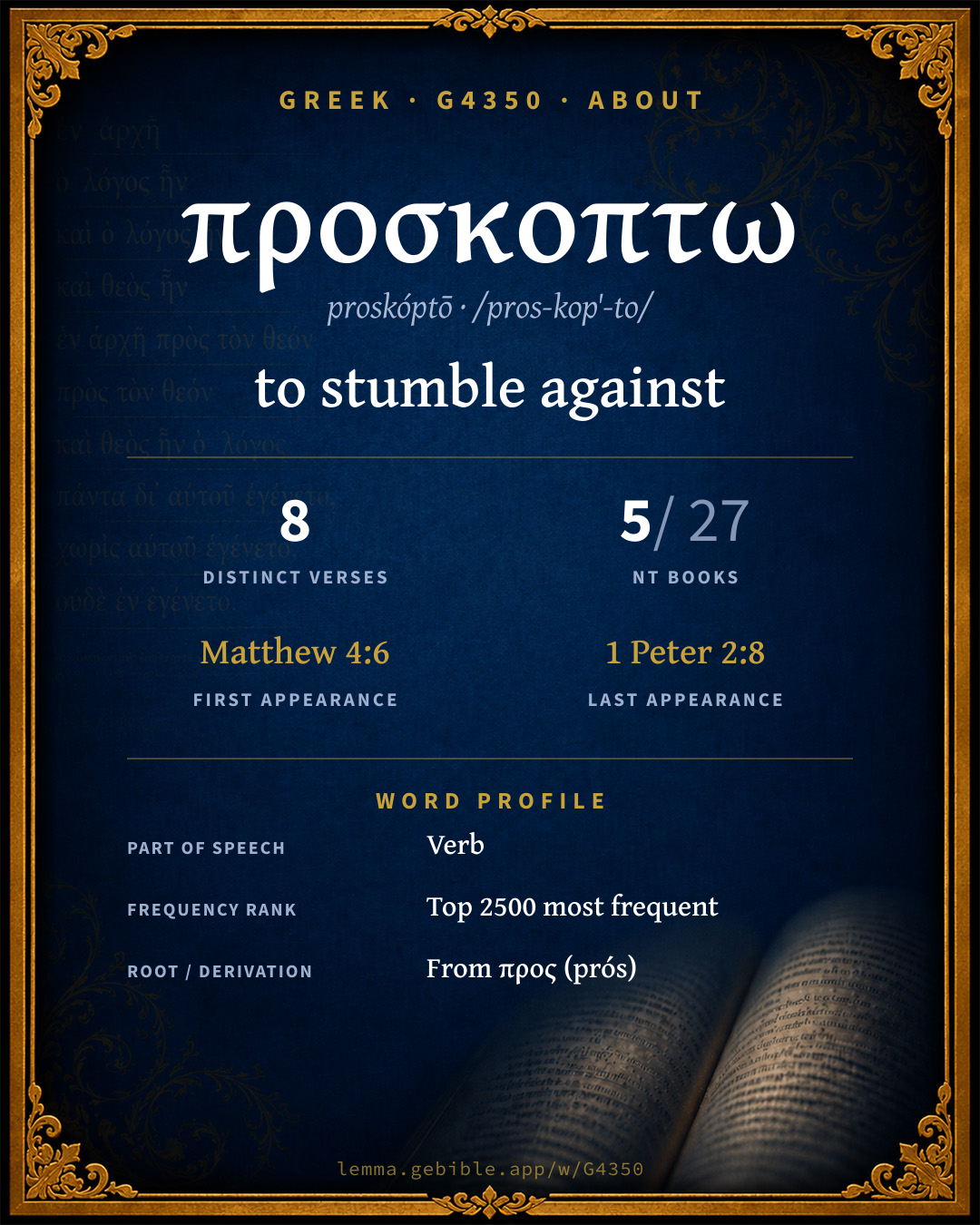
προσκόπτω
to stumble against
‘to stumble against’ is one of 4 main senses fuller range ↓
Full lexicon entry — Thayer's Greek Lexicon
From Thayer's Greek Lexicon
Where this word appears
See every Aorist-tense verb in the Greek New Testament →
Grammar key — what these labels mean
Part of speech
- Verb
- An action or state-of-being word.
Tense
- Present
- Ongoing or general action in present time (imperfective aspect).
- Aorist
- Action viewed as a simple whole, without regard to duration — often past (perfective aspect).
Voice
- Active
- The subject performs the action.
Mood
- Indicative
- States a fact or asks a factual question (the mood of reality).
- Subjunctive
- Expresses probability, purpose, or possibility (the mood of contingency).
Person
- 3rd person
- The one spoken about (“he / she / it / they”).
- 2nd person
- The one addressed (“you”).
Number
- Singular
- One.
- Plural
- More than one.
1 verse where G4350 appears in the Present tense in the Book of Romans. Filtered view — show all forms. Click any verse to open its interlinear word-by-word view. Verse text shown in the World English Bible for context — . Each verse’s Greek form is shown with its reference; the English is not keyword-highlighted, since the data carries no word-level English alignment. Use “Compare translations” on any verse to read it across multiple English versions. This concordance covers the Greek New Testament; Septuagint (Greek Old Testament) occurrences of this word are not indexed here.
Romans
About this entry
At a glance — auto-summarized from this page’s data, not written by a person. Every figure links to its source below. This summary describes the numbers; it doesn’t interpret them.
The Greek verb προσκοπτω centers on the idea of “to stumble against.” Thayer's distinguishes 4 senses for it. It appears 8 verses across 5 books of the Greek New Testament, among its uncommon vocabulary. The word gravitates to Matthew (25%), then John and Romans. Debuting at Matthew 4:6, it then recurs through the corpus. For the data behind this summary, explore the sense tree and the renderings breakdown below.
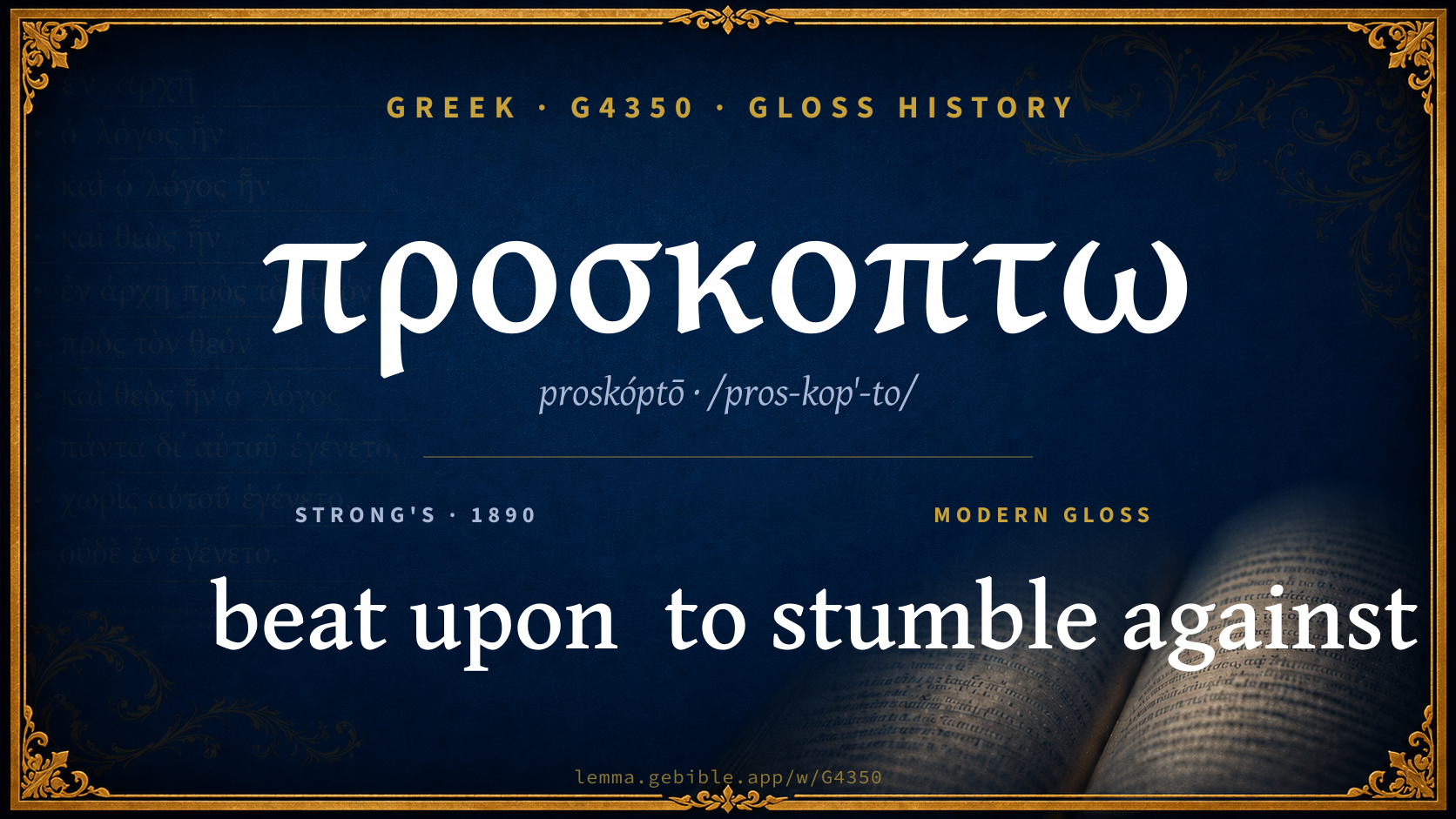
Gloss history
Strong's 1890 vs modern scholarship
About this word
Strong's G4350 catalogs a Greek word from the Greek New Testament.
These counts are not copied from any lexicon or concordance. They are computed here, from the morphology-tagged Greek New Testament. What Lemma adds →
- 8
- distinct verses
- The word appears in 8 distinct verses.
- 5 / 27
- NT books
- The word appears in 5 of 27 New Testament books.
- #1,240
- by frequency
- Top 2500 most frequent Greek words (rank 1,240 of 5,347 Greek words by occurrence).
View all 8 occurrences in the concordance →
By section of the New Testament
By traditional corpus
Conventional, traditional groupings — biblical authorship is debated, so this is a traditional corpus grouping, not an authorship claim. Some books belong to more than one corpus (Luke is in both the Gospels and the Lukan corpus, and so on), so these shares overlap and need not total 100%. Each figure is a share of the word’s 8 distinct verses.
- Gospels 5 verses · 63%
- Johannine 2 verses · 25%
- Pauline corpus 2 verses · 25%
- Lukan (Luke–Acts) 1 verse · 13%
- General (Catholic) Epistles 1 verse · 13%
How translations render this word
Counts come from each version’s own published word-to-Strong’s tagging or interlinear alignment — an approximate guide to how each version renders this word, not a word-level alignment the data otherwise carries. Because each total is that version’s own tagged count, the per-version totals vary from one another and need not match the appearance or distinct-verse counts above. These counts may also differ from a printed concordance because Lemma counts each distinctly tagged rendering and does not collapse phrase taggings into a single head-word total. This is a fixed set of word-tagged versions (KJV, ASV, BSB, ULT) and does not change with the reading translation you choose elsewhere. Each version’s license is shown beside its name below (and on Sources).
- King James Version: He stumbleth 2×, Thou dash 2×
- American Standard Version: He stumbleth 2×, Thou dash 2×
- Berean Standard Bible: Stumble 2×
- unfoldingWord Literal Text: Stumble 2×, You strike 2×
King James Version Public Domain
Renders G4350 across 8 tagged occurrences — most commonly:
Plus 4 renderings that appear only once — usually multi-word phrases or single function words the recovered tagging swept in, not distinct renderings.
American Standard Version Public Domain
Renders G4350 across 8 tagged occurrences — most commonly:
Plus 4 renderings that appear only once — usually multi-word phrases or single function words the recovered tagging swept in, not distinct renderings.
Berean Standard Bible Public Domain
Renders G4350 across 8 tagged occurrences — most commonly:
Plus 6 renderings that appear only once — usually multi-word phrases or single function words the recovered tagging swept in, not distinct renderings.
unfoldingWord Literal Text CC BY-SA 4.0
Renders G4350 across 9 tagged occurrences — most commonly:
Plus 5 renderings that appear only once — usually multi-word phrases or single function words the recovered tagging swept in, not distinct renderings.
Senses in Thayer's
The 4 senses Thayer's distinguishes for this word, in lexicon order (not ranked by frequency or importance). The full entry — with sub-senses — is in the Lexicon Entry tab.
- of those who strike against a stone or other obstacle in the path, to stumble
- to strike one's foot against a stone
- to rush upon, beat against
- to be made to stumble by a thing
Word origin
Derived from προς (prós) (G4314).
Forms in the corpus
The 4 distinct written forms G4350 takes in the Greek New Testament, most frequent first — each parse links to that tense’s occurrences in the concordance.
| Form | Parsing | Example | Uses |
|---|---|---|---|
| προσκόπτει proskóptei | Verb, Present, Active, Indicative, 3rd person, Singular | John 11:9 | 3 |
| προσέκοψαν prosékopsan | Verb, Aorist, Active, Indicative, 3rd person, Plural | Matthew 7:27 | 2 |
| προσκόψῃς proskópsēs | Verb, Aorist, Active, Subjunctive, 2nd person, Singular | Matthew 4:6 | 2 |
| προσκόπτουσιν proskóptousin | Verb, Present, Active, Indicative, 3rd person, Plural | 1 Peter 2:8 | 1 |
Same root — word family
Other Thayer's entries built from the same root as G4350, grouped by Strong’s listed origin. These share a root / origin per the lexicon — not necessarily a shared meaning. Each links to that word’s own entry.
Derives from
Shares the same root
- προσαγορευω prosagoreúō G4316 to address
- προσαγω proságō G4317 to bring
- προσαιτεω prosaitéō G4319 to ask alms
- προσαναβαινω prosanabaínō G4320 to go up higher
- προσαναλισκω prosanalískō G4321 to spend additionally
- προσαναπληροω prosanaplēróō G4322 to fill up
- προσανατιθημι prosanatíthēmi G4323 to lay upon
- προσαπειλεω prosapeiléō G4324 to threaten further
- προσδαπαναω prosdapanáō G4325 to spend besides
- προσδεομαι prosdéomai G4326 to need additionally
- προσδεχομαι prosdéchomai G4327 to receive to oneself
- προσδοκαω prosdokáō G4328 to expect
- προσεαω proseáō G4330 to permit approach
- προσεγγιζω prosengízō G4331 to approach
- προσεδρευω prosedreúō G4332 to sit near
- προσεργαζομαι prosergázomai G4333 to work besides
- προσερχομαι prosérchomai G4334 to draw near
- προσευχομαι proseúchomai G4336 to pray
- προσεχω proséchō G4337 to attend to
- προσηλοω prosēlóō G4338 to nail to
- προσκαιρος próskairos G4340 temporary
- προσκαλεομαι proskaléomai G4341 to call to
- προσκαρτερεω proskarteréō G4342 to adhere to
- προσκεφαλαιον proskephálaion G4344 pillow
+27 more words share this root (not shown).
Derived from this word
Compare all same-root words → Showing 4 of 55 — not the complete family. They share a root, not necessarily a meaning.
Septuagint usage
The same Greek word προσκοπτω appears 8 times in the Greek Old Testament (Septuagint), across 8 verses in 5 books.
- 8
- LXX occurrences
- Tagged occurrences of this Greek word in the Septuagint.
- 8
- verses
- Distinct Septuagint verses containing this word.
- 5 / 39
- OT books
- The word appears in 5 of the 39 Old Testament books.
Sample Septuagint occurrences
- Psalms 90:12 προςκόπτω
- Proverbs 3:23 προςκόπτω
- Isaiah 3:5 προςκόπτω
- Jeremiah 13:16 προςκόπτω
- Daniel 11:14 προςκόπτω
Septuagint occurrences (same lexeme)
Every verse where the same Strong’s number (G4350) appears in the Greek Septuagint. Verse text shown in the World English Bible for context; the Greek form is the matched word — the English is not keyword-highlighted.
- Psalms 90:12 προςκόπτω So teach us to number our days, That we may gain a heart of wisdom.
- Proverbs 3:23 προςκόπτω Then you shall walk in your way securely. Your foot won't stumble.
- Proverbs 4:19 προςκόπτω The way of the wicked is like darkness. They don't know what they stumble over.
- Isaiah 3:5 προςκόπτω The people will be oppressed, Everyone by another, And everyone by his neighbor. The child will behave himself proudly against the old man, And the base against the honorable.
- Jeremiah 13:16 προςκόπτω Give glory to Yahweh your God, before he cause darkness, and before your feet stumble on the dark mountains, and, while you look for light, he turn it into the shadow of death, and make it gross darkness.
- Daniel 11:14 προςκόπτω In those times there shall many stand up against the king of the south: also the children of the violent among your people shall lift themselves up to establish the vision; but they shall fall.
- Daniel 11:19 προςκόπτω Then he shall turn his face toward the fortresses of his own land; but he shall stumble and fall, and shall not be found.
- Daniel 11:33 προςκόπτω Those who are wise among the people shall instruct many; yet they shall fall by the sword and by flame, by captivity and by spoil, [many] days.
These are occurrences of the same Greek lexeme (G4350) in the Septuagint — not a translation of any one Hebrew word. The store carries no word-level Hebrew↔Greek alignment, so no Hebrew original is asserted here. Counts come from the recovered LXX Strong's tagging — high-frequency vocabulary is well covered, while rare or late forms may be untagged — so they reflect tagged occurrences and may slightly undercount.