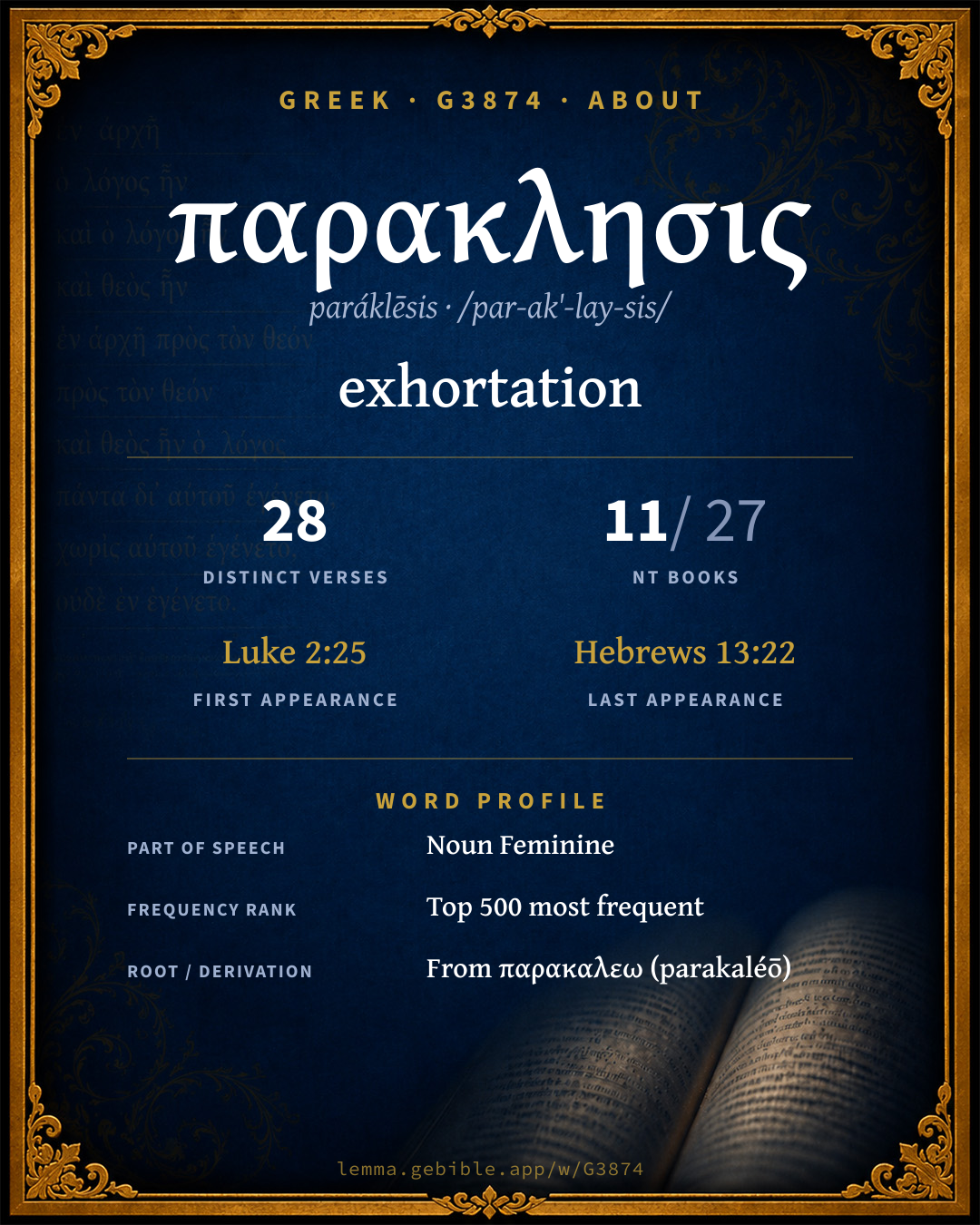
παράκλησις
exhortation
‘exhortation’ is one of 5 main senses fuller range ↓
Full lexicon entry — Thayer's Greek Lexicon
From Thayer's Greek Lexicon
Where this word appears
See every Dative-case word in the Greek New Testament →
Grammar key — what these labels mean
Part of speech
- Noun
- A naming word — a person, place, thing, or idea.
Case
- Genitive
- The case of source, possession, or “of” — answers “whose / from what.”
- Accusative
- The case of the direct object and of extent.
- Dative
- The case of the indirect object, means, or location — “to / for / with / in.”
- Nominative
- The case of the subject (and the predicate nominative).
Gender
- Feminine
- Grammatically feminine.
Number
- Singular
- One.
2 verses where G3874 appears in the Genitive case in the Book of Acts. Filtered view — show all forms. Click any verse to open its interlinear word-by-word view. Verse text shown in the World English Bible for context — . Each verse’s Greek form is shown with its reference; the English is not keyword-highlighted, since the data carries no word-level English alignment. Use “Compare translations” on any verse to read it across multiple English versions. This concordance covers the Greek New Testament; Septuagint (Greek Old Testament) occurrences of this word are not indexed here.
Acts
- Acts 4:36 παρακλήσεως n gen sg fem Joses, who by the apostles was surnamed Barnabas (which is, being interpreted, Son of Encouragement), a Levite, a man of Cyprus by race,
- Acts 13:15 παρακλήσεως n gen sg fem After the reading of the law and the prophets, the rulers of the synagogue sent to them, saying, "Brothers, if you have any word of exhortation for the people, speak."
About this entry
At a glance — auto-summarized from this page’s data, not written by a person. Every figure links to its source below. This summary describes the numbers; it doesn’t interpret them.
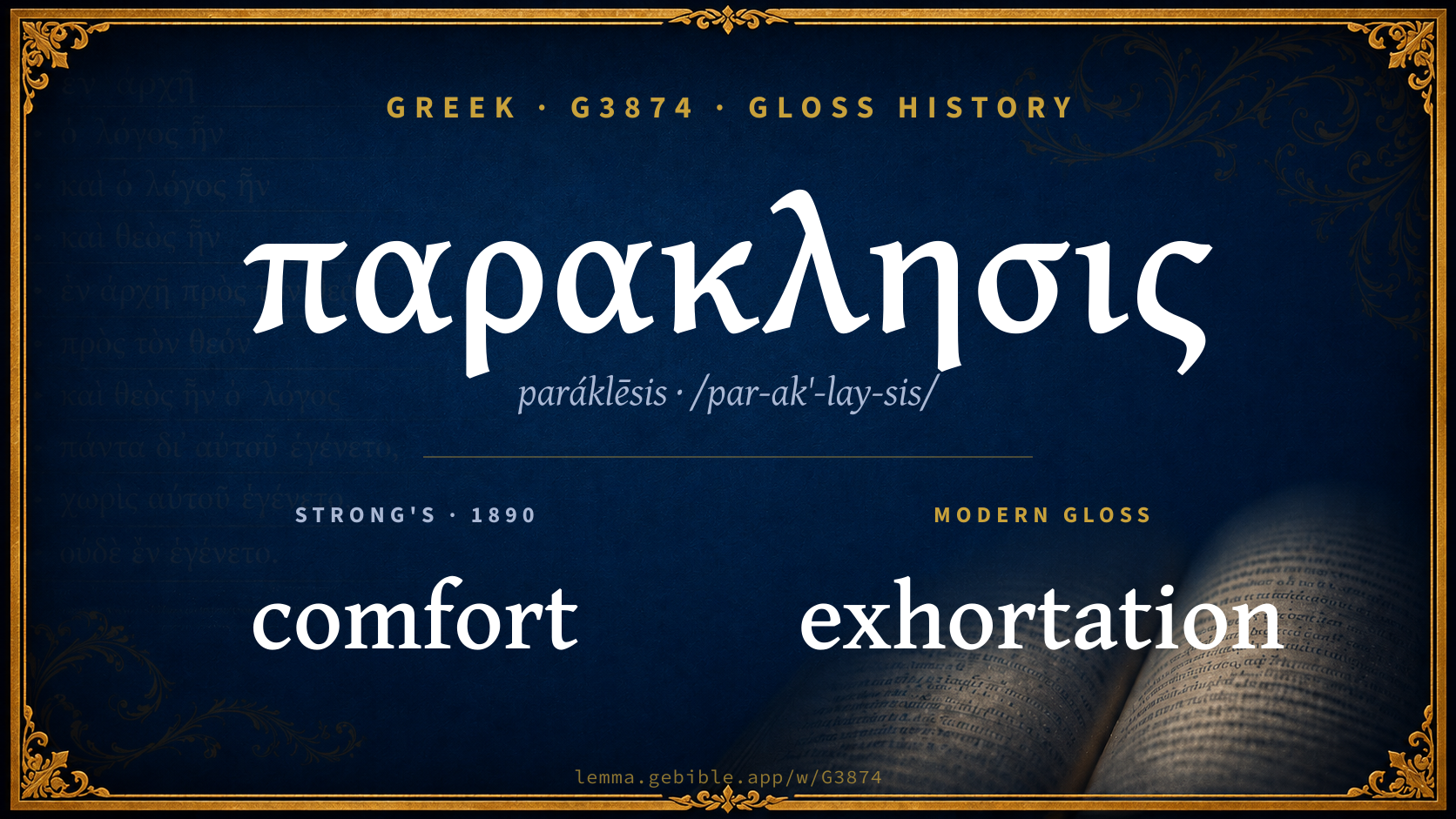
παρακλησις (paráklēsis) is a Greek noun most often rendered “exhortation.” Its English rendering has broadened — “consolation” classically, “encouragement” (Berean Standard Bible) in modern versions; see the renderings breakdown. Spanning 28 verses in 11 books, it ranks among the moderately common words of the Greek New Testament. 2 Corinthians dominates its distribution — 10 of 28 verses. Its lexical range runs to 5 senses. The sections below give every sense, occurrence, and version rendering.
Gloss history
Strong's 1890 vs modern scholarship
About this word
Strong's G3874 catalogs a Greek word from the Greek New Testament.
These counts are not copied from any lexicon or concordance. They are computed here, from the morphology-tagged Greek New Testament. What Lemma adds →
- 28
- distinct verses
- The word appears in 28 distinct verses.
- 11 / 27
- NT books
- The word appears in 11 of 27 New Testament books.
- #471
- by frequency
- Top 500 most frequent Greek words (rank 471 of 5,347 Greek words by occurrence).
View all 28 occurrences in the concordance →
Most concentrated in
- 2 Corinthians 10 verses 36%
- Acts 4 verses 14%
- Romans 3 verses 11%
By section of the New Testament
By traditional corpus
Conventional, traditional groupings — biblical authorship is debated, so this is a traditional corpus grouping, not an authorship claim. Some books belong to more than one corpus (Luke is in both the Gospels and the Lukan corpus, and so on), so these shares overlap and need not total 100%. Each figure is a share of the word’s 28 distinct verses.
- Pauline corpus 19 verses · 68%
- Lukan (Luke–Acts) 6 verses · 21%
- Hebrews 3 verses · 11%
- Gospels 2 verses · 7%
How translations render this word
Counts come from each version’s own published word-to-Strong’s tagging or interlinear alignment — an approximate guide to how each version renders this word, not a word-level alignment the data otherwise carries. Because each total is that version’s own tagged count, the per-version totals vary from one another and need not match the appearance or distinct-verse counts above. These counts may also differ from a printed concordance because Lemma counts each distinctly tagged rendering and does not collapse phrase taggings into a single head-word total. This is a fixed set of word-tagged versions (KJV, ASV, BSB, ULT) and does not change with the reading translation you choose elsewhere. Each version’s license is shown beside its name below (and on Sources).
- King James Version: Consolation 14×, Exhortation 8×, Comfort 6×
- American Standard Version: Comfort 12×, Exhortation 7×, Consolation 3×
- Berean Standard Bible: Encouragement 10×, Comfort 9×, Exhortation 3×
- unfoldingWord Literal Text: Encouragement 11×, Comfort 10×, Exhortation 5×
King James Version Public Domain
Renders G3874 across 29 tagged occurrences — most commonly:
Plus 1 rendering that appears only once — usually multi-word phrases or single function words the recovered tagging swept in, not distinct renderings.
American Standard Version Public Domain
Renders G3874 across 28 tagged occurrences — most commonly:
Plus 6 renderings that appear only once — usually multi-word phrases or single function words the recovered tagging swept in, not distinct renderings.
Berean Standard Bible Public Domain
Renders G3874 across 29 tagged occurrences — most commonly:
Plus 5 renderings that appear only once — usually multi-word phrases or single function words the recovered tagging swept in, not distinct renderings.
unfoldingWord Literal Text CC BY-SA 4.0
Renders G3874 across 31 tagged occurrences — most commonly:
Plus 5 renderings that appear only once — usually multi-word phrases or single function words the recovered tagging swept in, not distinct renderings.
Senses in Thayer's
The 5 senses Thayer's distinguishes for this word, in lexicon order (not ranked by frequency or importance). The full entry — with sub-senses — is in the Lexicon Entry tab.
- a calling near, summons, (esp. for help)
- importation, supplication, entreaty
- exhortation, admonition, encouragement
- consolation, comfort, solace; that which affords comfort or refreshment
- persuasive discourse, stirring address
Word origin
Derived from παρακαλεω (parakaléō) (G3870) — to call beside.
From G3870 ; imploration hortation solace : - comfort consolation exhortation intreaty.
— Strong’s Exhaustive Concordance (1890), public domain.
Forms in the corpus
The 4 distinct written forms G3874 takes in the Greek New Testament, most frequent first — each parse links to that case’s occurrences in the concordance.
| Form | Parsing | Example | Uses |
|---|---|---|---|
| παρακλήσεως paraklḗseōs | Noun, Genitive, Singular, Feminine | Acts 4:36 | 12 |
| παράκλησιν paráklēsin | Noun, Accusative, Singular, Feminine | Luke 2:25 | 7 |
| παρακλήσει paraklḗsei | Noun, Dative, Singular, Feminine | Acts 9:31 | 7 |
| παράκλησις paráklēsis | Noun, Nominative, Singular, Feminine | 2 Corinthians 1:5 | 3 |
Septuagint usage
The same Greek word παρακλησις appears 11 times in the Greek Old Testament (Septuagint), across 10 verses in 6 books.
- 11
- LXX occurrences
- Tagged occurrences of this Greek word in the Septuagint.
- 10
- verses
- Distinct Septuagint verses containing this word.
- 6 / 39
- OT books
- The word appears in 6 of the 39 Old Testament books.
Sample Septuagint occurrences
- Job 21:2 παράκλησις
- Psalms 93:19 παράκλησις
- Isaiah 28:29 παράκλησις
- Jeremiah 16:7 παράκλησις
- Hosea 13:14 παράκλησις
- Nahum 3:7 παράκλησις
Septuagint occurrences (same lexeme)
Every verse where the same Strong’s number (G3874) appears in the Greek Septuagint. Verse text shown in the World English Bible for context; the Greek form is the matched word — the English is not keyword-highlighted.
- Job 21:2 παράκλησις "Listen diligently to my speech. Let this be your consolation.
- Psalms 93:19 παράκλησις
- Isaiah 28:29 παράκλησις This also comes forth from Yahweh of Hosts, who is wonderful in counsel, and excellent in wisdom.
- Isaiah 30:7 παράκλησις For Egypt helps in vain, and to no purpose: therefore have I called her Rahab who sits still.
- Isaiah 57:18 παράκλησις I have seen his ways, and will heal him: I will lead him also, and restore comforts to him and to his mourners.
- Isaiah 66:11 παρακλήσις that you may suck and be satisfied with the breasts of her consolations; that you may milk out, and be delighted with the abundance of her glory.
- Jeremiah 16:7 παράκλησις neither shall men break [bread] for them in mourning, to comfort them for the dead; neither shall men give them the cup of consolation to drink for their father or for their mother.
- Jeremiah 38:9 παράκλησις My lord the king, these men have done evil in all that they have done to Jeremiah the prophet, whom they have cast into the dungeon; and he is likely to die in the place where he is, because of the famine; for there is no more bread in the city.
- Hosea 13:14 παράκλησις I will ransom them from the power of Sheol. I will redeem them from death! Death, where are your plagues? Sheol, where is your destruction? Compassion will be hidden from my eyes.
- Nahum 3:7 παράκλησις It will happen that all those who look at you will flee from you, and say, 'Nineveh is laid waste Who will mourn for her?' Where will I seek comforters for you?"
These are occurrences of the same Greek lexeme (G3874) in the Septuagint — not a translation of any one Hebrew word. The store carries no word-level Hebrew↔Greek alignment, so no Hebrew original is asserted here. Counts come from the recovered LXX Strong's tagging — high-frequency vocabulary is well covered, while rare or late forms may be untagged — so they reflect tagged occurrences and may slightly undercount.