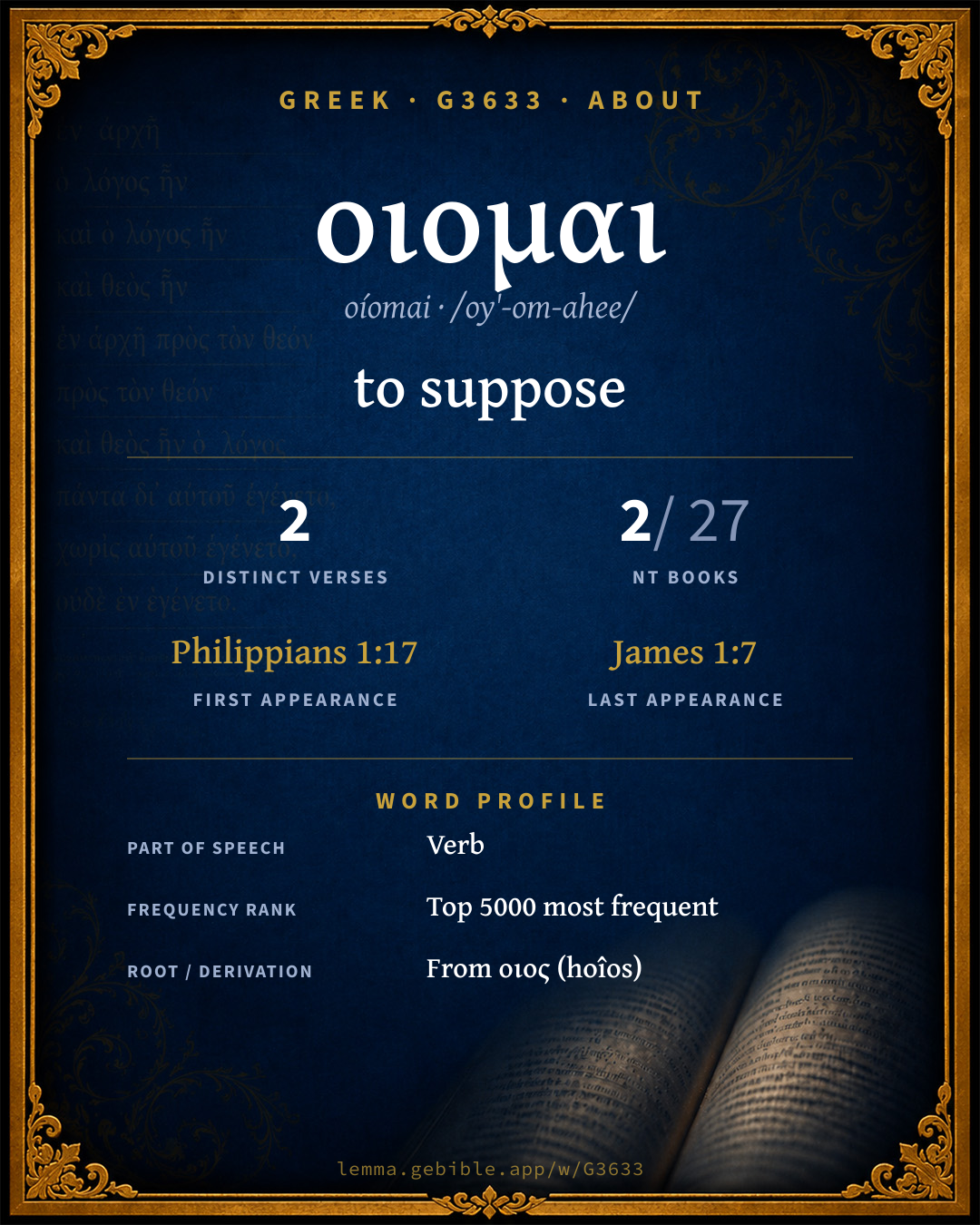
οιομαι
to suppose
Full lexicon entry — Thayer's Greek Lexicon
From Thayer's Greek Lexicon
Where this word appears
Grammar key — what these labels mean
Part of speech
- Verb
- An action or state-of-being word.
Tense
- Present
- Ongoing or general action in present time (imperfective aspect).
Voice
- Middle or Passive deponent
- Middle/passive in form but active in meaning.
Mood
- Imperative
- Expresses a command or request.
- Participle
- A verbal adjective (“writing,” “having written”).
Case
- Nominative
- The case of the subject (and the predicate nominative).
Person
- 3rd person
- The one spoken about (“he / she / it / they”).
Gender
- Masculine
- Grammatically masculine.
Number
- Singular
- One.
- Plural
- More than one.
Grammatical forms
- Verb, Present, Middle or Passive deponent, Imperative, 3rd person, Singular 1 time (50%)
- Verb, Present, Middle or Passive deponent, Participle, Nominative, Plural, Masculine 1 time (50%)
Parsed forms decoded from the imported morphology (Robinson–Tischendorf, public domain), counted across 2 parsed occurrences — not distinct verses.
Every verse where G3633 appears — 2 distinct verses across 2 books. Click any verse to open its interlinear word-by-word view. Verse text shown in the World English Bible for context — . Each verse’s Greek form is shown with its reference; the English is not keyword-highlighted, since the data carries no word-level English alignment. Use “Compare translations” on any verse to read it across multiple English versions. This concordance covers the Greek New Testament; Septuagint (Greek Old Testament) occurrences of this word are not indexed here.
Philippians 1 verse
James 1 verse
About this entry
At a glance — auto-summarized from this page’s data, not written by a person. Every figure links to its source below. This summary describes the numbers; it doesn’t interpret them.
οιομαι (oíomai) is a Greek verb most often rendered “to suppose.” The Greek New Testament uses it only 2 verses. Philippians dominates its distribution — 1 of 2 verses. It first appears in Philippians 1:17. The sections below give every sense, occurrence, and version rendering.
Gloss history
Strong's 1890 vs modern scholarship
About this word
Strong's G3633 catalogs a Greek word from the Greek New Testament.
These counts are not copied from any lexicon or concordance. They are computed here, from the morphology-tagged Greek New Testament. What Lemma adds →
- 2
- distinct verses
- The word appears in 2 distinct verses.
- 2 / 27
- NT books
- The word appears in 2 of 27 New Testament books.
- #2,678
- by frequency
- Top 5000 most frequent Greek words (rank 2,678 of 5,347 Greek words by occurrence).
View all 2 occurrences in the concordance →
Most concentrated in
- Philippians 1 verse 50%
- James 1 verse 50%
By section of the New Testament
By traditional corpus
Conventional, traditional groupings — biblical authorship is debated, so this is a traditional corpus grouping, not an authorship claim. Some books belong to more than one corpus (Luke is in both the Gospels and the Lukan corpus, and so on), so these shares overlap and need not total 100%. Each figure is a share of the word’s 2 distinct verses.
- Pauline corpus 1 verse · 50%
- General (Catholic) Epistles 1 verse · 50%
How translations render this word
Counts come from each version’s own published word-to-Strong’s tagging or interlinear alignment — an approximate guide to how each version renders this word, not a word-level alignment the data otherwise carries. Because each total is that version’s own tagged count, the per-version totals vary from one another and need not match the appearance or distinct-verse counts above. These counts may also differ from a printed concordance because Lemma counts each distinctly tagged rendering and does not collapse phrase taggings into a single head-word total. This is a fixed set of word-tagged versions (KJV, ASV, BSB, ULT) and does not change with the reading translation you choose elsewhere. Each version’s license is shown beside its name below (and on Sources).
- King James Version: I suppose 1×, Let 1×, Supposing 1×
- American Standard Version: I suppose that 1×, Think 1×, Thinking 1×
- Berean Standard Bible: Expect 1×, I suppose that 1×, Supposing that 1×
- unfoldingWord Literal Text: I imagine 1×, Let 1×, Supposing 1×
King James Version Public Domain
Renders G3633 across 4 tagged occurrences — most commonly:
American Standard Version Public Domain
Renders G3633 across 3 tagged occurrences — most commonly:
Berean Standard Bible Public Domain
Renders G3633 across 3 tagged occurrences — most commonly:
unfoldingWord Literal Text CC BY-SA 4.0
Renders G3633 across 4 tagged occurrences — most commonly:
Senses in Thayer's
The 1 sense Thayer's distinguishes for this word, in lexicon order (not ranked by frequency or importance). The full entry — with sub-senses — is in the Lexicon Entry tab.
- to suppose, think
Word origin
Derived from οιος (hoîos) (G3634) — what sort of.
Middle voice apparently from G3634 ; to make like (oneself) that is imagine ( be of the opinion ): - suppose think.
— Strong’s Exhaustive Concordance (1890), public domain.
Forms in the corpus
The 2 distinct written forms G3633 takes in the Greek New Testament, most frequent first — each parse links to that tense’s occurrences in the concordance.
| Form | Parsing | Example | Uses |
|---|---|---|---|
| οἰέσθω oiésthō | Verb, Present, Middle or Passive deponent, Imperative, 3rd person, Singular | James 1:7 | 1 |
| οἰόμενοι oiómenoi | Verb, Present, Middle or Passive deponent, Participle, Nominative, Plural, Masculine | Philippians 1:17 | 1 |
Septuagint usage
The same Greek word οιομαι appears 13 times in the Greek Old Testament (Septuagint), across 13 verses in 5 books.
- 13
- LXX occurrences
- Tagged occurrences of this Greek word in the Septuagint.
- 13
- verses
- Distinct Septuagint verses containing this word.
- 5 / 39
- OT books
- The word appears in 5 of the 39 Old Testament books.
Sample Septuagint occurrences
- Genesis 37:7 οἴομαι
- Esther 9:12 οἴομαι
- Job 11:2 οἴομαι
- Isaiah 57:8 οἴομαι
- Daniel 2:11 οἴομαι
Septuagint occurrences (same lexeme)
Every verse where the same Strong’s number (G3633) appears in the Greek Septuagint. Verse text shown in the World English Bible for context; the Greek form is the matched word — the English is not keyword-highlighted.
- Genesis 37:7 οἴομαι for, behold, we were binding sheaves in the field, and behold, my sheaf arose and also stood upright; and behold, your sheaves came around, and bowed down to my sheaf."
- Genesis 40:16 οἴομαι When the chief baker saw that the interpretation was good, he said to Joseph, "I also was in my dream, and, behold, three baskets of white bread were on my head.
- Genesis 41:1 οἴομαι It happened at the end of two full years, that Pharaoh dreamed: and, behold, he stood by the river.
- Genesis 41:17 οἴομαι Pharaoh spoke to Joseph, "In my dream, behold, I stood on the brink of the river:
- Esther 9:12 οἴομαι The king said to Esther the queen, The Jews have slain and destroyed five hundred men in Shushan the palace, and the ten sons of Haman; what then have they done in the rest of the king's provinces! Now what is your petition? and it shall be granted you: or what is your request further? and it shall be done.
- Job 11:2 οἴομαι "Shouldn't the multitude of words be answered? Should a man full of talk be justified?
- Job 34:12 οἴομαι Yes surely, God will not do wickedly, Neither will the Almighty pervert justice.
- Job 37:23 οἴομαι We can't reach the Almighty, He is exalted in power; In justice and great righteousness he will not oppress.
- Job 38:2 οἴομαι "Who is this who darkens counsel By words without knowledge?
- Job 40:8 οἴομαι Will you even annul my judgment? Will you condemn me, that you may be justified?
- Job 42:3 οἴομαι You asked, 'Who is this who hides counsel without knowledge?' Therefore I have uttered that which I did not understand, Things too wonderful for me, which I didn't know.
- Isaiah 57:8 οἴομαι Behind the doors and the posts have you set up your memorial: for you have uncovered [yourself] to another than me, and are gone up; you have enlarged your bed, and made you a covenant with them: you loved their bed where you saw it.
- Daniel 2:11 οἴομαι It is a rare thing that the king requires, and there is no other who can show it before the king, except the gods, whose dwelling is not with flesh.
These are occurrences of the same Greek lexeme (G3633) in the Septuagint — not a translation of any one Hebrew word. The store carries no word-level Hebrew↔Greek alignment, so no Hebrew original is asserted here. Counts come from the recovered LXX Strong's tagging — high-frequency vocabulary is well covered, while rare or late forms may be untagged — so they reflect tagged occurrences and may slightly undercount.