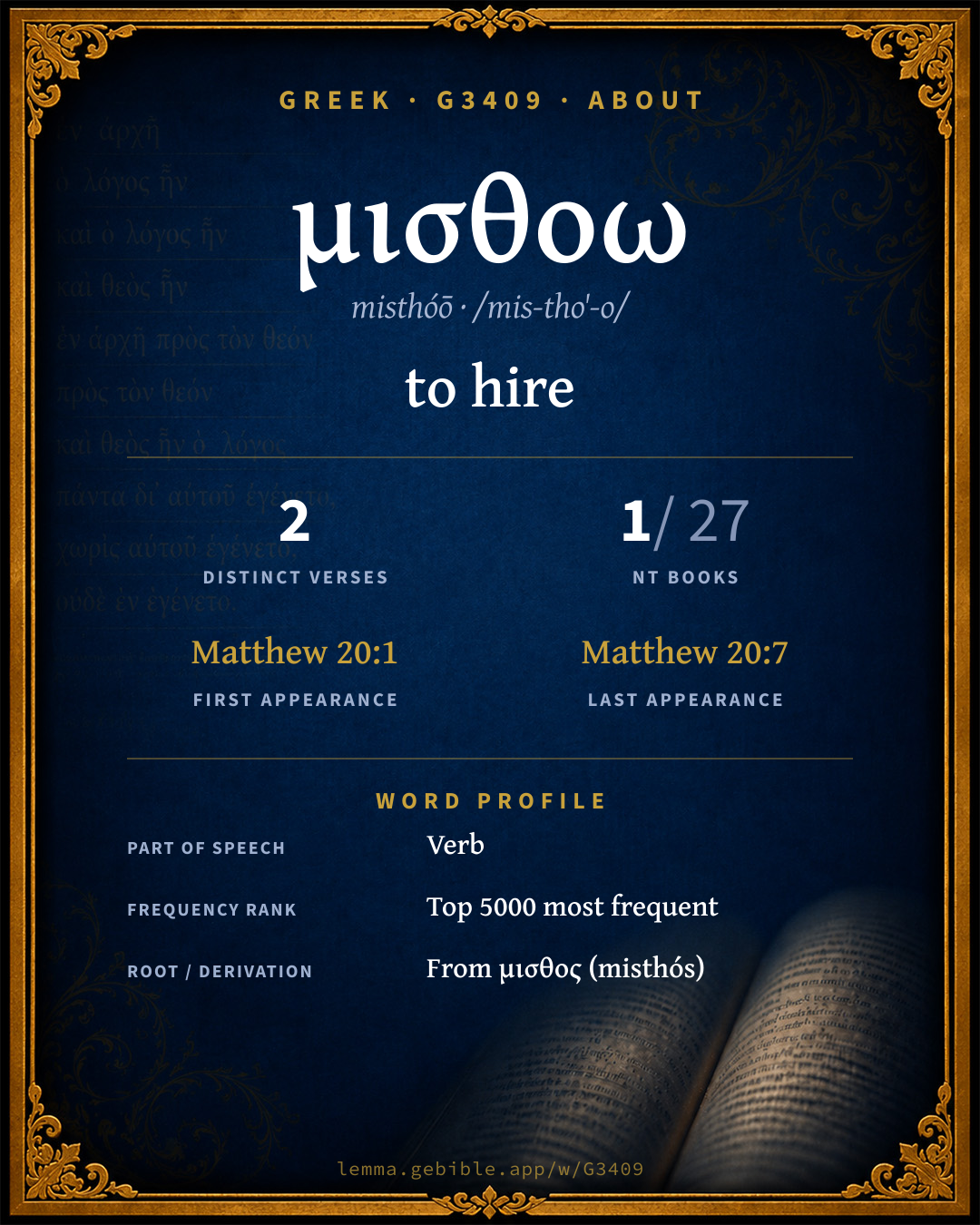
μισθόω
to hire
‘to hire’ is one of 2 main senses fuller range ↓
Full lexicon entry — Thayer's Greek Lexicon
From Thayer's Greek Lexicon
Where this word appears
Grammar key — what these labels mean
Part of speech
- Verb
- An action or state-of-being word.
Tense
- Aorist
- Action viewed as a simple whole, without regard to duration — often past (perfective aspect).
Voice
- Middle
- The subject acts on or for itself, or with special interest in the action.
Mood
- Indicative
- States a fact or asks a factual question (the mood of reality).
- Infinitive
- A verbal noun (“to write”), unmarked for person or number.
Person
- 3rd person
- The one spoken about (“he / she / it / they”).
Number
- Singular
- One.
Grammatical forms
- Verb, Aorist, Middle, Indicative, 3rd person, Singular 1 time (50%)
- Verb, Aorist, Middle, Infinitive 1 time (50%)
Parsed forms decoded from the imported morphology (Robinson–Tischendorf, public domain), counted across 2 parsed occurrences — not distinct verses.
Every verse where G3409 appears — 2 distinct verses across 1 book. Click any verse to open its interlinear word-by-word view. Verse text shown in the World English Bible for context — . Each verse’s Greek form is shown with its reference; the English is not keyword-highlighted, since the data carries no word-level English alignment. Use “Compare translations” on any verse to read it across multiple English versions. This concordance covers the Greek New Testament; Septuagint (Greek Old Testament) occurrences of this word are not indexed here.
Matthew 2 verses
- Matthew 20:1 μισθώσασθαι aor mid inf "For the Kingdom of Heaven is like a man who was the master of a household, who went out early in the morning to hire laborers for his vineyard.
- Matthew 20:7 ἐμισθώσατο aor mid ind 3sg "They said to him, 'Because no one has hired us.' "He said to them, 'You also go into the vineyard, and you will receive whatever is right.'
About this entry
At a glance — auto-summarized from this page’s data, not written by a person. Every figure links to its source below. This summary describes the numbers; it doesn’t interpret them.
At its core, μισθοω (misthóō) means “to hire.” It is rare — just 2 verses in the entire Greek New Testament. Its uses cluster heavily in Matthew (100% of all occurrences). Scripture first uses it in Matthew 20:1. Ranging over 2 senses, it is not a single-sense word. Each statement above links to its evidence; the full detail follows below.
Gloss history
Strong's 1890 vs modern scholarship
About this word
Strong's G3409 catalogs a Greek word from the Greek New Testament.
These counts are not copied from any lexicon or concordance. They are computed here, from the morphology-tagged Greek New Testament. What Lemma adds →
- 2
- distinct verses
- The word appears in 2 distinct verses.
- 1 / 27
- NT books
- The word appears in 1 of 27 New Testament books.
- #2,678
- by frequency
- Top 5000 most frequent Greek words (rank 2,678 of 5,347 Greek words by occurrence).
View all 2 occurrences in the concordance →
Most concentrated in
- Matthew 2 verses 100%
By section of the New Testament
By traditional corpus
Conventional, traditional groupings — biblical authorship is debated, so this is a traditional corpus grouping, not an authorship claim. Some books belong to more than one corpus (Luke is in both the Gospels and the Lukan corpus, and so on), so these shares overlap and need not total 100%. Each figure is a share of the word’s 2 distinct verses.
- Gospels 2 verses · 100%
How translations render this word
Counts come from each version’s own published word-to-Strong’s tagging or interlinear alignment — an approximate guide to how each version renders this word, not a word-level alignment the data otherwise carries. Because each total is that version’s own tagged count, the per-version totals vary from one another and need not match the appearance or distinct-verse counts above. These counts may also differ from a printed concordance because Lemma counts each distinctly tagged rendering and does not collapse phrase taggings into a single head-word total. This is a fixed set of word-tagged versions (KJV, ASV, BSB, ULT) and does not change with the reading translation you choose elsewhere. Each version’s license is shown beside its name below (and on Sources).
- King James Version: Hath hired 1×, Hire 1×
- American Standard Version: Hath hired 1×, Hire 1×
- Berean Standard Bible: Has hired 1×, Hire 1×
- unfoldingWord Literal Text: Hire 1×, Hired 1×
King James Version Public Domain
Renders G3409 across 2 tagged occurrences — most commonly:
American Standard Version Public Domain
Renders G3409 across 2 tagged occurrences — most commonly:
Berean Standard Bible Public Domain
Renders G3409 across 2 tagged occurrences — most commonly:
unfoldingWord Literal Text CC BY-SA 4.0
Renders G3409 across 2 tagged occurrences — most commonly:
Senses in Thayer's
The 2 senses Thayer's distinguishes for this word, in lexicon order (not ranked by frequency or importance). The full entry — with sub-senses — is in the Lexicon Entry tab.
- to let out for hire
- to hire
Word origin
Derived from μισθος (misthós) (G3408) — wages.
From G3408 ; to let out for wages that is (middle voice) to hire : - hire.
— Strong’s Exhaustive Concordance (1890), public domain.
Forms in the corpus
The 2 distinct written forms G3409 takes in the Greek New Testament, most frequent first — each parse links to that tense’s occurrences in the concordance.
| Form | Parsing | Example | Uses |
|---|---|---|---|
| μισθώσασθαι misthṓsasthai | Verb, Aorist, Middle, Infinitive | Matthew 20:1 | 1 |
| ἐμισθώσατο emisthṓsato | Verb, Aorist, Middle, Indicative, 3rd person, Singular | Matthew 20:7 | 1 |
Same root — word family
Other Thayer's entries built from the same root as G3409, grouped by Strong’s listed origin. These share a root / origin per the lexicon — not necessarily a shared meaning. Each links to that word’s own entry.
Derives from
Shares the same root
Derived from this word
- μισθαποδοτης misthapodótēs G3406 rewarder
- μισθωμα místhōma G3410 rent
- μισθωτος misthōtós G3411 hireling
Compare all same-root words → Showing 4 of 6 — not the complete family. They share a root, not necessarily a meaning.
Septuagint usage
The same Greek word μισθοω appears 13 times in the Greek Old Testament (Septuagint), across 13 verses in 9 books.
- 13
- LXX occurrences
- Tagged occurrences of this Greek word in the Septuagint.
- 13
- verses
- Distinct Septuagint verses containing this word.
- 9 / 39
- OT books
- The word appears in 9 of the 39 Old Testament books.
Sample Septuagint occurrences
- Deuteronomy 23:5 μισθόω
- Judges 9:4 μισθόω
- 2 Samuel 10:6 μισθόω
- 2 Kings 7:6 μισθόω
- 1 Chronicles 19:6 μισθόω
- 2 Chronicles 25:6 μισθόω
- Ezra 4:5 μισθόω
- Isaiah 46:6 μισθόω
- Hosea 3:2 μισθόω
Septuagint occurrences (same lexeme)
Every verse where the same Strong’s number (G3409) appears in the Greek Septuagint. Verse text shown in the World English Bible for context; the Greek form is the matched word — the English is not keyword-highlighted.
- Deuteronomy 23:5 μισθόω Nevertheless Yahweh your God wouldn't listen to Balaam; but Yahweh your God turned the curse into a blessing to you, because Yahweh your God loved you.
- Judges 9:4 μισθόω They gave him seventy [pieces] of silver out of the house of Baal Berith, with which Abimelech hired vain and light fellows, who followed him.
- Judges 18:4 μισθόω He said to them, Thus and thus has Micah dealt with me, and he has hired me, and I am become his priest.
- 2 Samuel 10:6 μισθόω When the children of Ammon saw that they were become odious to David, the children of Ammon sent and hired the Syrians of Beth Rehob, and the Syrians of Zobah, twenty thousand footmen, and the king of Maacah with one thousand men, and the men of Tob twelve thousand men.
- 2 Kings 7:6 μισθόω For the Lord had made the host of the Syrians to hear a noise of chariots, and a noise of horses, even the noise of a great host: and they said one to another, Behold, the king of Israel has hired against us the kings of the Hittites, and the kings of the Egyptians, to come on us.
- 1 Chronicles 19:6 μισθόω When the children of Ammon saw that they had made themselves odious to David, Hanun and the children of Ammon sent one thousand talents of silver to hire them chariots and horsemen out of Mesopotamia, and out of Arammaacah, and out of Zobah.
- 1 Chronicles 19:7 μισθόω So they hired them thirty-two thousand chariots, and the king of Maacah and his people, who came and encamped before Medeba. The children of Ammon gathered themselves together from their cities, and came to battle.
- 2 Chronicles 25:6 μισθόω He hired also one hundred thousand mighty men of valor out of Israel for one hundred talents of silver.
- Ezra 4:5 μισθόω and hired counselors against them, to frustrate their purpose, all the days of Cyrus king of Persia, even until the reign of Darius king of Persia.
- Ezra 16:12 μισθόω
- Ezra 23:2 μισθόω
- Isaiah 46:6 μισθόω Some pour out gold from the bag, and weigh silver in the balance. They hire a goldsmith, and he makes it a god. They fall down--yes, they worship.
- Hosea 3:2 μισθόω So I bought her for myself for fifteen pieces of silver and a homer and a half of barley.
These are occurrences of the same Greek lexeme (G3409) in the Septuagint — not a translation of any one Hebrew word. The store carries no word-level Hebrew↔Greek alignment, so no Hebrew original is asserted here. Counts come from the recovered LXX Strong's tagging — high-frequency vocabulary is well covered, while rare or late forms may be untagged — so they reflect tagged occurrences and may slightly undercount.