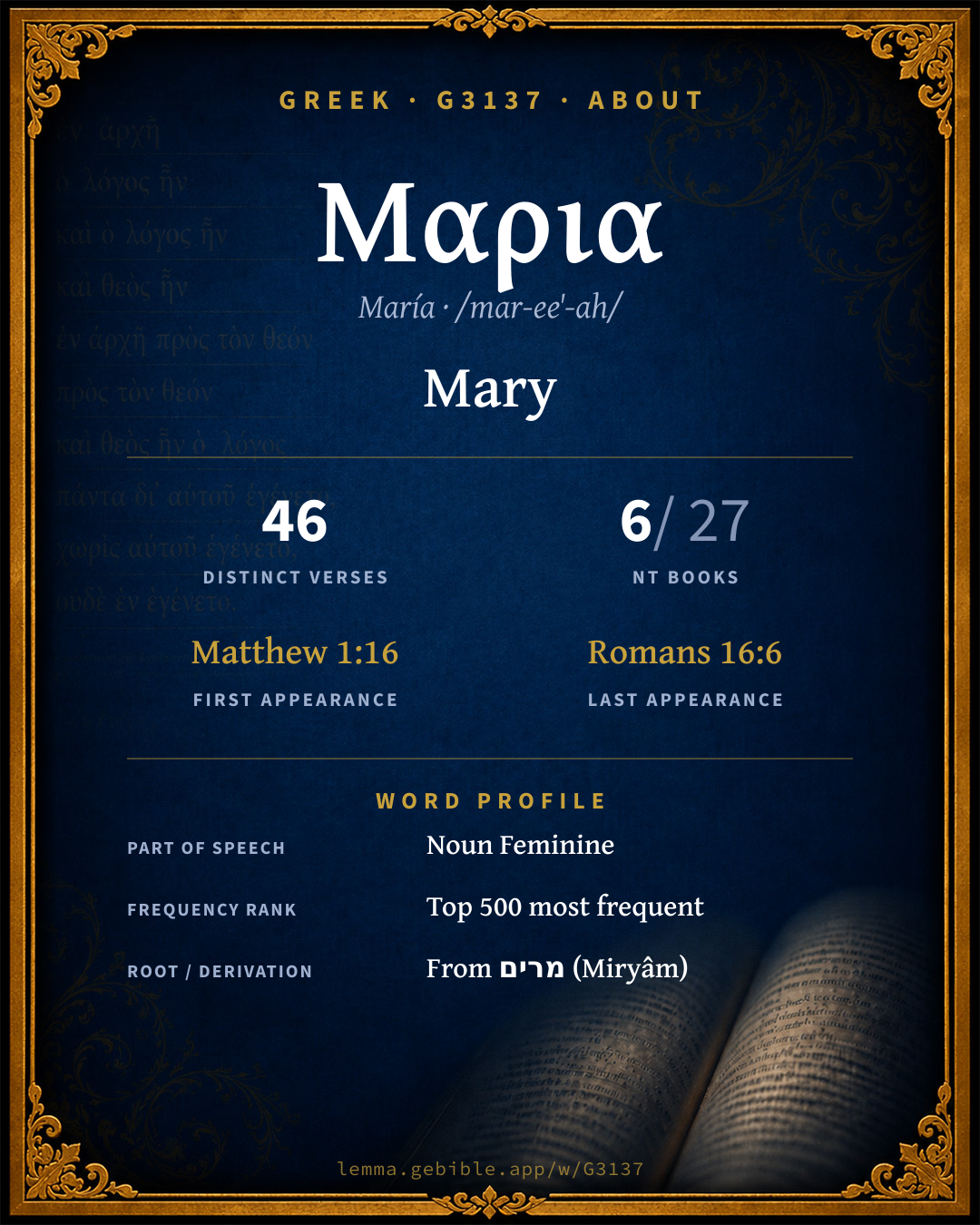
Μαρια
Mary
Thayer's lists 7 entries for ‘Mary’ fuller range ↓
Full lexicon entry — Thayer's Greek Lexicon
From Thayer's Greek Lexicon
Where this word appears
See every Nominative-case word in the Greek New Testament →
Grammar key — what these labels mean
Part of speech
- Noun
- A naming word — a person, place, thing, or idea.
Case
- Nominative
- The case of the subject (and the predicate nominative).
- Genitive
- The case of source, possession, or “of” — answers “whose / from what.”
- Accusative
- The case of the direct object and of extent.
- Dative
- The case of the indirect object, means, or location — “to / for / with / in.”
Gender
- Feminine
- Grammatically feminine.
Number
- Singular
- One.
Every verse where G3137 appears in the Book of Luke — 16 distinct verses. Click any verse to open its interlinear word-by-word view. Verse text shown in the World English Bible for context — . Each verse’s Greek form is shown with its reference; the English is not keyword-highlighted, since the data carries no word-level English alignment. Use “Compare translations” on any verse to read it across multiple English versions. This concordance covers the Greek New Testament; Septuagint (Greek Old Testament) occurrences of this word are not indexed here.
Luke
- Luke 1:27 Μαριάμ n proper indecl to a virgin pledged to be married to a man whose name was Joseph, of the house of David. The virgin's name was Mary.
- Luke 1:30 Μαριάμ n proper indecl The angel said to her, "Don't be afraid, Mary, for you have found favor with God.
- Luke 1:34 Μαριὰμ n proper indecl Mary said to the angel, "How can this be, seeing I am a virgin?"
- Luke 1:38 Μαριάμ n proper indecl Mary said, "Behold, the handmaid of the Lord; be it to me according to your word." The angel departed from her.
- Luke 1:39 Μαριὰμ n proper indecl Mary arose in those days and went into the hill country with haste, into a city of Judah,
- Luke 1:41 Μαρίας n gen sg fem It happened, when Elizabeth heard Mary's greeting, that the baby leaped in her womb, and Elizabeth was filled with the Holy Spirit.
- Luke 1:46 Μαριάμ n proper indecl Mary said, "My soul magnifies the Lord.
- Luke 1:56 Μαριὰμ n proper indecl Mary stayed with her about three months, and then returned to her house.
- Luke 2:5 Μαριὰμ n proper indecl to enroll himself with Mary, who was pledged to be married to him as wife, being pregnant.
- Luke 2:16 Μαριὰμ n proper indecl They came with haste, and found both Mary and Joseph, and the baby was lying in the feeding trough.
- Luke 2:19 Μαρία n nom sg fem But Mary kept all these sayings, pondering them in her heart.
- Luke 2:34 Μαριὰμ n proper indecl and Simeon blessed them, and said to Mary, his mother, "Behold, this child is set for the falling and the rising of many in Israel, and for a sign which is spoken against.
- Luke 8:2 Μαρία n nom sg fem and certain women who had been healed of evil spirits and infirmities: Mary who was called Magdalene, from whom seven demons had gone out;
- Luke 10:39 Μαριάμ n proper indecl She had a sister called Mary, who also sat at Jesus' feet, and heard his word.
- Luke 10:42 Μαρία n nom sg fem but one thing is needed. Mary has chosen the good part, which will not be taken away from her."
- Luke 24:10 Μαρία Μαρία n nom sg fem n nom sg fem Now they were Mary Magdalene, Joanna, and Mary the mother of James. The other women with them told these things to the apostles.
About this entry
At a glance — auto-summarized from this page’s data, not written by a person. Every figure links to its source below. This summary describes the numbers; it doesn’t interpret them.
Μαρια — transliterated María — is a Greek name carrying the sense “Mary.” It first appears in Matthew 1:16. With 46 verses in 6 books, it is a moderately common word in the Greek New Testament. Its uses concentrate in Luke (35% of all occurrences). See 46-verse concordance and the renderings breakdown below.
Gloss history
Strong's 1890 vs modern scholarship
About this word
Strong's G3137 catalogs a Greek word from the Greek New Testament.
These counts are not copied from any lexicon or concordance. They are computed here, from the morphology-tagged Greek New Testament. What Lemma adds →
- 46
- distinct verses
- The word appears in 46 distinct verses.
- 6 / 27
- NT books
- The word appears in 6 of 27 New Testament books.
- #295
- by frequency
- Top 500 most frequent Greek words (rank 295 of 5,347 Greek words by occurrence).
View all 46 occurrences in the concordance →
By section of the New Testament
By traditional corpus
Conventional, traditional groupings — biblical authorship is debated, so this is a traditional corpus grouping, not an authorship claim. Some books belong to more than one corpus (Luke is in both the Gospels and the Lukan corpus, and so on), so these shares overlap and need not total 100%. Each figure is a share of the word’s 46 distinct verses.
- Gospels 43 verses · 93%
- Lukan (Luke–Acts) 18 verses · 39%
- Johannine 14 verses · 30%
- Pauline corpus 1 verse · 2%
How translations render this word
Counts come from each version’s own published word-to-Strong’s tagging or interlinear alignment — an approximate guide to how each version renders this word, not a word-level alignment the data otherwise carries. Because each total is that version’s own tagged count, the per-version totals vary from one another and need not match the appearance or distinct-verse counts above. These counts may also differ from a printed concordance because Lemma counts each distinctly tagged rendering and does not collapse phrase taggings into a single head-word total. This is a fixed set of word-tagged versions (KJV, ASV, BSB, ULT) and does not change with the reading translation you choose elsewhere. Each version’s license is shown beside its name below (and on Sources).
- King James Version: Mary 53×
- American Standard Version: Mary 51×
- Berean Standard Bible: Mary 52×
- unfoldingWord Literal Text: Mary 52×
King James Version Public Domain
Renders G3137 across 54 tagged occurrences — most commonly:
Plus 1 rendering that appears only once — usually multi-word phrases or single function words the recovered tagging swept in, not distinct renderings.
American Standard Version Public Domain
Renders G3137 across 53 tagged occurrences — most commonly:
Plus 2 renderings that appear only once — usually multi-word phrases or single function words the recovered tagging swept in, not distinct renderings.
Berean Standard Bible Public Domain
Renders G3137 across 53 tagged occurrences — most commonly:
Plus 1 rendering that appears only once — usually multi-word phrases or single function words the recovered tagging swept in, not distinct renderings. Not rendered by a distinct English word in 1 further occurrence.
unfoldingWord Literal Text CC BY-SA 4.0
Renders G3137 across 54 tagged occurrences — most commonly:
Plus 2 renderings that appear only once — usually multi-word phrases or single function words the recovered tagging swept in, not distinct renderings.
7 senses in Thayer's, in lexicon order
The 7 senses Thayer's distinguishes for this word, in lexicon order (not ranked by frequency or importance). The full entry — with sub-senses — is in the Lexicon Entry tab.
- Mary or Miriam = "their rebellion"
- Mary the mother of Jesus
- Mary Magdalene, a women from Magdala
- Mary, the sister of Lazarus and Martha
- Mary of Cleophas the mother of James the less
- Mary the mother of John Mark, a sister of Barnabas
- Mary, a Roman Christian who is greeted by Paul in Rom. 16:6
Word origin
Derived from מרים (Miryâm) (H4813) — Miriam.
Of hebrew origin [ H4813 ]; Maria or Mariam (that is Mirjam ) the name of six Christian females : - Mary.
— Strong’s Exhaustive Concordance (1890), public domain.
Forms in the corpus
The 7 distinct written forms G3137 takes in the Greek New Testament, most frequent first — each parse links to that case’s occurrences in the concordance.
| Form | Parsing | Example | Uses |
|---|---|---|---|
| Μαρία María | Noun, Nominative, Singular, Feminine | Matthew 27:56 | 18 |
| Μαριὰμ Mariàm | Noun, Proper, indeclinable | Matthew 13:55 | 15 |
| Μαρίας Marías | Noun, Genitive, Singular, Feminine | Matthew 1:16 | 7 |
| Μαριάμ Mariám | Noun, Proper, indeclinable | Luke 1:27 | 7 |
| Μαρίαμ Maríam | Noun, Nominative, Singular, Feminine | John 19:25 | 5 |
| Μαρίᾳ María | Noun, Dative, Singular, Feminine | Mark 16:9 | 1 |
| Μαρὶαμ Marìam | Noun, Nominative, Singular, Feminine | John 20:11 | 1 |
Same root — word family
Other Thayer's entries built from the same root as G3137, grouped by Strong’s listed origin. These share a root / origin per the lexicon — not necessarily a shared meaning. Each links to that word’s own entry.
Derives from
Proper names from this root
People and places named from this root — a name, not an additional meaning of the word.
Compare all same-root words → 2 of the same-root words are proper names (people or places). They share a root, not necessarily a meaning.
Bible dictionary
Public-domain dictionary articles matched to this entry by name (Mary). A biblical name can be shared by more than one person or place, so an article may treat several.
Easton's Bible Dictionary · M. G. Easton, 1897
Hebrew Miriam. (1.) The wife of Joseph, the mother of Jesus, called the "Virgin Mary," though never so designated in Scripture (Matt. 2:11; Acts 1:14). Little is known of her personal history. Her genealogy is given in Luke 3. She was of the tribe of Judah and the lineage of David (Ps. 132:11; Luke 1:32). She was connected by marriage with Elisabeth, who was of the lineage of Aaron (Luke 1:36).
While she resided at Nazareth with her parents, before she became the wife of Joseph, the angel Gabriel announced to her that she was to be the mother of the promised Messiah (Luke 1:35). After this she went to visit her cousin Elisabeth, who was living with her husband Zacharias (probably at Juttah, Josh. 15:55; 21:16, in the neighbourhood of Maon), at a considerable distance, about 100 miles, from Nazareth. Immediately on entering the house she was saluted by Elisabeth as the mother of her Lord, and then forthwith gave utterance to her hymn of thanksgiving (Luke 1:46-56; comp. 1 Sam. 2:1-10). After three months Mary returned to Nazareth to her own home. Joseph was supernaturally made aware (Matt. 1:18-25) of her condition, and took her to his own home. Soon after this the decree of Augustus (Luke 2:1) required that they should proceed to Bethlehem (Micah 5:2), some 80 or 90 miles from Nazareth; and while they were there they found shelter in the inn or khan provided for strangers (Luke 2:6, 7). But as the inn was crowded, Mary had to retire to a place among the cattle, and there she brought forth her son, who was called Jesus (Matt. 1:21), because he was to save his people from their sins. This was followed by the presentation in the temple, the flight into Egypt, and their return in the following year and residence at Nazareth (Matt. 2). There for thirty years Mary, the wife of Joseph the carpenter, resides, filling her own humble sphere, and pondering over the strange things that had happened to her. During these years only one event in the history of Jesus is recorded, viz., his going up to Jerusalem when twelve years of age, and his being found among the doctors in the temple (Luke 2:41-52). Probably also during this period Joseph died, for he is not again mentioned.
After the commencement of our Lord's public ministry little notice is taken of Mary. She was present at the marriage in Cana. A year and a half after this we find her at Capernaum (Matt. 12:46, 48, 49), where Christ uttered the memorable words, "Who is my mother? and who are my brethren? And he stretched forth his hand toward his disciples, and said, Behold my mother and my brethren!" The next time we find her is at the cross along with her sister Mary, and Mary Magdalene, and Salome, and other women (John 19:26). From that hour John took her to his own abode. She was with the little company in the upper room after the Ascension (Acts 1:14). From this time she wholly disappears from public notice. The time and manner of her death are unknown.
(2.) Mary Magdalene, i.e., Mary of Magdala, a town on the western shore of the Lake of Tiberias. She is for the first time noticed in Luke 8:3 as one of the women who "ministered to Christ of their substance." Their motive was that of gratitude for deliverances he had wrought for them. Out of Mary were cast seven demons. Gratitude to her great Deliverer prompted her to become his follower. These women accompanied him also on his last journey to Jerusalem (Matt. 27:55; Mark 15:41; Luke 23:55). They stood near the cross. There Mary remained till all was over, and the body was taken down and laid in Joseph's tomb. Again, in the earliest dawn of the first day of the week she, with Salome and Mary the mother of James (Matt. 28:1; Mark 16:2), came to the sepulchre, bringing with them sweet spices, that they might anoint the body of Jesus. They found the sepulchre empty, but saw the "vision of angels" (Matt. 28:5). She hastens to tell Peter and John, who were probably living together at this time (John 20:1, 2), and again immediately returns to the sepulchre. There she lingers thoughtfully, weeping at the door of the tomb. The risen Lord appears to her, but at first she knows him not. His utterance of her name "Mary" recalls her to consciousness, and she utters the joyful, reverent cry, "Rabboni." She would fain cling to him, but he forbids her, saying, "Touch me not; for I am not yet ascended to my Father." This is the last record regarding Mary of Magdala, who now returned to Jerusalem. The idea that this Mary was "the woman who was a sinner," or that she was unchaste, is altogether groundless.
(3.) Mary the sister of Lazarus is brought to our notice in connection with the visits of our Lord to Bethany. She is contrasted with her sister Martha, who was "cumbered about many things" while Jesus was their guest, while Mary had chosen "the good part." Her character also appears in connection with the death of her brother (John 11:20, 31, 33). On the occasion of our Lord's last visit to Bethany, Mary brought "a pound of ointment of spikenard, very costly, and anointed the feet of Jesus" as he reclined at table in the house of one Simon, who had been a leper (Matt. 26:6; Mark 14:3; John 12:2, 3). This was an evidence of her overflowing love to the Lord. Nothing is known of her subsequent history. It would appear from this act of Mary's, and from the circumstance that they possessed a family vault (11:38), and that a large number of Jews from Jerusalem came to condole with them on the death of Lazarus (11:19), that this family at Bethany belonged to the wealthier class of the people. (See MARTHA.)
(4.) Mary the wife of Cleopas is mentioned (John 19:25) as standing at the cross in company with Mary of Magdala and Mary the mother of Jesus. By comparing Matt. 27:56 and Mark 15:40, we find that this Mary and "Mary the mother of James the little" are on and the same person, and that she was the sister of our Lord's mother. She was that "other Mary" who was present with Mary of Magdala at the burial of our Lord (Matt. 27:61; Mark 15:47); and she was one of those who went early in the morning of the first day of the week to anoint the body, and thus became one of the first witnesses of the resurrection (Matt. 28:1; Mark 16:1; Luke 24:1).
(5.) Mary the mother of John Mark was one of the earliest of our Lord's disciples. She was the sister of Barnabas (Col. 4:10), and joined with him in disposing of their land and giving the proceeds of the sale into the treasury of the Church (Acts 4:37; 12:12). Her house in Jerusalem was the common meeting-place for the disciples there.
(6.) A Christian at Rome who treated Paul with special kindness (Rom. 16:6).
Smith's Bible Dictionary · William Smith, 1863
a Roman Christian who is greeted by St. Paul in his Epistle to the Romans, ch. (Romans 16:6) as having toiled hard for him.
(a tear) of Cle'ophas. So in Authorized Version, but accurately "of Clopas," i.e. the wife of Clopas (or Alphaeus). She is brought before us for the first time on the day of the crucifixion, standing by the cross. (John 19:25) In the evening of the same day we find her sitting desolate at the tomb with Mary Magdalene, (Matthew 27:61; Mark 15:47) and at the dawn of Easter morning she was again there with sweet spices, which she had prepared on the Friday night, (Matthew 28:1; Mark 16:1; Luke 23:56) and was one of those who had "a vision of angels, which said that he was alive." (Luke 24:23) She had four sons and at least three daughters. The names of the daughters are unknown to us; those of the sons are, James, Joses, Jude and Simon, two of whom became enrolled among the twelve apostles [James The Less], and a third [Simon] may have succeeded his brother ill charge of the church of Jerusalem. By many she is thought to have been the sister of the Virgin Mary.
Hitchcock's Bible Names Dictionary · Roswell D. Hitchcock, 1869
same as Miriam
Classic public-domain reference works; full attribution on Sources.