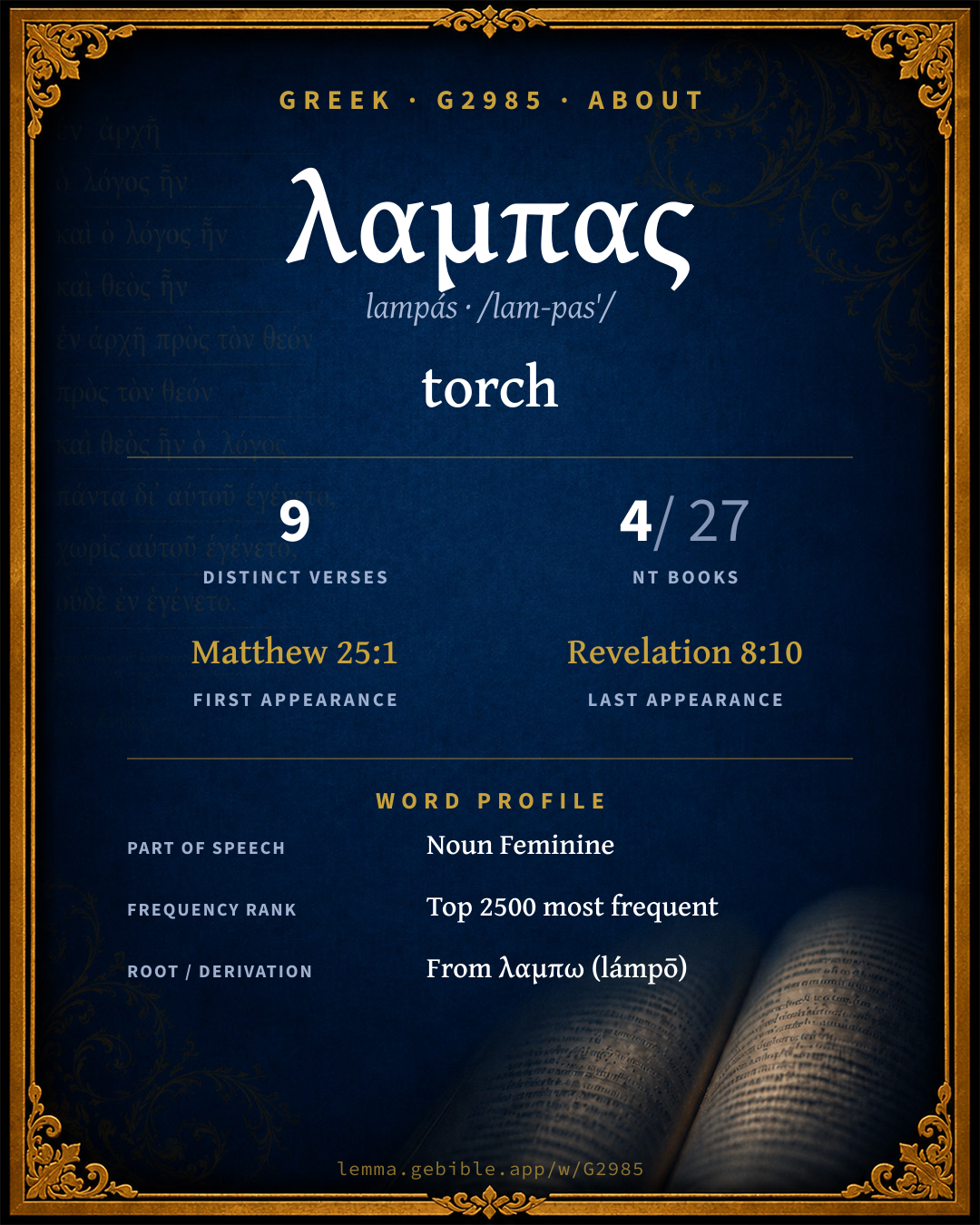
λαμπάς
torch
‘torch’ is one of 2 main senses fuller range ↓
Full lexicon entry — Thayer's Greek Lexicon
From Thayer's Greek Lexicon
Where this word appears
See every Nominative-case word in the Greek New Testament →
Grammar key — what these labels mean
Part of speech
- Noun
- A naming word — a person, place, thing, or idea.
Case
- Accusative
- The case of the direct object and of extent.
- Nominative
- The case of the subject (and the predicate nominative).
- Genitive
- The case of source, possession, or “of” — answers “whose / from what.”
Gender
- Feminine
- Grammatically feminine.
Number
- Plural
- More than one.
- Singular
- One.
3 distinct verses where G2985 appears in the Accusative case, across 1 book. Filtered view — show all forms. Click any verse to open its interlinear word-by-word view. Verse text shown in the World English Bible for context — . Each verse’s Greek form is shown with its reference; the English is not keyword-highlighted, since the data carries no word-level English alignment. Use “Compare translations” on any verse to read it across multiple English versions. This concordance covers the Greek New Testament; Septuagint (Greek Old Testament) occurrences of this word are not indexed here.
Matthew 3 verses
- Matthew 25:1 λαμπάδας n acc pl fem "Then the Kingdom of Heaven will be like ten virgins, who took their lamps, and went out to meet the bridegroom.
- Matthew 25:3 λαμπάδας n acc pl fem Those who were foolish, when they took their lamps, took no oil with them,
- Matthew 25:7 λαμπάδας n acc pl fem Then all those virgins arose, and trimmed their lamps.
About this entry
At a glance — auto-summarized from this page’s data, not written by a person. Every figure links to its source below. This summary describes the numbers; it doesn’t interpret them.
“torch” is the headline sense of the Greek noun λαμπας (lampás). More than half of its appearances fall in Matthew. The Greek New Testament uses it across 9 verses — uncommon. First canonically at Matthew 25:1, it enters the text early. Catalogued under 2 senses, its meaning is not single-sense. The sections below give every sense, occurrence, and version rendering.
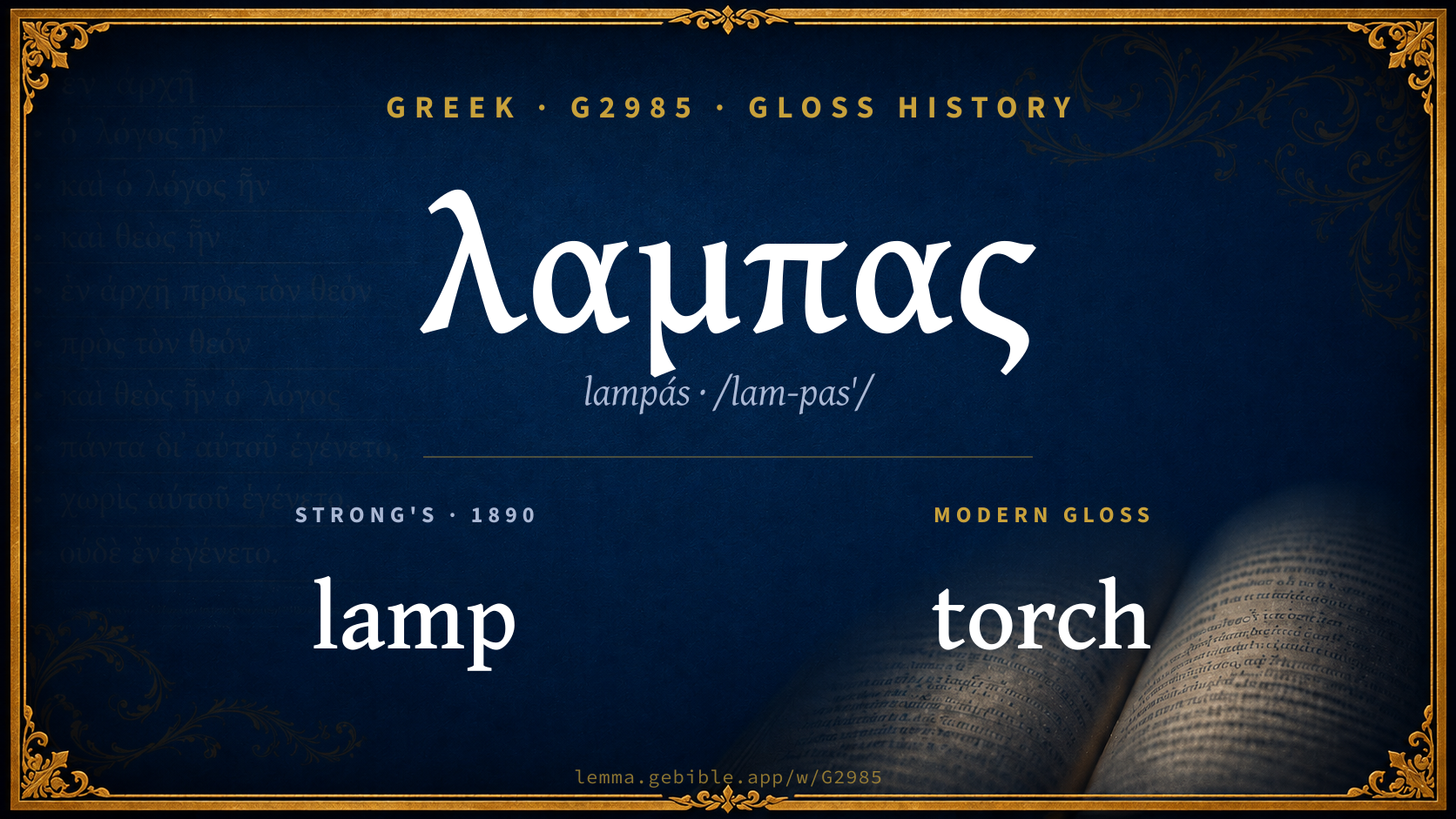
Gloss history
Strong's 1890 vs modern scholarship
About this word
Strong's G2985 catalogs a Greek word from the Greek New Testament.
These counts are not copied from any lexicon or concordance. They are computed here, from the morphology-tagged Greek New Testament. What Lemma adds →
- 9
- distinct verses
- The word appears in 9 distinct verses.
- 4 / 27
- NT books
- The word appears in 4 of 27 New Testament books.
- #1,140
- by frequency
- Top 2500 most frequent Greek words (rank 1,140 of 5,347 Greek words by occurrence).
View all 9 occurrences in the concordance →
Most concentrated in
- Matthew 5 verses 56%
- Revelation 2 verses 22%
- John 1 verse 11%
By section of the New Testament
By traditional corpus
Conventional, traditional groupings — biblical authorship is debated, so this is a traditional corpus grouping, not an authorship claim. Some books belong to more than one corpus (Luke is in both the Gospels and the Lukan corpus, and so on), so these shares overlap and need not total 100%. Each figure is a share of the word’s 9 distinct verses.
- Gospels 6 verses · 67%
- Johannine 3 verses · 33%
- Revelation 2 verses · 22%
- Lukan (Luke–Acts) 1 verse · 11%
How translations render this word
Counts come from each version’s own published word-to-Strong’s tagging or interlinear alignment — an approximate guide to how each version renders this word, not a word-level alignment the data otherwise carries. Because each total is that version’s own tagged count, the per-version totals vary from one another and need not match the appearance or distinct-verse counts above. These counts may also differ from a printed concordance because Lemma counts each distinctly tagged rendering and does not collapse phrase taggings into a single head-word total. This is a fixed set of word-tagged versions (KJV, ASV, BSB, ULT) and does not change with the reading translation you choose elsewhere. Each version’s license is shown beside its name below (and on Sources).
- King James Version: Lamps 6×
- American Standard Version: Lamps 6×
- Berean Standard Bible: Lamps 6×, Torches 2×
- unfoldingWord Literal Text: Lamps 7×
King James Version Public Domain
Renders G2985 across 9 tagged occurrences — most commonly:
Plus 3 renderings that appear only once — usually multi-word phrases or single function words the recovered tagging swept in, not distinct renderings.
American Standard Version Public Domain
Renders G2985 across 9 tagged occurrences — most commonly:
Plus 3 renderings that appear only once — usually multi-word phrases or single function words the recovered tagging swept in, not distinct renderings.
Berean Standard Bible Public Domain
Renders G2985 across 9 tagged occurrences — most commonly:
Plus 1 rendering that appears only once — usually multi-word phrases or single function words the recovered tagging swept in, not distinct renderings.
unfoldingWord Literal Text CC BY-SA 4.0
Renders G2985 across 9 tagged occurrences — most commonly:
Plus 2 renderings that appear only once — usually multi-word phrases or single function words the recovered tagging swept in, not distinct renderings.
Senses in Thayer's
The 2 senses Thayer's distinguishes for this word, in lexicon order (not ranked by frequency or importance). The full entry — with sub-senses — is in the Lexicon Entry tab.
- a torch
- a lamp, the flame of which is fed with oil
Word origin
Derived from λαμπω (lámpō) (G2989) — to shine.
From G2989 ; a lamp or flambeau : - lamp light torch.
— Strong’s Exhaustive Concordance (1890), public domain.
Forms in the corpus
The 4 distinct written forms G2985 takes in the Greek New Testament, most frequent first — each parse links to that case’s occurrences in the concordance.
| Form | Parsing | Example | Uses |
|---|---|---|---|
| λαμπάδας lampádas | Noun, Accusative, Plural, Feminine | Matthew 25:1 | 3 |
| λαμπάδες lampádes | Noun, Nominative, Plural, Feminine | Matthew 25:8 | 3 |
| λαμπάδων lampádōn | Noun, Genitive, Plural, Feminine | Matthew 25:4 | 2 |
| λαμπάς lampás | Noun, Nominative, Singular, Feminine | Revelation 8:10 | 1 |
Same root — word family
Other Thayer's entries built from the same root as G2985, grouped by Strong’s listed origin. These share a root / origin per the lexicon — not necessarily a shared meaning. Each links to that word’s own entry.
Derives from
Derived from this word
Compare all same-root words → They share a root, not necessarily a meaning.
Septuagint usage
The same Greek word λαμπας appears 13 times in the Greek Old Testament (Septuagint), across 12 verses in 9 books.
- 13
- LXX occurrences
- Tagged occurrences of this Greek word in the Septuagint.
- 12
- verses
- Distinct Septuagint verses containing this word.
- 9 / 39
- OT books
- The word appears in 9 of the 39 Old Testament books.
Sample Septuagint occurrences
- Genesis 15:17 λαμπάς
- Exodus 20:18 λαμπάς
- Judges 7:16 λαμπάς
- Job 41:11 λαμπάς
- Isaiah 62:1 λαμπάς
- Ezekiel 1:13 λαμπάς
- Daniel 10:6 λαμπάς
- Nahum 2:5 λαμπάς
- Zechariah 12:6 λαμπάς
Septuagint occurrences (same lexeme)
Every verse where the same Strong’s number (G2985) appears in the Greek Septuagint. Verse text shown in the World English Bible for context; the Greek form is the matched word — the English is not keyword-highlighted.
- Genesis 15:17 λαμπάς It came to pass that, when the sun went down, and it was dark, behold, a smoking furnace, and a flaming torch passed between these pieces.
- Exodus 20:18 λαμπάς All the people perceived the thunderings, the lightnings, the sound of the trumpet, and the mountain smoking. When the people saw it, they trembled, and stayed at a distance.
- Judges 7:16 λαμπάς He divided the three hundred men into three companies, and he put into the hands of all of them trumpets, and empty pitchers, with torches within the pitchers.
- Judges 7:20 λαμπάς The three companies blew the trumpets, and broke the pitchers, and held the torches in their left hands, and the trumpets in their right hands with which to blow; and they cried, The sword of Yahweh and of Gideon.
- Judges 15:4 λαμπάς Samson went and caught three hundred foxes, and took firebrands, and turned tail to tail, and put a firebrand in the midst between every two tails.
- Judges 15:5 λαμπάς When he had set the brands on fire, he let them go into the standing grain of the Philistines, and burnt up both the shocks and the standing grain, and also the olive groves.
- Job 41:11 λαμπάς Who has first given to me, that I should repay him? Everything under the heavens is mine.
- Isaiah 62:1 λαμπάς For Zion's sake will I not hold my peace, and for Jerusalem's sake I will not rest, until her righteousness go forth as brightness, and her salvation as a lamp that burns.
- Ezekiel 1:13 λαμπάς As for the likeness of the living creatures, their appearance was like burning coals of fire, like the appearance of torches: [the fire] went up and down among the living creatures; and the fire was bright, and out of the fire went forth lightning.
- Daniel 10:6 λαμπάς his body also was like the beryl, and his face as the appearance of lightning, and his eyes as flaming torches, and his arms and his feet like burnished brass, and the voice of his words like the voice of a multitude.
- Nahum 2:5 λαμπάς He summons his picked troops. They stumble on their way. They dash to its wall, and the protective shield is put in place.
- Zechariah 12:6 λαμπάς In that day I will make the chieftains of Judah like a pan of fire among wood, and like a flaming torch among sheaves; and they will devour all the surrounding peoples, on the right hand and on the left; and Jerusalem will yet again dwell in their own place, even in Jerusalem.
These are occurrences of the same Greek lexeme (G2985) in the Septuagint — not a translation of any one Hebrew word. The store carries no word-level Hebrew↔Greek alignment, so no Hebrew original is asserted here. Counts come from the recovered LXX Strong's tagging — high-frequency vocabulary is well covered, while rare or late forms may be untagged — so they reflect tagged occurrences and may slightly undercount.