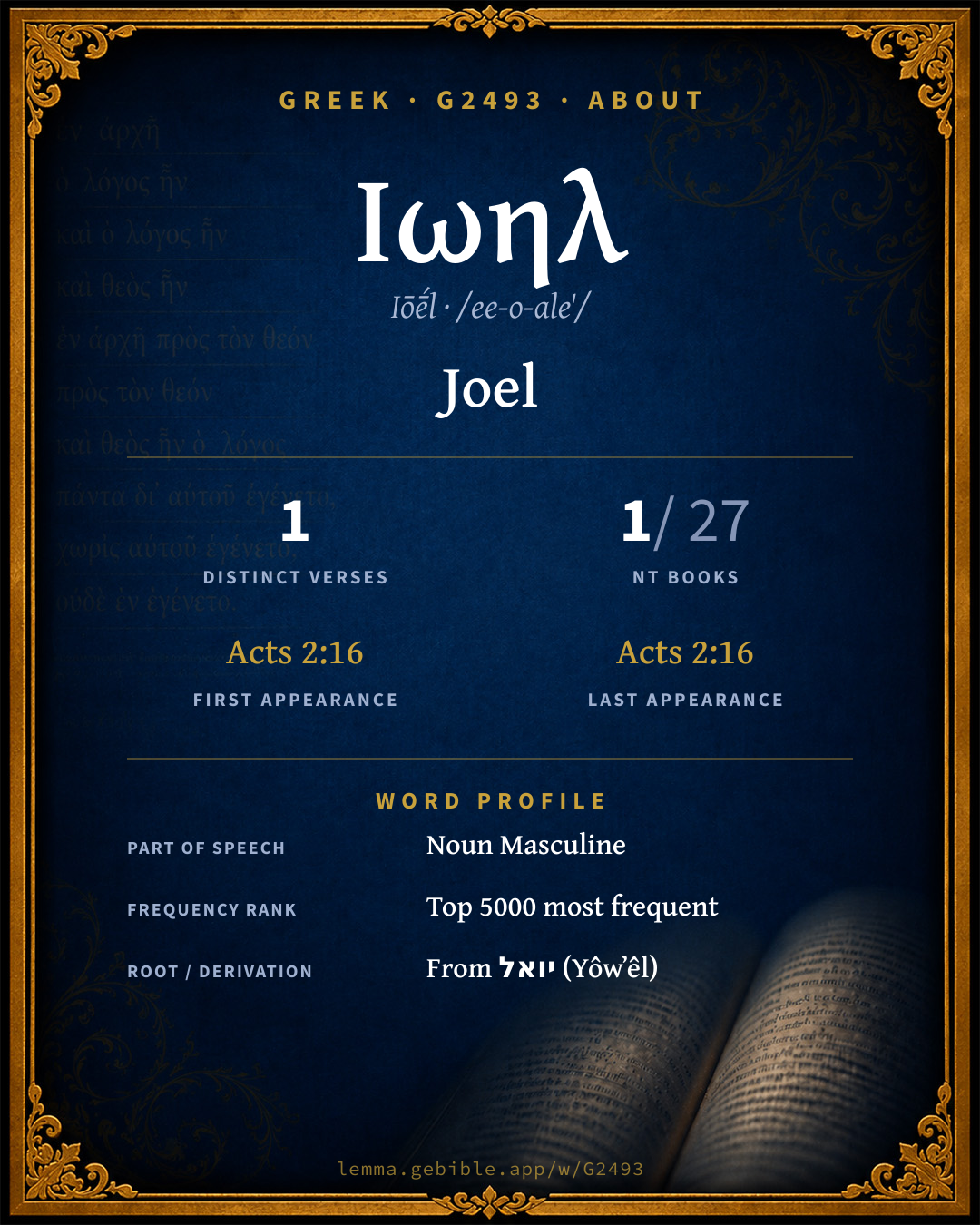
Ἰωήλ
Joel
Thayer's lists 2 entries for ‘Joel’ fuller range ↓
Full lexicon entry — Thayer's Greek Lexicon
From Thayer's Greek Lexicon
Where this word appears
Every verse where G2493 appears — 1 distinct verse across 1 book. Click any verse to open its interlinear word-by-word view. Verse text shown in the World English Bible for context — . Each verse’s Greek form is shown with its reference; the English is not keyword-highlighted, since the data carries no word-level English alignment. Use “Compare translations” on any verse to read it across multiple English versions. This concordance covers the Greek New Testament; Septuagint (Greek Old Testament) occurrences of this word are not indexed here.
Acts 1 verse
About this entry
At a glance — auto-summarized from this page’s data, not written by a person. Every figure links to its source below. This summary describes the numbers; it doesn’t interpret them.
The Greek name Ιωηλ centers on the idea of “Joel.” It is rare — just 1 verse in the entire Greek New Testament. Acts dominates its distribution — 1 of 1 verses. Found nowhere else but Acts 2:16. Dig into 1-verse concordance and the renderings breakdown below.
Gloss history
Strong's 1890 vs modern scholarship
About this word
Strong's G2493 catalogs a Greek word from the Greek New Testament.
These counts are not copied from any lexicon or concordance. They are computed here, from the morphology-tagged Greek New Testament. What Lemma adds →
- 1
- distinct verses
- The word appears in 1 distinct verse.
- 1 / 27
- NT books
- The word appears in 1 of 27 New Testament books.
- #3,503
- by frequency
- Top 5000 most frequent Greek words (rank 3,503 of 5,347 Greek words by occurrence).
View all 1 occurrence in the concordance →
Most concentrated in
- Acts 1 verse 100%
By section of the New Testament
By traditional corpus
Conventional, traditional groupings — biblical authorship is debated, so this is a traditional corpus grouping, not an authorship claim. Some books belong to more than one corpus (Luke is in both the Gospels and the Lukan corpus, and so on), so these shares overlap and need not total 100%. Each figure is a share of the word’s 1 distinct verse.
- Lukan (Luke–Acts) 1 verse · 100%
How translations render this word
Counts come from each version’s own published word-to-Strong’s tagging or interlinear alignment — an approximate guide to how each version renders this word, not a word-level alignment the data otherwise carries. Because each total is that version’s own tagged count, the per-version totals vary from one another and need not match the appearance or distinct-verse counts above. These counts may also differ from a printed concordance because Lemma counts each distinctly tagged rendering and does not collapse phrase taggings into a single head-word total. This is a fixed set of word-tagged versions (KJV, ASV, BSB, ULT) and does not change with the reading translation you choose elsewhere. Each version’s license is shown beside its name below (and on Sources).
- King James Version: Joel 1×
- American Standard Version: Joel 1×
- Berean Standard Bible: Joel 1×
- unfoldingWord Literal Text: Joel 1×
King James Version Public Domain
Renders G2493 across 1 tagged occurrence — most commonly:
American Standard Version Public Domain
Renders G2493 across 1 tagged occurrence — most commonly:
Berean Standard Bible Public Domain
Renders G2493 across 1 tagged occurrence — most commonly:
unfoldingWord Literal Text CC BY-SA 4.0
Renders G2493 across 1 tagged occurrence — most commonly:
Senses in Thayer's
The 2 senses Thayer's distinguishes for this word, in lexicon order (not ranked by frequency or importance). The full entry — with sub-senses — is in the Lexicon Entry tab.
- Joel = "to whom Jehovah is God"
- the second of the twelve minor prophets, the son of Pethuel, probably prophesied in Judah in the reign of Uzziah
Word origin
Derived from יואל (Yôwʼêl) (H3100) — Joel.
Of hebrew origin [ H3100 ]; Joel an Israelite : - Joel.
— Strong’s Exhaustive Concordance (1890), public domain.
Bible dictionary
Public-domain dictionary articles matched to this entry by name (Joel). A biblical name can be shared by more than one person or place, so an article may treat several.
Easton's Bible Dictionary · M. G. Easton, 1897
Jehovah is his God. (1.) The oldest of Samuel's two sons appointed by him as judges in Beersheba (1 Sam. 8:2). (See VASHNI.) (2.) A descendant of Reuben (1 Chr. 5:4, 8). (3.) One of David's famous warriors (1 Chr. 11:38). (4.) A Levite of the family of Gershom (1 Chr. 15:7, 11). (5.) 1 Chr. 7:3. (6.) 1 Chr. 27:20. (7.) The second of the twelve minor prophets. He was the son of Pethuel. His personal history is only known from his book.
Smith's Bible Dictionary · William Smith, 1863
(to whom Jehovah is God).
+ Eldest son of Samuel the prophet, (1 Samuel 8:2; 1 Chronicles 6:33; 15:17) and father of Heman the singer. (B.C. 1094.) + In (1 Chronicles 6:36) Authorized Version, Joel seems to be merely a corruption of Shaul in ver. 24. + A Simeonite chief. (1 Chronicles 4:35) + A descendant of Reuben. Junius and Tremellius make him the son of Hanoeh, while others trace his descent through Carmi. (1 Chronicles 5:4) (B.C. before 1092.) + Chief of the Gadites, who dwelt in the land of Bashan. (1 Chronicles 5:12) (B.C. 782.) + The son of Izrahiah, of the tribe of Issachar. (1 Chronicles 7:3) + The brother of Nathan of Zobah, (1 Chronicles 11:38) and one of David's guard. + The chief of the Gershomites in the reign of David. (1 Chronicles 15:7,11) + A Gershonite Levite in the reign of David, son of Jehiel, a descendant of Laadan, and probably the same as the preceding. (1 Chronicles 23:8; 26:22) (B.C. 1014.) + The son of Pedaiah, and a chief of the half-tribe of Manasseh west of Jordan, in the reign of David. (1 Chronicles 27:20) (B.C. 1014.) + A Kohathite Levite in the reign of Hezekiah. (2 Chronicles 29:12) (B.C. 726.) + One of the sons of Nebo, who returned with Ezra, and had married a foreign wife. (Ezra 10:43) (B.C. 459.) + The son of Zichri, a Benjamite. (Nehemiah 11:9) + The second of the twelve minor prophets, the son of Pethuel, probably prophesied in Judah in the reign of Uzziah, about B.C. 800. The book of Joel contains a grand outline of the whole terrible scene, which was to be depicted more and more in detail by subsequent prophets. The proximate event to which the prophecy related was a public calamity, then impending on Judah, of a two-plague of locusts--and continuing for several years. The prophet exhorts the people to turn to God with penitence, fasting and prayer; and then, he says, the plague shall cease, and the rain descendent in its season, and the land yield her accustomed fruit. Nay, the time will be a most joyful one; for God, by the outpouring of his Spirit, will extend the blessings of true religion to heathen lands. The prophecy is referred to in Acts 2.
Hitchcock's Bible Names Dictionary · Roswell D. Hitchcock, 1869
he that wills or commands
Classic public-domain reference works; full attribution on Sources.
Septuagint usage
The same Greek word Ιωηλ appears 23 times in the Greek Old Testament (Septuagint), across 23 verses in 5 books.
- 23
- LXX occurrences
- Tagged occurrences of this Greek word in the Septuagint.
- 23
- verses
- Distinct Septuagint verses containing this word.
- 5 / 39
- OT books
- The word appears in 5 of the 39 Old Testament books.
Sample Septuagint occurrences
- 1 Samuel 8:2 ιωηλ
- 1 Chronicles 3:22 ιωηλ
- 2 Chronicles 9:29 ιωηλ
- Ezra 10:43 ιωηλ
- Joel 1:1 ιωηλ
Septuagint occurrences (same lexeme)
Every verse where the same Strong’s number (G2493) appears in the Greek Septuagint. Verse text shown in the World English Bible for context; the Greek form is the matched word — the English is not keyword-highlighted.
- 1 Samuel 8:2 ιωηλ Now the name of his firstborn was Joel; and the name of his second, Abijah: they were judges in Beersheba.
- 1 Chronicles 3:22 ιωηλ The sons of Shecaniah: Shemaiah. The sons of Shemaiah: Hattush, and Igal, and Bariah, and Neariah, and Shaphat, six.
- 1 Chronicles 4:35 ιωηλ and Joel, and Jehu the son of Joshibiah, the son of Seraiah, the son of Asiel,
- 1 Chronicles 5:4 ιωηλ The sons of Joel: Shemaiah his son, Gog his son, Shimei his son,
- 1 Chronicles 5:7 ιωηλ His brothers by their families, when the genealogy of their generations was reckoned: the chief, Jeiel, and Zechariah,
- 1 Chronicles 5:8 ιωηλ and Bela the son of Azaz, the son of Shema, the son of Joel, who lived in Aroer, even to Nebo and Baal Meon:
- 1 Chronicles 5:12 ιωηλ Joel the chief, and Shapham the second, and Janai, and Shaphat in Bashan.
- 1 Chronicles 6:18 ιωηλ The sons of Kohath were Amram, and Izhar, and Hebron, and Uzziel.
- 1 Chronicles 6:21 ιωηλ Joah his son, Iddo his son, Zerah his son, Jeatherai his son.
- 1 Chronicles 7:3 ιωηλ The sons of Uzzi: Izrahiah. The sons of Izrahiah: Michael, and Obadiah, and Joel, Isshiah, five; all of them chief men.
- 1 Chronicles 11:38 ιωηλ Joel the brother of Nathan, Mibhar the son of Hagri,
- 1 Chronicles 12:3 ιωηλ The chief was Ahiezer; then Joash, the sons of Shemaah the Gibeathite, and Jeziel, and Pelet, the sons of Azmaveth, and Beracah, and Jehu the Anathothite,
- 1 Chronicles 15:7 ιωηλ of the sons of Gershom, Joel the chief, and his brothers one hundred thirty;
- 1 Chronicles 15:11 ιωηλ David called for Zadok and Abiathar the priests, and for the Levites, for Uriel, Asaiah, and Joel, Shemaiah, and Eliel, and Amminadab,
- 1 Chronicles 15:17 ιωηλ So the Levites appointed Heman the son of Joel; and of his brothers, Asaph the son of Berechiah; and of the sons of Merari their brothers, Ethan the son of Kushaiah;
- 1 Chronicles 23:8 ιωηλ The sons of Ladan: Jehiel the chief, and Zetham, and Joel, three.
- 1 Chronicles 26:22 ιωηλ The sons of Jehieli: Zetham, and Joel his brother, over the treasures of the house of Yahweh.
- 1 Chronicles 27:20 ιωηλ of the children of Ephraim, Hoshea the son of Azaziah: of the half-tribe of Manasseh, Joel the son of Pedaiah:
- 2 Chronicles 9:29 ιωηλ Now the rest of the acts of Solomon, first and last, aren't they written in the history of Nathan the prophet, and in the prophecy of Ahijah the Shilonite, and in the visions of Iddo the seer concerning Jeroboam the son of Nebat?
- 2 Chronicles 29:12 ιωηλ Then the Levites arose, Mahath, the son of Amasai, and Joel the son of Azariah, of the sons of the Kohathites; and of the sons of Merari, Kish the son of Abdi, and Azariah the son of Jehallelel; and of the Gershonites, Joah the son of Zimmah, and Eden the son of Joah;
- Ezra 10:43 ιωηλ Of the sons of Nebo: Jeiel, Mattithiah, Zabad, Zebina, Iddo, and Joel, Benaiah.
- Ezra 21:9 ιωηλ
- Joel 1:1 ιωηλ The Word of Yahweh that came to Joel, the son of Pethuel.
These are occurrences of the same Greek lexeme (G2493) in the Septuagint — not a translation of any one Hebrew word. The store carries no word-level Hebrew↔Greek alignment, so no Hebrew original is asserted here. Counts come from the recovered LXX Strong's tagging — high-frequency vocabulary is well covered, while rare or late forms may be untagged — so they reflect tagged occurrences and may slightly undercount.