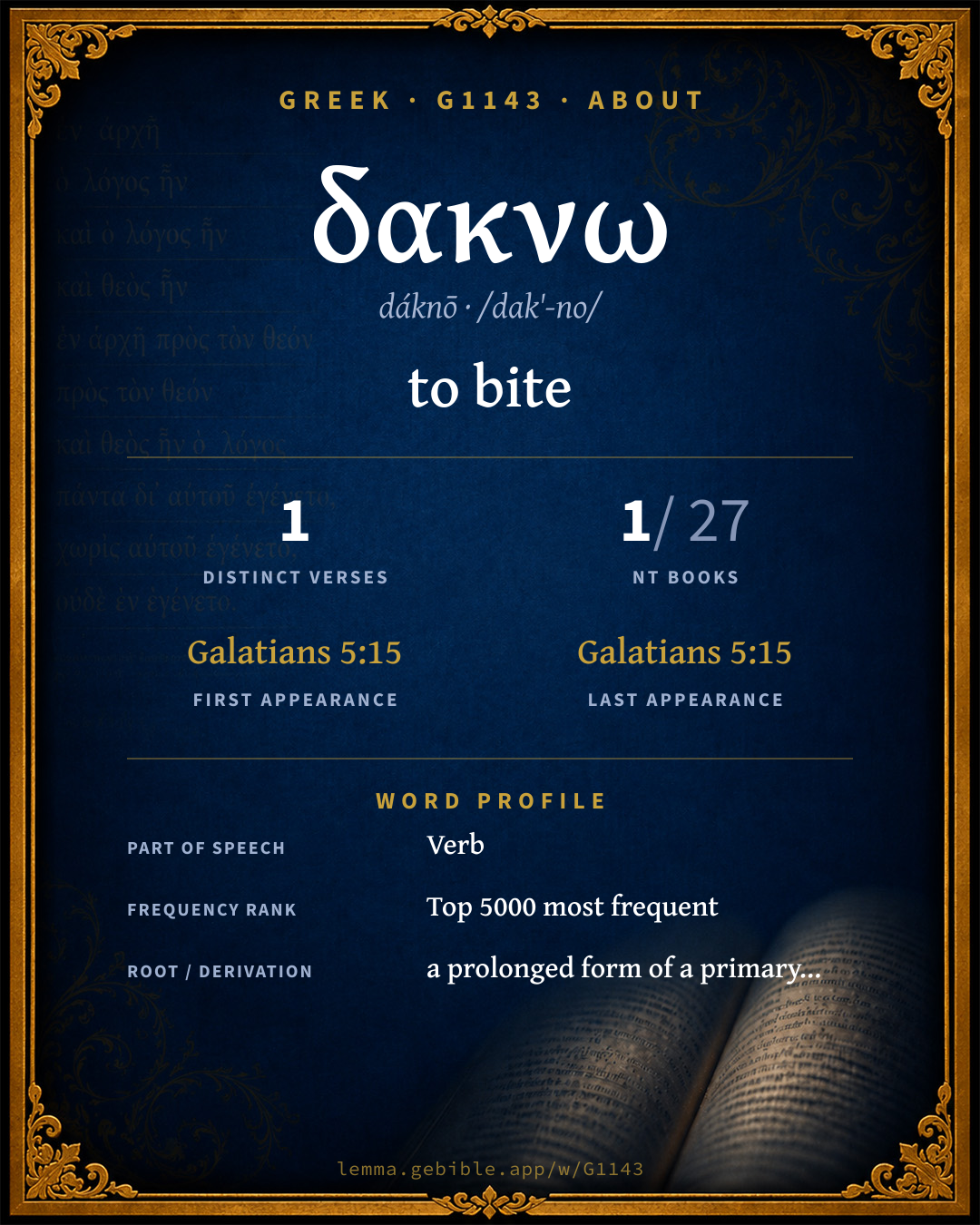
δάκνω
to bite
‘to bite’ is one of 2 main senses fuller range ↓
Full lexicon entry — Thayer's Greek Lexicon
From Thayer's Greek Lexicon
Where this word appears
Grammar key — what these labels mean
Part of speech
- Verb
- An action or state-of-being word.
Tense
- Present
- Ongoing or general action in present time (imperfective aspect).
Voice
- Active
- The subject performs the action.
Mood
- Indicative
- States a fact or asks a factual question (the mood of reality).
Person
- 2nd person
- The one addressed (“you”).
Number
- Plural
- More than one.
Every verse where G1143 appears — 1 distinct verse across 1 book. Click any verse to open its interlinear word-by-word view. Verse text shown in the World English Bible for context — . Each verse’s Greek form is shown with its reference; the English is not keyword-highlighted, since the data carries no word-level English alignment. Use “Compare translations” on any verse to read it across multiple English versions. This concordance covers the Greek New Testament; Septuagint (Greek Old Testament) occurrences of this word are not indexed here.
Galatians 1 verse
About this entry
At a glance — auto-summarized from this page’s data, not written by a person. Every figure links to its source below. This summary describes the numbers; it doesn’t interpret them.
At its core, δακνω (dáknō) means “to bite.” It is rare — just 1 verse in the entire Greek New Testament. Its uses cluster heavily in Galatians (100% of all occurrences). A true hapax — its single appearance is Galatians 5:15. Catalogued under 2 senses, its meaning is not single-sense. Dig into 1-verse concordance and the renderings breakdown below.
Gloss history
Strong's 1890 vs modern scholarship
About this word
Strong's G1143 catalogs a Greek word from the Greek New Testament.
These counts are not copied from any lexicon or concordance. They are computed here, from the morphology-tagged Greek New Testament. What Lemma adds →
- 1
- distinct verses
- The word appears in 1 distinct verse.
- 1 / 27
- NT books
- The word appears in 1 of 27 New Testament books.
- #3,503
- by frequency
- Top 5000 most frequent Greek words (rank 3,503 of 5,347 Greek words by occurrence).
View all 1 occurrence in the concordance →
Most concentrated in
- Galatians 1 verse 100%
By section of the New Testament
By traditional corpus
Conventional, traditional groupings — biblical authorship is debated, so this is a traditional corpus grouping, not an authorship claim. Some books belong to more than one corpus (Luke is in both the Gospels and the Lukan corpus, and so on), so these shares overlap and need not total 100%. Each figure is a share of the word’s 1 distinct verse.
- Pauline corpus 1 verse · 100%
How translations render this word
Counts come from each version’s own published word-to-Strong’s tagging or interlinear alignment — an approximate guide to how each version renders this word, not a word-level alignment the data otherwise carries. Because each total is that version’s own tagged count, the per-version totals vary from one another and need not match the appearance or distinct-verse counts above. These counts may also differ from a printed concordance because Lemma counts each distinctly tagged rendering and does not collapse phrase taggings into a single head-word total. This is a fixed set of word-tagged versions (KJV, ASV, BSB, ULT) and does not change with the reading translation you choose elsewhere. Each version’s license is shown beside its name below (and on Sources).
- King James Version: Ye bite 1×
- American Standard Version: Ye bite 1×
- Berean Standard Bible: You keep on biting 1×
- unfoldingWord Literal Text: You are biting 1×
King James Version Public Domain
Renders G1143 across 1 tagged occurrence — most commonly:
American Standard Version Public Domain
Renders G1143 across 1 tagged occurrence — most commonly:
Berean Standard Bible Public Domain
Renders G1143 across 1 tagged occurrence — most commonly:
unfoldingWord Literal Text CC BY-SA 4.0
Renders G1143 across 1 tagged occurrence — most commonly:
Senses in Thayer's
The 2 senses Thayer's distinguishes for this word, in lexicon order (not ranked by frequency or importance). The full entry — with sub-senses — is in the Lexicon Entry tab.
- to bite with the teeth
- metaph., to wound the soul, cut lacerate, rend with reproaches
Word origin
Origin: a prolonged form of a primary root
A prolonged form of a primary root; to bite that is (figuratively) thwart : - bite.
— Strong’s Exhaustive Concordance (1890), public domain.
Septuagint usage
The same Greek word δακνω appears 13 times in the Greek Old Testament (Septuagint), across 12 verses in 8 books.
- 13
- LXX occurrences
- Tagged occurrences of this Greek word in the Septuagint.
- 12
- verses
- Distinct Septuagint verses containing this word.
- 8 / 39
- OT books
- The word appears in 8 of the 39 Old Testament books.
Sample Septuagint occurrences
- Genesis 49:17 δάκνω
- Numbers 21:6 δάκνω
- Deuteronomy 8:15 δάκνω
- Ecclesiastes 10:8 δάκνω
- Jeremiah 8:17 δάκνω
- Amos 5:19 δάκνω
- Micah 3:5 δάκνω
- Habakkuk 2:7 δάκνω
Septuagint occurrences (same lexeme)
Every verse where the same Strong’s number (G1143) appears in the Greek Septuagint. Verse text shown in the World English Bible for context; the Greek form is the matched word — the English is not keyword-highlighted.
- Genesis 49:17 δάκνω Dan will be a serpent in the way, An adder in the path, That bites the horse's heels, So that his rider falls backward.
- Numbers 21:6 δάκνω Yahweh sent fiery serpents among the people, and they bit the people; and much people of Israel died.
- Numbers 21:8 δάκνω Yahweh said to Moses, Make you a fiery serpent, and set it on a standard: and it shall happen, that everyone who is bitten, when he sees it, shall live.
- Numbers 21:9 δάκνω Moses made a serpent of brass, and set it on the standard: and it happened, that if a serpent had bitten any man, when he looked to the serpent of brass, he lived.
- Deuteronomy 8:15 δάκνω who led you through the great and terrible wilderness, [in which were] fiery serpents and scorpions, and thirsty ground where was no water; who brought you forth water out of the rock of flint;
- Ecclesiastes 10:8 δάκνω He who digs a pit may fall into it; and whoever breaks through a wall may be bitten by a snake.
- Ecclesiastes 10:11 δάκνω If the snake bites before it is charmed, then is there no profit for the charmer's tongue.
- Jeremiah 8:17 δάκνω For, behold, I will send serpents, adders, among you, which will not be charmed; and they shall bite you, says Yahweh.
- Amos 5:19 δάκνω As if a man fled from a lion, And a bear met him; Or he went into the house and leaned his hand on the wall, And a snake bit him.
- Amos 9:3 δάκνω Though they hide themselves in the top of Carmel, I will search and take them out there; and though they be hid from my sight in the bottom of the sea, there I will command the serpent, and it will bite them.
- Micah 3:5 δάκνω Thus says Yahweh concerning the prophets who lead my people astray; for those who feed their teeth, they proclaim, "Peace!" and whoever doesn't provide for their mouths, they prepare war against him:
- Habakkuk 2:7 δάκνω Won't your debtors rise up suddenly, and wake up those who make you tremble, and you will be their victim?
These are occurrences of the same Greek lexeme (G1143) in the Septuagint — not a translation of any one Hebrew word. The store carries no word-level Hebrew↔Greek alignment, so no Hebrew original is asserted here. Counts come from the recovered LXX Strong's tagging — high-frequency vocabulary is well covered, while rare or late forms may be untagged — so they reflect tagged occurrences and may slightly undercount.