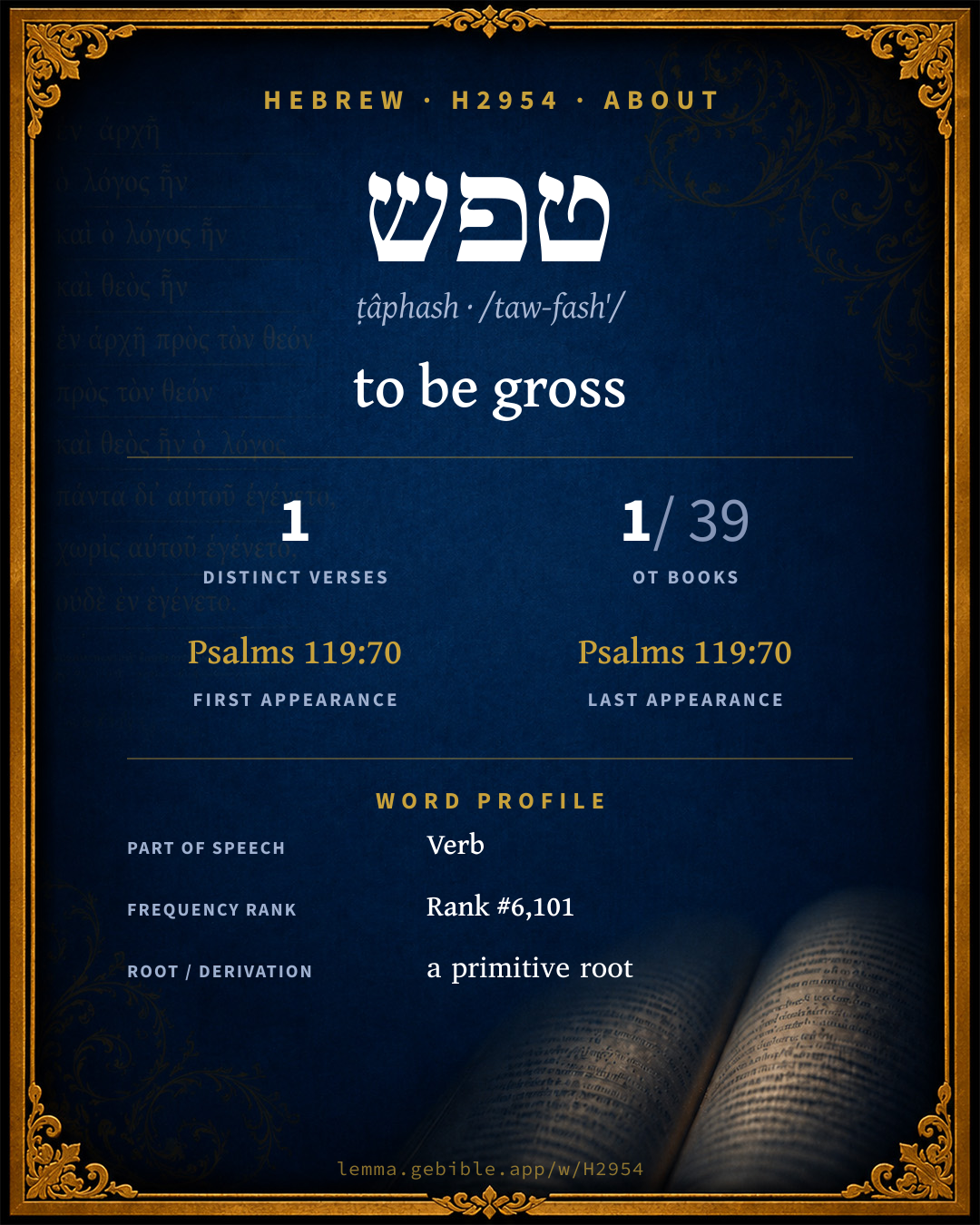
טָפַשׁ
to be gross
Full lexicon entry — Brown-Driver-Briggs (BDB)
From Brown-Driver-Briggs (BDB)
Where this word appears
Grammar key — what these labels mean
Part of speech
- Verb
- An action or state-of-being word.
Stem
- Qal
- The basic, simple active stem — the plain form of the verb (“he wrote”).
Form
- Perfect
- A completed action or state — Hebrew marks aspect (completeness) more than strict tense (“he wrote”).
Person
- 3rd Person
- The one spoken about (“he / she / it / they”).
Gender
- Masculine
- Grammatically masculine.
Number
- Singular
- One.
Every verse where H2954 appears — 1 distinct verse across 1 book. Click any verse to open its interlinear word-by-word view. Verse text shown in the World English Bible for context — . Each verse’s Hebrew form is shown with its reference; the English is not keyword-highlighted, since the data carries no word-level English alignment. Use “Compare translations” on any verse to read it across multiple English versions. This concordance covers the Hebrew Bible; Septuagint (Greek Old Testament) occurrences are not indexed here.
Psalms 1 verse
About this entry
At a glance — auto-summarized from this page’s data, not written by a person. Every figure links to its source below. This summary describes the numbers; it doesn’t interpret them.
טפש — transliterated ṭâphash — is a Hebrew verb carrying the sense “to be gross.” A scarce word — 1 verse in all of the Hebrew Bible. Its uses cluster heavily in Psalms (100% of all occurrences). Scripture uses it exactly once, at Psalms 119:70. See the sense tree, 1-verse concordance, and the renderings breakdown below.
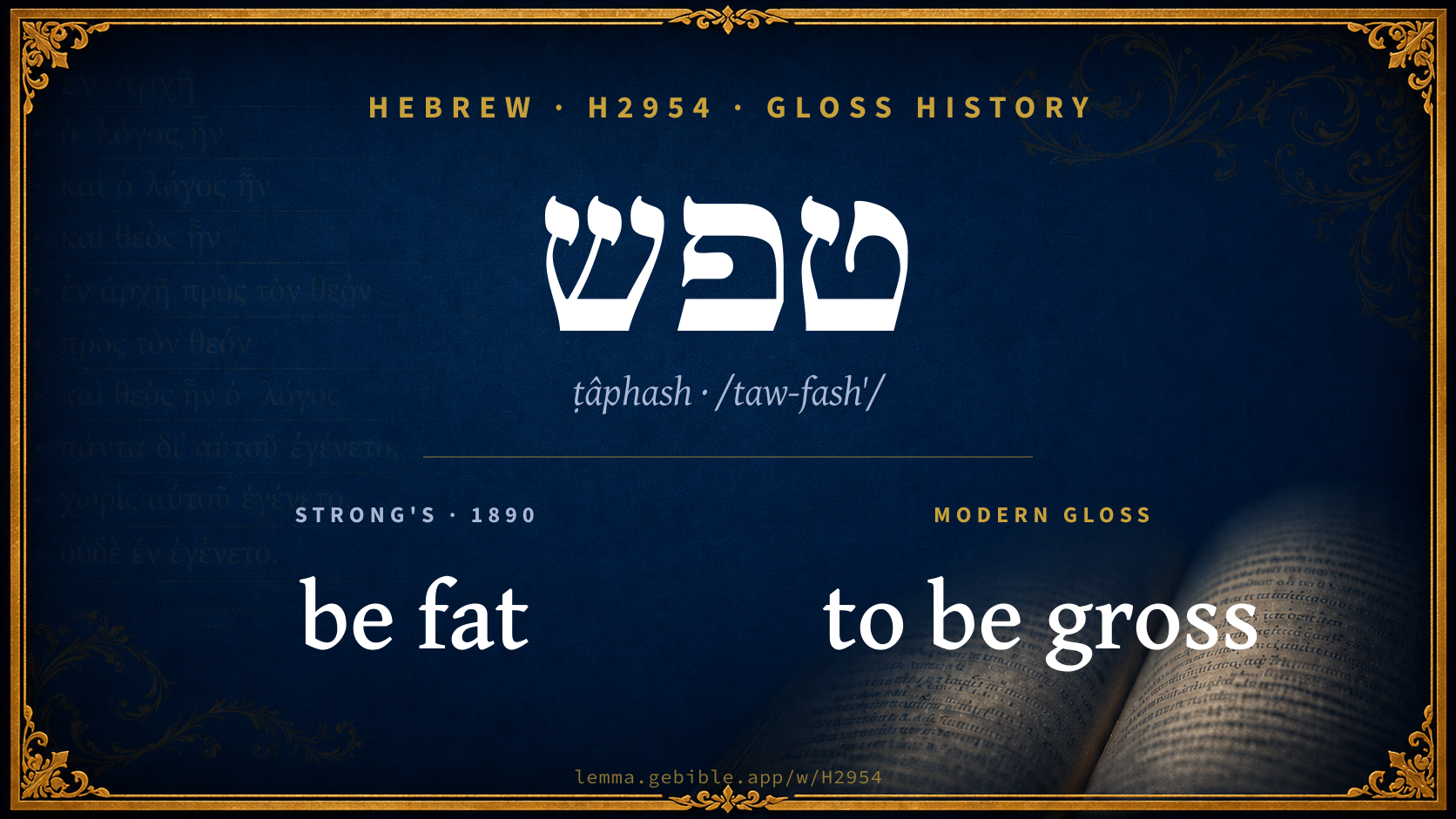
Gloss history
Strong's 1890 vs modern scholarship
About this word
Strong's H2954 catalogs a Hebrew word from the Hebrew Old Testament.
These counts are not copied from any lexicon or concordance. They are computed here, from the morphology-tagged Hebrew Old Testament. What Lemma adds →
- 1
- distinct verses
- The word appears in 1 distinct verse.
- 1 / 39
- OT books
- The word appears in 1 of 39 Old Testament books.
- #6,101
- by frequency
- Rank #6,101 (rank 6,101 of 8,640 Hebrew words by occurrence).
View all 1 occurrence in the concordance →
Most concentrated in
- Psalms 1 verse 100%
By section of the Old Testament
By traditional corpus
Conventional, traditional groupings — biblical authorship is debated, so this is a traditional corpus grouping, not an authorship claim. Each share is this word’s portion of its verses in that division of the Hebrew canon. Each figure is a share of the word’s 1 distinct verse.
- Writings (Ketuvim) 1 verse · 100%
How translations render this word
Counts come from each version’s own published word-to-Strong’s tagging or interlinear alignment — an approximate guide to how each version renders this word, not a word-level alignment the data otherwise carries. Because each total is that version’s own tagged count, the per-version totals vary from one another and need not match the appearance or distinct-verse counts above. These counts may also differ from a printed concordance because Lemma counts each distinctly tagged rendering and does not collapse phrase taggings into a single head-word total. This is a fixed set of word-tagged versions (KJV, ASV, BSB, ULT) and does not change with the reading translation you choose elsewhere. Each version’s license is shown beside its name below (and on Sources).
- King James Version: Is as fat 1×
- American Standard Version: Is as fat 1×
- Berean Standard Bible: Are callous 1×
- unfoldingWord Literal Text: Are unfeeling 1×
King James Version Public Domain
Renders H2954 across 1 tagged occurrence — most commonly:
American Standard Version Public Domain
Renders H2954 across 1 tagged occurrence — most commonly:
Berean Standard Bible Public Domain
Renders H2954 across 1 tagged occurrence — most commonly:
unfoldingWord Literal Text CC BY-SA 4.0
Renders H2954 across 1 tagged occurrence — most commonly:
Senses in BDB
The 1 sense BDB distinguishes for this word, in lexicon order (not ranked by frequency or importance). The full entry — with sub-senses — is in the Lexicon Entry tab.
- (Qal) to be gross, be insensitive, be fat
Word origin
vb. be gross (NH Hithp. grow stupid, and deriv., Aramaic טְפֵשׁ, for Heb. שׁמן Is 6:11, Ithp. be stupid; cf. Assyrian ṭapâšu, be abundant, large, GuyJAS 1883, Août-Sept. 189)—metaph. טָפַשׁ כַּחֵלָב לִבָּ֑ם ψ 119:70 their heart is gross, like fat.
— Brown-Driver-Briggs (Oxford 1906, public domain), digitized via Sefaria, supplemented by the OpenScriptures HebrewLexicon (CC BY 4.0). See Sources.
Origin: a primitive root
Jastrow Dictionary
A second Hebrew/Aramaic lexicon for comparison, covering Aramaic and post-biblical (Talmudic, Targumic, Midrashic) usage that the biblical-Hebrew BDB does not. Matched by lemma rather than by Strong’s number, so a lemma may carry more than one Jastrow headword (shown separately below), and the entries cover usage well beyond the Bible.
טָפַשׁ
- (b. h.) to be covered with fat; to be inaccessible, dull, obdurate, stupid (cmp. Lat. pinguis).
- to grow dull. Ber. 63ᵇ מִטַּפְּשִׁים they become dull; Taan. 7ᵃ; Macc. 10ᵃ
- , part. מְטוּפָּשׁ (denom. of טִפֵּשׁ) decried as a fool, made sport of. Sifré Deut. 309; Yalk. ib. 942 (corresp. to נבל a. לא חכם, Deut. XXXII, 6) מנוולים ומְטוּפָּשִׁים disgraced and ridiculed as fools. e.g. Deuteronomy 32:6
טְפֵשׁ
- v. infra.
- to make dull, obdurate. Targ. Is. VI, 10. Targ. Y. Deut. XXVIII, 28, v. מוֹקְרָא II.
- to become or to be dull, foolish; to act foolishly. Targ. Prov. XXX, 32 (some ed. תִיטְפֵשׁ Pe.). Targ. I Sam. XXVI, 21. Targ. Num. XII, 11. Targ. I Kings VIII, 47 (some ed. אַטְפֵ׳ Af.).; a. e.
טִפֵּשׁ
- (preced.) obdurate, dull, stupid. Tem. 16ᵃ. Y. Pes. X, 37ᵈ (Mekh. Bo., s. 18 תם). Cant. R. to I, 1 חכם ט׳ וכ׳ first wise, then foolish &c.; a. fr.—Pl. טִפְּשִׁים, טִפְּשִׁין, טִיפְּ׳. Sabb. 152ᵇ. Y. Pes. IX, end, 37ᵃ; a. fr.—Fem. טִפֶּשֶׁת. Num. R. s. 20 שזו הט׳ שבבהמה for this (the ass), the stupidest of animals; Tanḥ. Balak 9 הטִפְּשִׁית.
טִפֵּשׁ ²
- Targ. O. Lev. XXVI, 41 (h. text ערל). Targ. koh. II, 19; a. fr.—Koh. R. to X, 3 ט׳ … עמא טפשין וכ׳ the fool thinks all people are fools &c. Lam. R. to I, 1, רבתי (חד כות׳ 1) ט׳ דלבא dull of understanding; a. fr.—Pl. טַפְּשִׁין, טַפְּשַׁיָּא, טִיפְּ׳, טַפְּשָׁאֵי. Targ. Jer. IV, 22. Targ. Koh. V, 3; a. fr.—Ber. 17ᵇ (expl. אבירי לב, Is. XLVI, 12), v. גּוֹבַיָּא. Yoma 57ᵃ; a. fr. e.g. Isaiah 46:12
A Dictionary of the Targumim, the Talmud Babli and Yerushalmi, and the Midrashic Literature (Marcus Jastrow; London, Luzac, 1903) — Public Domain. Digitized via Sefaria. Digitized via Sefaria. Full attribution on Sources.