Micah 1:14

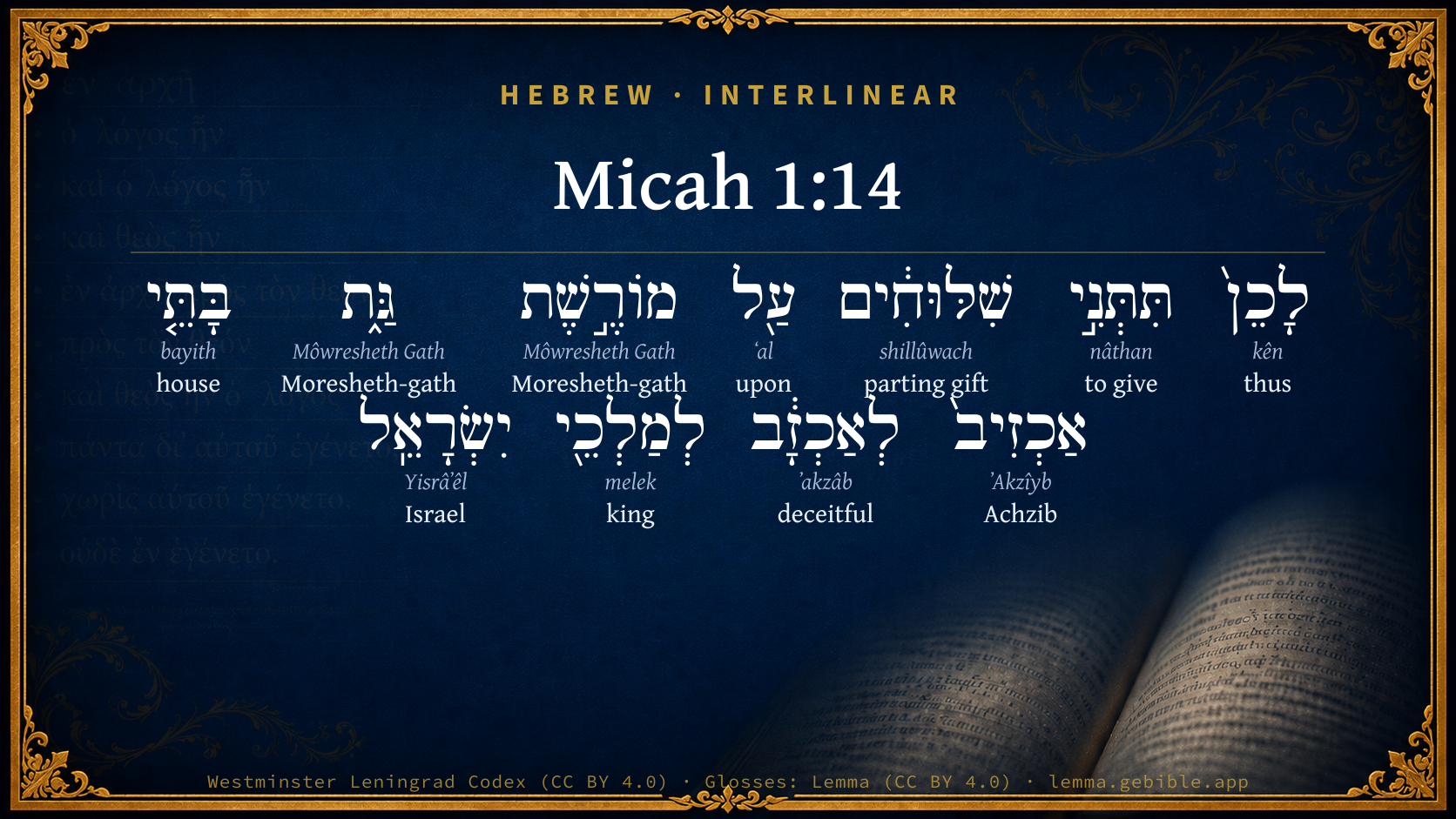
Hebrew (Westminster Leningrad Codex) Micah 1:14 appears in the Hebrew Old Testament. The text above is from the Westminster Leningrad Codex. Each word links to its Strong’s number, a concise gloss, and parsing drawn from the Open Scriptures Hebrew Bible morphology. Click any word for its full Brown-Driver-Briggs (BDB) entry.
Download image
Cite this verse

Micah 1:14 (World English Bible). Public Domain. Lemma interlinear Bible study tool, https://lemma.gebible.app/v/micah/1/14.

Show BibTeX & RIS
BibTeX
RIS
English Translation
Therefore you will give a parting gift to Moresheth-gath. The houses of Achzib will be a deceitful thing to the kings of Israel.
World English Bible · Public Domain
Highlights
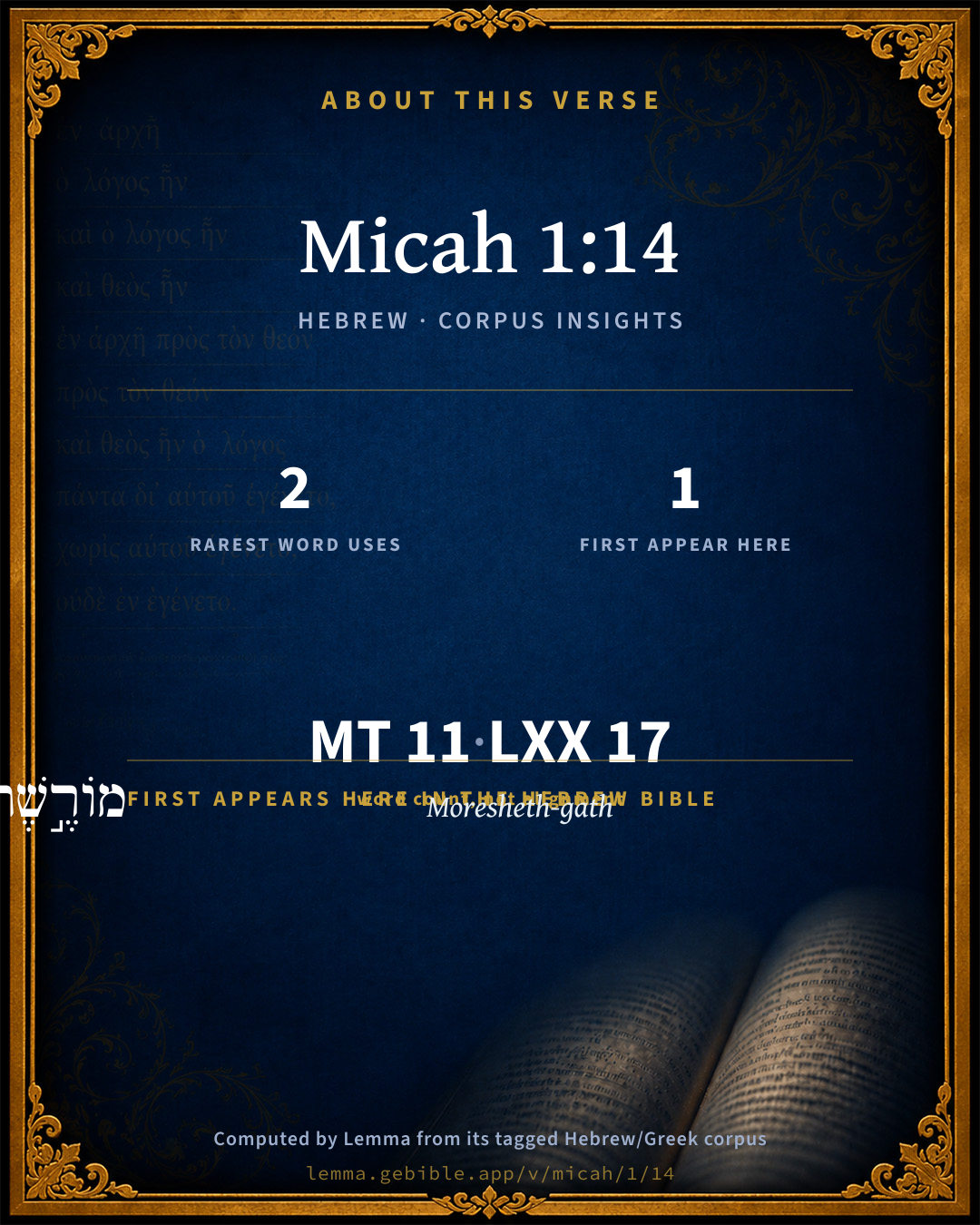
  • 1 first appearance in the Hebrew Bible
Full analysis ↓
Download a study sheet

One document with this verse’s original text, its word-by-word gloss line, the meaning frame, cross-references with their text, attributed commentary, and full source and license credits — printable, and it pastes into notes with its structure intact.

This verse Autodidact and up

Study sheet (.html) Plain text (.txt)

A passage Seminary Student

Up to 50 verses in one chapter. A passage sheet keeps up to 6 commentary sources and 12 cross-references per verse, in the order this page ranks them, and says so on the sheet whenever that leaves anything out. Ask for a single verse and you get the Autodidact verse sheet above.

Everything on this page stays free to read, with no account — the sheet is a download of what is already on screen, not access to it.

Want to remove ads? Support Godless Engineer
Compare translations 3

The same verse in 3 English versions, stacked beneath the original-language interlinear above. Click any original word for its lexicon entry.

Each is an independent rendering of the whole verse — the interlinear is not word-aligned to these translations.

Highlighted words mark where these versions differ — a whole-verse word diff, not a word-by-word alignment.

  • World English Bible Public Domain
    Therefore you will give a parting gift to Moresheth-gath. The houses of Achzib will be a deceitful thing to the kings of Israel.
  • King James Version Public Domain
    Therefore shalt thou give presents to Moreshethgath: the houses of Achzib shall be a lie to the kings of Israel.
  • unfoldingWord Literal Text CC BY-SA 4.0
    Therefore you will give dowry gifts to Moresheth Gath. The houses of Achzib become a deception to the kings of Israel.

unfoldingWord Literal Text — © unfoldingWord, licensed CC BY-SA 4.0. Word-aligned USFM3 via Door43 (git.door43.org/unfoldingWord/en_ult).

Versions to compare (up to 4)

3 of 4 selected

Show all 18 translations

Every available English version of this verse, each an independent rendering of the whole verse.

  • World English Bible Public Domain
    Therefore you will give a parting gift to Moresheth-gath. The houses of Achzib will be a deceitful thing to the kings of Israel.
  • Berean Standard Bible Public Domain
    Therefore, send farewell gifts to Moresheth-gath; the houses of Achzib will prove deceptive to the kings of Israel.
  • Majority Standard Bible Public Domain
    Therefore, send farewell gifts to Moresheth-gath; the houses of Achzib will prove deceptive to the kings of Israel.
  • King James Version Public Domain
    Therefore shalt thou give presents to Moreshethgath: the houses of Achzib shall be a lie to the kings of Israel.
  • American Standard Version (1901) Public Domain
    Therefore shalt thou give a parting gift to Moresheth-gath: the houses of Achzib shall be a deceitful thing unto the kings of Israel.
  • Revised Version (1885) Public Domain
    Therefore shalt thou give a parting gift to Moresheth-gath: the houses of Achzib shall be a deceitful thing unto the kings of Israel.
  • Geneva Bible (1599) Public Domain
    Therefore shalt thou giue presents to Moresheth Gath: the houses of Achzib shalbe as a lye to the Kings of Israel.
  • Douay-Rheims (1899) Public Domain
    Therefore shall she send messengers to the inheritance of Geth: the houses of lying to deceive the kings of Israel.
  • Young's Literal Translation Public Domain
    Therefore thou givest presents to Moresheth-Gath, The houses of Achzib become a lying thing to the kings of Israel.
  • Literal Standard Version CC BY-SA 4.0
    Therefore you give presents to Moresheth-Gath, || The houses of Achzib become a lying thing to the kings of Israel.
  • Unlocked Literal Bible CC BY-SA 4.0
    So you will give a parting gift to Moresheth Gath; the town of Akzib will disappoint the kings of Israel.
  • unfoldingWord Literal Text CC BY-SA 4.0
    Therefore you will give dowry gifts to Moresheth Gath. The houses of Achzib become a deception to the kings of Israel.
  • Darby Bible Public Domain
    Therefore shalt thou give parting-gifts to Moresheth-Gath: the houses of Achzib shall be a lie to the kings of Israel.
  • World Messianic Bible Public Domain
    Therefore you will give a parting gift to Moresheth Gath. The houses of Achzib will be a deceitful thing to the kings of Israel.
  • Webster's Bible Public Domain
    Therefore shalt thou give presents to Moresheth-gath: the houses of Achzib shall be a lie to the kings of Israel.
  • Free Bible Version CC BY-SA 4.0
    Send your goodbye gifts to Moresheth. The town of Achzib is a deception to the kings of Israel.
  • Bible in Basic English Public Domain
    For this cause give a parting offering to Moresheth-gath: the daughter of Achzib will be a deceit to the king of Israel.
  • JPS Tanakh (1917) Public Domain
    Therefore shalt thou give a parting gift to Moresheth-gath; the houses of Achzib shall be a deceitful thing unto the kings of Israel.

Literal Standard Version (2020), Covenant Press — licensed CC BY-SA 4.0. Text via the HelloAO Bible API (eBible.org). Unlocked Literal Bible (unfoldingWord) — licensed CC BY-SA 4.0. Text via the HelloAO Bible API (eBible.org). unfoldingWord Literal Text — © unfoldingWord, licensed CC BY-SA 4.0. Word-aligned USFM3 via Door43 (git.door43.org/unfoldingWord/en_ult). Free Bible Version, Dr. Jonathan Gallagher — licensed CC BY-SA 4.0. Text via the HelloAO Bible API (eBible.org).

Word by word

More ways to search: Search by grammar → Find every occurrence → Compare this word →

Practice this passage: Drill this verse → Learn its vocabulary →

About this verse

These counts appear in no published source. They are computed here, from the morphology-tagged text and Lemma’s own curated glosses. What Lemma adds →

11
words
10
distinct lemmas
Prophets
section

Notable vocabulary

The rarest word here is מוֹרֶ֣שֶׁת Moresheth-gath H4182 — appearing just 2 times in the whole Hebrew Bible.

First appearance in Scripture

This word makes its first canonical appearance in the Hebrew Bible here:

  • מוֹרֶ֣שֶׁת Moresheth-gath H4182

Grammatical profile

  • 1 verb
  • 7 nouns
  • 1 adjective
  • 1 preposition
  • 1 adverb

Verb forms

  • תִּתְּנִ֣י Qal · Imperfect

Repetition

A word recurs within this verse — often emphatic in Hebrew:

  • מוֹרֶ֣שֶׁת Moresheth-gath H4182 ×2

Hebrew & Septuagint length

In English translation the verse runs 23 words from the Hebrew and 28 from the Septuagint (LXX English) — closely comparable.

A rough comparison of the two English renderings, which tokenize alike — not a word-level alignment.

Word counts can differ between the Hebrew and the Greek without any difference in meaning — e.g. the Hebrew direct-object marker אֵת has no separate Greek word, and Greek often adds the article ὁ.

In the original languages it is 11 Hebrew tokens and 17 Greek tokens — but the two are counted differently (Hebrew bundles its prefixes and suffixes into one token; the Greek is in lemma form), so that isn’t a like-for-like length.

Cross-references

10

Topical passages linked to Micah 1:14 in the Treasury of Scripture Knowledge — connected by theme and wording, ordered by reader-vote popularity; previews shown in the World English Bible.

  • Joshua 15:44 and Keilah, and Achzib, and Mareshah; nine cities with their villages.
  • 2 Kings 16:8 Ahaz took the silver and gold that was found in the house of Yahweh, and in the treasures of the king's house, and sent it for a present to the king of Assyria.
  • Psalms 118:8–9 It is better to take refuge in Yahweh, Than to put confidence in man.
  • 2 Samuel 8:2 He struck Moab, and measured them with the line, making them to lie down on the ground; and he measured two lines to put to death, and one full line to keep alive. The Moabites became servants to David, and brought tribute.
  • 2 Kings 18:14–16 Hezekiah king of Judah sent to the king of Assyria to Lachish, saying, I have offended; return from me: that which you put on me will I bear. The king of Assyria appointed to Hezekiah king of Judah three hundred talents of silver and thirty talents of gold.
  • 2 Chronicles 16:1–3 In the six and thirtieth year of the reign of Asa, Baasha king of Israel went up against Judah, and built Ramah, that he might not allow anyone to go out or come in to Asa king of Judah.
  • Psalms 62:9 Surely men of low degree are just a breath, And men of high degree are a lie. In the balances they will go up. They are together lighter than a breath.
  • Psalms 146:3–4 Don't put your trust in princes, Each a son of man in whom there is no help.
  • Isaiah 30:6 The burden of the animals of the South. Through the land of trouble and anguish, from whence come the lioness and the lion, the viper and fiery flying serpent, they carry their riches on the shoulders of young donkeys, and their treasures on the humps of camels, to a people that shall not profit [them].
  • Jeremiah 15:18 Why is my pain perpetual, and my wound incurable, which refuses to be healed? will you indeed be to me as a deceitful [brook], as waters that fail?

Cross-references courtesy of OpenBible.info (CC BY 4.0).

Hebrew and Greek witnesses Masoretic Hebrew ↔ Greek Septuagint

The same verse in the two great witnesses to the Old Testament, shown verse-for-verse.

These are two independent witnesses, not word-aligned to each other, and the Septuagint is shown in lemma (dictionary) form.

Hebrew Micah 1:14 Masoretic · Westminster Leningrad Codex

לָכֵן֙ תִּתְּנִ֣י שִׁלּוּחִ֔ים עַ֖ל מוֹרֶ֣שֶׁת גַּ֑ת בָּתֵּ֤י אַכְזִיב֙ לְאַכְזָ֔ב לְמַלְכֵ֖י יִשְׂרָאֵֽל

Therefore you will give a parting gift to Moresheth-gath. The houses of Achzib will be a deceitful thing to the kings of Israel.

World English Bible · Public Domain

Greek LXX Micah 1:14 Septuagint · lemma form

διά οὗτος δίδωμι ἐκ ἀποστέλλω ἕως κληρονομία γεθ οἶκος μάταιος εἰς κενός γίγνομαι ὁ βασιλεύς ὁ ἰσραήλ

Therefore shall he cause men to be sent forth as far as the inheritance of Geth, even vain houses; they are become vanity to the kings of Israel;

LXX2012 (modern English Septuagint) · Public Domain

On this verse, The Pulpit Commentary discusses the Septuagint’s reading. Read the note in Commentary ↓

Hebrew: Westminster Leningrad Codex (CC BY 4.0). Greek: Septuagint (public domain); English from LXX2012 (modern English Septuagint) (Public Domain). How the Septuagint differs from the Hebrew →

Targum (Aramaic paraphrase)

1

The Targum is the ancient Jewish Aramaic paraphrase of the Hebrew Scriptures — an interpretive translation, not the Hebrew text itself. Onkelos (literal) and Pseudo-Jonathan (expansive) render the Torah, and Jonathan the Prophets. Coverage is partial: where no permissively-licensed English translation exists for a verse, only the Aramaic is shown. This is verse-level text, not a word-by-word alignment to the Hebrew.

  1. Targum Jonathan Prophets (Joshua–Malachi)
    בְּכֵן תְּשַׁדְרִין קוּרְבָּנִין לְמַחֲסִינֵי גַת בָּתֵּי אַכְזִיב יִתְמַסְרוּן לְעַמְמַיָא בְּחוֹבִין דִי פְלָחוּ בְּהוֹן לְטַעֲוָתָא מַלְכֵי יִשְׂרָאֵל:

    (no public-domain English translation for this verse)

    Targum Jonathan — Aramaic: “Mikraot Gedolot” (public domain). English: “Sefaria Community Translation” (CC0 1.0 (public-domain dedication)); “London "Chaldee Paraphrase," 1871” (public domain). Text via Sefaria.

Commentary

Notes on Micah 1:14 from classic Christian and Jewish commentators (each source and its license shown beneath its notes). The classic Christian expositions comment on the surrounding passage and are grouped to its opening verse, so a note may address several verses; the Jewish commentaries on the Tanakh (Rashi and others) are per-verse, so they appear only where the commentator wrote on this verse.

Lemma curates 59 commentaries, every one of them public domain or Creative Commons licensed, each selected and text-cleaned for this edition rather than reprinted as found. About our sources →

Adam Clarke's Commentary

Verse 14. Give presents to Moresheth-gath] Calmet says that Moresa or Morashti, and Achzib, were cities not far from Gath. It is possible that when Ahaz found himself pressed by Pekah, king of Israel, he might have sent to these places for succour, that by their assistance he might frustrate the hopes of the king of Israel; and this may be the meaning of "The houses of Achzib shall be a lie to the kings of Israel." In these verses there are several instances of the paronomasia. See Mic 1:10, עפר aphar, dust, and עפרה aphrah, the name of the city. Mic 1:11. צאנן tsaanan, the city, and יצאה yatsah, to go out. Mic 1:13, לכיש lachish, the city, and רכש rechesh, the swift beast. Mic 1:14, אכזיב achzib, the city, and אכזב achzab, a lie. Such paronomasias were reputed ornaments by the prophets. They occur in Isaiah with great effect. See Isa 5:7.

Adam Clarke's Commentary on the Bible (1810–1826) — public domain. Text from a community e-Sword/MySword module.

Trapp's Complete Commentary

John Trapp

Mic 1:14 Therefore shalt thou give presents to Moreshethgath: the houses of Achzib [shall be] a lie to the kings of Israel.

Ver. 14. Therefore shalt thou give presents, &c.] And so seek to make thee friends among the Philistines; but such carnal confederacies never prosper. The Greek Churches, A. D. 1438, afraid of the Turks, sent and subjected themselves to the Bishop of Rome, that they might have the help of the Latin Churches; but shortly after they were destroyed, their empire subdued, and swallowed up by the Ottoman greatness, &c. How much better were it to send a lamb to the ruler of the earth! Isa 16:1, to bring presents unto him that ought to be feared! Psa 76:11, even to God, who cutteth off the spirits of princes, and is terrible to the kings of the earth! Mic 1:12. Was he not so to Sennacherib, whom Lachish here feared, and fled from? to Nebuchadnezzar, Belshazzar, Xerxes, who, after he had wasted over two million men into Greece, and whipped the Hellespont (for battering his bridge of boats over it) with three hundred stripes, was defeated, routed, and forced to flee back in a poor fisher’s boat, to save his own life? (Herod.)

The houses of Achzib (that is, of a lie) shall be a lie to the kings of Israel] Or have been a lie to the kings of Israel; never true to those that trusted them: and wilt thou confederate with them, and confide in them?

John Trapp, A Commentary or Exposition upon All the Books of the Old and New Testament (1647–1656) — public domain. Text from a community e-Sword module.

Tyndale Open Study Notes

Tyndale Open Resources

1:14 Farewell gifts said good-bye to the doomed people of Moresheth-gath as that city also became Assyrian property.

Tyndale Open Study Notes — © Tyndale Open Resources, licensed CC BY-SA 4.0. Text via the HelloAO Bible API.

Geneva Bible (1599)

Geneva Bible translators

Thou shalt bribe the Philistines thy neighbors, but they shall deceive thee, as well as they of Jerusalem.

Geneva Bible (1599) marginal notes — public domain. Text via Bolls.life.

Jamieson, Fausset & Brown

Robert Jamieson, A. R. Fausset & David Brown

shalt thou give presents to Moresheth-gath--that its inhabitants may send thee help. MAURER explains it, "thou shalt give a writing of renunciation to Moresheth-gath," that is, thou shalt renounce all claim to it, being compelled to yield it up to the foe. "Thou," that is, Judah. "Israel" in this verse is used for the kingdom of Judah, which was the chief representative of the whole nation of Israel. Moresheth-gath is so called because it had fallen for a time under the power of the neighboring Philistines of Gath. It was the native town of Micah (Mic 1:1).

Achzib--meaning "lying." Achzib, as its name implies, shall prove a "lie to . . . Israel," that is, shall disappoint Israel's hopes of succor from her (compare Job 6:15-20; Jer 15:18). Achzib was in Judah between Keilah and Mareshah (Jos 15:44). Perhaps the same as Chezib (Gen 38:5).

Jamieson, Fausset & Brown — Commentary Critical and Explanatory on the Whole Bible (1871) — public domain (CC PDM 1.0). Text via the HelloAO Bible API.

John Calvin's Commentaries

Here the Prophet alludes to another thing, — that they would attempt to pacify their enemies with gifts, and would try to redeem themselves and their neighbors. But the Prophet expressly mentions this, that the event might teach them that nothing happens without a design; for it ought to work a greater conviction in blind and obstinate men, when they see that they really find that to be true which had been long before predicted. This, then, is the reason why the Prophet enumerates here various particulars; it was, that the hand of God might be more evident and conspicuous when he would begin, in an especial manner, to fulfill all the things which he now in words foretells, Thou, he says, wilt send a gift for Moreseth-gath; that is, for a neighboring city. And he calls it Moreseth-gath, to distinguish it from another city of the same name. Thou wilt then send gifts for Moreseth-gath, to the sons of Achzib for a lie אכזיב, aczib, is a word derived from one which means a lie. There is, therefore, a striking alliteration, when he says, Thou wilt send gifts to the sons of אכזיב, Aczib, for a lie, לאכזב, laaczeb; that is Thou wilt send gifts to the sons of a lie, for a lie. The city had obtained its name from its fallacies or guiles. And he says, for a lie to the kings of Israel; because it profited the children of Israel nothing to pacify them with gifts or to attempt to draw them to their side, as they hired the services of one another. So then he says, that they would be for a lie to the kings of Israel, for they would gain nothing by having many auxiliaries. Some take the words actively, — that the kings of Israel had first deceived the citizens of Achzib: but this view is less probable; I am therefore disposed to adopt the other, — that though the citizens of Lachish tried to conciliate their neighbors with a great sum of money, especially the people of Achzib, this would be yet to no purpose; for it would be a lie to the people of Israel: or, it may be, that the Prophet’s meaning is this, — that the citizens of Achzib had already wished to bring aid, but in vain to the kings of Israel; for Lachish was one of the first cities which the Assyrians conquered; but it was within the kingdom of Judah, or on its borders. It is then probable that the kings of Israel had recourse to the aid of this people, and were not assisted. Now, as the citizens of Lachish also endeavored to extricate themselves from the hand of their enemies by such aid, the prophet derides such a folly, inasmuch as they did not become wise by experience, having seen with their own eyes, that such an help had been useless and deceptive to the kings of Israel: they ought then to have tried some other means rather than to expose themselves to the same deceptions. I cannot finish the chapter to-day.

John Calvin's Commentaries (1540-1563) — public domain. Text from the Calvin Translation Society English edition (1840s-50s) via the Christian Classics Ethereal Library (ccel.org). Calvin's coverage is partial (roughly two-thirds of the Bible); uncommented books and verses are honest gaps, never fabricated. The 19th-century editor's footnotes and remarks are omitted so the notes are faithfully Calvin's own voice.

Ellicott's Commentary for English Readers

(14) Give presents—i.e., thou shalt cease to give to Moresheth-gath the protection due from a husband to a wife: thou shalt give her a bill of divorce. The Hebrew word means either the presents sent with a daughter or the dismissal sent to a wife.

Achzib.—A town on the sea-coast between Accho and Tyre. Its name means false, deceptive; it is used of a river drying up, and disappointing the traveller. In like manner Achzib shall fulfil the import of its name, and prove a lie, a broken reed, to the kings of Israel. (See also Jer_15:18, where the prophet asks God, “Wilt Thou be altogether unto me as a liar [Heb., Achzab], as waters that fail?”)

A Bible Commentary for English Readers, edited by Charles John Ellicott (1878–1897) — public domain. Text from a community e-Sword module.

The Cambridge Bible for Schools and Colleges

gen. ed. J. J. S. Perowne

14. Therefore] There is no logical sequence implied: ‘therefore’ often introduces a threatening passage—sin leading to punishment. The prophet abruptly turns to the people of Judah.

shalt thou give presents, &c.] More strictly, farewell-presents. The meaning of the whole clause is that Judah will have to give up Moresheth-gath. True, it was to an enemy that this town was to be surrendered, and ‘farewell presents’ seems to have been a technical term for the marriage-portion of a bride (so 1Ki_9:16). But a loose use of the phrase is quite intelligible; the literal meaning is simply ‘dismissal.’

Moresheth-gath] The birth-place of the prophet (see Introduction), who here makes an allusion to its meaning—‘possession of Gath.’

Achzib] Mentioned as in the Shephélah, Jos_15:44. Its name suggests the thought of deception or disappointment; hence the following words. It is probably the same as Chezib, and, remarkably enough, the passage where Chezib is mentioned contains a similar reference to the ominous purport of the name. ‘He (Judah) was at Chezib,’ we read in Gen_38:5, ‘when she (Tamar) bare him.’ It was an appropriate birthplace for Shelah, who afterwards disappointed the just expectations of Tamar in regard to Judah.

a lie] Rather, a disappointing brook. The word for ‘brook’ is omitted as in Jer_15:18, where the parallel clause explains the phrase to mean ‘waters that fail.’

the kings of Israel] ‘Israel,’ after the fall of the northern kingdom (predicted in Mic_1:6-7) is legitimately applied to Judah.

The Cambridge Bible for Schools and Colleges (gen. ed. J. J. S. Perowne; Cambridge University Press, 1878–1918) — public domain. Text from a community e-Sword module.

John Gill's Exposition

Therefore shalt thou give presents to Moreshethgath,.... Since Lachish was the cause of leading Judah into idolatry, and was a city so very wicked; therefore it should be reduced to such distress as to send messengers with presents to the Philistines at Moreshethgath, a place near to Gath of the Philistines, and may include that and other cities of theirs, to come and help them against the Assyrians:

the houses of Achzib shall be a lie to the kings of Israel; a city of Judah, Jos 15:44; or of Asher, Jos 19:29; the same with Chezib, Gen 38:5; and called Ecdippa by Josephus (h), Pliny (i), and Ptolemy (k). The Jewish writers commonly call it Cezib, of which they (l) say many things about that, and the land unto it, being subject to tithes, the laws of the seventh year, and the like. Maimonides and Bartenora say (m) it is the name of a place which divided between the land of Israel, which they possessed who came out of Babylon, and that land which they enjoyed who came out of Egypt; but the Jews are not agreed about the situation of it. One of their writers (n) places it to the northeast of the land of Israel; but another (o) observes, and proves from one that resided in those parts some time, and diligently inquired into and made his observation on places, that Cezib, and also Aco and Amana, frequently mentioned with it, were all on the western sea of the land of Israel, that is, the Mediterranean sea; in which he was right, without all doubt: the place is now called Zib by contraction, of which Mr. Maundrell (p) gives this account;

"having travelled about one hour in the plain of Acra, we passed by an old town called Zib, situate on an ascent close by the seaside; this may probably be the old Achzib, mentioned Jos 19:29; called afterwards Ecdippa; for St. Jerom (q) places Achzib nine miles distant from Ptolemais (or Aco), towards Tyre, to which account we found the situation of Zib exactly agreeing.''

Now the houses or families that dwelt in this place, or the idols' temples there, as some, and the idolatry exercised therein, should be a lie unto, or disappoint the expectations of, the kings of Israel; which, according to Kimchi, is put for Judah, who placed confidence in them, and had dependence on them: there is an elegant play on words between Achzib and a "lie" (r). The Targum is,

"thou shall send gifts to the heirs of Gath; the houses of Achzib shall be delivered to the people, because of the sins of the kings of Israel, who worshipped idols in them.''

(h) Antiqu. l. 5. c. 1. sect. 22. De Bello Jud. l. 1. c. 13. sect. 4. (i) Nat. Hist. l. 5. c. 19. (k) Geograph, l. 5. c. 15. (l) T. Hieros. Sheviith, fol. 36. 2. T. Bab. Gittin, foi. 7. 2. Misn. Demai, c. 1. sect. 3. (m) In Misn. Demai, c. 1. sect. 3. (n) Bartenora in Misn. Sheviith, c. 6. 1. & Challa, c. 4. sect. 8. (o) Yom Tob in Sheviith, c. 6. 1. e Caphtor Uperah, c. 11. (p) Journey from Aleppo, &c. p. 33. Ed. 7. (q) De locis Hebr. fol. 88. I. (r) &

John Gill's Exposition of the Whole Bible (1746–1763) — public domain (CC PDM 1.0). Text via the HelloAO Bible API.

Albert Barnes' Notes on the Bible

Therefore shalt thou give - (bridal) presents to Moresheth Gath Therefore! since Judah had so become a partaker of Israel’s sins, she had broken the covenant, whereby God had given her the land of the pagan, and she should part with it to aliens. The bridal presents, literally the dismissals, were the dowry 1Ki 9:16 with which the father sent away Jdg 12:9 his daughter, to belong to another, her lord or husband, never more to return. Moresheth, (literally, inheritance,) the inheritance which God gave her, was to be parted with; she was to be laden with gifts to the enemy. Judah should part with her, and her own treasure also.

The houses of Achzib shall be a lie - Achzib, so called probably from a winter brook, achzab, was to become what its name imported, a resource which should fail just in the time of need, as the winter brooks in the drought of summer. “Wilt Thou be unto me as a failing brook, waters which are not sure?” Jer 15:18. This Achzib, which is recounted between Keilah and Mareshah Jos 15:44, was probably one of, the oldest towns of Palestine being mentioned in the history of the Patriarch Judah. After having survived about 1,000 years, it should, in time of need, fail. The kings of Israel are here the kings of Judah. When this prophecy was to be accomplished, the ten tribes would have ceased to have any political existence, the remnant in their own lanai would have no head to look to, except the line of David, whose good kings had a care for them. Micah then, having prophesied the utter destruction of Samaria, speaks in accordance with the state of things which he foresaw and foretold.

Albert Barnes' Notes on the Bible (1834–1885) — public domain. Text from a community e-Sword/MySword module.

Haydock's Catholic Bible Commentary

Send. Lachis shall send to Geth for help; but in vain: for Geth, instead of helping, shall be found to be a house of lying and deceit to Israel. (Challoner) --- Inheritance. Some translate rather "Moreseth (or Morasthi) of Geth, the houses of Acsib," &c. Both these towns were near Geth, and perhaps at this time subject to it, 2 Paralipomenon xxviii. 18. Achaz sent to ask for aid against the king of Israel, ver. 9. (Calmet) --- Protestants, "therefore shalt thou give presents to Moresheth-Gath, the houses of Achzib shall be a lie to the," &c. (Haydock) --- There is an allusion between Acsib and a lie, as also between Maresa and an heir, (ver. 15.; Calmet) as the terms have those senses. (Haydock)

George Leo Haydock (1774–1849), Haydock's Catholic Family Bible and Commentary, 1859 edition — public domain. Excludes Psalms (Douay-Rheims chapter numbering differs from Protestant) and Deuterocanonical books (Catholic canon only).

Matthew Poole's English Annotations

Therefore; forasmuch as thou hast imitated Israel in sin, and been at least an occasion to Jerusalem and the kingdom of Judah to commit the same sins.

Shalt thou, Lachish,

give presents: though I do not remember the sacred story reporting this in matter of fact, we read not what presents were given, or by whom sent, or when; yet as it was foretold by the prophet, so no doubt it was fulfilled, and the inhabitants of Lachish courted the assistance of the Philistines against the Assyrian, and possibly against the Babylonian.

Moresheth-gath; a known city or town of the Philistines, called here Moresheth-gath to distinguish it from a town of the same name in the tribe of Judah and in the valley of Zephathah, where Asa smote Zerah, the Ethiopian king, who invaded Asa with a million of men.

Achzib: this was also a city of the Philistines not far from Mareshah, Ashkelon, and Gaza; it was a maritime town and strong. There was another city of that name toward Tyre also, but of this the prophet doth not speak in this place.

A lie; a lying refuge, or a prop that should break under them that leaned upon it, as Egypt proved a broken reed to Judah when trusted to: in the Hebrew there is an elegant allusion, which the translation cannot express.

To the kings of Israel; some say it is meant of the kings of Judah, but we find not that Hezekiah made any use of the houses of Achzib when Sennacherib invaded him. It is more probable the kings of the ten tribes are meant, and that Hoshea did rely on Gath. Achzib, &c., and on the friendship of the rest of the Philistines, to join with the Egyptians, or to give them a quiet passage through their country to help Israel against the Assyrian.

Matthew Poole's English Annotations on the Holy Bible (1683–1685) — public domain. Text from a community e-Sword/MySword module.

The Pulpit Commentary

Therefore. Because Judah has adopted the evil practices of Israel. The prophet here addresses Judah, and continues to do so to the end of the chapter. Shalt thou give presents to Moreshsth-Gath. The "presents" intended are parting gifts, farewell presents. The word is used (1Ki_9:16) for the dowry given to a daughter when she is married. The meaning, therefore, is that Judah must relinquish all claim to Moresheth. The paronomasia is explained in two ways. As Moresheth may mean "possession," the prophet may be understood to say, "Thou shalt give up possession of Gath"s possession." Or the play of words may depend upon the similarity of sound between Moresheth and Meorasah, "Betrothed", (Deu_22:29) "Thou shalt give dismissal (bill of divorcement) to the city once betrothed to thee." Moresheth-Gath, Micah"s birthplace, is placed just south of Beit Jibrin, or Eleutheropolis, about twenty-five miles from Gaza (see Introduction, The addition of Gath to the name of the town is meant to mark its situation in the immediate neighbourhood of that well known city. So we have Bethlehem-Judah, (Jud_1:17:7) Abel-Maim or Maachah. (1Ki_15:20 2Ch_16:4) Septuagint, Dwsei exapostellomenouv ewv klhronomiav Geo , "He shall cause men to be sent forth even to the inheritance of Geth;" Vulgate, Dabit emissarios super heredidatem Geth.

To give shilluchim the sense of "messengers" seems to be unprecedented. The houses of Achzib shall be a lie (achzab), a lying, deceiving brook, which disappoints the hope of the wayfarer, like "fundus mendax" (Horat., "Carm.," 3:1. 30). Septuagint, oikouv mataiouv , "vain houses;" Vulgate, domus mendacii. The city shall be yielded to the enemy and lost to the Judaeans. Achzib, (Jos_15:44) hod. Ain Kezbeh, eight miles north of Adullam, is probably the same as Chezib, (Gen_38:5) where Shelah, Judah"s son by Tamar, was born. The kings of Israel. "Israel" is here equivalent to Judah, having, according to the prediction of vers. 6, 7, lost its political existence. (comp. 2Ch_28:19, where Ahaz is called King of Israel)

The Pulpit Commentary (1880–1919), ed. H.D.M. Spence-Jones & Joseph S. Exell — public domain. Text from a community e-Sword module.

John Wesley's Explanatory Notes

Give presents - The inhabitants of Lachish courted the assistance of the Philistines against the Assyrian. Moresheth-gath - A known city of the Philistines, called Moresheth-gath, to distinguish it from a town of the same name in the tribe of Judah. Achzib - This was also a city of the Philistines. A lie - A lying refuge, a prop that will break under them.

John Wesley, Explanatory Notes Upon the Whole Bible (1754–1765) — public domain. Text via the GEBible commentary corpus.

Rashi

Rabbi Shlomo Yitzchaki (Rashi)

Since you give expulsions to the dynasty that gave you the possession of Gath—Since you give expulsions to the kingdom of David, which gave you the possession of Gath, as the matter is stated (I Chron. 18:1): “And he took Gath and its cities out of the hands of the Philistines.” But you reject it, as it is stated (Isa. 8:6): “Since this people has rejected the waters of the Shiloah that flow gently, etc.” Therefore, “the houses of Achzib” which was of the land of Judah and was drawn after Pekah the son of Remaliah, shall ultimately be a “dried up spring” to the kings of Israel - for Pekah the son of Remaliah will be assassinated, and all those who relied on him will be disappointed. This prophecy was prophesied during Ahaz’s reign.

since you give expulsions Heb. לָכֵן. The definition of לָכֵן is עַל אֲשֶׁר, because of. Cf. (Isa. 17:10) “Because (עַל כֵּן) I planted you with pleasant saplings,” and you turned into a branch of a stranger.

the houses of Achzib shall be a dried up spring Heb. לְאַכְזָב. This [too] is a play on words לְאַכְזָב אַכְזִיב. I learned the midrash of this verse from the Aggadah of the chapter “Chelek.” [from Sanh. 102a]

Rashi on the Tanakh — English translations: “The Judaica Press complete Tanach with Rashi, translated by A. J. Rosenberg” (CC BY 4.0); “Pentateuch with Rashi's commentary by M. Rosenbaum and A.M. Silbermann, 1929-1934” (public domain); “The Metsudah Tanach series, Lakewood, N.J” (CC BY 4.0); and “The Book of Joshua, Metsudah Publications, 1997” (CC BY 4.0). Text via Sefaria.

Lesson kit

Teaching starters — assembled from the data on this page, not authored interpretation. Every prompt links to the verse data it draws on. Edit before teaching.

Micah, in the Prophets, opens this verse with 11 words (10 distinct Hebrew lemmas). Its most distinctive word is Môwresheth Gath (“Moresheth-gath”). A historical commentator’s framing appears above. Read the whole chapter for the surrounding context.

Discussion questions

  1. What does “Moresheth-gath” (Môwresheth Gath) contribute to the verse as a whole?
  2. The word “Moresheth-gath” first appears here in Scripture. What is being introduced at this debut?
  3. Joshua 15:44 shares this passage’s theme. How do the two illuminate each other?
  4. “Moresheth-gath” occurs 2× in this one verse. What is the effect of the repetition?
  5. These translations render this verse differently. What is at stake in choosing one wording over another?
  6. The verb «תִּתְּנִ֣י» is Qal Imperfect. How does its form color the action?
  7. Reading how Adam Clarke's Commentary and Trapp's Complete Commentary read this verse, where do the two commentators agree and where do they part?

Things to notice

Reading settings

Reading text

Shown beneath each verse's original-language words.

Old Testament
Old Testament edition

Read the OT as the Masoretic Hebrew (MT) or the Greek Septuagint (LXX).

English shown for the Greek Septuagint (in the Hebrew ↔ Greek comparison).

Comparing translations? Open the Compare panel on any verse page to stack up to four side by side.