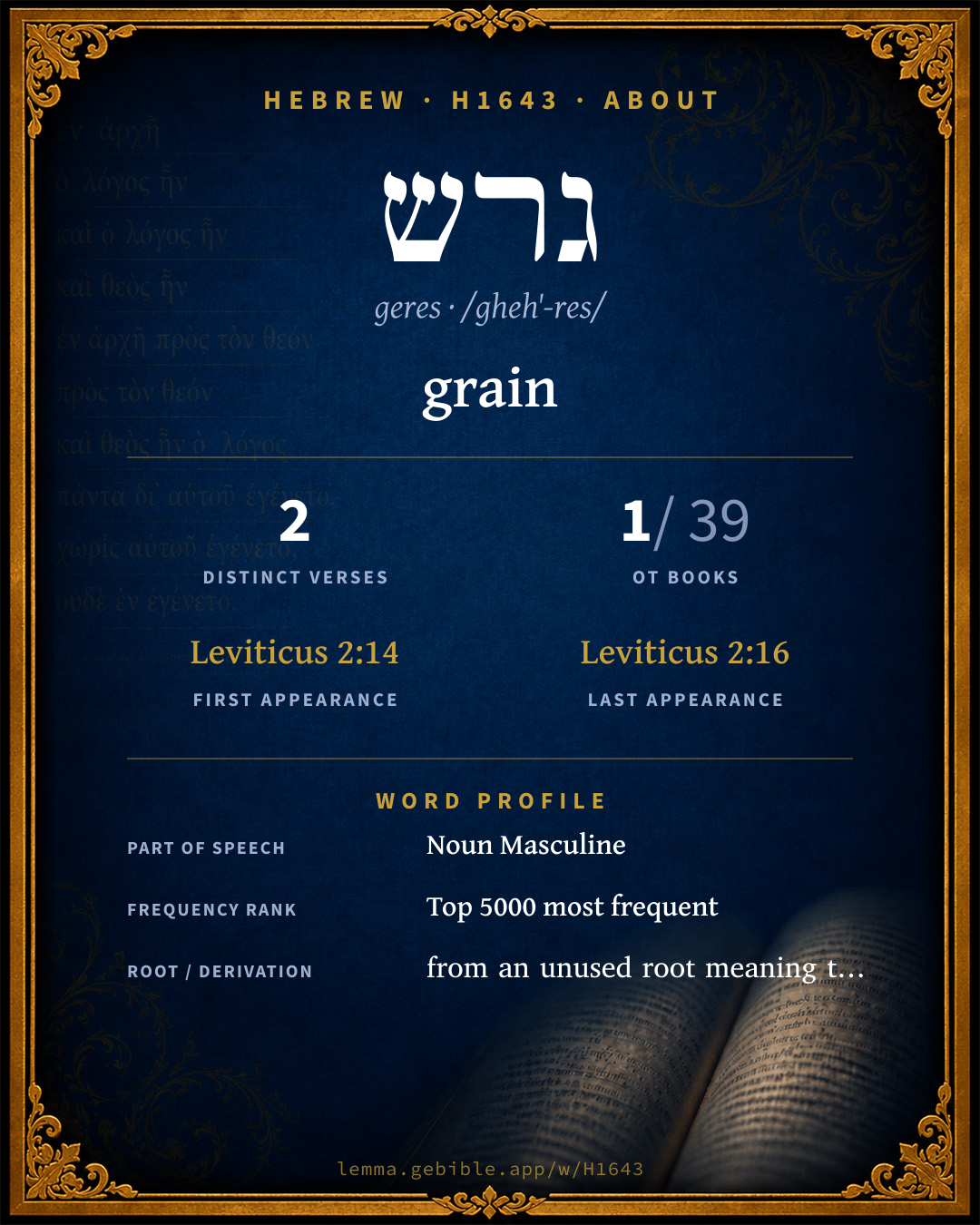
גֶּ֫רֶשׂ
grain
Full lexicon entry — Brown-Driver-Briggs (BDB)
From Brown-Driver-Briggs (BDB)
Where this word appears
Grammar key — what these labels mean
Part of speech
- Noun
- A naming word — a person, place, thing, or idea.
Noun type
- Common
- A common noun — a general class of person, place, or thing (“king,” “city,” “water”), not a specific name.
State
- Construct
- A noun bound to a following noun in a possessive / “of” relationship (the construct chain).
Gender
- Masculine
- Grammatically masculine.
Number
- Singular
- One.
Every verse where H1643 appears — 2 distinct verses across 1 book. Click any verse to open its interlinear word-by-word view. Verse text shown in the World English Bible for context — . Each verse’s Hebrew form is shown with its reference; the English is not keyword-highlighted, since the data carries no word-level English alignment. Use “Compare translations” on any verse to read it across multiple English versions. This concordance covers the Hebrew Bible; Septuagint (Greek Old Testament) occurrences are not indexed here.
Leviticus 2 verses
- Leviticus 2:14 גֶּ֣רֶשׂ n c ms cs "'If you offer a meal offering of first fruits to Yahweh, you shall offer for the meal offering of your first fruits grain in the ear parched with fire, bruised grain of the fresh ear.
- Leviticus 2:16 מִ/גִּרְשָׂ/הּ֙ prep + n c ms cs + sfx pers 3fs The priest shall burn as its memorial, part of its bruised grain, and part of its oil, along with all its frankincense: it is an offering made by fire to Yahweh.
About this entry
At a glance — auto-summarized from this page’s data, not written by a person. Every figure links to its source below. This summary describes the numbers; it doesn’t interpret them.
“grain” is the headline sense of the Hebrew noun גרש (geres). It occurs a mere 2 verses across Scripture. It clusters heavily in Leviticus, which alone accounts for 100% of its uses. First canonically at Leviticus 2:14, it enters the text early. See the sense tree, 2-verse concordance, and the renderings breakdown below.
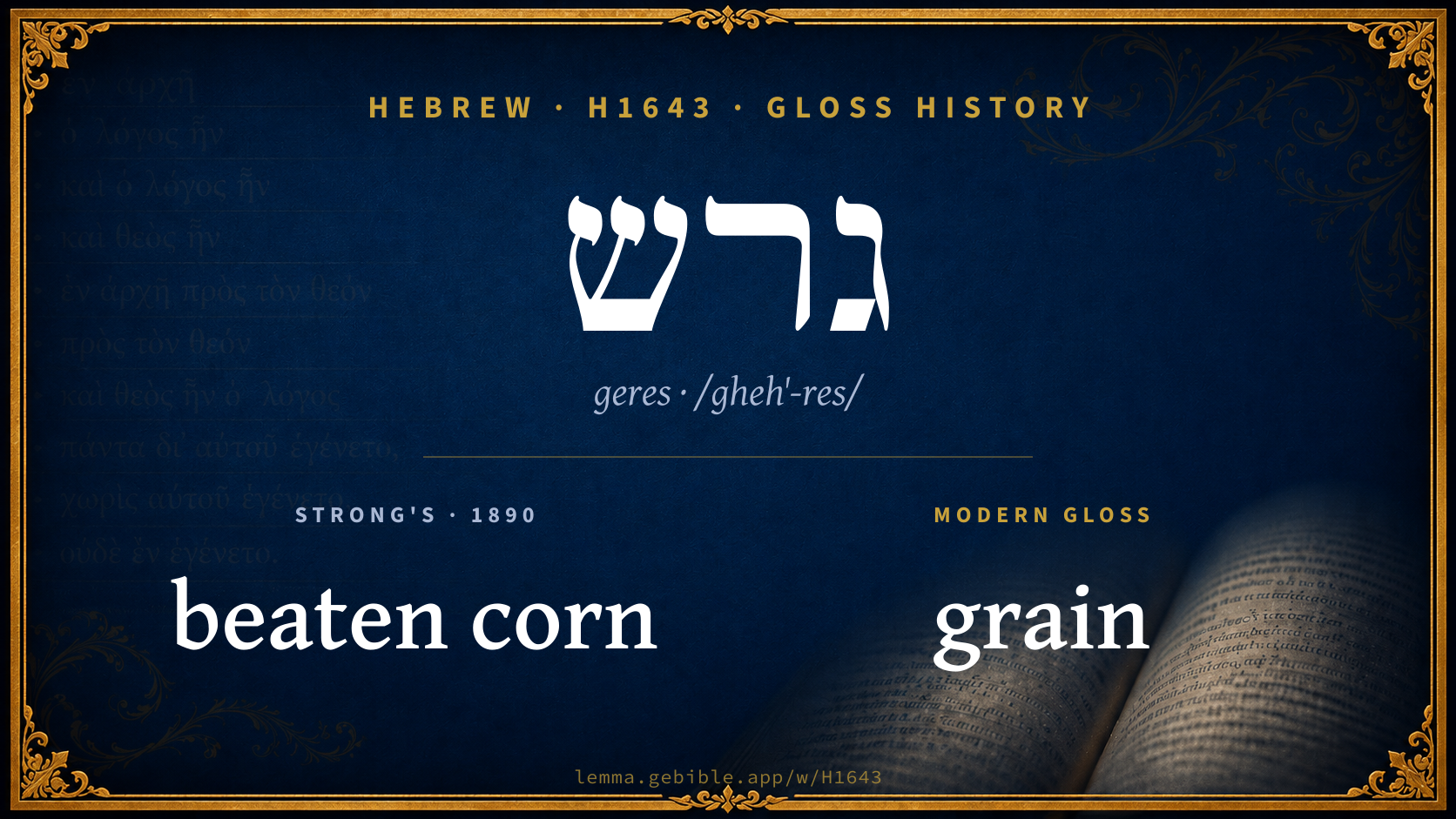
Gloss history
Strong's 1890 vs modern scholarship
About this word
Strong's H1643 catalogs a Hebrew word from the Hebrew Old Testament.
These counts are not copied from any lexicon or concordance. They are computed here, from the morphology-tagged Hebrew Old Testament. What Lemma adds →
- 2
- distinct verses
- The word appears in 2 distinct verses.
- 1 / 39
- OT books
- The word appears in 1 of 39 Old Testament books.
- #4,807
- by frequency
- Top 5000 most frequent Hebrew words (rank 4,807 of 8,640 Hebrew words by occurrence).
View all 2 occurrences in the concordance →
Most concentrated in
- Leviticus 2 verses 100%
By section of the Old Testament
By traditional corpus
Conventional, traditional groupings — biblical authorship is debated, so this is a traditional corpus grouping, not an authorship claim. Each share is this word’s portion of its verses in that division of the Hebrew canon. Each figure is a share of the word’s 2 distinct verses.
- Torah (Pentateuch) 2 verses · 100%
How translations render this word
Counts come from each version’s own published word-to-Strong’s tagging or interlinear alignment — an approximate guide to how each version renders this word, not a word-level alignment the data otherwise carries. Because each total is that version’s own tagged count, the per-version totals vary from one another and need not match the appearance or distinct-verse counts above. These counts may also differ from a printed concordance because Lemma counts each distinctly tagged rendering and does not collapse phrase taggings into a single head-word total. This is a fixed set of word-tagged versions (KJV, ASV, BSB, ULT) and does not change with the reading translation you choose elsewhere. Each version’s license is shown beside its name below (and on Sources).
- King James Version: Corn beaten 1×, Part of the beaten corn 1×
- American Standard Version: Bruised 1×, It 1×
- Berean Standard Bible: Crushed 1×, Crushed grain 1×
- unfoldingWord Literal Text: Crushed grain 1×, Crushed grains 1×, Of 1×
King James Version Public Domain
Renders H1643 across 2 tagged occurrences — most commonly:
American Standard Version Public Domain
Renders H1643 across 2 tagged occurrences — most commonly:
Berean Standard Bible Public Domain
Renders H1643 across 2 tagged occurrences — most commonly:
unfoldingWord Literal Text CC BY-SA 4.0
Renders H1643 across 3 tagged occurrences — most commonly:
Senses in BDB
The 1 sense BDB distinguishes for this word, in lexicon order (not ranked by frequency or importance). The full entry — with sub-senses — is in the Lexicon Entry tab.
- a crushing (that which is crushed), grain, grits, groats
Word origin
n.[m.] a crushing, but only concrete of that which is crushed, groats, grits (cf. Arabic جَرِيشٌ, NH גְּרִיס, Aramaic (rare) גִּרְשָׂא, גְּרוּסְיָא, ܓܳܪܣܳܐ )—אָבִיב קָלוּי בָּאֵשׁ גֶּרֶשׂ כַּרְמֶל Lv 2:14 young ears parched with fire, groats (&) fresh fruit (v. Sifra ad loc.); (וּמִשַּׁמְנָהּ) מִגִּרְשָׂהּ Lv 2:16.
— Brown-Driver-Briggs (Oxford 1906, public domain), digitized via Sefaria, supplemented by the OpenScriptures HebrewLexicon (CC BY 4.0). See Sources.
Origin: from an unused root meaning to husk
Jastrow Dictionary
A second Hebrew/Aramaic lexicon for comparison, covering Aramaic and post-biblical (Talmudic, Targumic, Midrashic) usage that the biblical-Hebrew BDB does not. Matched by lemma rather than by Strong’s number, so a lemma may carry more than one Jastrow headword (shown separately below), and the entries cover usage well beyond the Bible.
גָּרַשׁ
- (b. h.)
- 1. to stir up, to set in commotion. Sifré Deut. 39; Yalk. ib. 859 יכול יהו מים גּוֹרְשִׁין את העפר ממקום בקעה וכ׳ you might suppose the (rain) water will stir up the (fat) ground of the valley, and thus the valley will lack (drinking) water.
- 2. (cmp. טָרַד) to banish; to send off, divorce (a wife).—Part. pass. גָּרוּשׁ, f. גְּרוּשָׁה q. v.
- to send off, banish. Gen. R. s. 21.—Esp. to give a letter of divorce. Gitt. IX, 1 הַמְּגָרֵשׁ וכ׳ if one divorces his wife and says, on handing her the letter, &c.; a. v. fr.—Ib. VI, 5 if one says (to his delegates) … גָּרְשׁוּהָ ga’rshuha, they are authorized to write and deliver to her a letter of divorce (geresh being the colloquial term for divorcing).
- to be banished, &c. Pirké d’R. El. ch. XIX; XX ג׳ ויצא וכ׳ he was banished and he left paradise.—Part. מְגוּרָשׁ, f. מְגוּרֶשֶׁת. Gitt. VII, 4 מג׳ ואינה מג׳ she is and is not divorced, i.e. her divorce is doubtful, and she has to suffer the disqualifications of a married and of a divorced woman. Ib. 5; a. v. fr.
- 1. to be banished; to be divorced. Midr. Till. to Ps. XCII. Gitt. 65ᵃ מִתְגָּרֶשֶׁת בקידושי וכ׳ she is entitled to receive a letter of divorce for herself even though her father had contracted the marriage in her behalf; a. v. fr. [
- 2. to be stirred up, become muddy, thick. Midr. d’R. Akiba, Alef (Jellinek Beth Hammidrash III, 13).]
גְּרַשׁ I
- Pa. גָּרֵישׁ. Pes. 110ᵇ דגָרְשָׁהּ לאיתתיה Ms. M. (ed. דגרשא, corr. acc.) who had divorced his wife. Ber. 56ᵃ תרי נשי מְגָרְשׁת it will be thy destiny to divorce two wives. Arakh. 23ᵃ דלִיגָרֵש לדביתהו that he should divorce &c. Ib. אטו כל דמִגָרֵשׁ וכ׳ does every one who divorces his wife, give divorce in court?; a. fr.
- , infin. אִיגְּרוּשֵׁי to be divorced. Gitt. 78ᵃ בת אי׳ in a fit condition to receive a letter of divorce.
*גְּרַשׁ II
- (cmp. גרר to drag) to hoist up. Y. Kil. IX, 32ᶜ top. Y. Keth. XII, 35ᵇ top [read:] ואין עניית אתון גרשין לי and if I call, ye will hoist me up; (Koh. R. to IX, 10 שרר; Mat. K. quotes גדש, v. גְּדַשׁ II).
גֶּרֶשׂ
- v. גָּרִיס) grits. Sifra Vayikra, N’dabah, ch. XIV, Par. 13 אפשר יקלנו ג׳ I might think he must roast it after being pounded; Men. 66ᵇ
A Dictionary of the Targumim, the Talmud Babli and Yerushalmi, and the Midrashic Literature (Marcus Jastrow; London, Luzac, 1903) — Public Domain. Digitized via Sefaria. Digitized via Sefaria. Full attribution on Sources.
Forms in the corpus
The 2 distinct written forms H1643 takes in the Hebrew Bible, most frequent first — each parse links to that state’s occurrences in the concordance. Hebrew forms include their vowel points and cantillation, so a single lemma takes many written forms.
| Form | Parsing | Example | Uses |
|---|---|---|---|
| גֶּ֣רֶשׂ | Noun, Common, Masculine, Singular, Construct | Leviticus 2:14 | 1 |
| מִ/גִּרְשָׂ/הּ֙ | Noun, Common, Masculine, Singular, Construct | Leviticus 2:16 | 1 |
Septuagint verse parallels
This word appears in 2 verses that also exist in the Greek Old Testament (Septuagint), out of the 2 Hebrew verses it occurs in. You can read those verses in Greek by switching the Old Testament edition to the Septuagint.
Read these verses in the Septuagint
This is a verse-level parallel only — the same verses exist in both the Hebrew and Greek Old Testaments. No word-level Hebrew↔Greek correspondence is claimed: the data carries no such alignment, so no Greek word is shown as this Hebrew word’s translation. Coverage is not total — the Septuagint omits the deuterocanon and renumbers the Psalms, so some Hebrew verses have no direct Greek parallel.