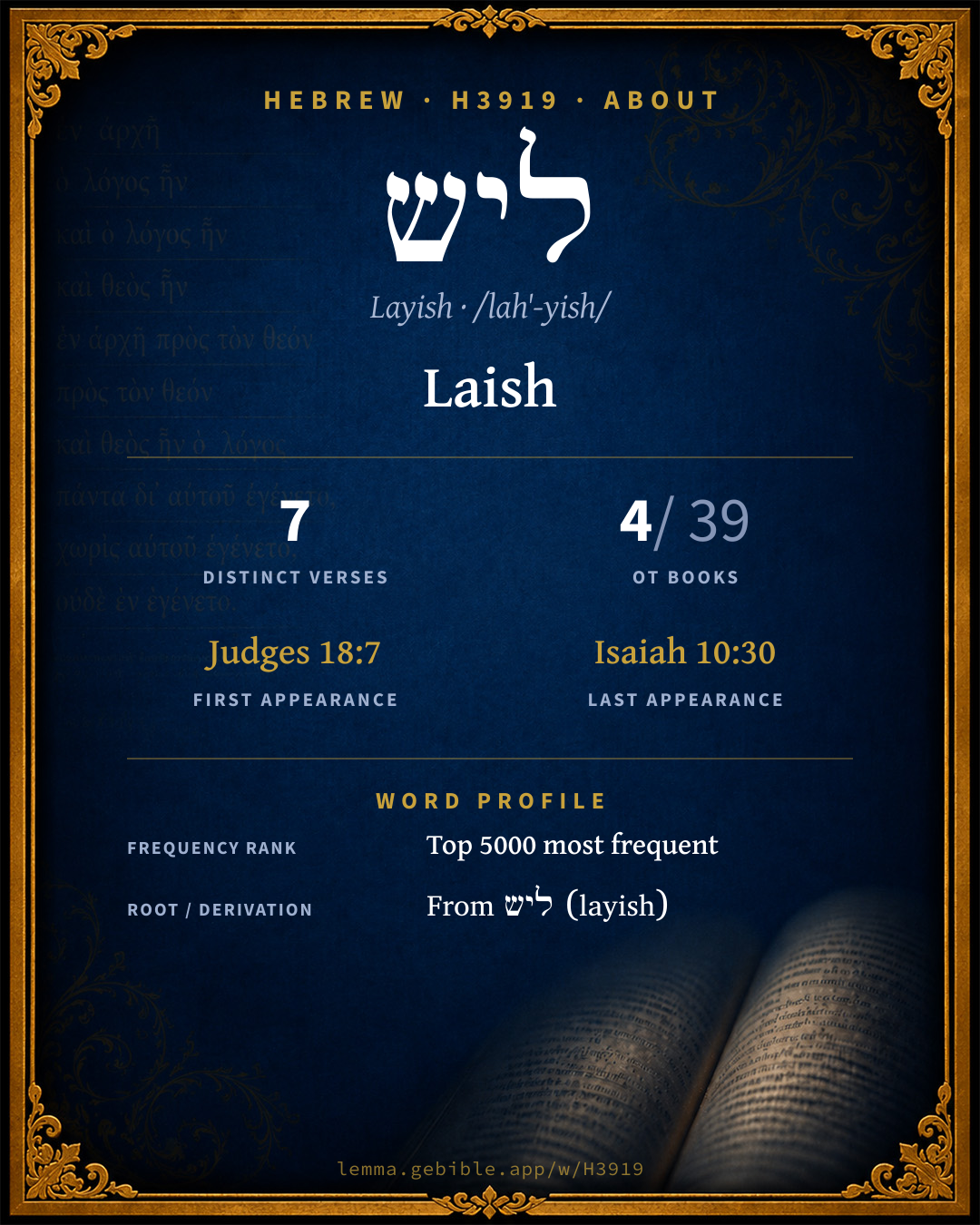
לַ֫יִשׁ
Laish
BDB lists 4 entries for ‘Laish’ fuller range ↓
Full lexicon entry — Brown-Driver-Briggs (BDB)
From Brown-Driver-Briggs (BDB)
Where this word appears
Grammar key — what these labels mean
Part of speech
- Noun
- A naming word — a person, place, thing, or idea.
Noun type
- Proper
- A name of a specific person, place, or people (e.g. Abraham, Zion, Israel).
Every verse where H3919 appears — 7 distinct verses across 4 books. Click any verse to open its interlinear word-by-word view. Verse text shown in the World English Bible for context — . Each verse’s Hebrew form is shown with its reference; the English is not keyword-highlighted, since the data carries no word-level English alignment. Use “Compare translations” on any verse to read it across multiple English versions. This concordance covers the Hebrew Bible; Septuagint (Greek Old Testament) occurrences are not indexed here.
Judges 4 verses
- Judges 18:7 לָ֑יְשָׁ/ה n Proper + sfx dem Then the five men departed, and came to Laish, and saw the people who were therein, how they lived in security, after the manner of the Sidonians, quiet and secure; for there was none in the land, possessing authority, that might put [them] to shame in anything, and they were far from the Sidonians, and had no dealings with any man.
- Judges 18:14 לַיִשׁ֒ n Proper Then the five men who went to spy out the country of Laish answered, and said to their brothers, Do you know that there is in these houses an ephod, and teraphim, and an engraved image, and a molten image? now therefore consider what you have to do.
- Judges 18:27 לַ֗יִשׁ n Proper They took that which Micah had made, and the priest whom he had, and came to Laish, to a people quiet and secure, and struck them with the edge of the sword; and they burnt the city with fire.
- Judges 18:29 לַ֥יִשׁ n Proper They called the name of the city Dan, after the name of Dan their father, who was born to Israel: however the name of the city was Laish at the first.
1 Samuel 1 verse
2 Samuel 1 verse
Isaiah 1 verse
About this entry
At a glance — auto-summarized from this page’s data, not written by a person. Every figure links to its source below. This summary describes the numbers; it doesn’t interpret them.
At its core, ליש (Layish) means “Laish.” Its uses cluster heavily in Judges (57% of all occurrences). Spanning 7 verses in 4 books, it ranks among the uncommon words of the Hebrew Bible. Scripture first uses it in Judges 18:7. Each statement above links to its evidence; the full detail follows below.
Gloss history
Strong's 1890 vs modern scholarship
About this word
Strong's H3919 catalogs a Hebrew word from the Hebrew Old Testament.
These counts are not copied from any lexicon or concordance. They are computed here, from the morphology-tagged Hebrew Old Testament. What Lemma adds →
- 7
- distinct verses
- The word appears in 7 distinct verses.
- 4 / 39
- OT books
- The word appears in 4 of 39 Old Testament books.
- #2,835
- by frequency
- Top 5000 most frequent Hebrew words (rank 2,835 of 8,640 Hebrew words by occurrence).
View all 7 occurrences in the concordance →
By section of the Old Testament
By traditional corpus
Conventional, traditional groupings — biblical authorship is debated, so this is a traditional corpus grouping, not an authorship claim. Each share is this word’s portion of its verses in that division of the Hebrew canon. Each figure is a share of the word’s 7 distinct verses.
- Prophets (Nevi'im) 7 verses · 100%
How translations render this word
Counts come from each version’s own published word-to-Strong’s tagging or interlinear alignment — an approximate guide to how each version renders this word, not a word-level alignment the data otherwise carries. Because each total is that version’s own tagged count, the per-version totals vary from one another and need not match the appearance or distinct-verse counts above. These counts may also differ from a printed concordance because Lemma counts each distinctly tagged rendering and does not collapse phrase taggings into a single head-word total. This is a fixed set of word-tagged versions (KJV, ASV, BSB, ULT) and does not change with the reading translation you choose elsewhere. Each version’s license is shown beside its name below (and on Sources).
BDB lists this Strong’s number as 4 distinct words (homographs). Each count above pools all of them and is not split by sense — see the Senses section below. A low-frequency rendering may belong to a different one of those words, not the primary meaning.
- King James Version†: Laish 5×
- American Standard Version†: Laish 3×
- Berean Standard Bible†: Laish 5×
- unfoldingWord Literal Text†: Laish 6×
King James Version Public Domain
Renders H3919 across 6† tagged occurrences — most commonly:
Plus 1 rendering that appears only once — usually multi-word phrases or single function words the recovered tagging swept in, not distinct renderings. Not rendered by a distinct English word in 1 further occurrence.
American Standard Version Public Domain
Renders H3919 across 5† tagged occurrences — most commonly:
Plus 2 renderings that appear only once — usually multi-word phrases or single function words the recovered tagging swept in, not distinct renderings.
Berean Standard Bible Public Domain
Renders H3919 across 6† tagged occurrences — most commonly:
Plus 1 rendering that appears only once — usually multi-word phrases or single function words the recovered tagging swept in, not distinct renderings.
unfoldingWord Literal Text CC BY-SA 4.0
Renders H3919 across 7† tagged occurrences — most commonly:
Plus 1 rendering that appears only once — usually multi-word phrases or single function words the recovered tagging swept in, not distinct renderings.
Senses in the full BDB
What do BDB’s symbols mean?
BDB uses these scholarly abbreviations:
| Symbol | Meaning |
|---|---|
| 𝔊 | the Septuagint (the ancient Greek translation, LXX) |
| 𝔙 | the Vulgate (the Latin translation) |
| 𝔖 | the Syriac version (the Peshitta) |
| 𝔗 | the Targum (the Aramaic translation) |
| ψ | the Psalms |
| √ | root (the underlying root or stem) |
| ‖ | parallel passage (a synonymous or contrasted parallel) |
| † | the dagger: every passage where the word occurs is cited |
The 0 senses and sub-senses the full Brown-Driver-Briggs lexicon distinguishes for this word, in lexicon order (not ranked by frequency), with BDB’s own verbatim wording and sub-sense lettering. Shown in Hebrew script with BDB’s own scholarly abbreviations. The condensed entry is in the Lexicon Entry tab. See also the Forms in the corpus table below.
ליש I loc. (on meaning lion, cf. RSSem i. 156 (om. 2nd ed.))
ליש II m. father of Michal’s second husband, 1 S 25
ליש III loc. N. of Jerus. Is 10
Senses from the full Brown-Driver-Briggs lexicon (Brown, Driver, Briggs; Oxford 1906 — public domain), digitized via Sefaria, supplemented by the OpenScriptures HebrewLexicon (CC BY 4.0). Full attribution on Sources.
Word origin
I. n.m. Jb 4:11 lion (Arabic لَيْثٌ, 𝔗 לֵיתָא; Assyrian nêšu, lion is comp. by Hal (cf. HptKAT2, 510) BaZA iii. 1888, 60);—lion Jb 4:11 Is 30:6 (‖ לָבִיא), ל׳ גִּבּוֹר בַּבְּהֵמָה Pr 30:30.
II. n.pr.loc. (on meaning lion, cf. RSSem i. 156 (om. 2nd ed.));—former name of Dan., in extreme north of Canaan, Ju 18:7, 14, 27, 29 (v. דָּן p. 192 b); 𝔊 Λαισα; = לָשֶׁם q.v.; cf. BuhlGeogr. § 124.
III. n.pr.m. father of Michal’s second husband, 1 S 25:44 + 2 S 3:15 Qr (Kt לושׁ), 𝔊 Αμεις, Σελλης, A Λα(ε)ις, 𝔊L Ιωας, Σελλειμ.
I. n.pr.loc. N. of Jerus. Is 10:30 (perhaps akin to iii. לַיִשׁ, v. Di); site unknown; v. KasterenZPV xiii. 101 conj. ʿIsawiye, village two miles NE. from Jerus. (PEF Map; Mem. iii. 27 RobBR i. 437 cf. BuhlGeogr. 175), 𝔊 ἐν Σα, Λαισα.
— Brown-Driver-Briggs (Oxford 1906, public domain), digitized via Sefaria, supplemented by the OpenScriptures HebrewLexicon (CC BY 4.0). See Sources.
Derived from ליש (layish) (H3918) — lion.
Jastrow Dictionary
A second Hebrew/Aramaic lexicon for comparison, covering Aramaic and post-biblical (Talmudic, Targumic, Midrashic) usage that the biblical-Hebrew BDB does not. Matched by lemma rather than by Strong’s number, so a lemma may carry more than one Jastrow headword (shown separately below), and the entries cover usage well beyond the Bible.
יֵשׁ
- 1. being, substance, wealth (of knowledge &c.). Y. Ned. V, end, 39ᵇ; Succ. 28ᵃ; B. Bath. 134ᵃ (Prov. VIII, 21, applied to R. Joh. b. Zaccai). e.g. Proverbs 8:21
- 2. there is, there are, v. אִית. Ber. VI, 4 אם יש ביניהם וכ׳ if there is among them one species &c. Peah VIII, 8 מי שיש לו וכ׳ he who possesses &c. Ḥag. 14ᵇ יש נאה דורש וכ׳ many a one preaches well but does not act well; a. v. fr.—יש אומרים (abbr. י"א) some say (anonymous authority). Hor. 13ᵇ אסיקו … ולר׳ נתן י"א the editors introduced ‘others say’ for R. M. and ‘some say’ for R. Nathan. B. Bath. 93ᵇ וי"א אף הוצאה and some say, he must indemnify him also for carrying the seed out; מאן י"א who is meant by ‘some say’? (v. Tosaf. a. l.). Ab. V, 6; a. v. fr.—יֶשְׁנוֹ he is, it is. Kidd. I, 10 כל שי׳ במקרא וכ׳ whosoever is (engaged) in the study of the Bible &c. Ḥag. 4ᵇ כל שי׳ בביאה י׳ וכ׳ whosoever is bound to visit the Temple, is also bound &c., v. הֲבָאָה; a. fr.—יֶשְׁנָהּ she is, it is. Kidd. 48ᵃ, a. fr. י׳ לשכירות וכ׳ the relation of employment exists from beginning to end, i.e. the employer is under obligation for every portion of the contracted labor, opp. אינה ל׳ … אלא בסוף the obligation takes effect only when the work is finished; a. fr.
לַיִשׁ I
- (b. h.) lion. Snh. 94ᵇ bot. (ref. to לַיְשָׁה, Is. X, 30) מהאי לא … דמתיל כאריה of him (Sennaherib) be not afraid, but be afraid of Nebucadnezzar who is compared to a lion (Jer. IV, 7). Ib. 95ᵃ מי דמי התם ארי הכא ל׳ how can you draw an analogy between these two passages?; there (Is. l. c.) layish is used, while here it is ări!—Ib. ששה שמות … וכ׳ the lion goes by six appellations &c., v. לָבִיא; Ab. d’R. N. ch. XXXIX; ib. II Vers. ch. XLIII; Yalk. Prov. 959, v. לוּשׁ; a. e. e.g. Isaiah 10:30
לַיִשׁ II
- (b. h.) pr. n. pl.
- 1. Laish, the northern limit of Palestine, called Dan. Tanḥ. Ki Thissa 14 (ref. to Jud. XVIII, 27) ל׳ זו פמיאס L. is Paneas; ib. R’eh 16; a. e. e.g. Judges 18:27
- 2. Laish, or (Laishah), prob. between Anathoth and Gallim. Snh. 94ᵇ, v. preced.
לַיִשׁ III
- dough, v. לַיִישׁ.
לִישׁ
- Targ. O. Ex. XII, 39 לֵי׳ (Ms. I לַיְי׳; Y. לִישָׁא). Targ. Y. ib. XVI, 2. Targ. Jer. VII, 18 ליי׳ ed. Lag.; a. e.—Y. Pes. III, beg. 29ᵈ מלמולין דליש crumbs of dough. Ab. Zar. 76ᵇ top, v. גְּדָנְפָא. B. Kam. 18ᵃ בלישא (not בלישה), v. ווּס.—Y. Ḥag. III, beg. 78ᵈ [read:] כבהדין לייש as if (they drove nails) into dough.—Pl. לֵישִׁין. Targ. Y. Ex. XII, 34 לֵישֵׁיהוֹן (O. ed. Berl. לֵישְׁהוֹן, Bxt. לִישָׁתְהוֹן).
A Dictionary of the Targumim, the Talmud Babli and Yerushalmi, and the Midrashic Literature (Marcus Jastrow; London, Luzac, 1903) — Public Domain. Digitized via Sefaria. Digitized via Sefaria. Full attribution on Sources.
Forms in the corpus
The 7 distinct written forms H3919 takes in the Hebrew Bible, most frequent first — each parse links to that state’s occurrences in the concordance. Hebrew forms include their vowel points and cantillation, so a single lemma takes many written forms.
| Form | Parsing | Example | Uses |
|---|---|---|---|
| לַ֖יְשָׁה | Noun, Proper | Isaiah 10:30 | 1 |
| לַ֖יִשׁ | Noun, Proper | 1 Samuel 25:44 | 1 |
| לַ֗יִשׁ | Noun, Proper | Judges 18:27 | 1 |
| לַ֥יִשׁ | Noun, Proper | Judges 18:29 | 1 |
| לַיִשׁ֒ | Noun, Proper | Judges 18:14 | 1 |
| לָ֑יְשָׁ/ה | Noun, Proper | Judges 18:7 | 1 |
| לָֽיִשׁ | Noun, Proper | 2 Samuel 3:15 | 1 |
Bible dictionary
Public-domain dictionary articles matched to this entry by name (Laish). A biblical name can be shared by more than one person or place, so an article may treat several.
Easton's Bible Dictionary · M. G. Easton, 1897
A lion. (1.) A city of the Sidonians, in the extreme north of Palestine (Judg. 18:7, 14); called also Leshem (Josh. 19:47) and Dan (Judg. 18:7, 29; Jer. 8:16). It lay near the sources of the Jordan, about 4 miles from Paneas. The restless and warlike tribe of Dan (q.v.), looking out for larger possessions, invaded this country and took Laish with its territory. It is identified with the ruin Tell-el-Kady, "the mound of the judge," to the north of the Waters of Merom (Josh. 11:5).
(2.) A place mentioned in Isa. 10:30. It has been supposed to be the modern el-Isawiyeh, about a mile north-east of Jerusalem.
(3.) The father of Phalti (1 Sam. 25:44).
Smith's Bible Dictionary · William Smith, 1863
(lion), father of Phaltiel, to whom Saul had given Michal, David's wife. (1 Samuel 25:44; 2 Samuel 3:15)
Hitchcock's Bible Names Dictionary · Roswell D. Hitchcock, 1869
a lion
Classic public-domain reference works; full attribution on Sources.
Septuagint verse parallels
This word appears in 7 verses that also exist in the Greek Old Testament (Septuagint), out of the 7 Hebrew verses it occurs in. You can read those verses in Greek by switching the Old Testament edition to the Septuagint.
Read these verses in the Septuagint
This is a verse-level parallel only — the same verses exist in both the Hebrew and Greek Old Testaments. No word-level Hebrew↔Greek correspondence is claimed: the data carries no such alignment, so no Greek word is shown as this Hebrew word’s translation. Coverage is not total — the Septuagint omits the deuterocanon and renumbers the Psalms, so some Hebrew verses have no direct Greek parallel.