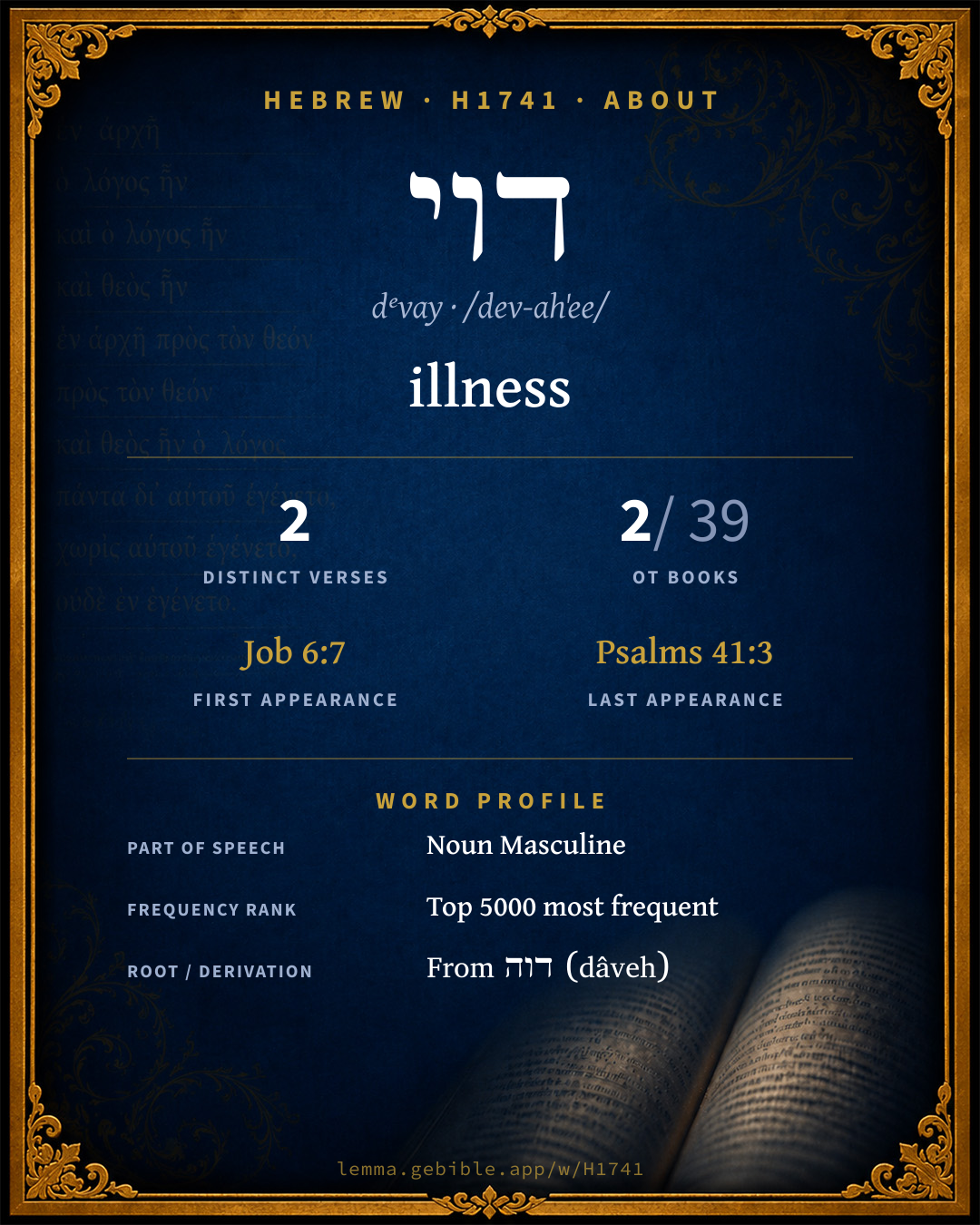
דְּוַי
illness
Full lexicon entry — Brown-Driver-Briggs (BDB)
From Brown-Driver-Briggs (BDB)
Where this word appears
See every Absolute-state word in the Hebrew Bible →
Grammar key — what these labels mean
Part of speech
- Noun
- A naming word — a person, place, thing, or idea.
Noun type
- Common
- A common noun — a general class of person, place, or thing (“king,” “city,” “water”), not a specific name.
State
- Absolute
- The independent form of a noun, not bound to a following word.
- Construct
- A noun bound to a following noun in a possessive / “of” relationship (the construct chain).
Gender
- Masculine
- Grammatically masculine.
Number
- Singular
- One.
Grammatical forms
- Noun, Common, Masculine, Singular, Absolute 1 time (50%)
- Noun, Common, Masculine, Singular, Construct 1 time (50%)
Parsed forms decoded from the imported morphology (morphhb / Westminster Leningrad Codex — WLC text public domain, morphhb tagging CC BY 4.0), counted across 2 parsed occurrences — not distinct verses.
Every verse where H1741 appears — 2 distinct verses across 2 books. Click any verse to open its interlinear word-by-word view. Verse text shown in the World English Bible for context — . Each verse’s Hebrew form is shown with its reference; the English is not keyword-highlighted, since the data carries no word-level English alignment. Use “Compare translations” on any verse to read it across multiple English versions. This concordance covers the Hebrew Bible; Septuagint (Greek Old Testament) occurrences are not indexed here.
Job 1 verse
Psalms 1 verse
About this entry
At a glance — auto-summarized from this page’s data, not written by a person. Every figure links to its source below. This summary describes the numbers; it doesn’t interpret them.
דוי (dᵉvay) is a Hebrew noun most often rendered “illness.” It occurs a mere 2 verses across Scripture. It clusters heavily in Job, which alone accounts for 50% of its uses. It first appears in Job 6:7. From the same root come דוה and דוי. For the data behind this summary, explore the sense tree and the renderings breakdown below.
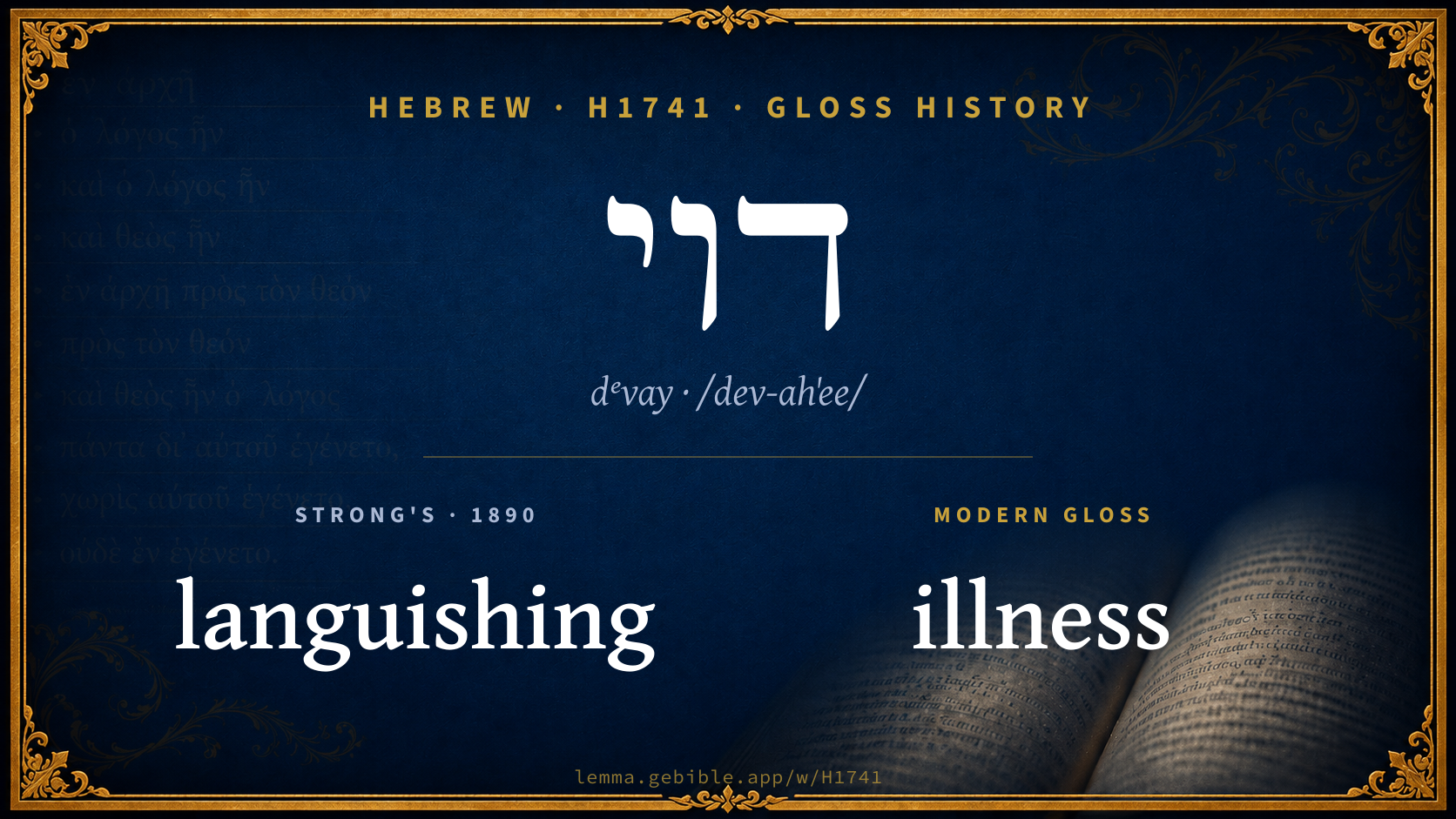
Gloss history
Strong's 1890 vs modern scholarship
About this word
Strong's H1741 catalogs a Hebrew word from the Hebrew Old Testament.
These counts are not copied from any lexicon or concordance. They are computed here, from the morphology-tagged Hebrew Old Testament. What Lemma adds →
- 2
- distinct verses
- The word appears in 2 distinct verses.
- 2 / 39
- OT books
- The word appears in 2 of 39 Old Testament books.
- #4,807
- by frequency
- Top 5000 most frequent Hebrew words (rank 4,807 of 8,640 Hebrew words by occurrence).
View all 2 occurrences in the concordance →
By traditional corpus
Conventional, traditional groupings — biblical authorship is debated, so this is a traditional corpus grouping, not an authorship claim. Each share is this word’s portion of its verses in that division of the Hebrew canon. Each figure is a share of the word’s 2 distinct verses.
- Writings (Ketuvim) 2 verses · 100%
How translations render this word
Counts come from each version’s own published word-to-Strong’s tagging or interlinear alignment — an approximate guide to how each version renders this word, not a word-level alignment the data otherwise carries. Because each total is that version’s own tagged count, the per-version totals vary from one another and need not match the appearance or distinct-verse counts above. These counts may also differ from a printed concordance because Lemma counts each distinctly tagged rendering and does not collapse phrase taggings into a single head-word total. This is a fixed set of word-tagged versions (KJV, ASV, BSB, ULT) and does not change with the reading translation you choose elsewhere. Each version’s license is shown beside its name below (and on Sources).
- King James Version: Are as my sorrowful 1×, Languishing 1×
- American Standard Version: Languishing 1×, Them 1×
- Berean Standard Bible: Illness 1×, Loathsome 1×
- unfoldingWord Literal Text: Are like disease 1×, Suffering 1×
King James Version Public Domain
Renders H1741 across 2 tagged occurrences — most commonly:
American Standard Version Public Domain
Renders H1741 across 2 tagged occurrences — most commonly:
Berean Standard Bible Public Domain
Renders H1741 across 2 tagged occurrences — most commonly:
unfoldingWord Literal Text CC BY-SA 4.0
Renders H1741 across 2 tagged occurrences — most commonly:
Senses in BDB
The 1 sense BDB distinguishes for this word, in lexicon order (not ranked by frequency or importance). The full entry — with sub-senses — is in the Lexicon Entry tab.
- illness, languishing
Word origin
n.[m.] illness, עֶרֶשׂ דְּוָי֑ ψ 41:4 bed of languishing (Che); sg. cstr. (Ew De Di) הֵמָּה כִּדְוֵי לַחְמִי Jb 6:7 they (i.e. my sufferings) are like disease (VB loathsomeness) in my meat, cf. Di; but text dub.
— Brown-Driver-Briggs (Oxford 1906, public domain), digitized via Sefaria, supplemented by the OpenScriptures HebrewLexicon (CC BY 4.0). See Sources.
Derived from דוה (dâveh) (H1739) — faint.
Jastrow Dictionary
A second Hebrew/Aramaic lexicon for comparison, covering Aramaic and post-biblical (Talmudic, Targumic, Midrashic) usage that the biblical-Hebrew BDB does not. Matched by lemma rather than by Strong’s number, so a lemma may carry more than one Jastrow headword (shown separately below), and the entries cover usage well beyond the Bible.
דוי
- [to drip, melt away,] to mourn, repine. Nidd. 23ᵇ (ref. to Deut. XXI, 17 אֹנוֹ, cmp. דְּוַי) מי שלבו דָוֶה עליו a child over whose death his (the father’s) heart is grieved. Ber. 16ᵇ אל יִדְיֶה לבנו may our heart not sink. Kidd. 81ᵇ יִדְווּ כל הדָּוִוים let all those mourn who feel the affliction; Naz. 23ᵃ. Yeb. 47ᵃ the Israelites … are דווים (some ed. דְּווּיִים, Part. pass.) broken down (under persecution). Gen. R. s. 60; s. 74; a. fr. e.g. Deuteronomy 21:17
- to be afflicted. Pesik. Asser, p. 96ᵃ על אותו האיש שנ׳ over this man (me) in his affliction; Tanḥ. R’eeh ed. Bub. 7 (Tanḥ. ib. 10 שנידוהו, Yalk. Deut. 892; Yalk. Prov. 962 שנדוהו, corr. acc.).
- to afflict. Y. R. Hash. I, 57ᵇ bot. מַדְוֶה לה וכ׳ afflicts it (the year, causes prayers and fasting from fear of failure of the crop) in its beginning.
דוי ²
- Targ. Jer. XLVIII, 17; a. e.
- to feel pain, groan. Ḥull. 51ᵃ מִידְּווּ וקיימי they groan constantly.
דוי ³
- (v. preced; cmp. b. h. כָּסַף, כָּלָה) to look out for, espy. Sabb. 35ᵃ דָּוֵי למזרח Ar. (ed. דָּאוֵי) he looked eastward (for the reflection of the setting sun). Ib. 53ᵇ they raise their nostrils [read:] ומסגי כי דָּוֵי (Ms. O. כדובי) and march like looking out (for the wolf). Ker. 6ᵃ דְּווּ לפומיה וכ׳ Ar. (ed. חזו) watch the lips of &c. Tam. 26ᵇ דוי להכא וכ׳ he (the watchman) looks out in both directions.
דָּוֵי
- (דְּוָא I) sad, depressed. Targ. I Kings XX, 43; XXI, 4 (ed. Vien. דַּוָי).—Pl. דָּוָן, דָּוָון. Targ. Is. XVI, 7 (ed. Lag. הו׳, corr. acc.); 11.
דְּוַי
- (= h. דְּוַי, v. preced.) grief, affliction. Targ. Gen. XXXV, 18 (h. text אוֹנִי, v. דָּוָה). Targ. Y. ib. XLII, 38 דָּווֹי (O. דוונא).
A Dictionary of the Targumim, the Talmud Babli and Yerushalmi, and the Midrashic Literature (Marcus Jastrow; London, Luzac, 1903) — Public Domain. Digitized via Sefaria. Digitized via Sefaria. Full attribution on Sources.
Forms in the corpus
The 2 distinct written forms H1741 takes in the Hebrew Bible, most frequent first — each parse links to that state’s occurrences in the concordance. Hebrew forms include their vowel points and cantillation, so a single lemma takes many written forms.
| Form | Parsing | Example | Uses |
|---|---|---|---|
| דְּוָ֑י | Noun, Common, Masculine, Singular, Absolute | Psalms 41:3 | 1 |
| כִּ/דְוֵ֥י | Noun, Common, Masculine, Singular, Construct | Job 6:7 | 1 |
Same root — word family
Other BDB entries built from the same root as H1741, grouped by Strong’s listed origin. These share a root / origin per the lexicon — not necessarily a shared meaning. Each links to that word’s own entry.
Derives from
Shares the same root
Compare all same-root words → They share a root, not necessarily a meaning.
Septuagint verse parallels
This word appears in 2 verses that also exist in the Greek Old Testament (Septuagint), out of the 2 Hebrew verses it occurs in. You can read those verses in Greek by switching the Old Testament edition to the Septuagint.
Read these verses in the Septuagint
This is a verse-level parallel only — the same verses exist in both the Hebrew and Greek Old Testaments. No word-level Hebrew↔Greek correspondence is claimed: the data carries no such alignment, so no Greek word is shown as this Hebrew word’s translation. Coverage is not total — the Septuagint omits the deuterocanon and renumbers the Psalms, so some Hebrew verses have no direct Greek parallel.