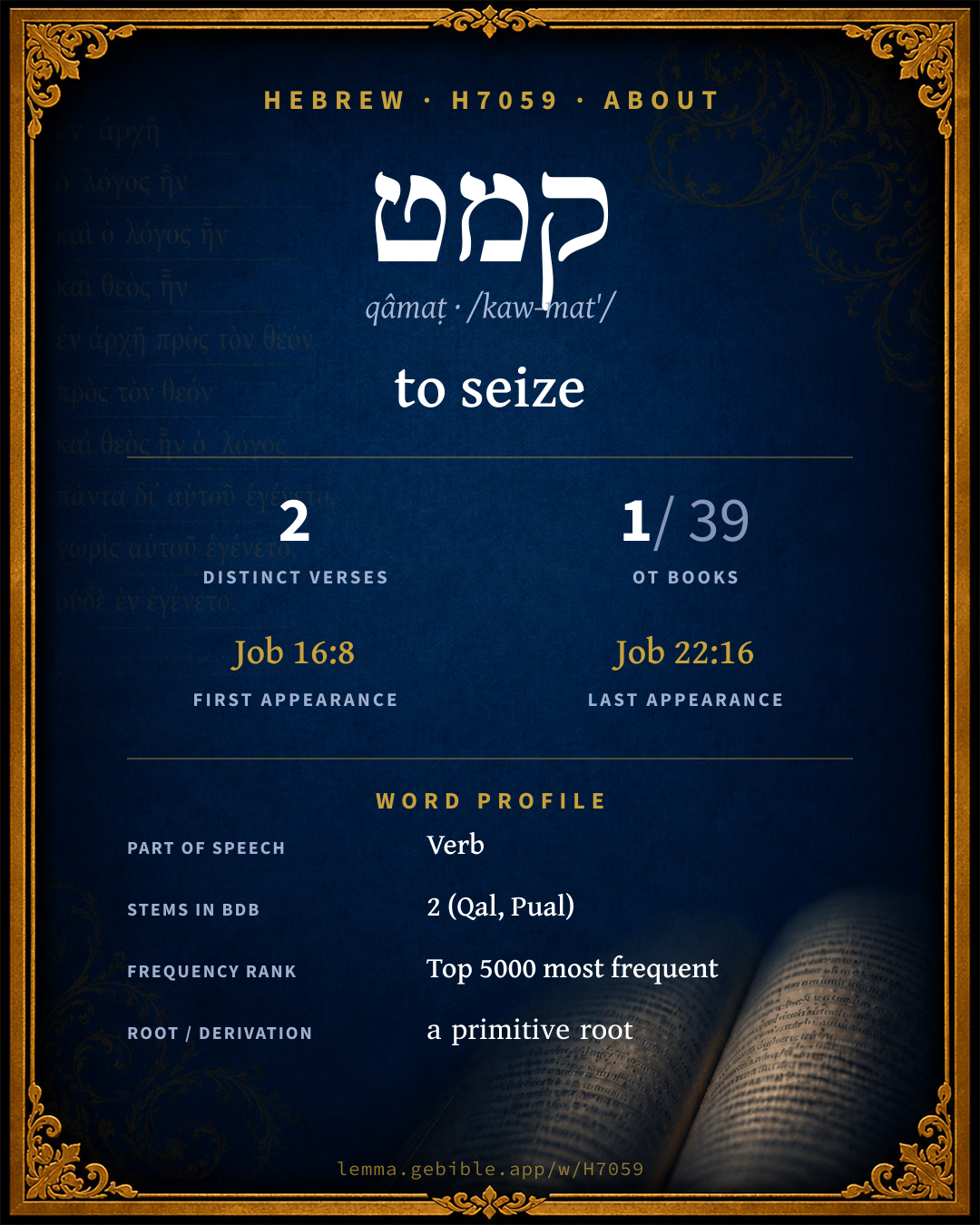
קָמַט
to seize
‘to seize’ is one of 3 main senses fuller range ↓
Full lexicon entry — Brown-Driver-Briggs (BDB)
From Brown-Driver-Briggs (BDB)
Where this word appears
See every Pual verb in the Hebrew Bible →
Grammar key — what these labels mean
Part of speech
- Verb
- An action or state-of-being word.
Stem
- Qal
- The basic, simple active stem — the plain form of the verb (“he wrote”). Here: ‘and thou didst seize me.’
- Pual
- The passive counterpart of the Piel.
Form
- Sequential Imperfect
- An imperfect with prefixed waw — the standard past-narrative form (waw-consecutive imperfect).
- Perfect
- A completed action or state — Hebrew marks aspect (completeness) more than strict tense (“he wrote”).
Person
- 2nd Person
- The one addressed (“you”).
- 3rd Person
- The one spoken about (“he / she / it / they”).
Gender
- Masculine
- Grammatically masculine.
- Common
- Either gender — not distinguished for this form.
Number
- Singular
- One.
- Plural
- More than one (in Hebrew, generally three or more).
Grammatical forms
- Verb, Qal, Sequential Imperfect, 2nd Person, Masculine, Singular 1 time (50%)
- Verb, Pual, Perfect, 3rd Person, Common, Plural 1 time (50%)
Parsed forms decoded from the imported morphology (morphhb / Westminster Leningrad Codex — WLC text public domain, morphhb tagging CC BY 4.0), counted across 2 parsed occurrences — not distinct verses.
Every verse where H7059 appears — 2 distinct verses across 1 book. Click any verse to open its interlinear word-by-word view. Verse text shown in the World English Bible for context — . Each verse’s Hebrew form is shown with its reference; the English is not keyword-highlighted, since the data carries no word-level English alignment. Use “Compare translations” on any verse to read it across multiple English versions. This concordance covers the Hebrew Bible; Septuagint (Greek Old Testament) occurrences are not indexed here.
Job 2 verses
About this entry
At a glance — auto-summarized from this page’s data, not written by a person. Every figure links to its source below. This summary describes the numbers; it doesn’t interpret them.
קמט — transliterated qâmaṭ — is a Hebrew verb carrying the sense “to seize.” With only 2 verses it sits in the long tail of Hebrew Bible vocabulary. More than three-quarters of its appearances fall in Job. It first appears in Job 16:8. The verb spans 2 stems, from Qal to Pual. See the sense tree, 2-verse concordance, and the renderings breakdown below.
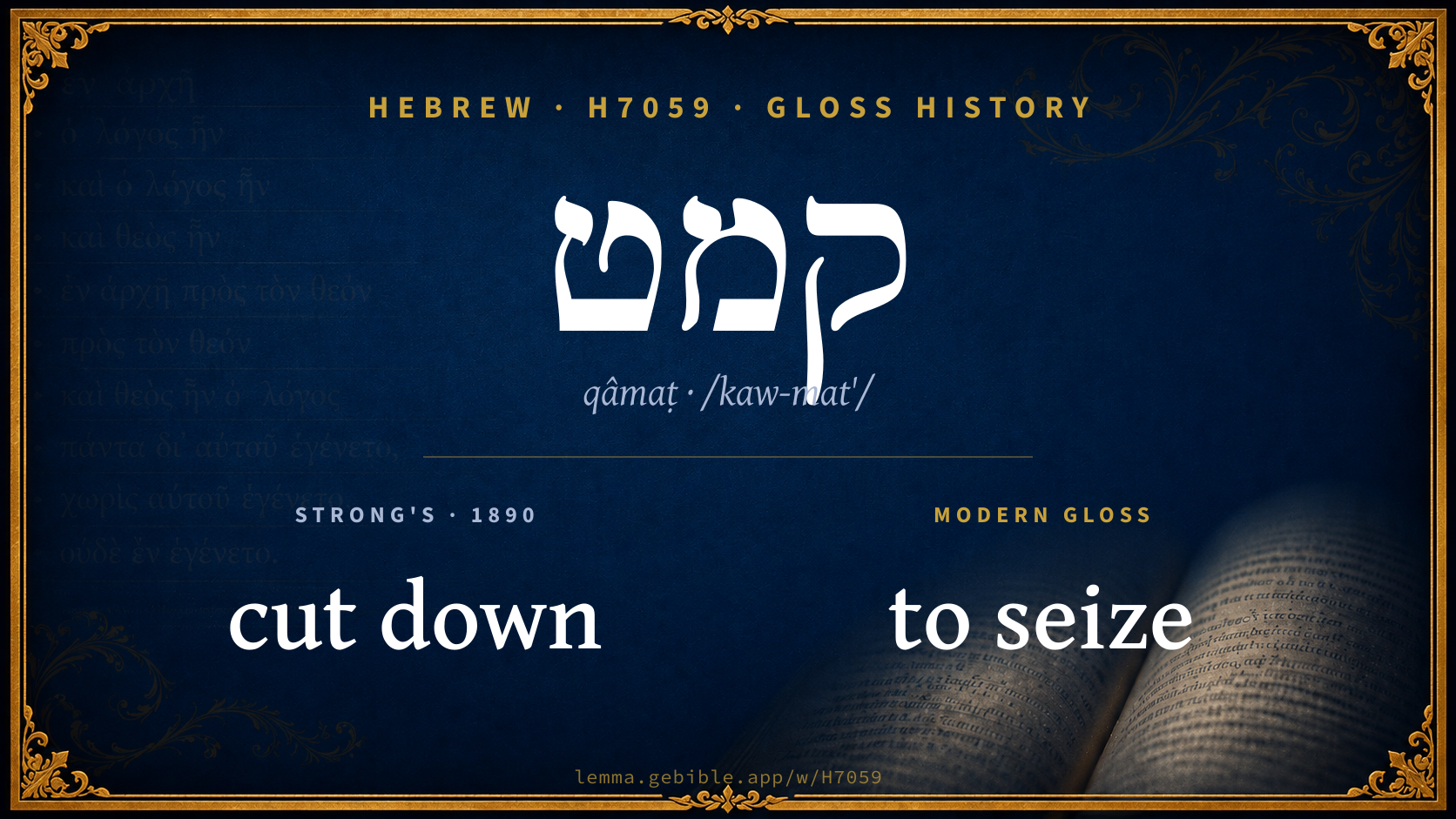
Gloss history
Strong's 1890 vs modern scholarship
About this word
Strong's H7059 catalogs a Hebrew word from the Hebrew Old Testament.
These counts are not copied from any lexicon or concordance. They are computed here, from the morphology-tagged Hebrew Old Testament. What Lemma adds →
- 2
- distinct verses
- The word appears in 2 distinct verses.
- 1 / 39
- OT books
- The word appears in 1 of 39 Old Testament books.
- #4,807
- by frequency
- Top 5000 most frequent Hebrew words (rank 4,807 of 8,640 Hebrew words by occurrence).
View all 2 occurrences in the concordance →
Most concentrated in
- Job 2 verses 100%
By section of the Old Testament
By traditional corpus
Conventional, traditional groupings — biblical authorship is debated, so this is a traditional corpus grouping, not an authorship claim. Each share is this word’s portion of its verses in that division of the Hebrew canon. Each figure is a share of the word’s 2 distinct verses.
- Writings (Ketuvim) 2 verses · 100%
How translations render this word
Counts come from each version’s own published word-to-Strong’s tagging or interlinear alignment — an approximate guide to how each version renders this word, not a word-level alignment the data otherwise carries. Because each total is that version’s own tagged count, the per-version totals vary from one another and need not match the appearance or distinct-verse counts above. These counts may also differ from a printed concordance because Lemma counts each distinctly tagged rendering and does not collapse phrase taggings into a single head-word total. This is a fixed set of word-tagged versions (KJV, ASV, BSB, ULT) and does not change with the reading translation you choose elsewhere. Each version’s license is shown beside its name below (and on Sources).
- King James Version: Thou hast filled me with wrinkles 1×, Were cut down 1×
- American Standard Version: Thou hast laid fast hold 1×, Were snatched away 1×
- Berean Standard Bible: Were snatched away 1×, You have bound me 1×
- unfoldingWord Literal Text: Were carried off 1×, You have shriveled me 1×
King James Version Public Domain
Renders H7059 across 2 tagged occurrences — most commonly:
American Standard Version Public Domain
Renders H7059 across 2 tagged occurrences — most commonly:
Berean Standard Bible Public Domain
Renders H7059 across 2 tagged occurrences — most commonly:
unfoldingWord Literal Text CC BY-SA 4.0
Renders H7059 across 2 tagged occurrences — most commonly:
Senses in the full BDB
Hebrew verbs can shift meaning by stem (binyan): Qal is the basic action, Niphal is often passive or reflexive, Piel often intensifies or makes it factitive, and Hiphil is typically causative. The senses below are grouped under the stem BDB assigns to each. This entry also uses Pual (the passive of Piel).
What do BDB’s symbols mean?
BDB uses these scholarly abbreviations:
| Symbol | Meaning |
|---|---|
| 𝔊 | the Septuagint (the ancient Greek translation, LXX) |
| 𝔙 | the Vulgate (the Latin translation) |
| 𝔖 | the Syriac version (the Peshitta) |
| 𝔗 | the Targum (the Aramaic translation) |
| ψ | the Psalms |
| √ | root (the underlying root or stem) |
| ‖ | parallel passage (a synonymous or contrasted parallel) |
| † | the dagger: every passage where the word occurs is cited |
The 2 senses and sub-senses the full Brown-Driver-Briggs lexicon distinguishes for this word, in lexicon order (not ranked by frequency), with BDB’s own verbatim wording and sub-sense lettering. Shown in Hebrew script with BDB’s own scholarly abbreviations. The condensed entry is in the Lexicon Entry tab. See also the Forms in the corpus table below.
Qal
- and thou didst seize me.
Pual
- . be snatched (untimely)
Senses from the full Brown-Driver-Briggs lexicon (Brown, Driver, Briggs; Oxford 1906 — public domain), digitized via Sefaria, supplemented by the OpenScriptures HebrewLexicon (CC BY 4.0). Full attribution on Sources.
Word origin
Origin: a primitive root
Jastrow Dictionary
A second Hebrew/Aramaic lexicon for comparison, covering Aramaic and post-biblical (Talmudic, Targumic, Midrashic) usage that the biblical-Hebrew BDB does not. Matched by lemma rather than by Strong’s number, so a lemma may carry more than one Jastrow headword (shown separately below), and the entries cover usage well beyond the Bible.
קָמַט
- (b. h.) to compress; (neut. verb) to contract, curl. Yalk. Gen. 151 מעי קוֹמְטִין עלי וכ׳ (Ar. קמתין, corr. acc.) my bowels curl themselves within me like a rope (cmp. קָמַז).—Part. pass. קָמוּט folded, creased. Tosef. Neg. I, 8 כק׳ שנפשט like a folded sheet that has been straightened out.
- 1. to fold, wrinkle. Ḥag. 14ᵃ (ref. to Job XXII, 16 קמטו) אלו … שמְקַמְּטִין עצמן וכ׳ that means the students that wrinkle themselves (cause wrinkles on their foreheads) over the words of the Law; Yalk. Job 908.—Part. pass. מְקוּמָּט. Tosef. Neg. l. c. סדין המק׳ a creased sheet, v. פָּשַׁט. e.g. Job 22:16
- 2. to press, crowd. Ḥag. 13ᵇ sq. (ref. to Job l. c.) שקִימְּטוּ עצמן להיבראות וכ׳ Ms. M. 2 (v. Rabb. D. S. a. l. note 20) who pressed themselves (rushed) forward to be created before the world was created, v. infra.
- to be crowded, rushed. Ib. על אשר קוּמְּטוּ בלא עת Ms. M. because they rushed (to be created) before their time; Yalk. Jer. 304.—Part. מְקוּמָּט, v. supra.
קְמַט
- , ch. same, to seize, hold fast; to tie. Targ. Prov. IV, 4 (ed. Wil. יְקַמֵּט Pa.; h. text תמך). Ib. V, 22 (h. text לכד).—Sabb. 110ᵃ קָמֵיט ליה, v. infra.—Part. pass. קָמִיט bound, constipated. Yeb. 64ᵇ איכא … דק׳ דמא there are families in which the blood is tied up (whose members bleed little when wounded), opp. דרפי דמא who bleed profusely. Pes. 42ᵇ דק׳ מרפא ליה ודרפא מַקְמִיט ליה on him who is constipated it acts as a laxative, and him who is loose it constipates; Sabb. l. c. דק׳ … קָמֵיט ליה.
- 1. to press down, double; to tie. Targ. Prov. IV, 4, v. supra.—Snh. 95ᵃ תפשיה וקַמְּטֵיח Ar. he seized and tied him (ed. כפתיה קמטיה he tied him, he pressed him down); Yalk. Sam. 155 נקטיה וק׳. Gitt. 47ᵃ בעינא מְקַמְּטִינְכוּ וכ׳ Ar. (ed. אַקְמְטִינְכוּ, Rashi אִיקַמְּטִי׳) I want to tie you; קַמְּטִינְהוּ he did tie them.
- 2. to cause constipation. Pes. l. c.; Sabb. l. c., v. supra.
*קָמֵט
- (preced.; cmp. קוּץ I) [shrinking,] feeling aversion. Yalk. Lev. 626, v. קיּץ I.
קֶמֶט
- (preced. wds.) fold, crease, wrinkle, crumple. Neg. VII, 1 בק׳ ונגלה when the white spot was covered up by a wrinkle, and then became visible; Tosef. ib. II, 13 והק׳ שנפשט. Nidd. V, 8 משיעלה הק׳ וכ׳ when wrinkles are formed under the breast; expl. ib. 47ᵃ כדי שתחזיר ידיה … הק׳ וכ׳ when she turns her arm backwards, and it has the appearance as if there were wrinkles; a. e.—Pl. קְמָטִים, קְמָטִין. Neg. VI, 8 הק׳ והק׳ שבצואר וכ׳ the folds on the body (armpit &c., v. קוּמָּט), and the folds on the neck &c. Mikv. VIII, 5 בית הק׳ parts of the body which have folds, contrad. to בית הסתרים, v. סֵתֶר; Nidd. 66ᵇ. Ib. בית קְמָטֶיהָ. B. Bath. 120ᵃ, v. עָדַן; a. e.
A Dictionary of the Targumim, the Talmud Babli and Yerushalmi, and the Midrashic Literature (Marcus Jastrow; London, Luzac, 1903) — Public Domain. Digitized via Sefaria. Digitized via Sefaria. Full attribution on Sources.
Forms in the corpus
The 2 distinct written forms H7059 takes in the Hebrew Bible, most frequent first — each parse links to that stem’s occurrences in the concordance. Hebrew forms include their vowel points and cantillation, so a single lemma takes many written forms.
| Form | Parsing | Example | Uses |
|---|---|---|---|
| וַֽ֭/תִּקְמְטֵ/נִי | Verb, Qal, Sequential Imperfect, 2nd Person, Masculine, Singular | Job 16:8 | 1 |
| קֻמְּט֥וּ | Verb, Pual, Perfect, 3rd Person, Common, Plural | Job 22:16 | 1 |
Septuagint verse parallels
This word appears in 2 verses that also exist in the Greek Old Testament (Septuagint), out of the 2 Hebrew verses it occurs in. You can read those verses in Greek by switching the Old Testament edition to the Septuagint.
Read these verses in the Septuagint
This is a verse-level parallel only — the same verses exist in both the Hebrew and Greek Old Testaments. No word-level Hebrew↔Greek correspondence is claimed: the data carries no such alignment, so no Greek word is shown as this Hebrew word’s translation. Coverage is not total — the Septuagint omits the deuterocanon and renumbers the Psalms, so some Hebrew verses have no direct Greek parallel.