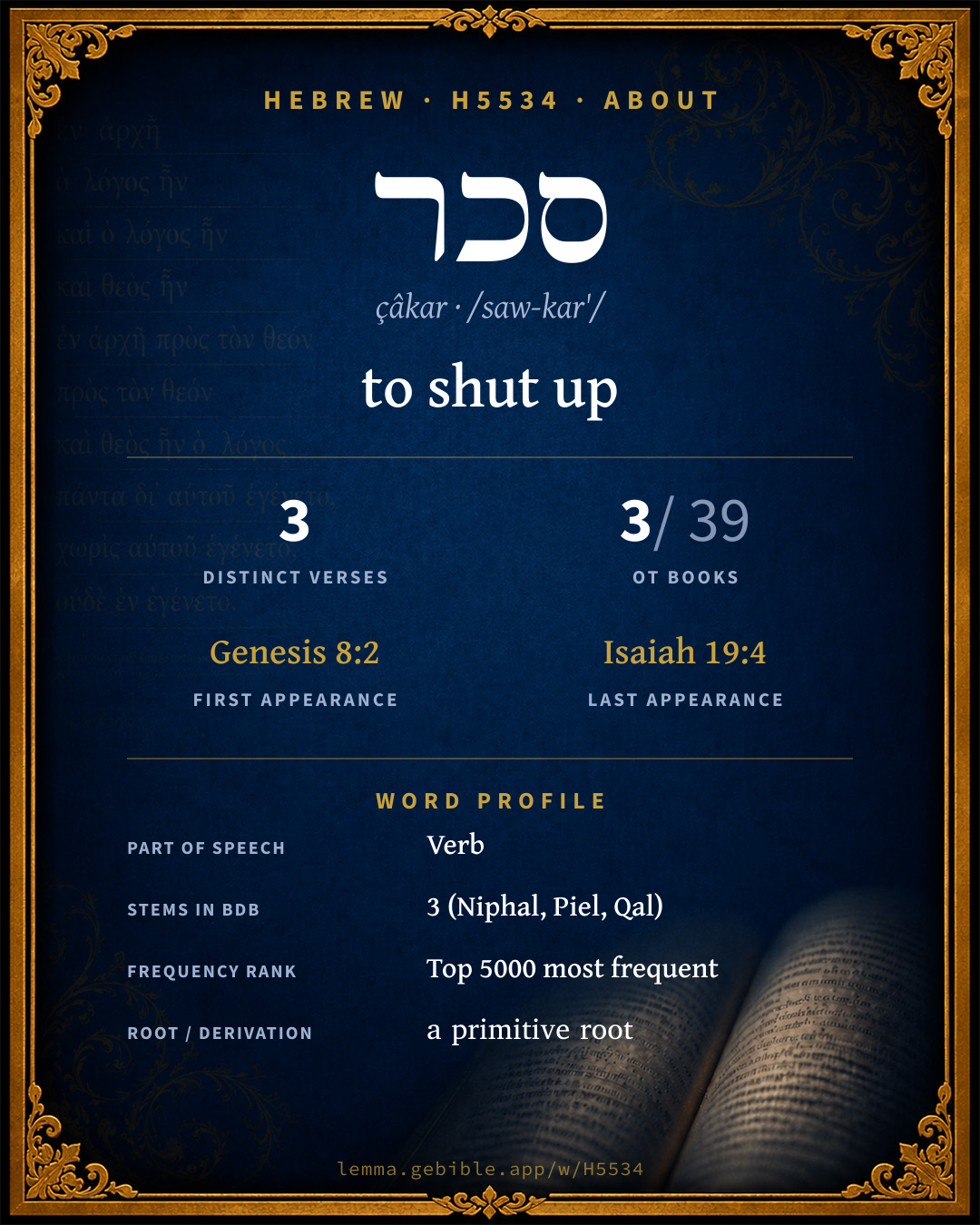
סָכַר
to shut up
‘to shut up’ is one of 3 main senses fuller range ↓
Full lexicon entry — Brown-Driver-Briggs (BDB)
From Brown-Driver-Briggs (BDB)
Where this word appears
See every Niphal verb in the Hebrew Bible →
Grammar key — what these labels mean
Part of speech
- Verb
- An action or state-of-being word.
Stem
- Niphal
- Usually the simple passive or reflexive of the Qal (“he was written”).
- Piel
- An intensive or resultative active stem.
Form
- Sequential Imperfect
- An imperfect with prefixed waw — the standard past-narrative form (waw-consecutive imperfect).
- Sequential Perfect
- A perfect with prefixed waw continuing a preceding imperfect or command (waw-consecutive perfect).
- Imperfect
- An incomplete, ongoing, or future action (“he will / would write”).
Person
- 3rd Person
- The one spoken about (“he / she / it / they”).
- 1st Person
- The speaker (“I / we”).
Gender
- Masculine
- Grammatically masculine.
- Common
- Either gender — not distinguished for this form.
Number
- Plural
- More than one (in Hebrew, generally three or more).
- Singular
- One.
Grammatical forms
- Verb, Niphal, Sequential Imperfect, 3rd Person, Masculine, Plural 1 time (33%)
- Verb, Piel, Sequential Perfect, 1st Person, Common, Singular 1 time (33%)
- Verb, Niphal, Imperfect, 3rd Person, Masculine, Singular 1 time (33%)
Parsed forms decoded from the imported morphology (morphhb / Westminster Leningrad Codex — WLC text public domain, morphhb tagging CC BY 4.0), counted across 3 parsed occurrences — not distinct verses.
Every verse where H5534 appears — 3 distinct verses across 3 books. Click any verse to open its interlinear word-by-word view. Verse text shown in the World English Bible for context — . Each verse’s Hebrew form is shown with its reference; the English is not keyword-highlighted, since the data carries no word-level English alignment. Use “Compare translations” on any verse to read it across multiple English versions. This concordance covers the Hebrew Bible; Septuagint (Greek Old Testament) occurrences are not indexed here.
Genesis 1 verse
Psalms 1 verse
Isaiah 1 verse
About this entry
At a glance — auto-summarized from this page’s data, not written by a person. Every figure links to its source below. This summary describes the numbers; it doesn’t interpret them.
סכר — transliterated çâkar — is a Hebrew verb carrying the sense “to shut up.” With only 3 verses it sits in the long tail of Hebrew Bible vocabulary. More than a third of its appearances fall in Genesis. Debuting at Genesis 8:2, it then recurs through the corpus. Across 3 stems, its meaning turns on the binyan (Niphal, Piel). See the sense tree, 3-verse concordance, and the renderings breakdown below.
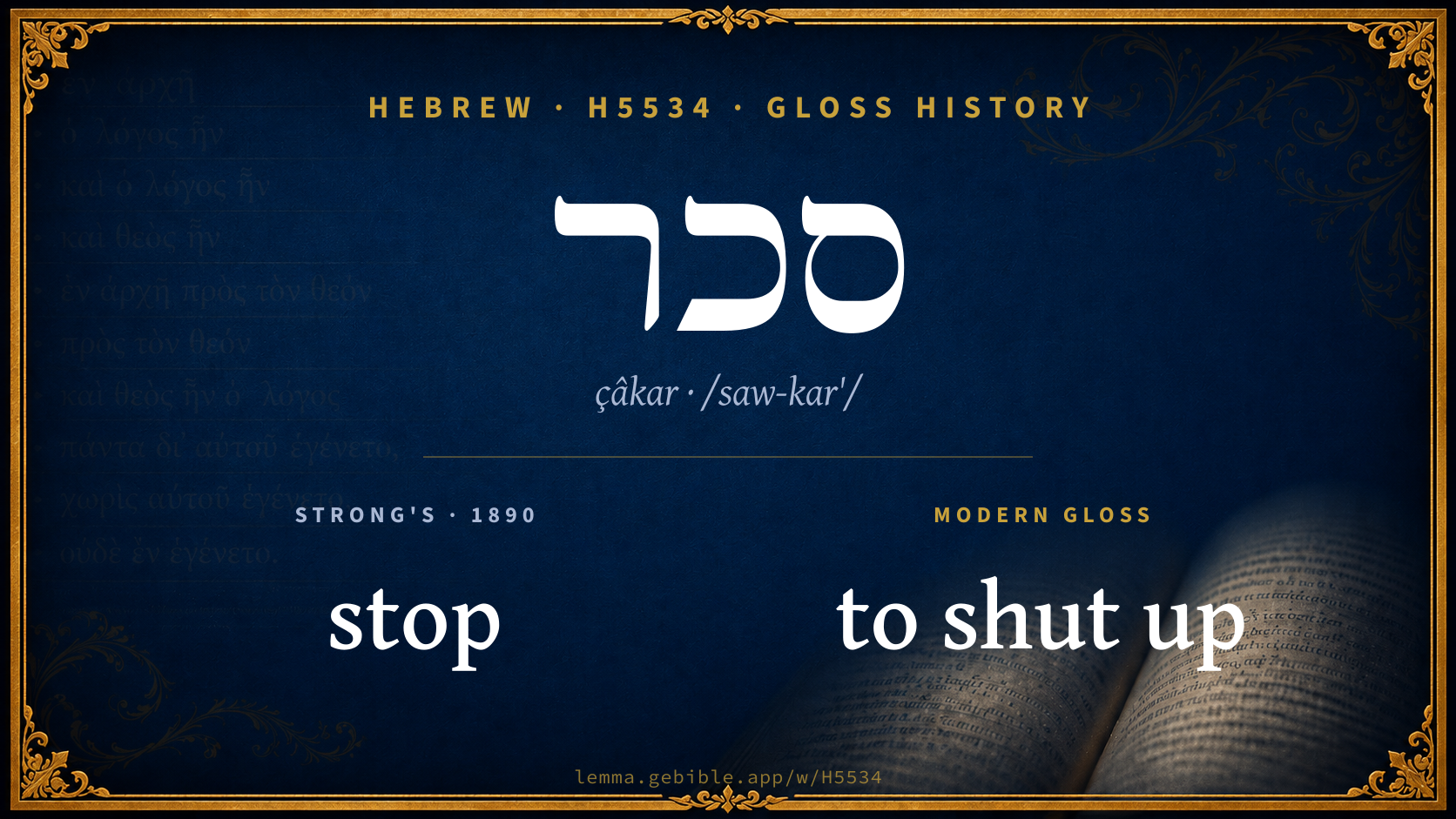
Gloss history
Strong's 1890 vs modern scholarship
About this word
Strong's H5534 catalogs a Hebrew word from the Hebrew Old Testament.
These counts are not copied from any lexicon or concordance. They are computed here, from the morphology-tagged Hebrew Old Testament. What Lemma adds →
- 3
- distinct verses
- The word appears in 3 distinct verses.
- 3 / 39
- OT books
- The word appears in 3 of 39 Old Testament books.
- #4,179
- by frequency
- Top 5000 most frequent Hebrew words (rank 4,179 of 8,640 Hebrew words by occurrence).
View all 3 occurrences in the concordance →
By section of the Old Testament
By traditional corpus
Conventional, traditional groupings — biblical authorship is debated, so this is a traditional corpus grouping, not an authorship claim. Each share is this word’s portion of its verses in that division of the Hebrew canon. Each figure is a share of the word’s 3 distinct verses.
- Torah (Pentateuch) 1 verse · 33%
- Prophets (Nevi'im) 1 verse · 33%
- Writings (Ketuvim) 1 verse · 33%
How translations render this word
Counts come from each version’s own published word-to-Strong’s tagging or interlinear alignment — an approximate guide to how each version renders this word, not a word-level alignment the data otherwise carries. Because each total is that version’s own tagged count, the per-version totals vary from one another and need not match the appearance or distinct-verse counts above. These counts may also differ from a printed concordance because Lemma counts each distinctly tagged rendering and does not collapse phrase taggings into a single head-word total. This is a fixed set of word-tagged versions (KJV, ASV, BSB, ULT) and does not change with the reading translation you choose elsewhere. Each version’s license is shown beside its name below (and on Sources).
BDB lists this Strong’s number as 2 distinct words (homographs). Each count above pools all of them and is not split by sense — see the Senses section below. A low-frequency rendering may belong to a different one of those words, not the primary meaning.
- King James Version†: Shall be stopped 1×, Were stopped 1×, Will i give over 1×
- American Standard Version†: I will give over 1×, Shall be stopped 1×, Were stopped 1×
- Berean Standard Bible†: I will deliver 1×, Were closed 1×, Will be shut 1×
- unfoldingWord Literal Text†: And 1×, I will deliver 1×, Were closed 1×
King James Version Public Domain
Renders H5534 across 3† tagged occurrences — most commonly:
Not rendered by a distinct English word in 1 further occurrence.
American Standard Version Public Domain
Renders H5534 across 3† tagged occurrences — most commonly:
Berean Standard Bible Public Domain
Renders H5534 across 3† tagged occurrences — most commonly:
unfoldingWord Literal Text CC BY-SA 4.0
Renders H5534 across 4† tagged occurrences — most commonly:
Senses in the full BDB
Hebrew verbs can shift meaning by stem (binyan): Qal is the basic action, Niphal is often passive or reflexive, Piel often intensifies or makes it factitive, and Hiphil is typically causative. The senses below are grouped under the stem BDB assigns to each.
What do BDB’s symbols mean?
BDB uses these scholarly abbreviations:
| Symbol | Meaning |
|---|---|
| 𝔊 | the Septuagint (the ancient Greek translation, LXX) |
| 𝔙 | the Vulgate (the Latin translation) |
| 𝔖 | the Syriac version (the Peshitta) |
| 𝔗 | the Targum (the Aramaic translation) |
| ψ | the Psalms |
| √ | root (the underlying root or stem) |
| ‖ | parallel passage (a synonymous or contrasted parallel) |
| † | the dagger: every passage where the word occurs is cited |
The 3 senses and sub-senses the full Brown-Driver-Briggs lexicon distinguishes for this word, in lexicon order (not ranked by frequency), with BDB’s own verbatim wording and sub-sense lettering. Shown in Hebrew script with BDB’s own scholarly abbreviations. The condensed entry is in the Lexicon Entry tab. See also the Forms in the corpus table below.
סכר I shut up, stop up (Aramaic סְכַר, ܣܟܰܪ shut up, stop up, dam up
Niphal
- Impf. 3 ms. יִסָּכֵר פִּי וגו׳ ψ 63:12 the mouth of liars shall be stopped; 3 mpl. וַיִּסָּֽכְרוּ Gn 8:2 (P) and the springs of the deep etc., were shut up. e.g. Psalms 63:12
Piel
- Pf. וְסִכַּרְתִּ֫י אֶת־מִצְרַיִם בְּיַד Is 19:4 and I will shut up (deliver) Egypt into the hand of, etc. (cf. סגר, מגן). e.g. Isaiah 19:4
סכר II hire ( = שָׂכַר
Qal
- Pt. pl. וְסֹכְרִים Ezr 4:5 and hiring against (על) them agents. e.g. Ezra 4:5
Senses from the full Brown-Driver-Briggs lexicon (Brown, Driver, Briggs; Oxford 1906 — public domain), digitized via Sefaria, supplemented by the OpenScriptures HebrewLexicon (CC BY 4.0). Full attribution on Sources.
Word origin
I. vb. shut up, stop up (Aramaic סְכַר, ܣܟܰܪ shut up, stop up, dam up; Arabic سَكَرَ fill, stop up, dam (river), etc., also close, stop up door, Lane1390; Assyrian sikệru, dam up, ii. 2. stop ears; cf. sikkuru, bolt DlHWB 499; appar. kindr. with סגר;—hence Egyptian t’akar, barrier, Bondi88);—
II. vb. hire ( = שָׂכַר; ס erroneously for שׂ);—only
— Brown-Driver-Briggs (Oxford 1906, public domain), digitized via Sefaria, supplemented by the OpenScriptures HebrewLexicon (CC BY 4.0). See Sources.
Origin: a primitive root
Jastrow Dictionary
A second Hebrew/Aramaic lexicon for comparison, covering Aramaic and post-biblical (Talmudic, Targumic, Midrashic) usage that the biblical-Hebrew BDB does not. Matched by lemma rather than by Strong’s number, so a lemma may carry more than one Jastrow headword (shown separately below), and the entries cover usage well beyond the Bible.
סָכַר
- to bar, dam in; to stop, choke; v. אַסְכָּרָה.
- to be choked, stopped. Tanḥ. P’kudé 2 יִסָּכֵר פיהם של וכ׳ let the mouth of the nations be stopped.
- to be dammed in; trnsf. (cmp. Is. XIX, 4) to be hindered, curbed. Y. Hor. III, 48ᶜ top צפה … להַיסְתַּכֵּר במלכיות וכ׳ (Var. להִיסְתַּכֵּךְ) Moses divined that the Israelites would be curbed (oppressed) by foreign governments, and their chiefs would stand by them (protect them). e.g. Isaiah 19:4
סְכַר I
- Gitt. 60ᵇ במִיסְכַּר ואשקויי as to damming (the canal) and using the water for irrigation. Ib. סְכַר מיסכר ואשקי וכ׳ dam thou the canal, but &c., v. הַנְדְּזָא
- same. Targ. Prov. XXI, 13. Ib. XXVIII, 9 דמְסַכַּר Ms. (ed. מַסְכִּיר Af.).—Sabb. 109ᵇ נְסַכְּרִינוּן וכ׳ let them stop up his orifices (ears and nose).
- to be dammed in, closed. Targ. O. Gen. VIII, 2 (Y. אסתגר).—B. Mets. 106ᵇ א׳ נהר מלכא סבא the Old King’s Canal became obstructed (and the waters took a different direction). Ib. לא עביד דמִסְתַּכַּר Ms. F. a. oth. (ed. דמִיסְּכַר) it is unusual (for this canal) to be obstructed.
סְכַר II
- , Pa. סַכַּר a. Po. סוֹכַר (cmp. סְבַר III a. כְּרֵי) [to bore, dig,] to let blood. Gitt. 67ᵇ לשימשא … בת תרי יומי סַכּוּרֵי for sunstroke … on the second day blood-letting is indicated (some ed. סִיכּוּרֵי pl. noun). Pes. 112ᵃ, a. e. מְסוֹכַר (interch. with סְבַר III).
סַכָּר
- (סָכַר) maker of water-locks for fishing purposes, fisherman. — Pl. סַכָּרִין. Kel. XXIII, 5 מצודות הס׳ the skeins of the fishermen.
A Dictionary of the Targumim, the Talmud Babli and Yerushalmi, and the Midrashic Literature (Marcus Jastrow; London, Luzac, 1903) — Public Domain. Digitized via Sefaria. Digitized via Sefaria. Full attribution on Sources.
Forms in the corpus
The 3 distinct written forms H5534 takes in the Hebrew Bible, most frequent first — each parse links to that stem’s occurrences in the concordance. Hebrew forms include their vowel points and cantillation, so a single lemma takes many written forms.
| Form | Parsing | Example | Uses |
|---|---|---|---|
| וְ/סִכַּרְתִּי֙ | Verb, Piel, Sequential Perfect, 1st Person, Common, Singular | Isaiah 19:4 | 1 |
| וַ/יִּסָּֽכְרוּ֙ | Verb, Niphal, Sequential Imperfect, 3rd Person, Masculine, Plural | Genesis 8:2 | 1 |
| יִ֝סָּכֵ֗ר | Verb, Niphal, Imperfect, 3rd Person, Masculine, Singular | Psalms 63:11 | 1 |
Septuagint verse parallels
This word appears in 3 verses that also exist in the Greek Old Testament (Septuagint), out of the 3 Hebrew verses it occurs in. You can read those verses in Greek by switching the Old Testament edition to the Septuagint.
Read these verses in the Septuagint
This is a verse-level parallel only — the same verses exist in both the Hebrew and Greek Old Testaments. No word-level Hebrew↔Greek correspondence is claimed: the data carries no such alignment, so no Greek word is shown as this Hebrew word’s translation. Coverage is not total — the Septuagint omits the deuterocanon and renumbers the Psalms, so some Hebrew verses have no direct Greek parallel.