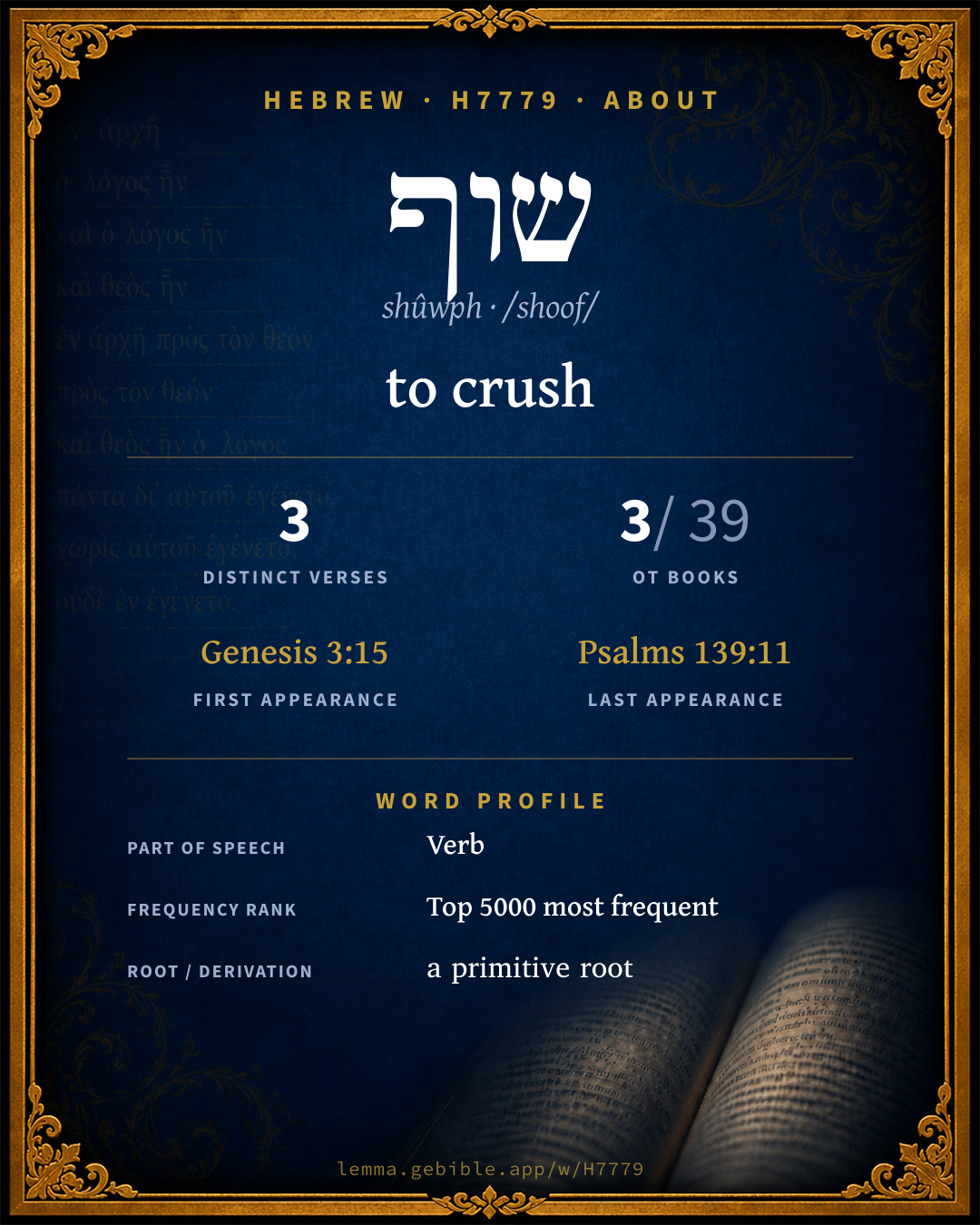
שׁוּף
to crush
‘to crush’ is one of 2 main senses fuller range ↓
Full lexicon entry — Brown-Driver-Briggs (BDB)
From Brown-Driver-Briggs (BDB)
Where this word appears
Grammar key — what these labels mean
Part of speech
- Verb
- An action or state-of-being word.
Stem
- Qal
- The basic, simple active stem — the plain form of the verb (“he wrote”).
Form
- Imperfect
- An incomplete, ongoing, or future action (“he will / would write”).
Person
- 3rd Person
- The one spoken about (“he / she / it / they”).
- 2nd Person
- The one addressed (“you”).
Gender
- Masculine
- Grammatically masculine.
Number
- Singular
- One.
Grammatical forms
- Verb, Qal, Imperfect, 3rd Person, Masculine, Singular 3 times (75%)
- Verb, Qal, Imperfect, 2nd Person, Masculine, Singular 1 time (25%)
Parsed forms decoded from the imported morphology (morphhb / Westminster Leningrad Codex — WLC text public domain, morphhb tagging CC BY 4.0), counted across 4 parsed occurrences — not distinct verses.
Every verse where H7779 appears — 3 distinct verses across 3 books. Click any verse to open its interlinear word-by-word view. Verse text shown in the World English Bible for context — . Each verse’s Hebrew form is shown with its reference; the English is not keyword-highlighted, since the data carries no word-level English alignment. Use “Compare translations” on any verse to read it across multiple English versions. This concordance covers the Hebrew Bible; Septuagint (Greek Old Testament) occurrences are not indexed here.
Genesis 1 verse
Job 1 verse
Psalms 1 verse
About this entry
At a glance — auto-summarized from this page’s data, not written by a person. Every figure links to its source below. This summary describes the numbers; it doesn’t interpret them.
The Hebrew verb שוף centers on the idea of “to crush.” It occurs a mere 3 verses across Scripture. The word gravitates to Genesis (33%), then Job and Psalms. First canonically at Genesis 3:15, it enters the text early. Lexicons map it across 2 senses. For the data behind this summary, explore the sense tree and the renderings breakdown below.
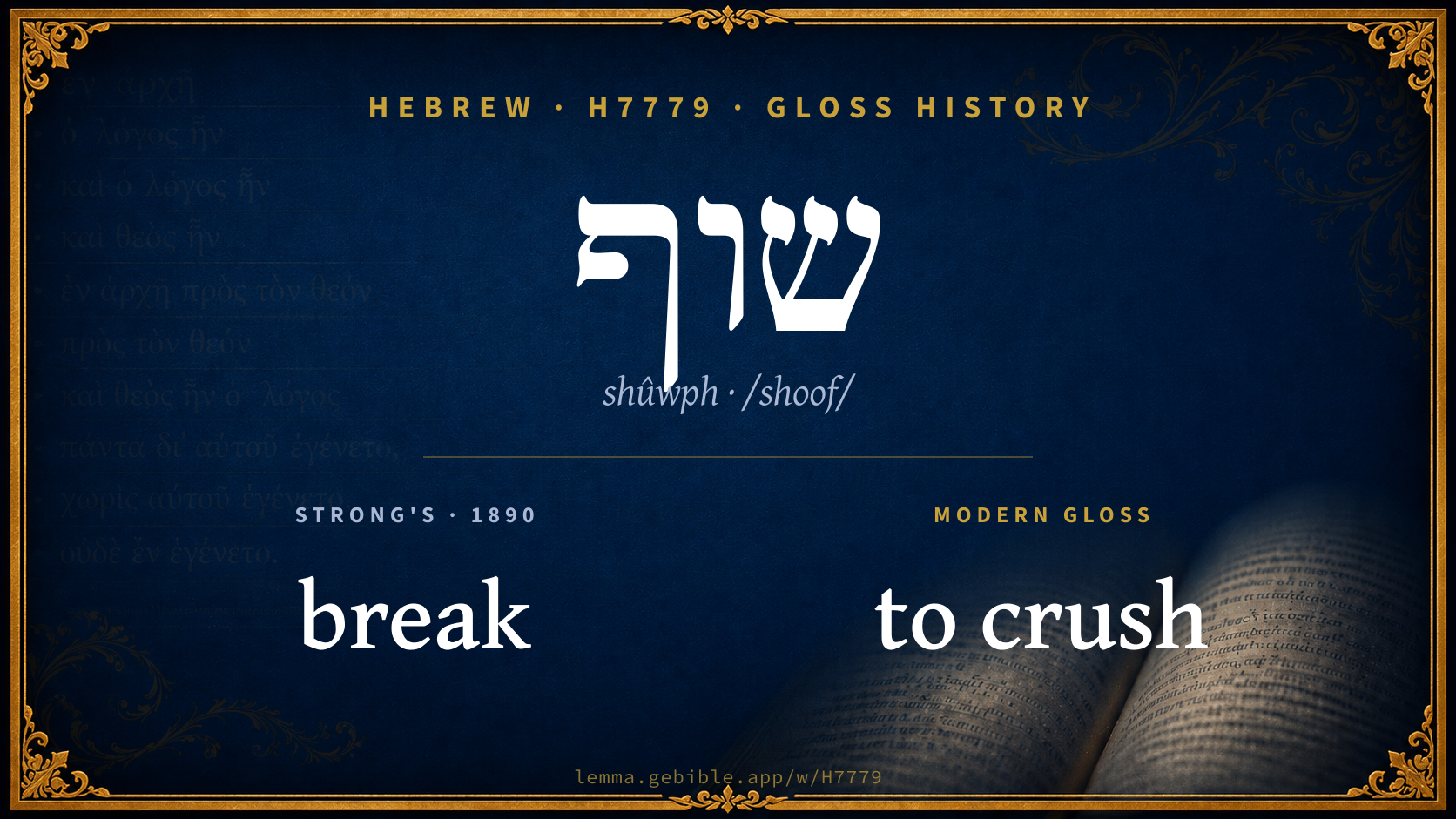
Gloss history
Strong's 1890 vs modern scholarship
About this word
Strong's H7779 catalogs a Hebrew word from the Hebrew Old Testament.
These counts are not copied from any lexicon or concordance. They are computed here, from the morphology-tagged Hebrew Old Testament. What Lemma adds →
- 3
- distinct verses
- The word appears in 3 distinct verses.
- 3 / 39
- OT books
- The word appears in 3 of 39 Old Testament books.
- #3,696
- by frequency
- Top 5000 most frequent Hebrew words (rank 3,696 of 8,640 Hebrew words by occurrence).
View all 3 occurrences in the concordance →
By section of the Old Testament
By traditional corpus
Conventional, traditional groupings — biblical authorship is debated, so this is a traditional corpus grouping, not an authorship claim. Each share is this word’s portion of its verses in that division of the Hebrew canon. Each figure is a share of the word’s 3 distinct verses.
- Writings (Ketuvim) 2 verses · 67%
- Torah (Pentateuch) 1 verse · 33%
How translations render this word
Counts come from each version’s own published word-to-Strong’s tagging or interlinear alignment — an approximate guide to how each version renders this word, not a word-level alignment the data otherwise carries. Because each total is that version’s own tagged count, the per-version totals vary from one another and need not match the appearance or distinct-verse counts above. These counts may also differ from a printed concordance because Lemma counts each distinctly tagged rendering and does not collapse phrase taggings into a single head-word total. This is a fixed set of word-tagged versions (KJV, ASV, BSB, ULT) and does not change with the reading translation you choose elsewhere. Each version’s license is shown beside its name below (and on Sources).
- King James Version: He breaketh 1×, Shall bruise 1×, Shall cover 1×
- American Standard Version: He breaketh 1×, He shall bruise 1×, Shall overwhelm 1×
- Berean Standard Bible: He would crush me 1×, Will crush 1×, Will hide me 1×
- unfoldingWord Literal Text: Will crush me 1×, Will strike him 1×, Will strike you 1×
King James Version Public Domain
Renders H7779 across 4 tagged occurrences — most commonly:
American Standard Version Public Domain
Renders H7779 across 4 tagged occurrences — most commonly:
Berean Standard Bible Public Domain
Renders H7779 across 4 tagged occurrences — most commonly:
unfoldingWord Literal Text CC BY-SA 4.0
Renders H7779 across 4 tagged occurrences — most commonly:
Senses in BDB
The 2 senses BDB distinguishes for this word, in lexicon order (not ranked by frequency or importance). The full entry — with sub-senses — is in the Lexicon Entry tab.
- to bruise, crush, gape upon, desire?, seize?, strike out?
- (Qal) to fall upon, bruise
Word origin
Origin: a primitive root
Jastrow Dictionary
A second Hebrew/Aramaic lexicon for comparison, covering Aramaic and post-biblical (Talmudic, Targumic, Midrashic) usage that the biblical-Hebrew BDB does not. Matched by lemma rather than by Strong’s number, so a lemma may carry more than one Jastrow headword (shown separately below), and the entries cover usage well beyond the Bible.
שׁוּף
- to blow. Num. R. s. 5, beg. וכיון … היתה האש שָׁפָה וכ׳ when the sparks (preceding the march of the Israelites) went forth, the fire blew (was wafted) towards those carrying the Ark; a. e.—Esp. (of the serpent, cmp. שָׂרָף; v. נָשַׁף) to emit poisonous breath, to poison. Midr. Till. to Ps. XCII (ref. to Ps. CXXXIX, 11) והיה יושב … וִישׁוּפֵנִי עקב and he (Adam) sat thinking in his heart, perchance the serpent that led me astray on the Sabbath eve will come and poison me in the heel. Lev. R. s. 15, end; Gen. R. s. 16; Yalk. ib. 22, v. נָשַׁף. e.g. Psalms 139:11
שׁוּף II
- 1. to smooth, rub, polish, sharpen; to smear over, plaster. Kel. XIV, 5 משיְשׁוּפֶינּוּ (Mish. ed. משישׁוּפֶנּוּ; Ar. משיְשַׁפֶּנּוּ, fr. שָׁפָה I) a sword becomes susceptible of uncleanness when it is furbished. Ib. XVI, 1 משיְשׁוּפם בעור הדג when he smooths them by rubbing with the skin of a fish; Snh. 20ᵇ; Ned. 56ᵇ משיְשַׁפֵּם (Rashi משישופם). Kel. l. c. גמר שלא לָשׁוּף if he decided not to smooth them. Y. Ber. III, 5ᵈ bot. לאיזה דבר הוא שָׁפָהּ for what purpose should he polish it? Ḥull. 25ᵃ, sq.; Tosef. Kel. B. Mets. II, 10. Tosef. Toh. VI, 12 ושָׁפָה את רוקו and she rubbed his spittle off (with her foot); שָׁפוֹת וכ׳ (להיות) … שכן for it is the habit of Israelitish women during menstruation to rub off &c. Y. Sabb. VII, 10ᵇ top רוקק ושָׁף he spits on the stone pavement and rubs it out (with his foot). M. Kat. I, 10 שָׁפִין את הסדקין you may plaster over the rifts in the roof (during the festive week). Sabb. XX, 3 ולא שפין אותן nor must you rub them (with the hand to cleanse them). Eduy. I, 8 שורין ושפין וכ׳ you must observe levitical cleanness when you soak them and rub (your body) with them. Sabb. 75ᵇ השף בין העמודים he who rubs (smooths skins) between columns; Y. ib. VII, 10ᶜ bot. השף את העור על גבי העמוד. Kel. XXX, 1 שָׁפָן בשופין files them with a file. Pes. II, 7 אבל שָׁפָה היא וכ׳ but she may rub (the bran) dry over her body (to soften her skin); a. fr.
- 2. to run smoothly, glide. Gen. R. s. 6; Midr. Sam. ch. IX.
- 3. (b. h.) to grind, crush, stamp. Sifré Deut. 315 שיהו חטים שָׁפוֹת זו וכ׳ that wheat grains rub against one another and drop &c., v. סֹלֶת; Yalk. ib. 944.—Midr. Till. to Ps. IV, 7 וישראל … ואתם באים לָשׁוּף אותה מן העקב and the Israelites say to them (the gentiles asking for a share in the hereafter), in how many troubles … we surrendered our lives for the sanctification of the Lord, and you want to stamp it (all this good) out of your heels (out of the ground)?; (ed. Bub. אותם על העקב, corr. acc.); Yalk. ib. 627 לשוף עצמיכם מן העקב (corr. acc.).—[Midr. Till. to Ps. XCII וישופני עקב, v. שׁוּף I.]
- 1. to be rubbed off, made smooth, level. Tosef. B. Kam. X, 4 מטבע ונ׳ if he took by force a coin, and it became rubbed off (effaced).
- 2. to be ground, crushed. Tosef. B. Mets. XI, 8 מוציא אדם זבלו … כדי שיִישּׁוֹף וכ׳ a man may take out his material for dung and place it in front of his house, that it may be stamped upon by the feet of man and beast; B. Kam. 30ᵃ; 81ᵇ; B. Mets. 118ᵇ כדי שיהא נישוף. B. Kam. 28ᵇ נשוף באבן (Ms. F. ונושף, read: נִישָּׁף) was smashed against a stone; (Y. ib. III, 3ᶜ top נחבט).—V. שָׁפַף.
שׁוּף ²
- 1. to rub (with oil), anoint; to rub off. Targ. II Sam. XII, 20. Ib. XIV, 2. Targ. O. Deut. XXVIII, 40 ed. Berl. (oth. ed. סוך); a. e.—Pes. 25ᵇ דשָׁיֵיף לה וכ׳ as he was rubbing his (sick) daughter’s skin with undeveloped grapes of ʿOrlah. B. Kam. 23ᵇ דשָׁף צלמי when the animal in scratching itself rubbed figures off (which were on the wall).—Part. pass. שִׁיף, שִׁיפָא. Ab. Zar. 52ᵇ, v. דִּינָרָא.
- 2. to grind, crush, file. Targ. O. Deut. IX, 21 (Y. שפיית, fr. שְׁפֵי). Targ. Ps. XCIV, 5. Targ. Job XIV, 19; a. e.—[Snh. 64ᵃ דשייף קליה, v. שְׁאֵב.]
- same, to rub, grind, file. B. Kam. 98ᵃ שייפא בשופינא (read: שַׁיְּיפֵיה; Ms. M. שפייה, fr. שְׁפֵי) if he rubbed the stamp off with a file.
- to be crushed. Targ. Job XXX, 8 אִשְׁתּוֹפְפוּן Ms. (ed. ישתפפון, v. שְׁפַף).
שׁוּף III
- (preced.) smooth-faced.—Pl. שׁוּפִים, שׁוּפִין. Kil. III, 2 אפונים הש׳ smooth beans (without incisions).—V. שִׁיף.
A Dictionary of the Targumim, the Talmud Babli and Yerushalmi, and the Midrashic Literature (Marcus Jastrow; London, Luzac, 1903) — Public Domain. Digitized via Sefaria. Digitized via Sefaria. Full attribution on Sources.
Forms in the corpus
The 3 distinct written forms H7779 takes in the Hebrew Bible, most frequent first — each parse links to that stem’s occurrences in the concordance. Hebrew forms include their vowel points and cantillation, so a single lemma takes many written forms.
| Form | Parsing | Example | Uses |
|---|---|---|---|
| יְשׁוּפֵ֑/נִי | Verb, Qal, Imperfect, 3rd Person, Masculine, Singular | Job 9:17 | 2 |
| יְשׁוּפְ/ךָ֣ | Verb, Qal, Imperfect, 3rd Person, Masculine, Singular | Genesis 3:15 | 1 |
| תְּשׁוּפֶ֥/נּוּ | Verb, Qal, Imperfect, 2nd Person, Masculine, Singular | Genesis 3:15 | 1 |
Same root — word family
Other BDB entries built from the same root as H7779, grouped by Strong’s listed origin. These share a root / origin per the lexicon — not necessarily a shared meaning. Each links to that word’s own entry.
Derived from this word
Compare all same-root words → They share a root, not necessarily a meaning.
Septuagint verse parallels
This word appears in 3 verses that also exist in the Greek Old Testament (Septuagint), out of the 3 Hebrew verses it occurs in. You can read those verses in Greek by switching the Old Testament edition to the Septuagint.
Read these verses in the Septuagint
This is a verse-level parallel only — the same verses exist in both the Hebrew and Greek Old Testaments. No word-level Hebrew↔Greek correspondence is claimed: the data carries no such alignment, so no Greek word is shown as this Hebrew word’s translation. Coverage is not total — the Septuagint omits the deuterocanon and renumbers the Psalms, so some Hebrew verses have no direct Greek parallel.