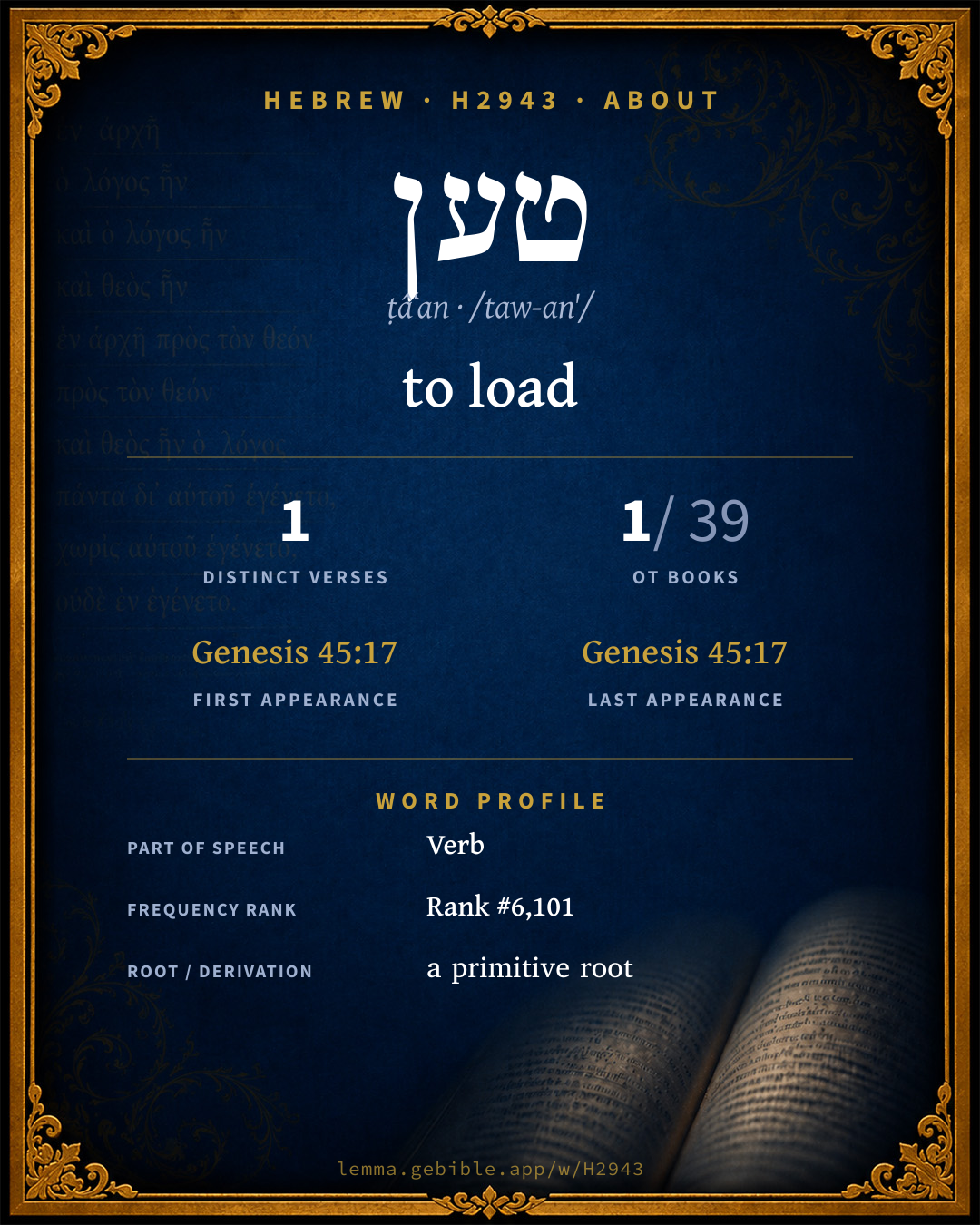
טָעַן
to load
Full lexicon entry — Brown-Driver-Briggs (BDB)
From Brown-Driver-Briggs (BDB)
Where this word appears
Grammar key — what these labels mean
Part of speech
- Verb
- An action or state-of-being word.
Stem
- Qal
- The basic, simple active stem — the plain form of the verb (“he wrote”).
Form
- Imperative
- A direct command (“write!”).
Person
- 2nd Person
- The one addressed (“you”).
Gender
- Masculine
- Grammatically masculine.
Number
- Plural
- More than one (in Hebrew, generally three or more).
Every verse where H2943 appears — 1 distinct verse across 1 book. Click any verse to open its interlinear word-by-word view. Verse text shown in the World English Bible for context — . Each verse’s Hebrew form is shown with its reference; the English is not keyword-highlighted, since the data carries no word-level English alignment. Use “Compare translations” on any verse to read it across multiple English versions. This concordance covers the Hebrew Bible; Septuagint (Greek Old Testament) occurrences are not indexed here.
Genesis 1 verse
About this entry
At a glance — auto-summarized from this page’s data, not written by a person. Every figure links to its source below. This summary describes the numbers; it doesn’t interpret them.
טען — transliterated ṭâʻan — is a Hebrew verb carrying the sense “to load.” A scarce word — 1 verse in all of the Hebrew Bible. Its uses cluster heavily in Genesis (100% of all occurrences). Its lone occurrence is Genesis 45:17. See the sense tree, 1-verse concordance, and the renderings breakdown below.
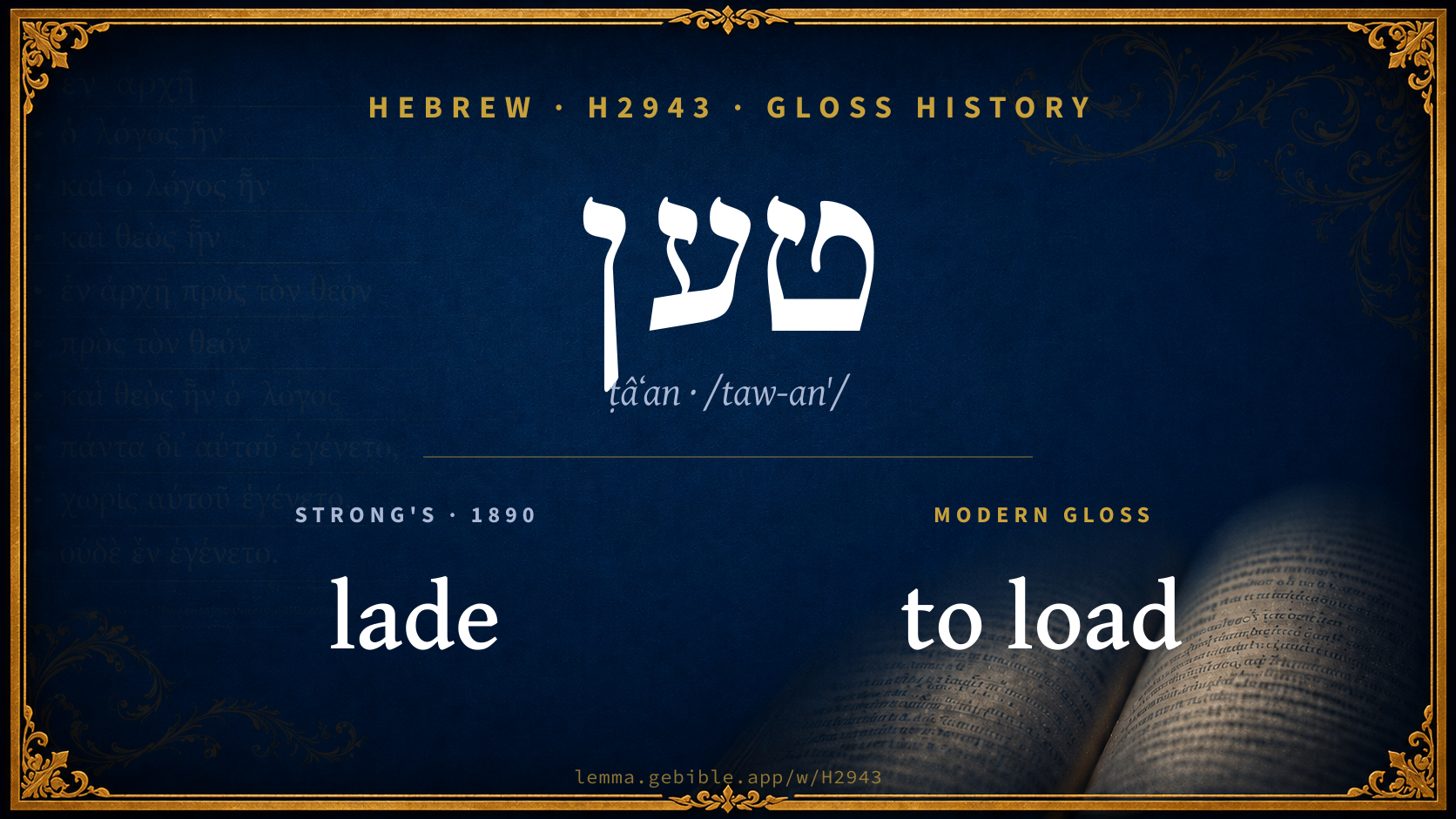
Gloss history
Strong's 1890 vs modern scholarship
About this word
Strong's H2943 catalogs a Hebrew word from the Hebrew Old Testament.
These counts are not copied from any lexicon or concordance. They are computed here, from the morphology-tagged Hebrew Old Testament. What Lemma adds →
- 1
- distinct verses
- The word appears in 1 distinct verse.
- 1 / 39
- OT books
- The word appears in 1 of 39 Old Testament books.
- #6,101
- by frequency
- Rank #6,101 (rank 6,101 of 8,640 Hebrew words by occurrence).
View all 1 occurrence in the concordance →
Most concentrated in
- Genesis 1 verse 100%
By section of the Old Testament
By traditional corpus
Conventional, traditional groupings — biblical authorship is debated, so this is a traditional corpus grouping, not an authorship claim. Each share is this word’s portion of its verses in that division of the Hebrew canon. Each figure is a share of the word’s 1 distinct verse.
- Torah (Pentateuch) 1 verse · 100%
How translations render this word
Counts come from each version’s own published word-to-Strong’s tagging or interlinear alignment — an approximate guide to how each version renders this word, not a word-level alignment the data otherwise carries. Because each total is that version’s own tagged count, the per-version totals vary from one another and need not match the appearance or distinct-verse counts above. These counts may also differ from a printed concordance because Lemma counts each distinctly tagged rendering and does not collapse phrase taggings into a single head-word total. This is a fixed set of word-tagged versions (KJV, ASV, BSB, ULT) and does not change with the reading translation you choose elsewhere. Each version’s license is shown beside its name below (and on Sources).
- King James Version: Ye lade 1×
- American Standard Version: Ye 1×
- Berean Standard Bible: Load 1×
- unfoldingWord Literal Text: Load 1×
King James Version Public Domain
Renders H2943 across 1 tagged occurrence — most commonly:
American Standard Version Public Domain
Renders H2943 across 1 tagged occurrence — most commonly:
Berean Standard Bible Public Domain
Renders H2943 across 1 tagged occurrence — most commonly:
unfoldingWord Literal Text CC BY-SA 4.0
Renders H2943 across 1 tagged occurrence — most commonly:
Senses in BDB
The 1 sense BDB distinguishes for this word, in lexicon order (not ranked by frequency or importance). The full entry — with sub-senses — is in the Lexicon Entry tab.
- (Qal) to load
Word origin
[ טָעַן ] vb. load — Qal Gn 45:17 (E)
— Brown-Driver-Briggs (Oxford 1906, public domain), digitized via Sefaria, supplemented by the OpenScriptures HebrewLexicon (CC BY 4.0). See Sources.
Origin: a primitive root
Jastrow Dictionary
A second Hebrew/Aramaic lexicon for comparison, covering Aramaic and post-biblical (Talmudic, Targumic, Midrashic) usage that the biblical-Hebrew BDB does not. Matched by lemma rather than by Strong’s number, so a lemma may carry more than one Jastrow headword (shown separately below), and the entries cover usage well beyond the Bible.
טָעַן I
- (cmp. טָעָה) [to seek, ask, (cmp. בְּעָא),]
- 1. to claim before court, to sue, to plead. Keth. XIII, 4 הטוֹעֵן את חבירו כדי וכ׳ if one claims from his neighbor a certain number of jugs of oil. Ib. 108ᵇ, a. e. טְעָנוֹ חטין וכ׳ if one claims wheat and barley (two different things), and defendant admits barley. Shebu. 43ᵃ עד שיִטְעֲנֶנּוּ בדבר וכ׳ until he sues him for something weighable or countable. Gitt. 58ᵇ טוֹעֲנִין ליורש וכ׳ the court pleads in behalf of the heir &c.; a. v. fr.—Part. pass. טָעוּן, f. טְעוּנָה is required for, requires. Zeb. V, 7 דמן ט׳ הזייה their blood is required for sprinkling (must be sprinkled). Bicc. II, 1 טְעוּנִים רחיצת וכ׳ require washing of hands; a. v. fr.—Denom. טֹעַן, טוֹעַן requirement, obligation, fr. which טָ׳ טֹעַן to require. Sifra introd. ויצא מן הכלל לִיטְעוֹן ט׳ אחר שהוא וכ׳ and is specified for another requirement in keeping with the general subject.
- 2. to seek after, to suspect, v. infra.
- 1. to be sued, to be respondent, defendant. Y. B. Kam. X, beg. 7ᵇ אפי׳ קטנים נִטְעָנִין להן בב"ד even for minors defense is made in court (prob. to be read: טוֹעֲנִין, cmp. Gitt. 58ᵇ, quoted supra). [In later literature טוֹעֵן claimant, נִטְעָן defendant.]
- 2. to be inquired after, suspected, to be summoned on suspicion. Yeb. II, 8 הנ׳ על א"א וכ׳ if one was suspected of intercourse with a married woman, and the court caused her to be sent away from him (her husband) on his account; ib. 24ᵇ; Tosef. ib. IV, 5 הניט׳ מא"א. Y. ib. II, 4ᵃ bot. בנ׳ בעדים when the suspicion has been corroborated by witnesses.
טְעַן
- , to plead. Keth. 105ᵇ אי בעי טָעֵין וכ׳ if he chooses, he may plead thus. Gitt. 58ᵇ אי דקא טעין וכ׳ is it that he pleads (demurs) and says &c.?; a. fr.
טָעַן II
- , a. Ges. H. Dict.10 s. v. צען) [to move, make ready for travelling,]
- 1. (cmp. נָשָׂא) to load, pack up. Num. R. s. 6 וטוֹעֲנִים על העגלות and pack (them) upon wagons; a. fr.—Part. pass. טָעוּן (interch. with טוֹעֵן) laden, carrying. Ib. s. 5 מי שהוא ט׳ בקרשים some had a share in carrying (moving) the boards. Ib. טוענין כל כלי האריגה had to carry all woven materials. Ib. s. 6 היה מִטּוֹעֲנֵי וכ׳ was one of those carrying the ark. B. Mets. 32ᵇ טְעוּנָה יין אסור carrying forbidden wine.—Midr. Till. to Ps. XVIII בשעה … טְעוּנִין את המים when the clouds are charged with water; Yalk. Sam. 160 טוענין מן המים (corr. acc.), v. חָשַׁךְ. Ib. אלו טוענין חרבות וכ׳ those carrying swords, others lances &c.; a. fr.—3) Esp. to help one broken down on the road to load again, contrad. to פרק to help in unloading. B. Mets. II, 10 מצוה לִטְעוֹן … the biblical law requires man to help in unloading, but not in loading (without remuneration); אף לט׳ loading, too, must be done gratuitously, v. טְעִינָה; a. fr.
- 1. to be laden. Gen. R. s. 82 נ׳ ברכות was laden with blessings; a. e.—Trnsf. (cmp. כָּבֵד) to be very ill. Treat. S’maḥ. ch. VIII אמר לו נ׳ he said to him, He (thy son) is very ill.
- 2. to be carried. Midr. Till. to Ps. LXXXVII [read:) אינן יכולין להִטָּעֵן … וטוֹעֲנִין וכ׳ who cannot be carried (on wagons &c.) … and they carry them on their hands (in a chair); (v. next w. a. Yalk. Ps. 838).
- 1. to lade, put on. Lev. R. s. 13 ה׳ לחמורו וכ׳ he put on his ass five S’ah &c. Sabb. 5ᵃ הִטְעִינוֹ חבירו his neighbor placed something in his hand to carry, ה׳ שמים the heavens placed &c. (when he put his hand forth to collect and carry rain water); a. e.
- 2. to carry goods for sale. Y. Peah I, 16ᵃ top (ref. to Lev. XIX, 16) שלא תהא כרוכל הזה מַטְעִין דבריו וכ׳ be not like the peddler carrying the talk of this one to the other &c. e.g. Leviticus 19:16
טְעַן ²
- 1. to be laden; to carry, bear (h. נשא). Targ. Y. II, Num. XIII, 23 (ed. Amst. טַעֲנוּ Pa.). Targ. O. Gen. XLIV, 1. Targ. Joel II, 22; a. fr.—B. Mets. 40ᵇ כיון דטָעוּן טָעוּן when they are once impregnated (with the fluid), they resorb no more.—Trnsf. to suffer, bear. Targ. Prov. IX, 12; a. e.
- 2. to lade, to harness. Targ. O. Gen. XLV, 17 טְעוּנוּ ed. Berl. (oth ed. a. Y. טְעִינוּ). Targ. Y. ib. XLIV, 13.—Esp. to help carrying, opp. פרק, v. preced. Gen. R. s. 96 משל הדיוט … טעון וכ׳ the common adage says, if thy friend’s son is dead, help carrying; if thy friend is dead, throw off (common people show no favor where no return can be expected). Y. Ḥag. II, 77ᵇ top מִיטְעוֹן תרי וכ׳ that two carry one load; a. fr.
- same. Ib. הוון מְטַעֲנִין להין they made them carry &c.—Part. pass. מְטַעַן carried, moved. Cant. R. to IV, 8 דלית אינון … מְטַעֲנִין וכ׳ who are too feeble to be carried in a lectica, and whom they carry in a cathedra
- 1. to carry. Ib. מַטְעִינִין. Y. Ḥag. l. c. אַטְעוּנְנוֹן יחידאין carry them singly, אַטְעוֹנִינוֹן וכ׳ they did so; אטעונינון צלוחיין carry straight through (without resting).—א׳ חינא = h. נשא חן to find grace. Targ. Esth. II, 17 (ed. Lag. אִיטְּ׳, Ithpe.); a. e.
- 1. to be laden. Targ. Lam. V, 5. Targ. Esth. l. c., v. supra.
- 2. to be carried (in a chair). Y. Bets. I, 60ᶜ bot. מִיטְּעַן מערס וכ׳ allowed himself to be carried from one seat (where he lectured) to another. Ib., v. סְדִינָא.
- 3. (v. preced.Nif.) to become severely ill. Targ. II Sam. XII, 15 (h. text ויאנש).
טְעַן III
- to move to and back, to swing a whip &c. Num. R. s. 12 דלא יהוון טַעֲנִין וכ׳ that they should not swing the rod over the children (Midr. Till. to Ps. XCI … מחון; Yalk. Ps. 842 מחיין).
- swung upon, struck with a spear &c., wounded. Targ. Is. XIV, 19 מְטַעֲנֵי חרב (h. text מְטֹעֲנֵי). Targ. Jer. XXXVII, 10 מְטַעֲנִין (h. text מדקרים); a. e.
טֹעַן
- (טָעַן I)
- 1. requirement, v. טוֹעַן a. טָעַן I. I.
- 2. search, claim. B. Mets. 28ᵇ אבן ט׳, v. טָעָה.
A Dictionary of the Targumim, the Talmud Babli and Yerushalmi, and the Midrashic Literature (Marcus Jastrow; London, Luzac, 1903) — Public Domain. Digitized via Sefaria. Digitized via Sefaria. Full attribution on Sources.
Septuagint verse parallels
This word appears in 1 verse that also exists in the Greek Old Testament (Septuagint), out of the 1 Hebrew verse it occurs in. You can read those verses in Greek by switching the Old Testament edition to the Septuagint.
Read these verses in the Septuagint
This is a verse-level parallel only — the same verses exist in both the Hebrew and Greek Old Testaments. No word-level Hebrew↔Greek correspondence is claimed: the data carries no such alignment, so no Greek word is shown as this Hebrew word’s translation. Coverage is not total — the Septuagint omits the deuterocanon and renumbers the Psalms, so some Hebrew verses have no direct Greek parallel.