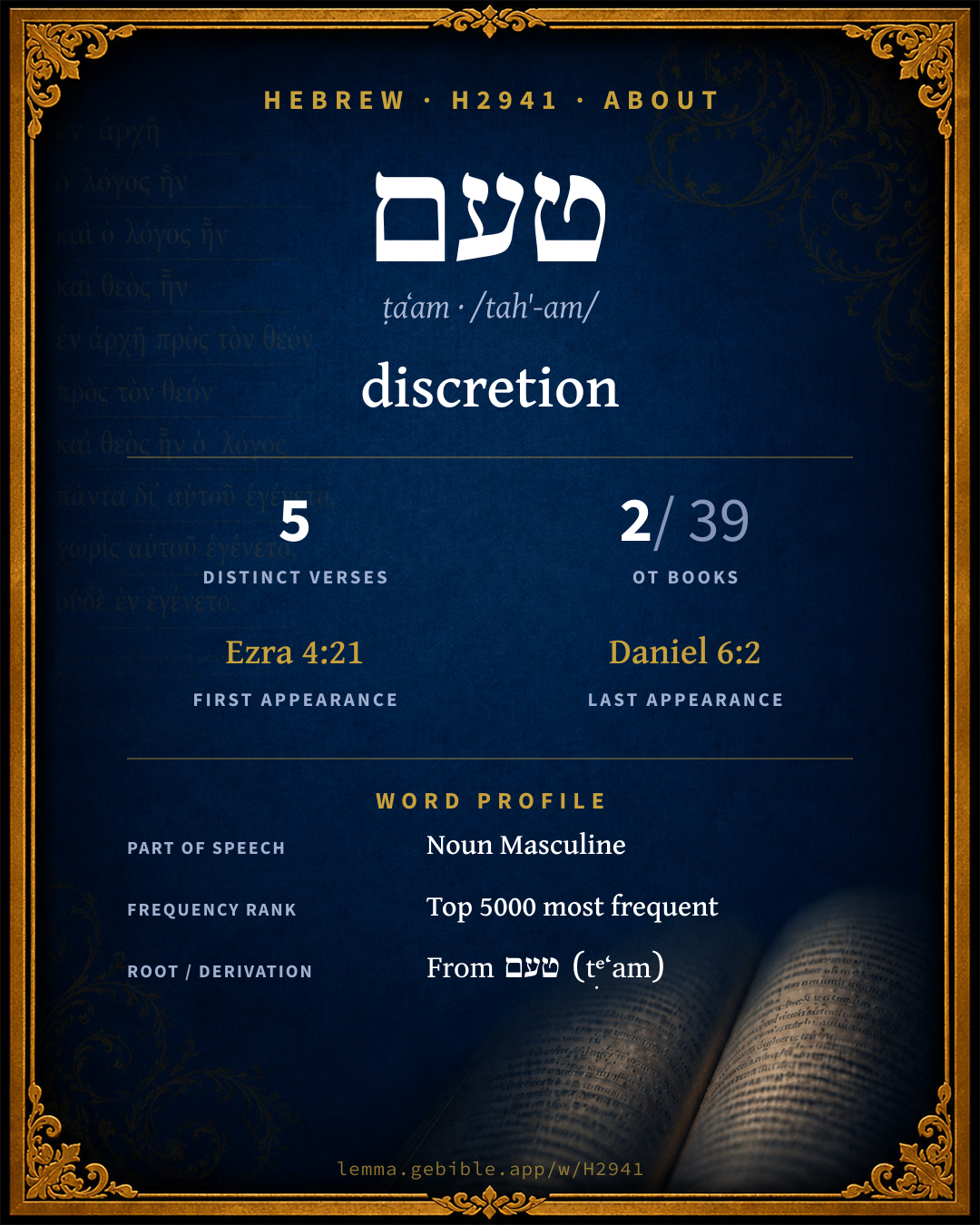
טְעֵם
discretion
‘discretion’ is one of 5 main senses fuller range ↓
Full lexicon entry — Brown-Driver-Briggs (BDB)
From Brown-Driver-Briggs (BDB)
Where this word appears
Grammar key — what these labels mean
Part of speech
- Noun
- A naming word — a person, place, thing, or idea.
Noun type
- Common
- A common noun — a general class of person, place, or thing (“king,” “city,” “water”), not a specific name.
State
- Construct
- A noun bound to a following noun in a possessive / “of” relationship (the construct chain).
Gender
- Masculine
- Grammatically masculine.
Number
- Singular
- One.
Grammatical forms
- Particle, Definite Article 3 times (60%)
- Noun, Common, Masculine, Singular, Construct 2 times (40%)
Parsed forms decoded from the imported morphology (morphhb / Westminster Leningrad Codex — WLC text public domain, morphhb tagging CC BY 4.0), counted across 5 parsed occurrences — not distinct verses.
Every verse where H2941 appears — 5 distinct verses across 2 books. Click any verse to open its interlinear word-by-word view. Verse text shown in the World English Bible for context — . Each verse’s Hebrew form is shown with its reference; the English is not keyword-highlighted, since the data carries no word-level English alignment. Use “Compare translations” on any verse to read it across multiple English versions. This concordance covers the Hebrew Bible; Septuagint (Greek Old Testament) occurrences are not indexed here.
Ezra 4 verses
- Ezra 4:21 טַעְמָ֥/א n c ms det + ptcl def.art Make you now a decree to cause these men to cease, and that this city not be built, until a decree shall be made by me.
- Ezra 5:5 טַעְמָ֖/א n c ms det + ptcl def.art But the eye of their God was on the elders of the Jews, and they did not make them cease, until the matter should come to Darius, and then answer should be returned by letter concerning it.
- Ezra 6:14 טַ֨עַם֙ n c ms cs The elders of the Jews built and prospered, through the prophesying of Haggai the prophet and Zechariah the son of Iddo. They built and finished it, according to the commandment of the God of Israel, and according to the decree of Cyrus, and Darius, and Artaxerxes king of Persia.
- Ezra 7:23 טַ֨עַם֙ n c ms cs Whatever is commanded by the God of heaven, let it be done exactly for the house of the God of heaven; for why should there be wrath against the realm of the king and his sons?
Daniel 1 verse
About this entry
At a glance — auto-summarized from this page’s data, not written by a person. Every figure links to its source below. This summary describes the numbers; it doesn’t interpret them.
At its core, טעם (ṭaʻam) means “discretion.” It occurs a mere 5 verses across Scripture. Its uses cluster heavily in Ezra (80% of all occurrences). Scripture first uses it in Ezra 4:21. Catalogued under 5 senses, its meaning is not single-sense. Each statement above links to its evidence; the full detail follows below.
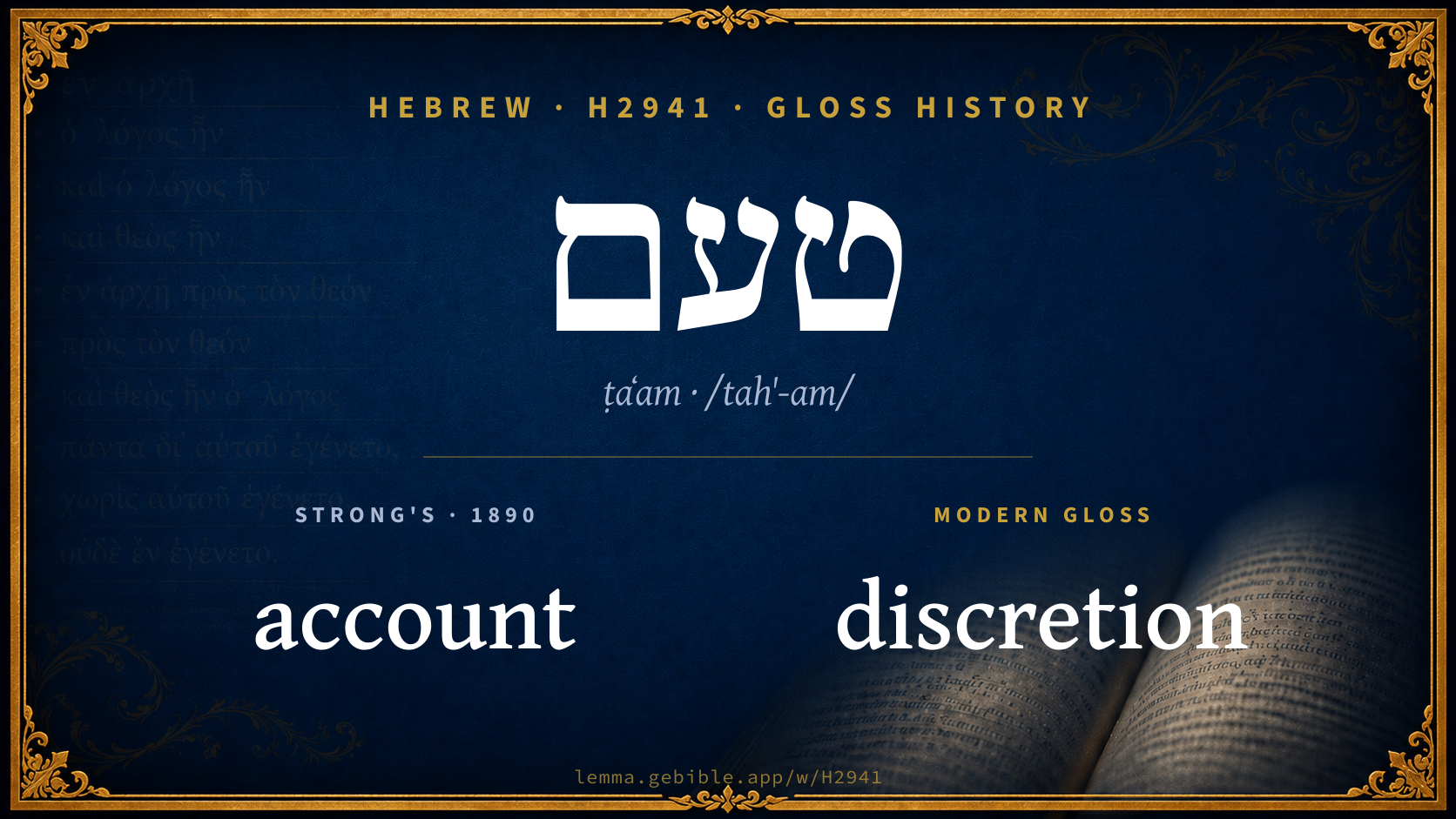
Gloss history
Strong's 1890 vs modern scholarship
About this word
Strong's H2941 catalogs a Hebrew word from the Hebrew Old Testament.
These counts are not copied from any lexicon or concordance. They are computed here, from the morphology-tagged Hebrew Old Testament. What Lemma adds →
- 5
- distinct verses
- The word appears in 5 distinct verses.
- 2 / 39
- OT books
- The word appears in 2 of 39 Old Testament books.
- #3,337
- by frequency
- Top 5000 most frequent Hebrew words (rank 3,337 of 8,640 Hebrew words by occurrence).
View all 5 occurrences in the concordance →
By traditional corpus
Conventional, traditional groupings — biblical authorship is debated, so this is a traditional corpus grouping, not an authorship claim. Each share is this word’s portion of its verses in that division of the Hebrew canon. Each figure is a share of the word’s 5 distinct verses.
- Writings (Ketuvim) 5 verses · 100%
How translations render this word
Counts come from each version’s own published word-to-Strong’s tagging or interlinear alignment — an approximate guide to how each version renders this word, not a word-level alignment the data otherwise carries. Because each total is that version’s own tagged count, the per-version totals vary from one another and need not match the appearance or distinct-verse counts above. These counts may also differ from a printed concordance because Lemma counts each distinctly tagged rendering and does not collapse phrase taggings into a single head-word total. This is a fixed set of word-tagged versions (KJV, ASV, BSB, ULT) and does not change with the reading translation you choose elsewhere. Each version’s license is shown beside its name below (and on Sources).
- King James Version: Accounts 1×, Another commandment 1×, Commandment 1×
- American Standard Version: According to the commandment 1×, Account 1×, Decree 1×
- Berean Standard Bible: Report 1×, Were accountable 1×
- unfoldingWord Literal Text: Decree of 2×
King James Version Public Domain
Renders H2941 across 5 tagged occurrences — most commonly:
American Standard Version Public Domain
Renders H2941 across 5 tagged occurrences — most commonly:
Berean Standard Bible Public Domain
Renders H2941 across 2 tagged occurrences — most commonly:
unfoldingWord Literal Text CC BY-SA 4.0
Renders H2941 across 5 tagged occurrences — most commonly:
Plus 3 renderings that appear only once — usually multi-word phrases or single function words the recovered tagging swept in, not distinct renderings.
Senses in BDB
The 5 senses BDB distinguishes for this word, in lexicon order (not ranked by frequency or importance). The full entry — with sub-senses — is in the Lexicon Entry tab.
- taste, judgment, command
- taste
- judgment, discretion
- report
- command
Word origin
טְעֵם 30 n.m. taste, judgment, command
— Brown-Driver-Briggs (Oxford 1906, public domain), digitized via Sefaria, supplemented by the OpenScriptures HebrewLexicon (CC BY 4.0). See Sources.
Derived from טעם (ṭᵉʻam) (H2939) — to feed.
Jastrow Dictionary
A second Hebrew/Aramaic lexicon for comparison, covering Aramaic and post-biblical (Talmudic, Targumic, Midrashic) usage that the biblical-Hebrew BDB does not. Matched by lemma rather than by Strong’s number, so a lemma may carry more than one Jastrow headword (shown separately below), and the entries cover usage well beyond the Bible.
טָעַם
- (b. h.) [to be bright, wise (v. Ps. XXXIV, 9),] to examine, to taste, test, try, experience. Yoma 22ᵇ לא ט׳ טַעַם חטא never tasted the taste of sin (was innocent). Y. Succ. V, 55ᵇ לא היו טוֹעֲמִין טעם וכ׳ had not even a taste of sleep. Ber. 35ᵃ אסור … שיִטְעוֹם וכ׳ one must not taste food without a blessing. Ib. 14ᵃ מהו שיטעום dare he (who fasts) taste food when cooking? Num. R. s. 7 כל מי … היה טוֹעֲמוֹ whoever desired to eat meat felt its taste (in the mannah); a. v. fr. e.g. Psalms 34:9
- 1. to give to taste. Ned. 66ᵇ עד שתַּטְעִימִי … לרב וכ׳ until thou makest R. J. taste of thy dish. B. Mets. 75ᵃ כדי להַטְעִימָן וכ׳ in order to give them a taste of usury (that they might feel its oppressiveness). Cant. R. to VII, 2 תהא … ומטעמני (read ומַטְעִימֵנִי or ומְטַעֲמֵנִי Pi.) thou shalt bring some of them before me and let me taste them; a. fr.
- 2. to make tasteful, to explain. Sot. 21ᵇ המַטְעִים דבריו וכ׳ who explains his case to the judge (trying to preoccupy him), before his adversary appears; Tanḥ. Mishp. 6; a. e.—V. מַטְעֶמֶת.
טְעַם
- Targ. I Sam. XIV, 24; a. fr.—Targ. Y. Deut. XXXII, 1 דלא טַעֲמִין מיתותא which taste no death (heaven and earth).—Ber. 44ᵃ דלא ט׳ זיונא that he tasted no food. Sabb. 11ᵃ לִיטְעוֹם מר מידי take some refreshment, Sir!—Hor. 11ᵃ אִטְעוֹם טעם דאיסורא I wish to try how a forbidden thing tastes; a. fr.
- to give to taste. Targ. Y. Gen. XXIV, 17.—Koh. R. to I, 3 לית את מַטְעַם לי מתבשילי wilt thou not let me taste what I have cooked (for thee?); Lev. R. s. 28; Pesik. R. s. 18; Pesik. Haomer, p. 70ᵃ … מַטְעִים … מתבשילך of the dish prepared for thee?
- to taste. Part. pass. מְטַעַם tasted, touched. Lev. R. l. c. why do the dishes come out ולא מְטַעֲמִין without being touched?; (Koh. R. l. c. ולא טעמין and they taste them not).
טַעַם
- preced.) [pleasure, will (Jonah III, 7),] e.g. Jonah 3:7
- 1. sense, wisdom, sound reasoning; reason, cause, ground. Ab. Zar. 18ᵃ דברים של ט׳ sensible argument. Ḥull. 6ᵃ להחזיר לו ט׳ to give him a clear answer.—Sabb. 83ᵇ ולא נתגלה טַעֲמָהּ the reason of it has not been made known. Ḥull. 101ᵇ מאיזה ט׳ וכ׳ for what reason it has been forbidden to them; a. fr.—Pl. טְעָמִים, טְעָמִין. Snh. 34ᵃ מקרא אחד יוצא לכמה ט׳ ואין טעם אחד וכ׳ one biblical expression may be used for many arguments, but one and the same argument must not be deduced from different biblical expressions. Erub. 13ᵇ טַעֲמֵי טומאה arguments in favor of uncleanness; a. fr.—פִּסְקי טְעָמִים the incisions, in the Bible verse, according to sense; punctuation signs, accents. Meg. 3ᵃ (ref. to ויבינו במקרא, Neh. VIII, 8) אלו פ׳ ט׳ that means the punctuation signs; Y. ib. IV, 74ᵈ bot.; Gen. R. s. 36 (ref. to ושום שכל, Neh. l. c.) אלו הט׳ (sub. פסקי).—Esp. taste. Yoma 22ᵇ, v. טָעַם. Ḥull. 98ᵇ ט׳ כעיקר the taste of a forbidden thing is as forbidden as the substance itself. Pes. 44ᵇ top ליתן ט׳ כעיקר to intimate that the taste (of grapes soaked in water) is equally forbidden as the substance (of grapes). Ḥull. 108ᵃ טַעֲמוֹ ולא ממשו וכ׳ the taste of a thing without the substance (after removing the forbidden substance) is in all cases biblically forbidden. Ib. VII, 4 אם יש בה בנותן ט׳ if there is enough of it to give a taste to the entire mixture. Ib. בזמן שמכירו בנותן ט׳ as long as it can be recognized (and removed), it depends on its giving a taste (whether or not the mixture is forbidden). Ib. 111ᵇ נותן ט׳ בר נותן ט׳ an object forbidden for its having absorbed the taste of a forbidden thing, and which (through mixture) has again given taste to another thing, a taste-giver in the second degree. Ab. Zar. 39ᵇ, a. fr. נותן טעם לפגם (abbr. נ"ט) imparting a deteriorating taste, נ"ט לשבח giving an improving taste; a. v. fr.— e.g. Nehemiah 8:8
טְעַם ²
- 1. pleasure, will. Dan. III, 10; a. e. e.g. Daniel 3:10
- 2. good cheer. Ib. V, 2.
- 3. reason, argument, sense &c. Targ. Job XII, 20; a. e.—B. Bath. 173ᵇ דלא יהבי ט׳ וכ׳ who give no reason for their decisions (judge arbitrarily). Ib., a. fr. מאי ט׳ (abbr. מ"ט) what is the reason (of the law of the Mishnah)?—Kidd. 68ᵇ, a. fr. דריש ט׳ דקרא interprets the biblical law on its reason and accordingly modifies it, extending or limiting, e.g. (B. Mets. 115ᵃ) applying the law Deut. XXIV, 17 only to poor widows. Ib. אלא לרבנן מאי טַעֲמֵיה but according to the Rabbis (who do not interpret the law on its reason), where is the argument for it? (prob. to be read: טַעֲמַיְיהוּ; Yeb. 23ᵃ מנא לן). Ber. 7ᵇ מ"ט לא אתי מר וכ׳ why do you not come to synagogue for prayer?—Ib. 11ᵃ קא מפרשי טַעֲמַיְיהוּ וט׳ וכ׳ they give their reason for their own opinion and for differing with Beth-Sh.—Keth. 83ᵇ הלכה כר׳ … ולא מטַעֲמֵיה the rule (practice) is in agreement with R. S.’s opinion, but not for the reason he had for it. Ib. 84ᵃ כטעמיה וכהלכתיה in agreement both with his argument and his legal opinion; a. fr.—Pes. 21ᵇ, a. fr. ט׳ דכתב וכ׳ the reason (of this) is, because &c., i.e. this is so only because &c.—וּלְטַעֲמֵיךְ now, according to your argument (assuming it to be correct,—what then?). Ber. 43ᵃ; a. v. fr. e.g. Deuteronomy 24:17
- 4. argument on the cause of bereavement, consolation (v. טַמָּא). M. Kat. 18ᵃ למישאל ט׳ מיניה (Ms. M.; second time, לשיולי ביה ט׳) to get his permission to argue (with him), i.e. to console him. Snh. 113ᵃ [read:] למשאל ביה ט׳ (or טמא, v. Rabb. D. S. a. l. note 7) to console him.—בֵּי טַעֲמָא, v. טַמָּא.
- 5. taste. Targ. Num. XI, 8; a. e.—Yoma 78ᵇ ט׳ דמיתותא a foretaste of death. Hor. 11ᵃ, v. טְעַם. Ḥull. 97ᵃ בט׳ it depends on the taste (whether a mixture be forbidden), v. preced. Ib.ᵇ מין בשאינו מינו … בט׳ in case of a mixture of heterogeneous things which are permitted, we decide by the taste; a. fr.—Pl. טַעֲמִין. Targ. Cant. V, 11; 13.
A Dictionary of the Targumim, the Talmud Babli and Yerushalmi, and the Midrashic Literature (Marcus Jastrow; London, Luzac, 1903) — Public Domain. Digitized via Sefaria. Digitized via Sefaria. Full attribution on Sources.
Forms in the corpus
The 4 distinct written forms H2941 takes in the Hebrew Bible, most frequent first — each parse links to that state’s occurrences in the concordance. Hebrew forms include their vowel points and cantillation, so a single lemma takes many written forms.
| Form | Parsing | Example | Uses |
|---|---|---|---|
| טַ֨עַם֙ | Noun, Common, Masculine, Singular, Construct | Ezra 6:14 | 2 |
| טַעְמָ֔/א | Particle, Definite Article | Daniel 6:2 | 1 |
| טַעְמָ֖/א | Particle, Definite Article | Ezra 5:5 | 1 |
| טַעְמָ֥/א | Particle, Definite Article | Ezra 4:21 | 1 |
Same root — word family
Other BDB entries built from the same root as H2941, grouped by Strong’s listed origin. These share a root / origin per the lexicon — not necessarily a shared meaning. Each links to that word’s own entry.
Derives from
Shares the same root
Compare all same-root words → They share a root, not necessarily a meaning.
Septuagint verse parallels
This word appears in 5 verses that also exist in the Greek Old Testament (Septuagint), out of the 5 Hebrew verses it occurs in. You can read those verses in Greek by switching the Old Testament edition to the Septuagint.
Read these verses in the Septuagint
This is a verse-level parallel only — the same verses exist in both the Hebrew and Greek Old Testaments. No word-level Hebrew↔Greek correspondence is claimed: the data carries no such alignment, so no Greek word is shown as this Hebrew word’s translation. Coverage is not total — the Septuagint omits the deuterocanon and renumbers the Psalms, so some Hebrew verses have no direct Greek parallel.