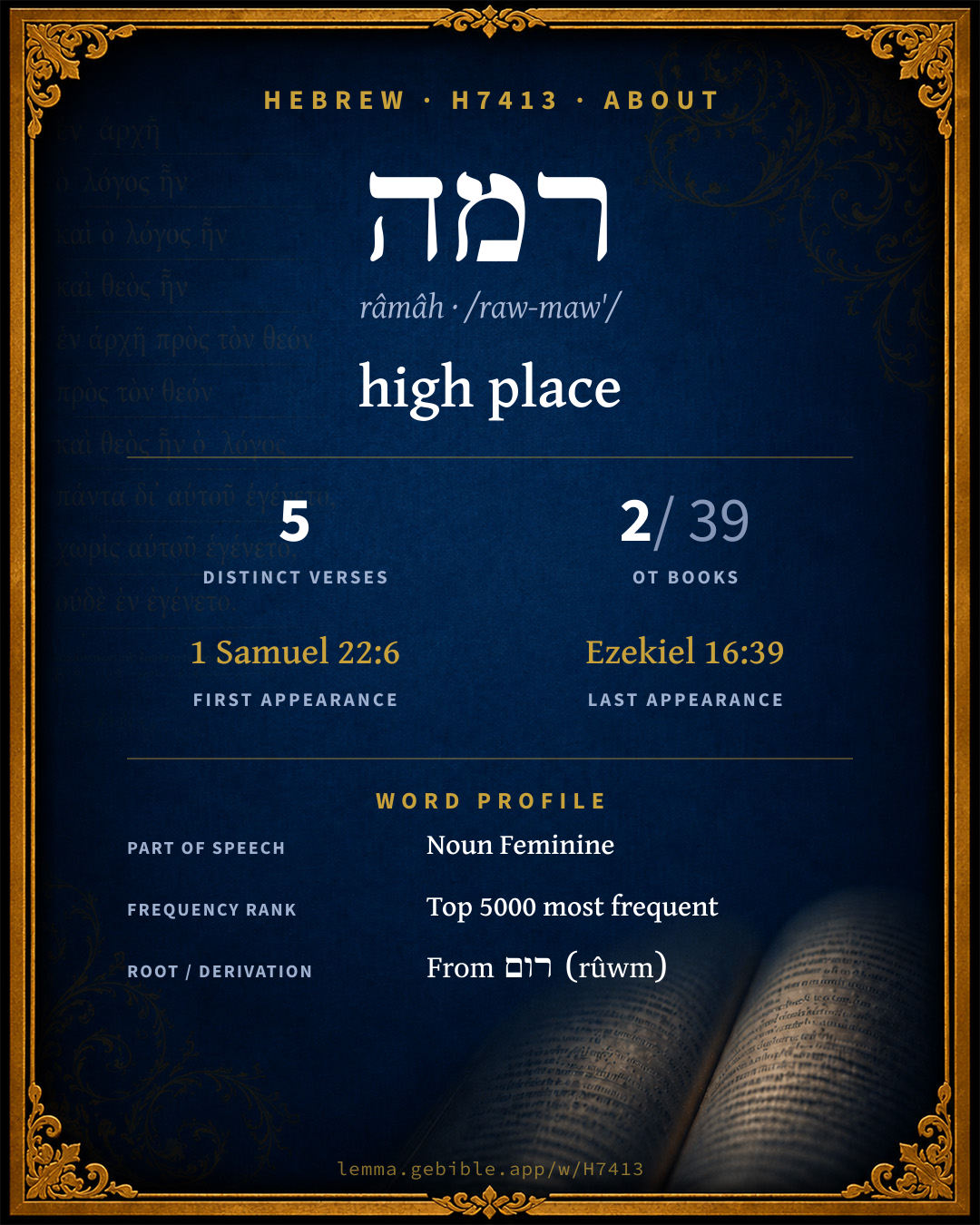
רָמָה
high place
‘high place’ is one of 2 main senses fuller range ↓
Full lexicon entry — Brown-Driver-Briggs (BDB)
From Brown-Driver-Briggs (BDB)
Where this word appears
See every Construct-state word in the Hebrew Bible →
Grammar key — what these labels mean
Part of speech
- Noun
- A naming word — a person, place, thing, or idea.
Noun type
- Common
- A common noun — a general class of person, place, or thing (“king,” “city,” “water”), not a specific name.
State
- Construct
- A noun bound to a following noun in a possessive / “of” relationship (the construct chain).
- Absolute
- The independent form of a noun, not bound to a following word.
Gender
- Feminine
- Grammatically feminine.
Number
- Singular
- One.
- Plural
- More than one (in Hebrew, generally three or more).
Grammatical forms
- Noun, Common, Feminine, Singular, Construct 2 times (40%)
- Noun, Common, Feminine, Singular, Absolute 2 times (40%)
- Noun, Common, Feminine, Plural, Construct 1 time (20%)
Parsed forms decoded from the imported morphology (morphhb / Westminster Leningrad Codex — WLC text public domain, morphhb tagging CC BY 4.0), counted across 5 parsed occurrences — not distinct verses.
Every verse where H7413 appears — 5 distinct verses across 2 books. Click any verse to open its interlinear word-by-word view. Verse text shown in the World English Bible for context — . Each verse’s Hebrew form is shown with its reference; the English is not keyword-highlighted, since the data carries no word-level English alignment. Use “Compare translations” on any verse to read it across multiple English versions. This concordance covers the Hebrew Bible; Septuagint (Greek Old Testament) occurrences are not indexed here.
1 Samuel 1 verse
Ezekiel 4 verses
- Ezekiel 16:24 רָמָ֖ה n c fs that you have built to you a vaulted place, and have made you a lofty place in every street.
- Ezekiel 16:25 רָֽמָתֵ֔/ךְ n c fs cs + sfx pers 2fs You have built your lofty place at the head of every way, and have made your beauty an abomination, and have opened your feet to everyone who passed by, and multiplied your prostitution.
- Ezekiel 16:31 וְ/רָמָתֵ֥/ךְ conj + n c fs cs + sfx pers 2fs in that you build your vaulted place at the head of every way, and make your lofty place in every street, and have not been as a prostitute, in that you scorn pay.
- Ezekiel 16:39 רָמֹתַ֔יִ/ךְ n c fp cs + sfx pers 2fs I will also give you into their hand, and they shall throw down your vaulted place, and break down your lofty places; and they shall strip you of your clothes, and take your beautiful jewels; and they shall leave you naked and bare.
About this entry
At a glance — auto-summarized from this page’s data, not written by a person. Every figure links to its source below. This summary describes the numbers; it doesn’t interpret them.
רמה — transliterated râmâh — is a Hebrew noun carrying the sense “high place.” It is rare — just 5 verses in the entire Hebrew Bible. Its uses cluster heavily in Ezekiel (80% of all occurrences). It first appears in 1 Samuel 22:6. It is not a single-sense word — see its full sense range. Dig into 5-verse concordance and the renderings breakdown below.
Gloss history
Strong's 1890 vs modern scholarship
About this word
Strong's H7413 catalogs a Hebrew word from the Hebrew Old Testament.
These counts are not copied from any lexicon or concordance. They are computed here, from the morphology-tagged Hebrew Old Testament. What Lemma adds →
- 5
- distinct verses
- The word appears in 5 distinct verses.
- 2 / 39
- OT books
- The word appears in 2 of 39 Old Testament books.
- #3,337
- by frequency
- Top 5000 most frequent Hebrew words (rank 3,337 of 8,640 Hebrew words by occurrence).
View all 5 occurrences in the concordance →
By traditional corpus
Conventional, traditional groupings — biblical authorship is debated, so this is a traditional corpus grouping, not an authorship claim. Each share is this word’s portion of its verses in that division of the Hebrew canon. Each figure is a share of the word’s 5 distinct verses.
- Prophets (Nevi'im) 5 verses · 100%
How translations render this word
Counts come from each version’s own published word-to-Strong’s tagging or interlinear alignment — an approximate guide to how each version renders this word, not a word-level alignment the data otherwise carries. Because each total is that version’s own tagged count, the per-version totals vary from one another and need not match the appearance or distinct-verse counts above. These counts may also differ from a printed concordance because Lemma counts each distinctly tagged rendering and does not collapse phrase taggings into a single head-word total. This is a fixed set of word-tagged versions (KJV, ASV, BSB, ULT) and does not change with the reading translation you choose elsewhere. Each version’s license is shown beside its name below (and on Sources).
BDB lists this Strong’s number as 4 distinct words (homographs). Each count above pools all of them and is not split by sense — see the Senses section below. A low-frequency rendering may belong to a different one of those words, not the primary meaning.
- King James Version†: High place 2×
- American Standard Version†: Lofty place 2×
- Berean Standard Bible†: Lofty shrines 3×
- unfoldingWord Literal Text†: Height 1×, High place 1×, High places 1×
King James Version Public Domain
Renders H7413 across 4† tagged occurrences — most commonly:
Plus 2 renderings that appear only once — usually multi-word phrases or single function words the recovered tagging swept in, not distinct renderings.
American Standard Version Public Domain
Renders H7413 across 4† tagged occurrences — most commonly:
Plus 2 renderings that appear only once — usually multi-word phrases or single function words the recovered tagging swept in, not distinct renderings.
Berean Standard Bible Public Domain
Renders H7413 across 5† tagged occurrences — most commonly:
Plus 2 renderings that appear only once — usually multi-word phrases or single function words the recovered tagging swept in, not distinct renderings.
unfoldingWord Literal Text CC BY-SA 4.0
Renders H7413 across 5† tagged occurrences — most commonly:
7 senses and sub-senses in the full BDB
Hebrew verbs can shift meaning by stem (binyan): Qal is the basic action, Niphal is often passive or reflexive, Piel often intensifies or makes it factitive, and Hiphil is typically causative. The senses below are grouped under the stem BDB assigns to each.
What do BDB’s symbols mean?
BDB uses these scholarly abbreviations:
| Symbol | Meaning |
|---|---|
| 𝔊 | the Septuagint (the ancient Greek translation, LXX) |
| 𝔙 | the Vulgate (the Latin translation) |
| 𝔖 | the Syriac version (the Peshitta) |
| 𝔗 | the Targum (the Aramaic translation) |
| ψ | the Psalms |
| √ | root (the underlying root or stem) |
| ‖ | parallel passage (a synonymous or contrasted parallel) |
| † | the dagger: every passage where the word occurs is cited |
The 7 senses and sub-senses the full Brown-Driver-Briggs lexicon distinguishes for this word, in lexicon order (not ranked by frequency), with BDB’s own verbatim wording and sub-sense lettering. Shown in Hebrew script with BDB’s own scholarly abbreviations. The condensed entry is in the Lexicon Entry tab. See also the Forms in the corpus table below.
רמה I height, high-place
רמה II loc. usually c. art. הָר׳ the Height, Rama, הָרָמָה (except Je 31
- 1. in Benj., on border of Ephr., Ho 5:8; 1 K 15:17, 21, 22 = 2 Ch 16:1, 5, 6; Ju 4:5; 19:3; Is 10:29; Je 31:15; 40:1; Jos 18:25 (P), Ezr 2:26 = Ne 7:30, prob. also Ne 11:33; 𝔊 usually Ραμα; mod. er-Râm, 5 miles N. of Jerus., BuhlGeogr. 172. e.g. Hosea 5:8
- 2. in hill-country of Ephr. (= 1?), home of Samuel 1 S 1:19; 2:11; 7:17; 8:4; 15:34; 16:13; 19:18, 22a (all c. ה loc., הָרָמָ֫תָה), v 19, 22b, 23(×2); 20:1; 25:1; 28:3, = הָרָמָתַיִם 1:1 (v. צוּפִי); 𝔊 Αρμαθαιμ, Ραμα; perhaps (if distinct from 1) = Beit-Rima, 13 miles ENE. of Lydda (GASmGeogr. 254 BuhlGeogr. 170); or Râm-allah, 3 m. SW. of Bethel (EwHist. ii. 421 al.) [cf. also Ἀριμαθαία Mt 27:57 +]. e.g. 1 Samuel 1:19
- 3. in Asher Jos 19:29 (P), Ραμα; perhaps Râmiye, c. 12 miles E. of Ladder of Tyre RobBR iii. 79 BuhlGeogr. 231. e.g. Joshua 19:29
- 4. in Naphtali, Jos 19:36 (P), Αραηλ, A 𝔊L Ραμα; mod. Râmeh, c. 8 miles WSW. of Safed BuhlGeogr. 222. e.g. Joshua 19:36
- 5. (בָּ)רָמָה 2 K 8:29 = 2 Ch 22:6 (Ρεμμωθ, Ραμωθ; 𝔊L Ραμαθ Γαλ.), v. רָמוֹת 1—Vid. Dr Hast. DB. RAMAH. e.g. 2 Kings 8:29
רמה III cast, shoot (Assyrian ramû, throw, lay
Qal
- Pf. 3 ms. ר׳, subj. י׳ Ex 15:1, 21 (song), c. acc. + בַּיָּם; Pt. רֹמֵה קֶשֶׁת Je 4:29 coll. (or read רֹמֵי) bow-shooters, bowmen, pl. cstr. נוֹשְׁקֵי רוֹמֵי־ק׳ ψ 78:9 (v. II. נשׁק); cf. רֹבֵה Gn 21:20 (v. II. רבה, קַשָּׁת). e.g. Exodus 15:1
רמה IV
Piel
- beguile, deal treacherously with (NH in deriv.; 𝔗 רְמָא Pa.; BuhlLex cp. Arabic رَمَى vi. be sluggish, backward (of wound), become putrid, corrupt);—Pf. 3 ms. רִמָּה Pr 26:19, sf. רִמָּנִי 2 S 19:27; 2 ms. sf. רִמִּיתָנִי Gn 29:25 1 S 28:12; 2 fs. sf. רִמִּיתִנִי 19:17, etc.; Inf. cstr. sf. לְרַמּוֹתַנִי 1 Ch 12:18 (van d. H. v 17);—beguile, deceive, mislead, acc. pers., Gn 29:25 (E), Jos 9:22 (JE), 1 S 28:12; 2 S 19:27; Pr 26:19; deal treacherously with, betray, acc. pers., 1 S 19:17 La 1:19, + לְצָרַי 1 Ch 12:17. e.g. Proverbs 26:19
Senses from the full Brown-Driver-Briggs lexicon (Brown, Driver, Briggs; Oxford 1906 — public domain), digitized via Sefaria, supplemented by the OpenScriptures HebrewLexicon (CC BY 4.0). Full attribution on Sources.
Word origin
I. n.f. height, high-place;—abs. ר׳ as term. techn. (cf. בָּמָה), = shrine (for illicit worship): Ez 16:25; ‖ גַּב v 24, 31, 39; so perhaps 1 S 22:6, but read prob. בָּמָה, 𝔊 Βαμα (A Ραμμα), HPS.
II. n.pr.loc. usually c. art. הָר׳ the Height, Rama, הָרָמָה (except Je 31:15 Ne 11:33):
III. vb. cast, shoot (Assyrian ramû, throw, lay; Arabic رَمَى throw, shoot; Ethiopic ረመየ: strike, aim a blow at; Aramaic רְמָא, ܪܡܳܐ cast, throw);—
— Brown-Driver-Briggs (Oxford 1906, public domain), digitized via Sefaria, supplemented by the OpenScriptures HebrewLexicon (CC BY 4.0). See Sources.
Derived from רום (rûwm) (H7311) — to rise.
Jastrow Dictionary
A second Hebrew/Aramaic lexicon for comparison, covering Aramaic and post-biblical (Talmudic, Targumic, Midrashic) usage that the biblical-Hebrew BDB does not. Matched by lemma rather than by Strong’s number, so a lemma may carry more than one Jastrow headword (shown separately below), and the entries cover usage well beyond the Bible.
רָמָה I
- 1. high, v. רָם.
- 2. height.—Pl. רָמוֹת. Meg. 14ᵃ, v. צָפָה.
רָמָה II
- , v. רמי
רִמָּה
- רמם to move; cmp. רחש a. deriv.) worm, esp. the worm in man’s grave. Ber. 18ᵇ קשׁה ר׳ למת וכ׳ the worm is as painful to the dead body as a needle in sound flesh. Sot. 5ᵃ (play on בֹשרֹ) ב̇ושה סֹרוחה ר̇ basar (flesh) suggests ‘shame’, ‘putrefied’, ‘worm’. B. Mets. 83ᵇ אין ר׳ ותולעה וכ׳ no worm of any kind shall have power over you. Ab. IV, 4 תקות אנוש ר׳ the prospects of man are worms. Koh. R. to V, 10 הרי הוא לר׳ ותולעה he is (food) for worms; a. fr.—Pesik. Vayhi, p. 93ᵇ (in Chald. dict.) דהדין גופא אזל לר׳ that this (my) body must go to the worms; Koh. R. to XI, 2 לאדמה (corr. acc.); ib. ברם ר׳ לית וכ׳ but worms shall have no power over me except &c.
רמי
- (b. h.) [to move,] to throw, swing. Mekh. B’shall., Shir., s. 2 (ref. to Ex. XV, 1 a. 4) ר׳ שהיו עולין למרום וכ׳ ramah means that they were hurled upward, yarah, that they were thrown down the deep. e.g. Exodus 15:1
- to impose upon, deceive; to be cunning. Y. Hor. III, 48ᵃ bot. (he was no deceiver) אלא שהיה מְרַמֶּה במצות but he was cunning in charitable deeds (waited until others had subscribed, and then gave as much as all of them combined); Deut. R. s. 4; Tanḥ. R’eh 5. Gen. R. s. 85 אתה רִמִּיתָ באביך בגדי … שתמר מְרַמָּה בך וכ׳ thou (Judah) didst deceive thy father by means of a kid (Gen. XXXVII, 31); by thy life! Tamar shall deceive thee through a kid (ib. XXXVIII, 20); Yalk. ib. 145 לאביך … לך; a. e.—Part. pass. מְרוּמֶּה. Snh. 32ᵇ, a. e. דין מ׳, v. דִּין II e.g. Genesis 37:31
A Dictionary of the Targumim, the Talmud Babli and Yerushalmi, and the Midrashic Literature (Marcus Jastrow; London, Luzac, 1903) — Public Domain. Digitized via Sefaria. Digitized via Sefaria. Full attribution on Sources.
Forms in the corpus
The 5 distinct written forms H7413 takes in the Hebrew Bible, most frequent first — each parse links to that state’s occurrences in the concordance. Hebrew forms include their vowel points and cantillation, so a single lemma takes many written forms.
| Form | Parsing | Example | Uses |
|---|---|---|---|
| בָּֽ/רָמָה֙ | Noun, Common, Feminine, Singular, Absolute | 1 Samuel 22:6 | 1 |
| וְ/רָמָתֵ֥/ךְ | Noun, Common, Feminine, Singular, Construct | Ezekiel 16:31 | 1 |
| רָֽמָתֵ֔/ךְ | Noun, Common, Feminine, Singular, Construct | Ezekiel 16:25 | 1 |
| רָמָ֖ה | Noun, Common, Feminine, Singular, Absolute | Ezekiel 16:24 | 1 |
| רָמֹתַ֔יִ/ךְ | Noun, Common, Feminine, Plural, Construct | Ezekiel 16:39 | 1 |
Same root — word family
Other BDB entries built from the same root as H7413, grouped by Strong’s listed origin. These share a root / origin per the lexicon — not necessarily a shared meaning. Each links to that word’s own entry.
Derives from
Shares the same root
- מרום mârôwm H4791 height
- רום rûwm H7312 haughtiness
- רום rûwm H7313 to rise
- רום rôwm H7315 on high
- רמות râmûwth H7419 height
- תרומה tᵉrûwmâh H8641 offering
Proper names from this root
People and places named from this root — a name, not an additional meaning of the word.
- ירימות Yᵉrîymôwth H3406 Jerimoth
- ירמות Yarmûwth H3412 Jarmuth
- ירמי Yᵉrêmay H3413 Jeremai
- ירמיה Yirmᵉyâh H3414 Jeremiah
- מרמות Mᵉrêmôwth H4822 Meremoth
- רומה Rûwmâh H7316 height
- רוממתי עזר Rôwmamtîy ʻEzer H7320 Romamti-ezer
- רם Râm H7410 Ram
- רמיה Ramyâh H7422 Ramiah
- רמה Râmâh H7414 Ramah
- רמות Râmôwth H7418 Ramoth
- רמת גלעד Râmôth Gilʻâd H7433 Ramoth
- רמת המצפה Râmath ham-Mit-speh H7434 Ramath-mizpeh
- רמתים צופים Râmâthayim Tsôwphîym H7436 Ramathaim-zophim
- רמת לחי Râmath Lechîy H7437 Ramath-lehi
Compare all same-root words → Showing 4 of 23 — not the complete family. 15 of the same-root words are proper names (people or places). They share a root, not necessarily a meaning.
Septuagint verse parallels
This word appears in 5 verses that also exist in the Greek Old Testament (Septuagint), out of the 5 Hebrew verses it occurs in. You can read those verses in Greek by switching the Old Testament edition to the Septuagint.
Read these verses in the Septuagint
This is a verse-level parallel only — the same verses exist in both the Hebrew and Greek Old Testaments. No word-level Hebrew↔Greek correspondence is claimed: the data carries no such alignment, so no Greek word is shown as this Hebrew word’s translation. Coverage is not total — the Septuagint omits the deuterocanon and renumbers the Psalms, so some Hebrew verses have no direct Greek parallel.