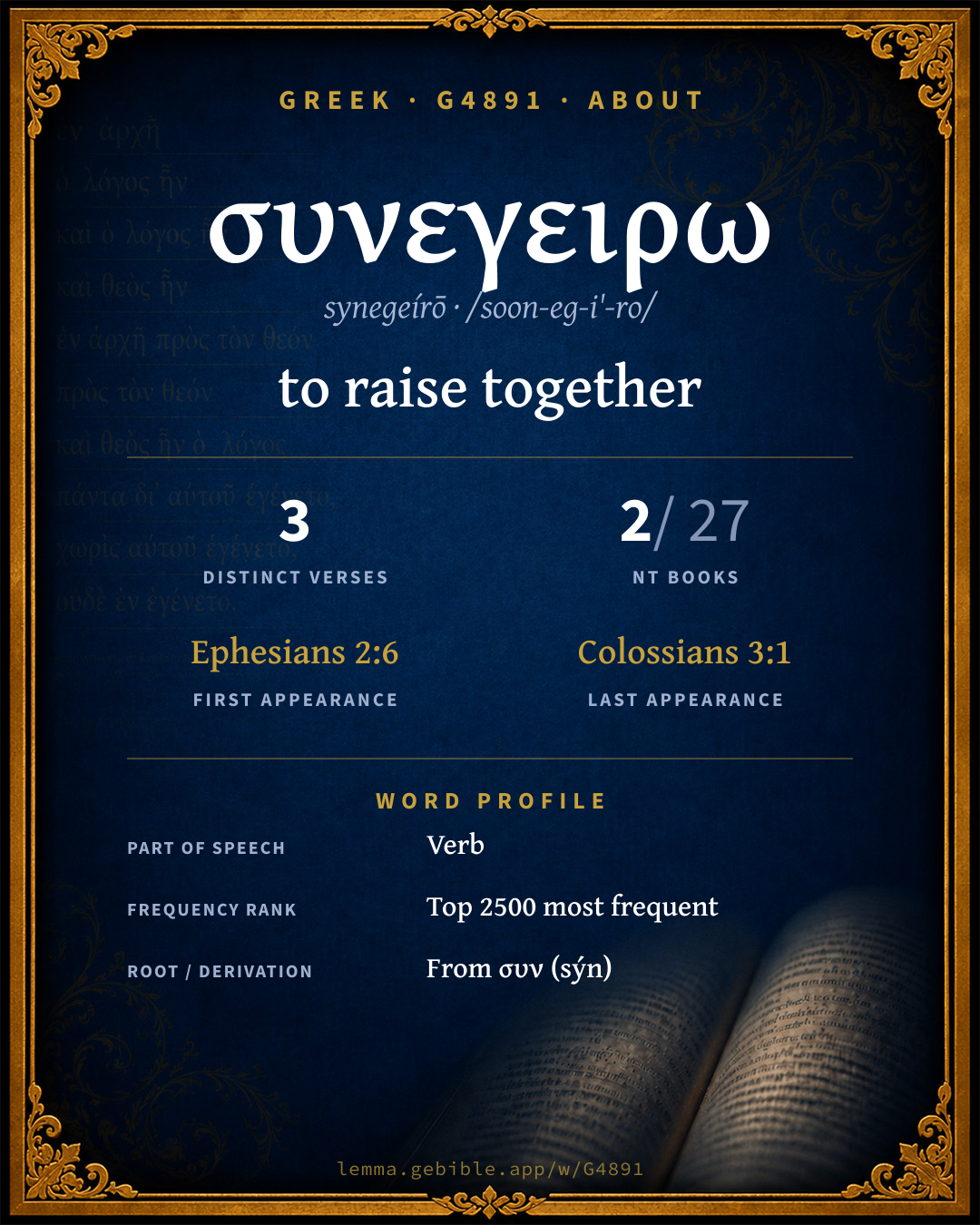
συνεγείρω
to raise together
‘to raise together’ is one of 2 main senses fuller range ↓
Full lexicon entry — Thayer's Greek Lexicon
From Thayer's Greek Lexicon
Where this word appears
Grammar key — what these labels mean
Part of speech
- Verb
- An action or state-of-being word.
Tense
- Aorist
- Action viewed as a simple whole, without regard to duration — often past (perfective aspect).
Voice
- Passive
- The subject receives the action.
- Active
- The subject performs the action.
Mood
- Indicative
- States a fact or asks a factual question (the mood of reality).
Person
- 2nd person
- The one addressed (“you”).
- 3rd person
- The one spoken about (“he / she / it / they”).
Number
- Plural
- More than one.
- Singular
- One.
Grammatical forms
- Verb, Aorist, Passive, Indicative, 2nd person, Plural 2 times (67%)
- Verb, Aorist, Active, Indicative, 3rd person, Singular 1 time (33%)
Parsed forms decoded from the imported morphology (Robinson–Tischendorf, public domain), counted across 3 parsed occurrences — not distinct verses.
Every verse where G4891 appears — 3 distinct verses across 2 books. Click any verse to open its interlinear word-by-word view. Verse text shown in the World English Bible for context — . Each verse’s Greek form is shown with its reference; the English is not keyword-highlighted, since the data carries no word-level English alignment. Use “Compare translations” on any verse to read it across multiple English versions. This concordance covers the Greek New Testament; Septuagint (Greek Old Testament) occurrences of this word are not indexed here.
Ephesians 1 verse
Colossians 2 verses
- Colossians 2:12 συνηγέρθητε aor pass ind 2pl having been buried with him in baptism, in which you were also raised with him through faith in the working of God, who raised him from the dead.
- Colossians 3:1 συνηγέρθητε aor pass ind 2pl If then you were raised together with Christ, seek the things that are above, where Christ is, seated on the right hand of God.
About this entry
At a glance — auto-summarized from this page’s data, not written by a person. Every figure links to its source below. This summary describes the numbers; it doesn’t interpret them.
“to raise together” is the headline sense of the Greek verb συνεγειρω (synegeírō). The Greek New Testament uses it only 3 verses. More than two-thirds of its appearances fall in Colossians. First canonically at Ephesians 2:6, it enters the text early. Catalogued under 2 senses, its meaning is not single-sense. See the sense tree, 3-verse concordance, and the renderings breakdown below.
Gloss history
Strong's 1890 vs modern scholarship
About this word
Strong's G4891 catalogs a Greek word from the Greek New Testament.
These counts are not copied from any lexicon or concordance. They are computed here, from the morphology-tagged Greek New Testament. What Lemma adds →
- 3
- distinct verses
- The word appears in 3 distinct verses.
- 2 / 27
- NT books
- The word appears in 2 of 27 New Testament books.
- #2,203
- by frequency
- Top 2500 most frequent Greek words (rank 2,203 of 5,347 Greek words by occurrence).
View all 3 occurrences in the concordance →
Most concentrated in
- Colossians 2 verses 67%
- Ephesians 1 verse 33%
By section of the New Testament
By traditional corpus
Conventional, traditional groupings — biblical authorship is debated, so this is a traditional corpus grouping, not an authorship claim. Some books belong to more than one corpus (Luke is in both the Gospels and the Lukan corpus, and so on), so these shares overlap and need not total 100%. Each figure is a share of the word’s 3 distinct verses.
- Pauline corpus 3 verses · 100%
How translations render this word
Counts come from each version’s own published word-to-Strong’s tagging or interlinear alignment — an approximate guide to how each version renders this word, not a word-level alignment the data otherwise carries. Because each total is that version’s own tagged count, the per-version totals vary from one another and need not match the appearance or distinct-verse counts above. These counts may also differ from a printed concordance because Lemma counts each distinctly tagged rendering and does not collapse phrase taggings into a single head-word total. This is a fixed set of word-tagged versions (KJV, ASV, BSB, ULT) and does not change with the reading translation you choose elsewhere. Each version’s license is shown beside its name below (and on Sources).
- King James Version: Be risen 1×, Hath raised us up together 1×, Ye 1×
- American Standard Version: Raised 1×, Raised with 1×, Up with him 1×
- Berean Standard Bible: Raised up with 1×, You have been raised with 1×, You were raised with 1×
- unfoldingWord Literal Text: Him 1×, Raised us up with 1×, You were raised up 1×
King James Version Public Domain
Renders G4891 across 4 tagged occurrences — most commonly:
American Standard Version Public Domain
Renders G4891 across 5 tagged occurrences — most commonly:
Berean Standard Bible Public Domain
Renders G4891 across 3 tagged occurrences — most commonly:
unfoldingWord Literal Text CC BY-SA 4.0
Renders G4891 across 4 tagged occurrences — most commonly:
Senses in Thayer's
The 2 senses Thayer's distinguishes for this word, in lexicon order (not ranked by frequency or importance). The full entry — with sub-senses — is in the Lexicon Entry tab.
- to raise together, to cause to raise together
- to raise up together from mortal death to a new and blessed life dedicated to God
Word origin
Derived from συν (sýn) (G4862) — with.
Forms in the corpus
The 2 distinct written forms G4891 takes in the Greek New Testament, most frequent first — each parse links to that tense’s occurrences in the concordance.
| Form | Parsing | Example | Uses |
|---|---|---|---|
| συνηγέρθητε synēgérthēte | Verb, Aorist, Passive, Indicative, 2nd person, Plural | Colossians 2:12 | 2 |
| συνήγειρεν synḗgeiren | Verb, Aorist, Active, Indicative, 3rd person, Singular | Ephesians 2:6 | 1 |
Same root — word family
Other Thayer's entries built from the same root as G4891, grouped by Strong’s listed origin. These share a root / origin per the lexicon — not necessarily a shared meaning. Each links to that word’s own entry.
Derives from
Shares the same root
- κοινος koinós G2839 common
- συγγενης syngenḗs G4773 related by blood
- συγγνωμη syngnṓmē G4774 pardon
- συγκαθημαι synkáthēmai G4775 to sit together
- συγκαθιζω synkathízō G4776 to sit together
- συγκακοπαθεω synkakopathéō G4777 to suffer together
- συγκακουχεω synkakouchéō G4778 to be ill-treated together
- συγκαλεω synkaléō G4779 to call together
- συγκαλυπτω synkalýptō G4780 to cover completely
- συγκαμπτω synkámptō G4781 to bend together
- συγκαταβαινω synkatabaínō G4782 to go down with
- συγκατατιθεμαι synkatatíthemai G4784 to deposit together
- συγκαταψηφιζω synkatapsēphízō G4785 to vote against
- συγκεραννυμι synkeránnymi G4786 to mix together
- συγκλειω synkleíō G4788 to shut up
- συγκληρονομος synklēronómos G4789 joint heir
- συγκοινωνεω synkoinōnéō G4790 to share together
- συγκοινωνος synkoinōnós G4791 joint partner
- συγκομιζω synkomízō G4792 to collect together
- συγκρινω synkrínō G4793 to join together
- συγκυπτω synkýptō G4794 to bend together
- συγκυρια synkyría G4795 by chance
- συγχαιρω synchaírō G4796 to rejoice with
- συγχεω synchéō G4797 to disturb
+125 more words share this root (not shown).
Compare all same-root words → Showing 4 of 151 — not the complete family. They share a root, not necessarily a meaning.
Septuagint usage
The same Greek word συνεγειρω appears 2 times in the Greek Old Testament (Septuagint), across 2 verses in 2 books.
- 2
- LXX occurrences
- Tagged occurrences of this Greek word in the Septuagint.
- 2
- verses
- Distinct Septuagint verses containing this word.
- 2 / 39
- OT books
- The word appears in 2 of the 39 Old Testament books.
Sample Septuagint occurrences
- Exodus 23:5 συνἐγείρω
- Isaiah 14:9 συνἐγείρω
Septuagint occurrences (same lexeme)
Every verse where the same Strong’s number (G4891) appears in the Greek Septuagint. Verse text shown in the World English Bible for context; the Greek form is the matched word — the English is not keyword-highlighted.
- Exodus 23:5 συνἐγείρω If you see the donkey of him who hates you fallen down under his burden, don't leave him, you shall surely help him with it.
- Isaiah 14:9 συνἐγείρω Sheol from beneath is moved for you to meet you at your coming; it stirs up the dead for you, even all the chief ones of the earth; it has raised up from their thrones all the kings of the nations.
These are occurrences of the same Greek lexeme (G4891) in the Septuagint — not a translation of any one Hebrew word. The store carries no word-level Hebrew↔Greek alignment, so no Hebrew original is asserted here. Counts come from the recovered LXX Strong's tagging — high-frequency vocabulary is well covered, while rare or late forms may be untagged — so they reflect tagged occurrences and may slightly undercount.