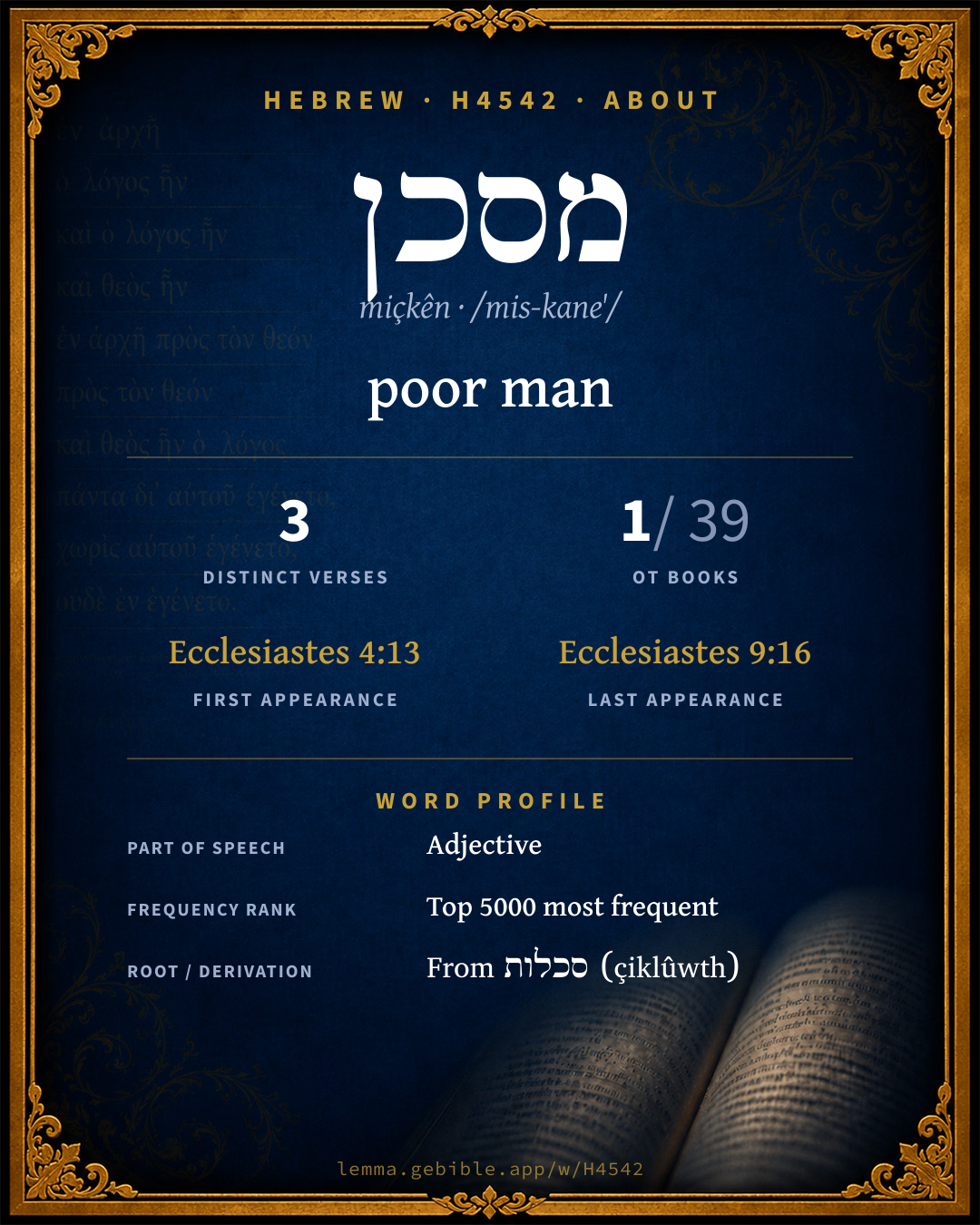
מִסְכֵּן
poor man
Full lexicon entry — Brown-Driver-Briggs (BDB)
From Brown-Driver-Briggs (BDB)
Where this word appears
Grammar key — what these labels mean
Part of speech
- Adjective
- A word that describes or qualifies a noun.
State
- Absolute
- The independent form of a noun, not bound to a following word.
Gender
- Masculine
- Grammatically masculine.
Number
- Singular
- One.
Every verse where H4542 appears — 3 distinct verses across 1 book. Click any verse to open its interlinear word-by-word view. Verse text shown in the World English Bible for context — . Each verse’s Hebrew form is shown with its reference; the English is not keyword-highlighted, since the data carries no word-level English alignment. Use “Compare translations” on any verse to read it across multiple English versions. This concordance covers the Hebrew Bible; Septuagint (Greek Old Testament) occurrences are not indexed here.
Ecclesiastes 3 verses
- Ecclesiastes 4:13 מִסְכֵּ֖ן adj Adjective ms Better is a poor and wise youth than an old and foolish king who doesn't know how to receive admonition any more.
- Ecclesiastes 9:15 מִסְכֵּן֙ הַ/מִּסְכֵּ֖ן adj Adjective ms ptcl def.art + Adjective Adjective ms Now a poor wise man was found in it, and he by his wisdom delivered the city; yet no man remembered that same poor man.
- Ecclesiastes 9:16 הַ/מִּסְכֵּן֙ ptcl def.art + Adjective Adjective ms Then said I, Wisdom is better than strength. Nevertheless the poor man's wisdom is despised, and his words are not heard.
About this entry
At a glance — auto-summarized from this page’s data, not written by a person. Every figure links to its source below. This summary describes the numbers; it doesn’t interpret them.
At its core, מסכן (miçkên) means “poor man.” The Hebrew Bible uses it only 3 verses. Its uses cluster heavily in Ecclesiastes (100% of all occurrences). Scripture first uses it in Ecclesiastes 4:13. Sharing its root, it stands alongside סכלות and מסכנת. Dig into 3-verse concordance and the renderings breakdown below.
Gloss history
Strong's 1890 vs modern scholarship
About this word
Strong's H4542 catalogs a Hebrew word from the Hebrew Old Testament.
These counts are not copied from any lexicon or concordance. They are computed here, from the morphology-tagged Hebrew Old Testament. What Lemma adds →
- 3
- distinct verses
- The word appears in 3 distinct verses.
- 1 / 39
- OT books
- The word appears in 1 of 39 Old Testament books.
- #3,696
- by frequency
- Top 5000 most frequent Hebrew words (rank 3,696 of 8,640 Hebrew words by occurrence).
View all 3 occurrences in the concordance →
Most concentrated in
- Ecclesiastes 3 verses 100%
By section of the Old Testament
By traditional corpus
Conventional, traditional groupings — biblical authorship is debated, so this is a traditional corpus grouping, not an authorship claim. Each share is this word’s portion of its verses in that division of the Hebrew canon. Each figure is a share of the word’s 3 distinct verses.
- Writings (Ketuvim) 3 verses · 100%
How translations render this word
Counts come from each version’s own published word-to-Strong’s tagging or interlinear alignment — an approximate guide to how each version renders this word, not a word-level alignment the data otherwise carries. Because each total is that version’s own tagged count, the per-version totals vary from one another and need not match the appearance or distinct-verse counts above. These counts may also differ from a printed concordance because Lemma counts each distinctly tagged rendering and does not collapse phrase taggings into a single head-word total. This is a fixed set of word-tagged versions (KJV, ASV, BSB, ULT) and does not change with the reading translation you choose elsewhere. Each version’s license is shown beside its name below (and on Sources).
- King James Version: Is a poor 1×, Nevertheless the poor man's 1×, Poor 1×
- American Standard Version: Is a poor 1×, Nevertheless the poor man 1×, Poor 1×
- Berean Standard Bible: Poor 2×
- unfoldingWord Literal Text: Poor 3×
King James Version Public Domain
Renders H4542 across 4 tagged occurrences — most commonly:
American Standard Version Public Domain
Renders H4542 across 4 tagged occurrences — most commonly:
Berean Standard Bible Public Domain
Renders H4542 across 4 tagged occurrences — most commonly:
Plus 2 renderings that appear only once — usually multi-word phrases or single function words the recovered tagging swept in, not distinct renderings.
unfoldingWord Literal Text CC BY-SA 4.0
Renders H4542 across 4 tagged occurrences — most commonly:
Plus 1 rendering that appears only once — usually multi-word phrases or single function words the recovered tagging swept in, not distinct renderings.
Senses in BDB
The 1 sense BDB distinguishes for this word, in lexicon order (not ranked by frequency or importance). The full entry — with sub-senses — is in the Lexicon Entry tab.
- poor, poor man
Word origin
adj. poor, only Ec. (NH id.; Aramaic id., ܡܶܣܟܶܝܢ PS2632; Arabic مِسْكِينٌ; Ethiopic ምስኪን Di382; √ dub.; usually der. from III. סכן q.v.; perhaps loan-wd.; according to JenZA iv (1889), 271 f Zimib. vii (1892), 353=Assyrian muškênu, beggar, needy one);—always abs. מ׳:—יֶלָד מ׳ וְחָכָם Ec 4:13 (opp. מֶלֶךְ זָקִן וּכְסִיל); אִישׁ מ׳ חָכָם 9:15, הָאִישׁ הַמּ׳ v 15; as subst. הַמּ׳ v 16 the poor man.
— Brown-Driver-Briggs (Oxford 1906, public domain), digitized via Sefaria, supplemented by the OpenScriptures HebrewLexicon (CC BY 4.0). See Sources.
Derived from סכלות (çiklûwth) (H5531) — foolishness.
Jastrow Dictionary
A second Hebrew/Aramaic lexicon for comparison, covering Aramaic and post-biblical (Talmudic, Targumic, Midrashic) usage that the biblical-Hebrew BDB does not. Matched by lemma rather than by Strong’s number, so a lemma may carry more than one Jastrow headword (shown separately below), and the entries cover usage well beyond the Bible.
*מִסְכָּן
- (next w.) poverty. Cant. R. to I, 4 (interpreting מַסְכְּנֵנִי, v. מִסְכֵּן II; strike out דבר אחר) ממִסְכָּנִי אחריך נרוצה out of my poverty, we shall run after thee.
מִסְכֵּן I
- poor man; (adj.) scanty, scarce; trnsf. mean. Midr. Prov. ch. XXII מ׳ שהוא מְסוּכָּן בחייו the poor man is called misken, because he is sparsely supplied with means of livelihood; Lev. R. s. 34 מפני שהוא בזוי לכל he is called misken, because he is despised of all men (ref. to Koh. IX, 16). Ruth R. to I, 1 (ref. to Koh. l. c.) וכי חכמתו של ר"ע שהיה מ׳ בזויה היתה אלא מהו מ׳ מי שהוא בזוי בדבריו וכ׳ was the wisdom of R. Akiba who was a poor man despised? But what does misken here mean? One who proves himself mean by his own words (not practicing what he preaches); Koh. R. to l. c. [read:] אלא זה שהוא מ׳ בדבריו; Yalk. Ruth 598 אלא ההוא דמ׳ בדבריו בזויה (insert חכמתו). Koh. R. l. c. אין מ׳ אלא מי שמְמַסְכֵּין דבריו (not שמסכין) behold, a misken is none but he who makes his words appear mean. Ib. to IX, 15 ולמה קורא אותו מ׳ שאינו מצוי בכל הבריות ואין וכ׳ and why does the text call him (the good genius in man) misken (scarce)? Because he is rare among men, and (mean) because the majority of people do not listen to him; ib. to IV, 13; a. fr.—Yalk. ib. 979; Y’lamd. to Num. XXIV, 5 quot. in Ar. שמ׳ מדברי תורה, read: שמ׳ בדבריו, v. supra.—Denom. e.g. Ecclesiastes 9:16
מִסְכֵּן II
- to make poor, make contemptible. Koh. R. to IX, 16, v. preced. Ex. R. s. 1; Sot. 11ᵃ (play on מִסְכְּנוֹת, Ex. I, 11) שמְמַסְכְּנוֹת את בעליהן (read: בוניהן) for they (the buildings) impoverish their builders; Yalk. Ex. 162 שמסכנות (corr. acc.). Cant. R. to I, 4 (play on משכני, ib.) [read:] מַסְכְּנֵינִי אחריך נרוצה make me (Israel) poor, and we shall run after thee (v. preced.). e.g. Exodus 1:11
- to become poor. Sot. l. c. כל העוסק בבנין מִתְמַסְכֵּן whoever makes building his business will get poor; Yeb. 63ᵃ; Ex. R. l. c.; Yalk. Ex. l. c.
מִסְכֵּן
- Targ. Koh. IV, 13, sq. Targ. O. Deut. XV, 11; a. e.—Y. B. Mets. II, 8ᶜ top אינש מ׳ a poor man. Y. Peah VII, 21ᵇ top; a. fr.—Pl. מִסְכֵּנִין, מִסְכֵּנַיָּא, מִסְכֵּי׳, מִי׳. Targ. Y. Deut. l. c. (not מַסְכְּנִין). Targ. Prov. XXII, 7; a. e.—Y. Peah l. c. יהב … דפלג למ׳ gave his son Samuel money to distribute among the poor. Y. Ḥag. II, 77ᵈ bot.; Y. Snh. VI, 23ᶜ ייתון מ׳ וכ׳ let the poor come and eat it, that it may not go to ruin. Y. Sot. III, 19ᵃ; Y. Peah VIII, 21ᵃ bot. יליף זכי … מעשר מ׳ used to give him the tithes of the poor every third year; a. fr.—Denom.:
מַסְכֵּן
- = מִסְכֵּן II, to make poor, reduce. Targ. Ps. LVI, 8 (h. text הורד). Ib. XCIV, 5 (h. text עִנָּה). Targ. Job VI, 9 (h. text דִּכֵּא); a. e.
A Dictionary of the Targumim, the Talmud Babli and Yerushalmi, and the Midrashic Literature (Marcus Jastrow; London, Luzac, 1903) — Public Domain. Digitized via Sefaria. Digitized via Sefaria. Full attribution on Sources.
Forms in the corpus
The 4 distinct written forms H4542 takes in the Hebrew Bible, most frequent first — each parse links to that state’s occurrences in the concordance. Hebrew forms include their vowel points and cantillation, so a single lemma takes many written forms.
| Form | Parsing | Example | Uses |
|---|---|---|---|
| הַ/מִּסְכֵּ֖ן | Adjective, Adjective, Masculine, Singular, Absolute | Ecclesiastes 9:15 | 1 |
| הַ/מִּסְכֵּן֙ | Adjective, Adjective, Masculine, Singular, Absolute | Ecclesiastes 9:16 | 1 |
| מִסְכֵּ֖ן | Adjective, Adjective, Masculine, Singular, Absolute | Ecclesiastes 4:13 | 1 |
| מִסְכֵּן֙ | Adjective, Adjective, Masculine, Singular, Absolute | Ecclesiastes 9:15 | 1 |
Same root — word family
Other BDB entries built from the same root as H4542, grouped by Strong’s listed origin. These share a root / origin per the lexicon — not necessarily a shared meaning. Each links to that word’s own entry.
Derives from
Derived from this word
Compare all same-root words → They share a root, not necessarily a meaning.
Septuagint verse parallels
This word appears in 3 verses that also exist in the Greek Old Testament (Septuagint), out of the 3 Hebrew verses it occurs in. You can read those verses in Greek by switching the Old Testament edition to the Septuagint.
Read these verses in the Septuagint
This is a verse-level parallel only — the same verses exist in both the Hebrew and Greek Old Testaments. No word-level Hebrew↔Greek correspondence is claimed: the data carries no such alignment, so no Greek word is shown as this Hebrew word’s translation. Coverage is not total — the Septuagint omits the deuterocanon and renumbers the Psalms, so some Hebrew verses have no direct Greek parallel.