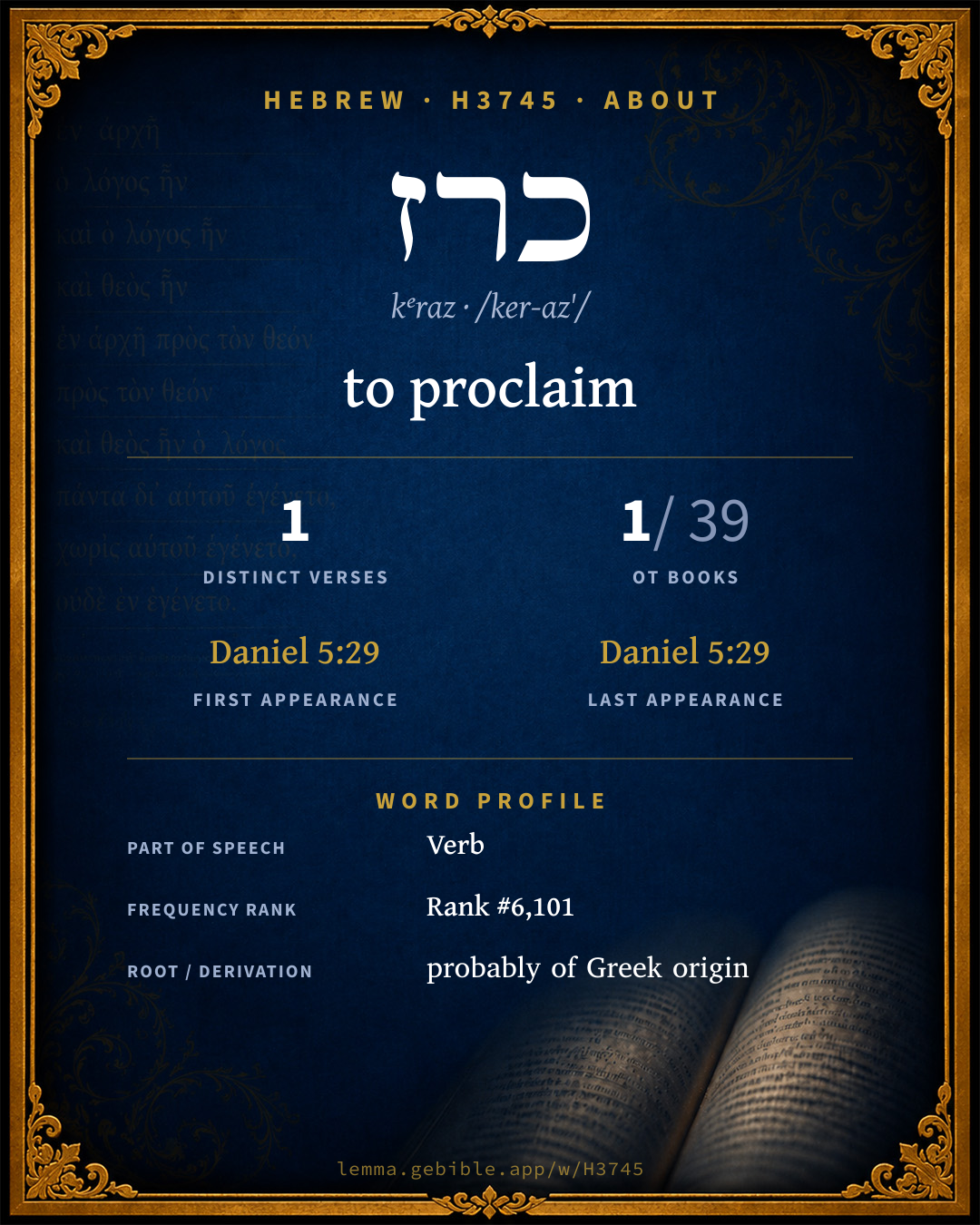
כְּרַז
to proclaim
Full lexicon entry — Brown-Driver-Briggs (BDB)
From Brown-Driver-Briggs (BDB)
Where this word appears
Grammar key — what these labels mean
Stem
- Hiphil
- The causative active stem (“he caused / brought about”).
Form
- Perfect
- A completed action or state — Hebrew marks aspect (completeness) more than strict tense (“he wrote”).
Person
- 3rd Person
- The one spoken about (“he / she / it / they”).
Gender
- Masculine
- Grammatically masculine.
Number
- Plural
- More than one (in Hebrew, generally three or more).
Every verse where H3745 appears — 1 distinct verse across 1 book. Click any verse to open its interlinear word-by-word view. Verse text shown in the World English Bible for context — . Each verse’s Hebrew form is shown with its reference; the English is not keyword-highlighted, since the data carries no word-level English alignment. Use “Compare translations” on any verse to read it across multiple English versions. This concordance covers the Hebrew Bible; Septuagint (Greek Old Testament) occurrences are not indexed here.
Daniel 1 verse
About this entry
At a glance — auto-summarized from this page’s data, not written by a person. Every figure links to its source below. This summary describes the numbers; it doesn’t interpret them.
“to proclaim” is the headline sense of the Hebrew verb כרז (kᵉraz). It occurs a mere 1 verse across Scripture. It clusters heavily in Daniel, which alone accounts for 100% of its uses. A true hapax — its single appearance is Daniel 5:29. From the same root come כרוז. The sections below give every sense, occurrence, and version rendering.
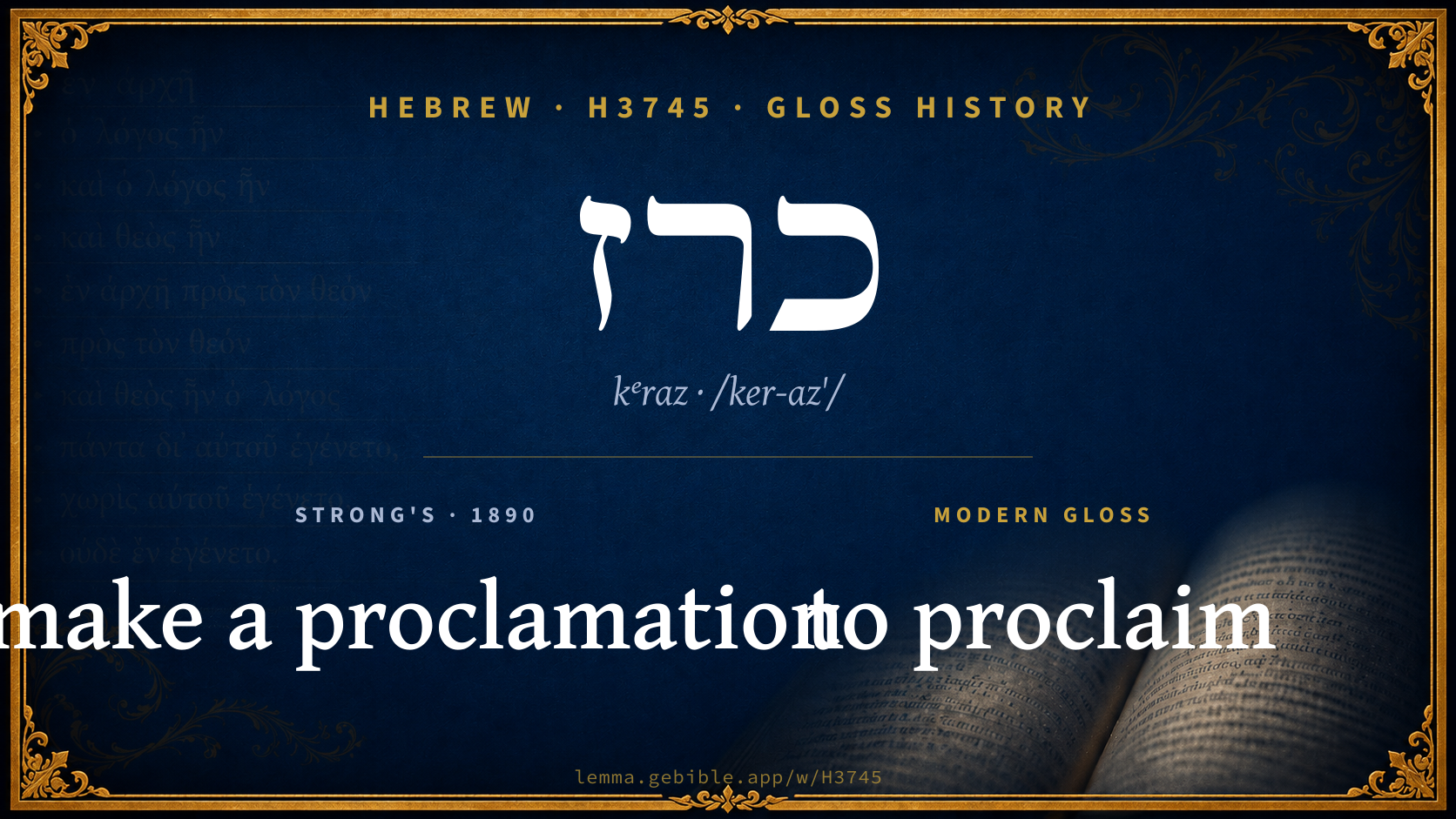
Gloss history
Strong's 1890 vs modern scholarship
About this word
Strong's H3745 catalogs a Hebrew word from the Hebrew Old Testament.
These counts are not copied from any lexicon or concordance. They are computed here, from the morphology-tagged Hebrew Old Testament. What Lemma adds →
- 1
- distinct verses
- The word appears in 1 distinct verse.
- 1 / 39
- OT books
- The word appears in 1 of 39 Old Testament books.
- #6,101
- by frequency
- Rank #6,101 (rank 6,101 of 8,640 Hebrew words by occurrence).
View all 1 occurrence in the concordance →
Most concentrated in
- Daniel 1 verse 100%
By section of the Old Testament
By traditional corpus
Conventional, traditional groupings — biblical authorship is debated, so this is a traditional corpus grouping, not an authorship claim. Each share is this word’s portion of its verses in that division of the Hebrew canon. Each figure is a share of the word’s 1 distinct verse.
- Writings (Ketuvim) 1 verse · 100%
How translations render this word
Counts come from each version’s own published word-to-Strong’s tagging or interlinear alignment — an approximate guide to how each version renders this word, not a word-level alignment the data otherwise carries. Because each total is that version’s own tagged count, the per-version totals vary from one another and need not match the appearance or distinct-verse counts above. These counts may also differ from a printed concordance because Lemma counts each distinctly tagged rendering and does not collapse phrase taggings into a single head-word total. This is a fixed set of word-tagged versions (KJV, ASV, BSB, ULT) and does not change with the reading translation you choose elsewhere. Each version’s license is shown beside its name below (and on Sources).
- King James Version: Made a proclamation 1×
- American Standard Version: Made proclamation 1×
- Berean Standard Bible: Proclaimed 1×
- unfoldingWord Literal Text: Proclamation was made 1×
King James Version Public Domain
Renders H3745 across 1 tagged occurrence — most commonly:
American Standard Version Public Domain
Renders H3745 across 1 tagged occurrence — most commonly:
Berean Standard Bible Public Domain
Renders H3745 across 1 tagged occurrence — most commonly:
unfoldingWord Literal Text CC BY-SA 4.0
Renders H3745 across 1 tagged occurrence — most commonly:
Senses in BDB
The 1 sense BDB distinguishes for this word, in lexicon order (not ranked by frequency or importance). The full entry — with sub-senses — is in the Lexicon Entry tab.
- (Aphel) to herald, proclaim, make proclamation
Word origin
[ כְּרַז ] vb. denom. Haph. make proclamation;— Dn 5:29
— Brown-Driver-Briggs (Oxford 1906, public domain), digitized via Sefaria, supplemented by the OpenScriptures HebrewLexicon (CC BY 4.0). See Sources.
Origin: probably of Greek origin
Jastrow Dictionary
A second Hebrew/Aramaic lexicon for comparison, covering Aramaic and post-biblical (Talmudic, Targumic, Midrashic) usage that the biblical-Hebrew BDB does not. Matched by lemma rather than by Strong’s number, so a lemma may carry more than one Jastrow headword (shown separately below), and the entries cover usage well beyond the Bible.
כָּרַז
- to call together (cmp. כְּלֵי II); to call out, announce. Tanḥ. Mishp. 19 וכשהמלאך כּוֹרֵז האדם בשלום as long as the angel cries out (‘give honor to the image of God’), man is safe. Ib. (ref. to Job XXXIII, 23) אם יהא מן אותן אלף כורז וכ׳ if there be one out of the thousand (angels) crying out before him, to proclaim a man’s righteousness. Esth. R. to VI, 12 כּוֹרֵז, v. כָּרוֹז. Deut. R. s. 4 והכרוזות כּוֹרְזִין וכ׳ and the criers (angels) call out before him, Give room &c., v. infra. e.g. Job 33:23
- same. Tanḥ. l. c. ואחד מהם מַכְרִיז … תנו וכ׳ and one of them (the angels) cries out before him, saying, Give honor &c.; Midr. Till. to Ps. XVII; Yalk. Ps. 670 מַכְרִיזִין, v. אִיקוֹנְיָא. B. Mets. II, 1, sq. אלו חייב להַכְרִיז the following finds one must publish. Ib. 28ᵇ אבידתא מַכְרִיז the crier announces that something has been found (not defining the object), opp. to גלימא מכריז ‘a cloak’ (or whatever the object may be).—Pes. 113ᵃ שלשה הקב"ה מכריז עליהם וכ׳ Ms. M. there are three persons for whose sake the Lord sends out the crier every day (to announce their praise); a. fr.
כְּרַז
- , Af. אַכְרֵיז same. Targ. Jon. III, 7 (h. text ויזעק); a. fr.—Targ. Ps. CV, 16 Ms. (ed. ואכלי, v. כְּלֵי II). Targ. Y. Deut. XXIV, 3 אַכְרִיזוּ וכ׳ it has been announced (decreed) in heaven.—Kidd. 81ᵃ מר זוטרא מלקי ומַכְרִיז M. Z. punished (a woman for being closeted with a man) and published the fact (in order to protect her children’s legitimacy). Ib. אי לאו דקא מַכְרִיזֵי (מַכְרְזֵי) וכ׳ if it had not been called out in heaven, Beware of R. M. &c. Yoma 72ᵇ, a. fr.
A Dictionary of the Targumim, the Talmud Babli and Yerushalmi, and the Midrashic Literature (Marcus Jastrow; London, Luzac, 1903) — Public Domain. Digitized via Sefaria. Digitized via Sefaria. Full attribution on Sources.
Same root — word family
Other BDB entries built from the same root as H3745, grouped by Strong’s listed origin. These share a root / origin per the lexicon — not necessarily a shared meaning. Each links to that word’s own entry.
Derived from this word
Compare all same-root words → They share a root, not necessarily a meaning.