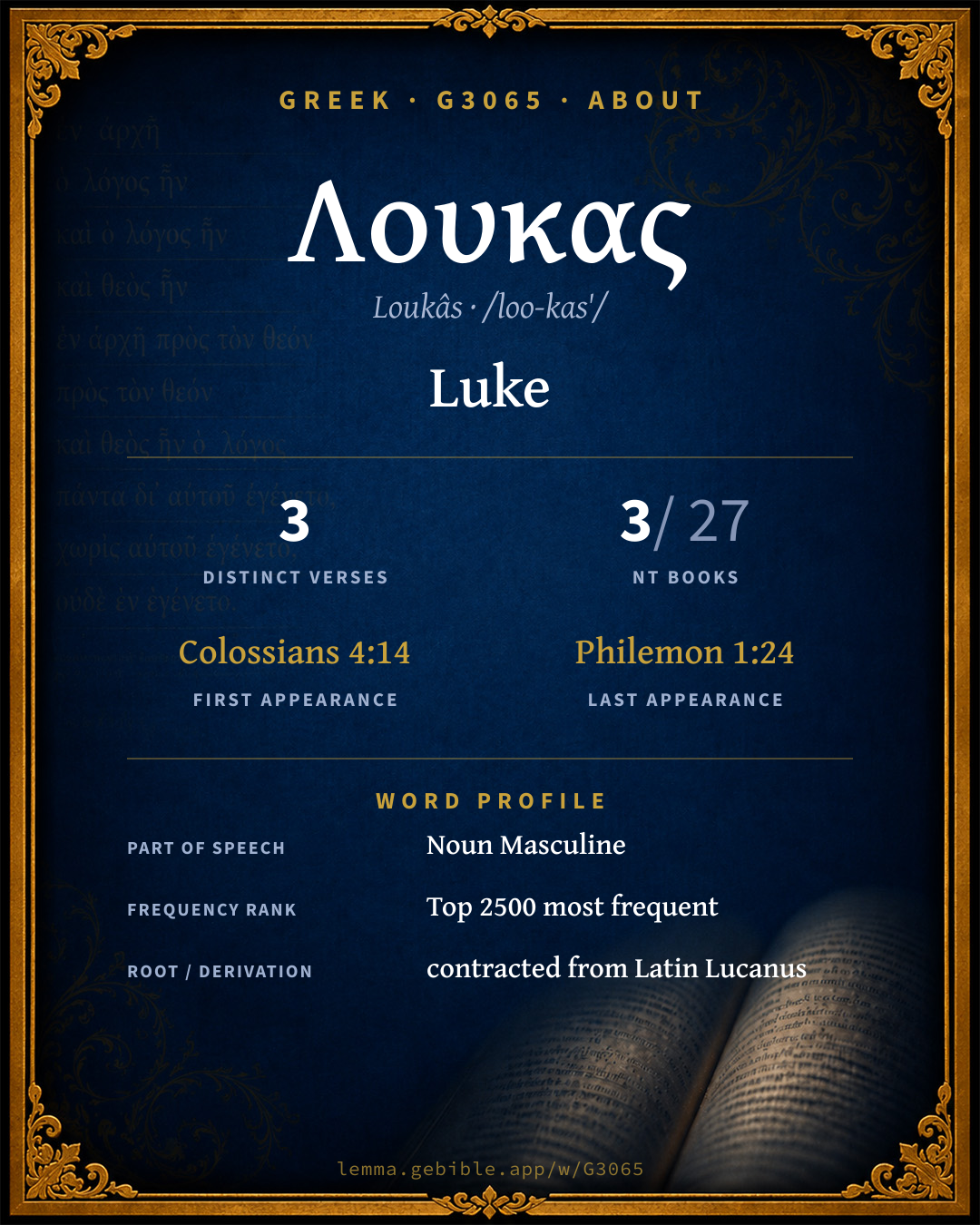
Λουκᾶς
Luke
Thayer's lists 2 entries for ‘Luke’ fuller range ↓
Full lexicon entry — Thayer's Greek Lexicon
From Thayer's Greek Lexicon
Where this word appears
Grammar key — what these labels mean
Part of speech
- Noun
- A naming word — a person, place, thing, or idea.
Case
- Nominative
- The case of the subject (and the predicate nominative).
Gender
- Masculine
- Grammatically masculine.
Number
- Singular
- One.
Every verse where G3065 appears — 3 distinct verses across 3 books. Click any verse to open its interlinear word-by-word view. Verse text shown in the World English Bible for context — . Each verse’s Greek form is shown with its reference; the English is not keyword-highlighted, since the data carries no word-level English alignment. Use “Compare translations” on any verse to read it across multiple English versions. This concordance covers the Greek New Testament; Septuagint (Greek Old Testament) occurrences of this word are not indexed here.
Colossians 1 verse
2 Timothy 1 verse
Philemon 1 verse
About this entry
At a glance — auto-summarized from this page’s data, not written by a person. Every figure links to its source below. This summary describes the numbers; it doesn’t interpret them.
The Greek name Λουκας centers on the idea of “Luke.” It is rare — just 3 verses in the entire Greek New Testament. Colossians dominates its distribution — 1 of 3 verses. Debuting at Colossians 4:14, it then recurs through the corpus. For the data behind this summary, explore 3-verse concordance and the renderings breakdown below.
Gloss history
Strong's 1890 vs modern scholarship

About this word
Strong's G3065 catalogs a Greek word from the Greek New Testament.
These counts are not copied from any lexicon or concordance. They are computed here, from the morphology-tagged Greek New Testament. What Lemma adds →
- 3
- distinct verses
- The word appears in 3 distinct verses.
- 3 / 27
- NT books
- The word appears in 3 of 27 New Testament books.
- #2,203
- by frequency
- Top 2500 most frequent Greek words (rank 2,203 of 5,347 Greek words by occurrence).
View all 3 occurrences in the concordance →
Most concentrated in
- Colossians 1 verse 33%
- 2 Timothy 1 verse 33%
- Philemon 1 verse 33%
By section of the New Testament
By traditional corpus
Conventional, traditional groupings — biblical authorship is debated, so this is a traditional corpus grouping, not an authorship claim. Some books belong to more than one corpus (Luke is in both the Gospels and the Lukan corpus, and so on), so these shares overlap and need not total 100%. Each figure is a share of the word’s 3 distinct verses.
- Pauline corpus 3 verses · 100%
How translations render this word
Counts come from each version’s own published word-to-Strong’s tagging or interlinear alignment — an approximate guide to how each version renders this word, not a word-level alignment the data otherwise carries. Because each total is that version’s own tagged count, the per-version totals vary from one another and need not match the appearance or distinct-verse counts above. These counts may also differ from a printed concordance because Lemma counts each distinctly tagged rendering and does not collapse phrase taggings into a single head-word total. This is a fixed set of word-tagged versions (KJV, ASV, BSB, ULT) and does not change with the reading translation you choose elsewhere. Each version’s license is shown beside its name below (and on Sources).
- King James Version: Luke 2×
- American Standard Version: Luke 2×
- Berean Standard Bible: Luke 3×
- unfoldingWord Literal Text: Luke 3×
King James Version Public Domain
Renders G3065 across 3 tagged occurrences — most commonly:
Plus 1 rendering that appears only once — usually multi-word phrases or single function words the recovered tagging swept in, not distinct renderings.
American Standard Version Public Domain
Renders G3065 across 2 tagged occurrences — most commonly:
Not rendered by a distinct English word in 1 further occurrence.
Berean Standard Bible Public Domain
Renders G3065 across 3 tagged occurrences — most commonly:
unfoldingWord Literal Text CC BY-SA 4.0
Renders G3065 across 3 tagged occurrences — most commonly:
Senses in Thayer's
The 2 senses Thayer's distinguishes for this word, in lexicon order (not ranked by frequency or importance). The full entry — with sub-senses — is in the Lexicon Entry tab.
- Luke or Lucus = "light-giving"
- a Gentile Christian…
Word origin
Origin: contracted from Latin Lucanus
Contracted from the Latin Lucanus ; Lucas a Christian : - Lucas Luke.
— Strong’s Exhaustive Concordance (1890), public domain.
Bible dictionary
Public-domain dictionary articles matched to this entry by name (Luke). A biblical name can be shared by more than one person or place, so an article may treat several.
Easton's Bible Dictionary · M. G. Easton, 1897
The evangelist, was a Gentile. The date and circumstances of his conversion are unknown. According to his own statement (Luke 1:2), he was not an "eye-witness and minister of the word from the beginning." It is probable that he was a physician in Troas, and was there converted by Paul, to whom he attached himself. He accompanied him to Philippi, but did not there share his imprisonment, nor did he accompany him further after his release in his missionary journey at this time (Acts 17:1). On Paul's third visit to Philippi (20:5, 6) we again meet with Luke, who probably had spent all the intervening time in that city, a period of seven or eight years. From this time Luke was Paul's constant companion during his journey to Jerusalem (20:6-21:18). He again disappears from view during Paul's imprisonment at Jerusalem and Caesarea, and only reappears when Paul sets out for Rome (27:1), whither he accompanies him (28:2, 12-16), and where he remains with him till the close of his first imprisonment (Philemon 1:24; Col. 4:14). The last notice of the "beloved physician" is in 2 Tim. 4:11.
There are many passages in Paul's epistles, as well as in the writings of Luke, which show the extent and accuracy of his medical knowledge.
Smith's Bible Dictionary · William Smith, 1863
(light-giving), or Lu'cas, is an abbreviated form of Lucanus. It is not to be confounded with Lucius, (Acts 13:1; Romans 16:21) which belongs to a different person. The name Luke occurs three times in the New Testament-- (Colossians 4:14; 2 Timothy 4:11); Phle 1:24--And probably in all three the third evangelist is the person spoken of. Combining the traditional element with the scriptural we are able to trace the following dim outline of the evangelist's life. He was born at Antioch in Syria, and was taught the science of medicine. The well known tradition that Luke was also a painter, and of no mean skill, rests on the authority of late writers. He was not born a Jew, for he is not reckoned among those "of the circumcision" by St. Paul. Comp. (Colossians 4:11) with ver. 14. The date of his conversion is uncertain. He joined St. Paul at Troas, and shared his Journey into Macedonia. The sudden transition to the first person plural in (Acts 16:9) is most naturally explained after all the objections that have been urged, by supposing that Luke the writer of the Acts, formed one of St. Paul's company from this point. As far as Philippi the evangelist journeyed with the apostle. The resumption of the third person on Paul's departure from that place, (Acts 17:1) would show that Luke was now left behind. During the rest of St. Paul's second missionary journey we hear of Luke no more; but on the third journey the same indication reminds us that Luke is again of the company, (Acts 20:5) having joined it apparently at Philippi, where he had been left. With the apostle he passed through Miletus, Tyre and Caesarea to Jerusalem. ch. Acts 20:6; 21:18 As to his age and death there is the utmost uncertainty. He probably died a martyr, between A.D. 75 and A.D. 100. He wrote the Gospel that bears his name, and also the book of Acts.
Hitchcock's Bible Names Dictionary · Roswell D. Hitchcock, 1869
luminous; white
Classic public-domain reference works; full attribution on Sources.