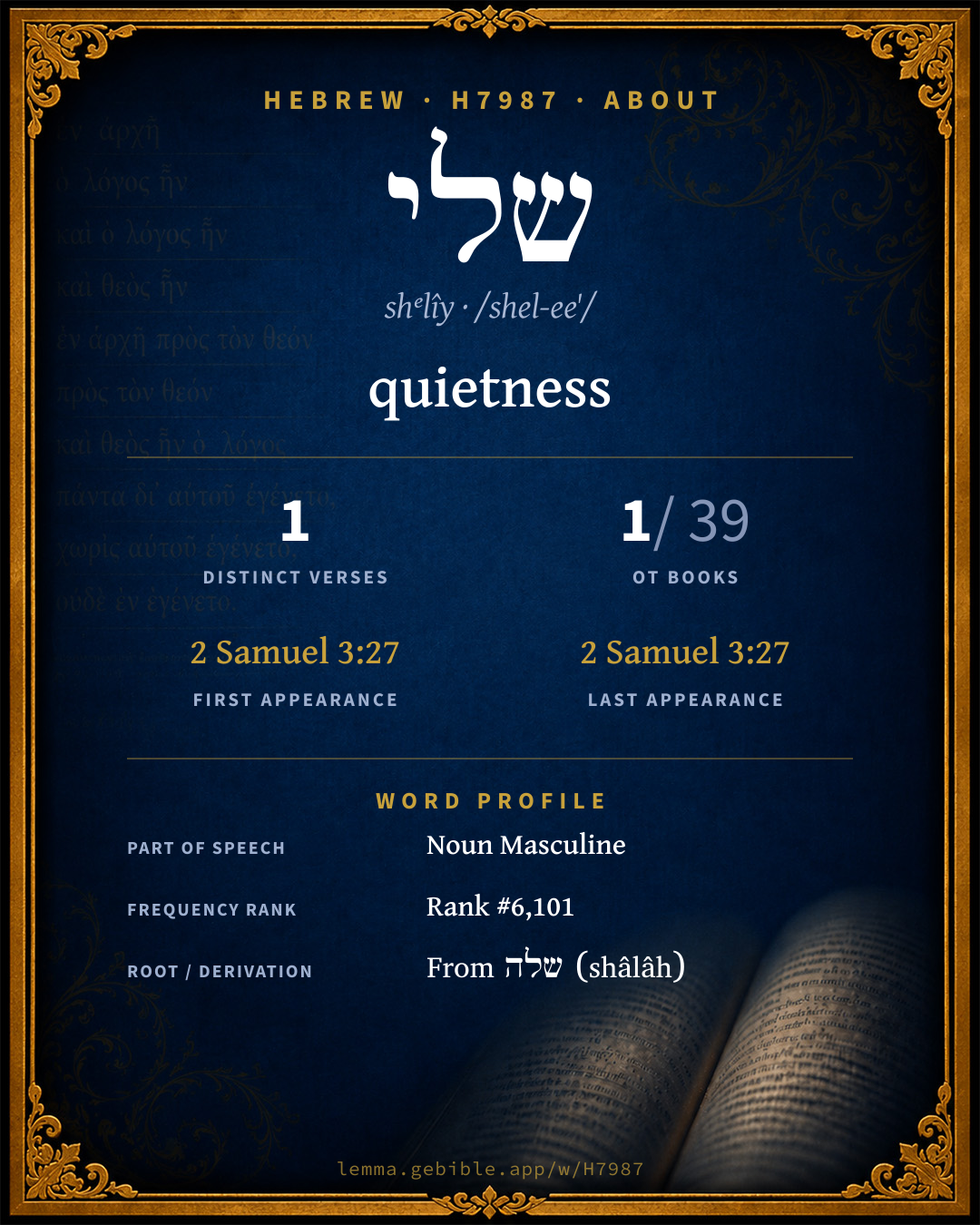
שְׁלִי
quietness
Full lexicon entry — Brown-Driver-Briggs (BDB)
From Brown-Driver-Briggs (BDB)
Where this word appears
Grammar key — what these labels mean
Noun type
- Common
- A common noun — a general class of person, place, or thing (“king,” “city,” “water”), not a specific name.
State
- Absolute
- The independent form of a noun, not bound to a following word.
Gender
- Masculine
- Grammatically masculine.
Number
- Singular
- One.
Every verse where H7987 appears — 1 distinct verse across 1 book. Click any verse to open its interlinear word-by-word view. Verse text shown in the World English Bible for context — . Each verse’s Hebrew form is shown with its reference; the English is not keyword-highlighted, since the data carries no word-level English alignment. Use “Compare translations” on any verse to read it across multiple English versions. This concordance covers the Hebrew Bible; Septuagint (Greek Old Testament) occurrences are not indexed here.
2 Samuel 1 verse
About this entry
At a glance — auto-summarized from this page’s data, not written by a person. Every figure links to its source below. This summary describes the numbers; it doesn’t interpret them.
The Hebrew noun שלי centers on the idea of “quietness.” It is rare — just 1 verse in the entire Hebrew Bible. The word gravitates to 2 Samuel (100%). It occurs only once, in 2 Samuel 3:27. It shares a root with שלה, שילה and שלה. For the data behind this summary, explore the sense tree and the renderings breakdown below.
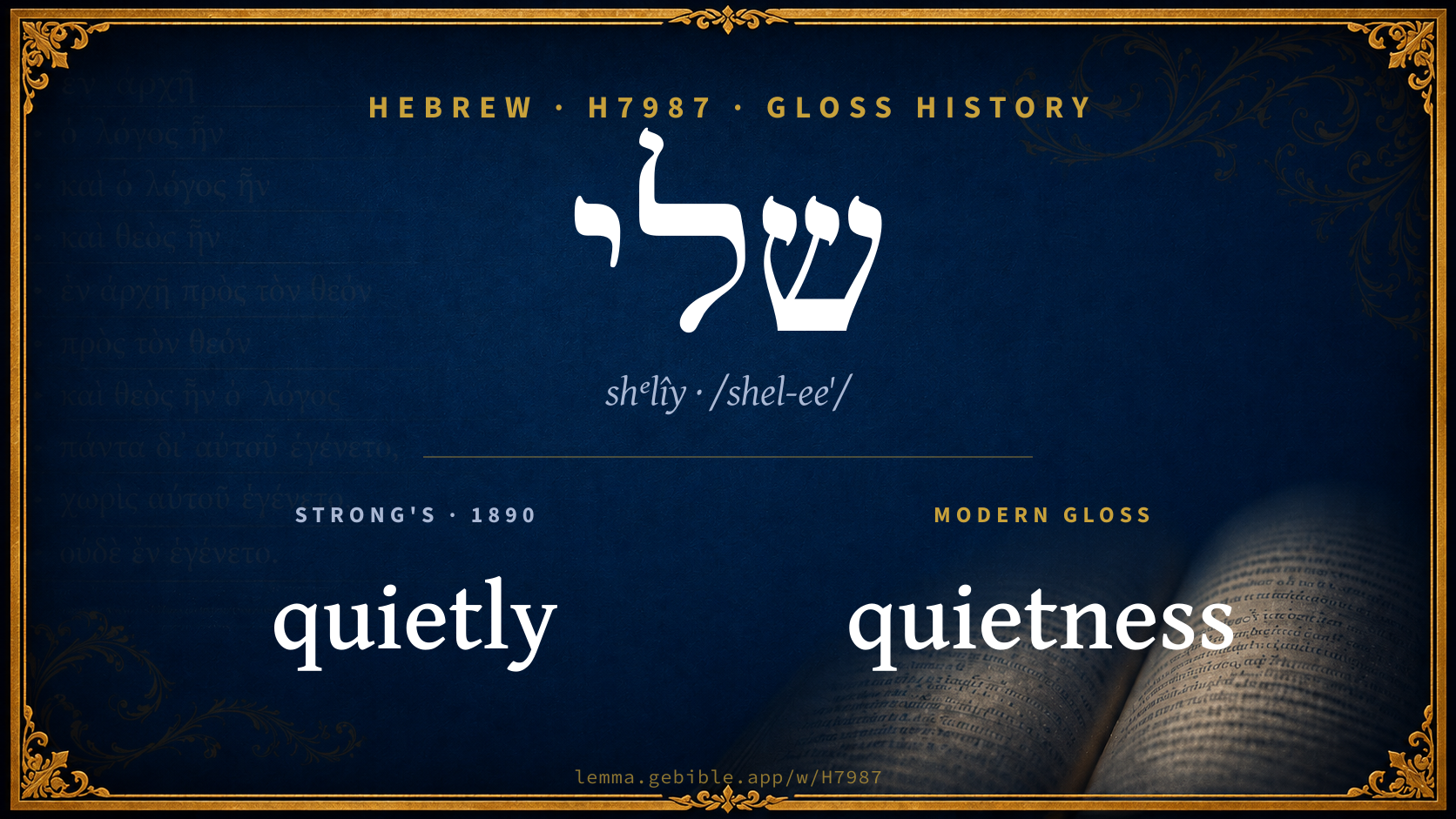
Gloss history
Strong's 1890 vs modern scholarship
About this word
Strong's H7987 catalogs a Hebrew word from the Hebrew Old Testament.
These counts are not copied from any lexicon or concordance. They are computed here, from the morphology-tagged Hebrew Old Testament. What Lemma adds →
- 1
- distinct verses
- The word appears in 1 distinct verse.
- 1 / 39
- OT books
- The word appears in 1 of 39 Old Testament books.
- #6,101
- by frequency
- Rank #6,101 (rank 6,101 of 8,640 Hebrew words by occurrence).
View all 1 occurrence in the concordance →
Most concentrated in
- 2 Samuel 1 verse 100%
By section of the Old Testament
By traditional corpus
Conventional, traditional groupings — biblical authorship is debated, so this is a traditional corpus grouping, not an authorship claim. Each share is this word’s portion of its verses in that division of the Hebrew canon. Each figure is a share of the word’s 1 distinct verse.
- Prophets (Nevi'im) 1 verse · 100%
How translations render this word
Counts come from each version’s own published word-to-Strong’s tagging or interlinear alignment — an approximate guide to how each version renders this word, not a word-level alignment the data otherwise carries. Because each total is that version’s own tagged count, the per-version totals vary from one another and need not match the appearance or distinct-verse counts above. These counts may also differ from a printed concordance because Lemma counts each distinctly tagged rendering and does not collapse phrase taggings into a single head-word total. This is a fixed set of word-tagged versions (KJV, ASV, BSB, ULT) and does not change with the reading translation you choose elsewhere. Each version’s license is shown beside its name below (and on Sources).
- King James Version: Quietly 1×
- American Standard Version: Quietly 1×
- Berean Standard Bible: not separately translated
- unfoldingWord Literal Text: Quiet 1×
King James Version Public Domain
Renders H7987 across 1 tagged occurrence — most commonly:
American Standard Version Public Domain
Renders H7987 across 1 tagged occurrence — most commonly:
Berean Standard Bible Public Domain
Does not render H7987 with a distinct English word (not separately translated in its 1 tagged occurrence).
unfoldingWord Literal Text CC BY-SA 4.0
Renders H7987 across 1 tagged occurrence — most commonly:
Senses in BDB
The 1 sense BDB distinguishes for this word, in lexicon order (not ranked by frequency or importance). The full entry — with sub-senses — is in the Lexicon Entry tab.
- quiet, private, quietness
Word origin
Derived from שלה (shâlâh) (H7951) — to be at rest.
Jastrow Dictionary
A second Hebrew/Aramaic lexicon for comparison, covering Aramaic and post-biblical (Talmudic, Targumic, Midrashic) usage that the biblical-Hebrew BDB does not. Matched by lemma rather than by Strong’s number, so a lemma may carry more than one Jastrow headword (shown separately below), and the entries cover usage well beyond the Bible.
שלי
- Job XXVII, 8) to draw out, pull. Taan. 24ᵃ; Sabb. 107ᵇ השׁוֹלֶה דג וכ׳ he that takes a fish out of the water (on the Sabbath). Ḥull. 63ᵃ (expl. שָׁלָךְ, Lev. XI, 17) זה השולה דגים וכ׳ that is the bird that catches fish out of the sea. M. Kat. II, 3 ושולה פשתנו וכ׳ and may take his flax out of the pond. Yalk. Koh. 966 אדם שוקע … שולה ראשון if one sinks pots into his furnace, he takes out first what he has last put in; a. fr.—[Y. Maas. Sh. III, 53ᶜ top שולה, read: שורה, v. שָׁרָה.] e.g. Job 27:8
- same, esp. to draw wine (out of the pit). Ab. Zar. 56ᵃ; B. Mets. 92ᵇ היין … משׁיְשַׁלֶּה בחביות wine is subject to tithes …, when he fills it into kegs; Y. Ter. II, 41ᵇ bot. משישלה ומשיקפה (not משיקיפה) when he has filled and skimmed it; עד שלא שי׳ וכ׳ before he filled or skimmed it. Tosef. Maasr. I, 7 המקדיש … עד שלא שילה וקיפה מששילה וקיפה וכ׳ (ed. Zuck. שולה וקופה וכ׳, corr. acc.) if one dedicates the contents of a pit before he has drawn and skimmed the wine, and the Temple collector comes after he has done so &c.; a. e.
- to be pulled, drawn away. Gen. R. s. 22, beg. (ref. to Gen. IV, 1) ידע מאיזו שלוה נ׳ he knew from what happiness he was drawn away (through his wife). e.g. Genesis 4:1
שְׁלֵי
- Targ. Y. Lev. XI, 17; Deut. XIV, 17 שָׁלֵי נונא (some ed., a. O. שְׁלֵינוּנָא, שַׁלֵּינ׳, שָׁלֵינ׳; h. text שָׁלָךְ), v. preced. e.g. Deuteronomy 14:17
שלי ²
- II, v. שָׁלֵו
שְׁלֵי ²
- (v. שְׁלָה) [to be lax,]
- 1. to be at ease, quiet, unconcerned. Targ. Job III, 17. Ib. 25. Targ. II Esth. IV, 14 (h. text החרש); a. fr.
- 2. to neglect, forget. Targ. Ps. IX, 13 (h. text שכח). Targ. Job VIII, 13. Ib. XXXIX, 15; a. e.
- 3. to be unaware, err, make a mistake (corresp. to h. שגג, שגה). Ib. VI, 24. Ib. XII, 16. Targ. Ps. CXIX, 67 שָׁלֵי (Ms. שָׁאלֵי); a. e.
- 1. to let go, leave off; to abandon, neglect. Ib. XXXIX, 14. Ib. IX, 18. Ib. XLIV, 10. Targ. Prov. I, 30. Ib. V, 12 (ed. Lag. אַסְלֵי); a. fr.
- 2. to cause to err, let go astray. Targ. Job XII, 16. Targ. Ps. CXIX, 10.
- 1. to be abandoned, forgotten. Ib. IX, 19.
- 2. to let one’s self go, err, forget. Targ. Lev. IV, 13; V, 18. Targ. Ez. XLV, 20. Targ. Jer. XXIX, 26 (h. text משגע); a. e.—Ber. 53ᵇ אכיל וא׳ ולא וכ׳ he ate and through forgetfulness failed to say grace. Ab. Zar. 72ᵇ דילמא מִשְׁתְּלִיתוּ וכ׳ you may forget yourselves (or relax) aud throw the entire weight upon him. Yeb. 115ᵇ אִישְׁתַּלּוּיֵי אי׳ (not אישתלוי) he may have been careless (or have forgotten, to wipe off the mark).
שֶׁלִי
- preced.) unconcern; mistake.—מִשּׁ׳ unexpectedly, by chance. Tanḥ. M’tsorʿa 1; ed. Bub. 3; Yalk. Lev. 558, v. מַרְדּוּת I.
A Dictionary of the Targumim, the Talmud Babli and Yerushalmi, and the Midrashic Literature (Marcus Jastrow; London, Luzac, 1903) — Public Domain. Digitized via Sefaria. Digitized via Sefaria. Full attribution on Sources.
Same root — word family
Other BDB entries built from the same root as H7987, grouped by Strong’s listed origin. These share a root / origin per the lexicon — not necessarily a shared meaning. Each links to that word’s own entry.
Derives from
Shares the same root
- שילה Shîylôh H7886 tranquillity
- שלה shᵉlâh H7954 at ease
- שלו sᵉlâv H7958 quail
- שלו shelev H7959 ease
- שלו shâlêv H7961 quiet
- שלוה shalvâh H7962 quietness
Compare all same-root words → Showing 4 of 8 — not the complete family. They share a root, not necessarily a meaning.
Septuagint verse parallels
This word appears in 1 verse that also exists in the Greek Old Testament (Septuagint), out of the 1 Hebrew verse it occurs in. You can read those verses in Greek by switching the Old Testament edition to the Septuagint.
Read these verses in the Septuagint
This is a verse-level parallel only — the same verses exist in both the Hebrew and Greek Old Testaments. No word-level Hebrew↔Greek correspondence is claimed: the data carries no such alignment, so no Greek word is shown as this Hebrew word’s translation. Coverage is not total — the Septuagint omits the deuterocanon and renumbers the Psalms, so some Hebrew verses have no direct Greek parallel.