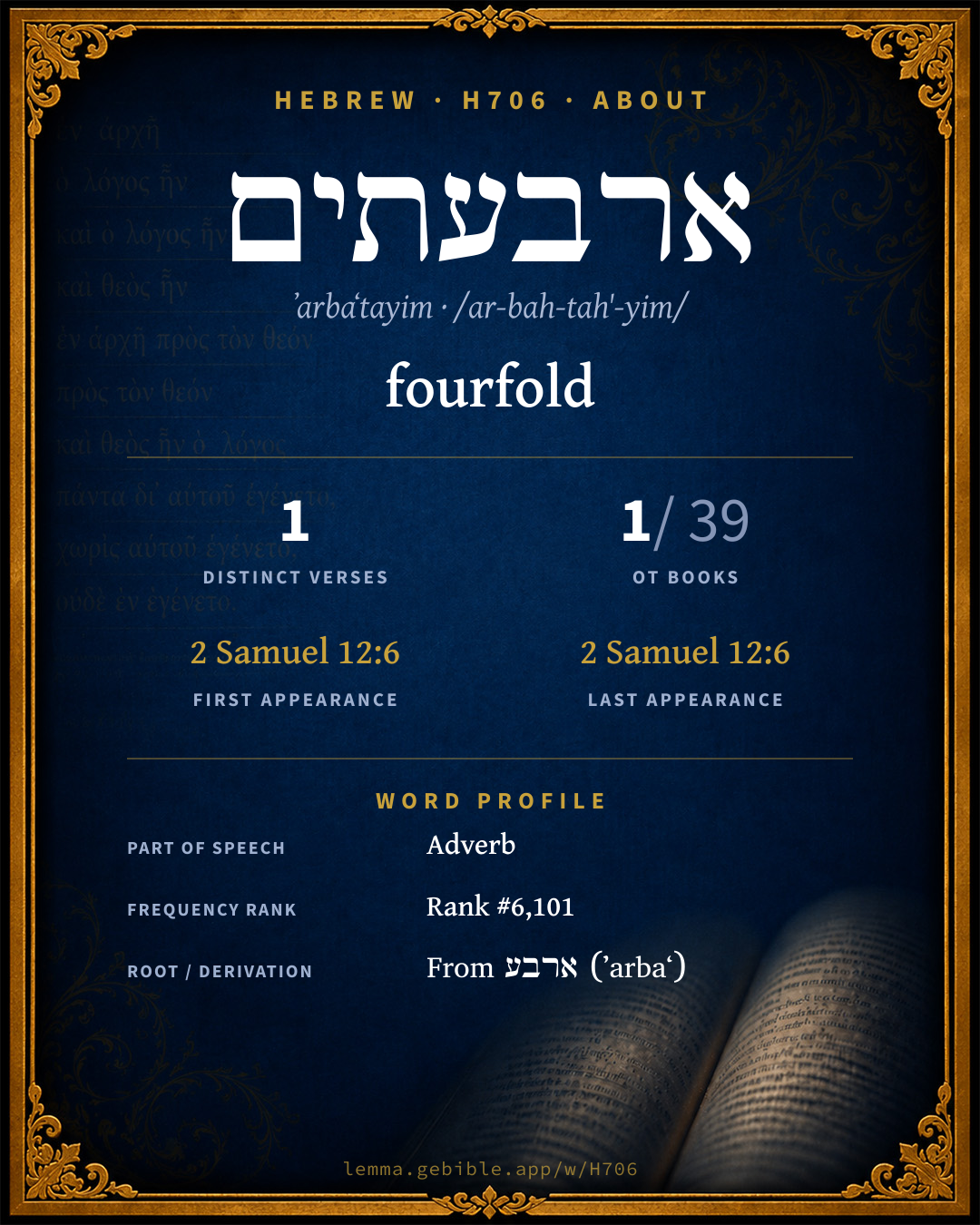
אַרְבַּעְתַּיִם
fourfold
Full lexicon entry — Brown-Driver-Briggs (BDB)
From Brown-Driver-Briggs (BDB)
Where this word appears
Grammar key — what these labels mean
Part of speech
- Adjective
- A word that describes or qualifies a noun.
State
- Absolute
- The independent form of a noun, not bound to a following word.
Gender
- Feminine
- Grammatically feminine.
Number
- Dual
- Exactly two — for natural pairs and some measures of time.
Every verse where H706 appears — 1 distinct verse across 1 book. Click any verse to open its interlinear word-by-word view. Verse text shown in the World English Bible for context — . Each verse’s Hebrew form is shown with its reference; the English is not keyword-highlighted, since the data carries no word-level English alignment. Use “Compare translations” on any verse to read it across multiple English versions. This concordance covers the Hebrew Bible; Septuagint (Greek Old Testament) occurrences are not indexed here.
2 Samuel 1 verse
About this entry
At a glance — auto-summarized from this page’s data, not written by a person. Every figure links to its source below. This summary describes the numbers; it doesn’t interpret them.
ארבעתים — transliterated ʼarbaʻtayim — is a Hebrew verb carrying the sense “fourfold.” It is rare — just 1 verse in the entire Hebrew Bible. More than three-quarters of its appearances fall in 2 Samuel. A true hapax — its single appearance is 2 Samuel 12:6. Related forms include ארבע, ארבע and ארבעים. See the sense tree, 1-verse concordance, and the renderings breakdown below.
Gloss history
Strong's 1890 vs modern scholarship
About this word
Strong's H706 catalogs a Hebrew word from the Hebrew Old Testament.
These counts are not copied from any lexicon or concordance. They are computed here, from the morphology-tagged Hebrew Old Testament. What Lemma adds →
- 1
- distinct verses
- The word appears in 1 distinct verse.
- 1 / 39
- OT books
- The word appears in 1 of 39 Old Testament books.
- #6,101
- by frequency
- Rank #6,101 (rank 6,101 of 8,640 Hebrew words by occurrence).
View all 1 occurrence in the concordance →
Most concentrated in
- 2 Samuel 1 verse 100%
By section of the Old Testament
By traditional corpus
Conventional, traditional groupings — biblical authorship is debated, so this is a traditional corpus grouping, not an authorship claim. Each share is this word’s portion of its verses in that division of the Hebrew canon. Each figure is a share of the word’s 1 distinct verse.
- Prophets (Nevi'im) 1 verse · 100%
How translations render this word
Counts come from each version’s own published word-to-Strong’s tagging or interlinear alignment — an approximate guide to how each version renders this word, not a word-level alignment the data otherwise carries. Because each total is that version’s own tagged count, the per-version totals vary from one another and need not match the appearance or distinct-verse counts above. These counts may also differ from a printed concordance because Lemma counts each distinctly tagged rendering and does not collapse phrase taggings into a single head-word total. This is a fixed set of word-tagged versions (KJV, ASV, BSB, ULT) and does not change with the reading translation you choose elsewhere. Each version’s license is shown beside its name below (and on Sources).
BDB lists this Strong’s number as 3 distinct words (homographs). Each count above pools all of them and is not split by sense — see the Senses section below. A low-frequency rendering may belong to a different one of those words, not the primary meaning.
- King James Version†: Fourfold 1×
- American Standard Version†: Fourfold 1×
- Berean Standard Bible†: Four times over 1×
- unfoldingWord Literal Text†: Fourfold 1×
King James Version Public Domain
Renders H706 across 1† tagged occurrence — most commonly:
American Standard Version Public Domain
Renders H706 across 1† tagged occurrence — most commonly:
Berean Standard Bible Public Domain
Renders H706 across 1† tagged occurrence — most commonly:
unfoldingWord Literal Text CC BY-SA 4.0
Renders H706 across 1† tagged occurrence — most commonly:
9 senses and sub-senses in the full BDB
What do BDB’s symbols mean?
BDB uses these scholarly abbreviations:
| Symbol | Meaning |
|---|---|
| 𝔊 | the Septuagint (the ancient Greek translation, LXX) |
| 𝔙 | the Vulgate (the Latin translation) |
| 𝔖 | the Syriac version (the Peshitta) |
| 𝔗 | the Targum (the Aramaic translation) |
| ψ | the Psalms |
| √ | root (the underlying root or stem) |
| ‖ | parallel passage (a synonymous or contrasted parallel) |
| † | the dagger: every passage where the word occurs is cited |
The 9 senses and sub-senses the full Brown-Driver-Briggs lexicon distinguishes for this word, in lexicon order (not ranked by frequency), with BDB’s own verbatim wording and sub-sense lettering. Shown in Hebrew script with BDB’s own scholarly abbreviations. The condensed entry is in the Lexicon Entry tab.
ארבעתים I f. four (NH = BH
- 1. without other num.:
- a. אַרְבַּע (1) before n.fpl. Je 15:3; Ex 25:12 (P) + 101 times, incl. א׳ אַמּוֹת Dt 3:11 + 5 times (but also †א׳ בַּאַמָּה four (in) cubit(s) Ex 26:2, 8; 36:9 1 K 7:27(×2), 38), and א׳ מֵאוֹת = 400 Gn 11:13 + 55 times (2) א׳ bef. du. רַנְלָ֑יִם Lv 11:23, רַגְלָיו Ex 25:26. †(3) bef. collective, א׳ צֹאן Ex 21:37 (E); א׳ רִבּוֹא = 40,000 Ezr 2:64 = Ne 7:66. †(4) rare and late, after n.fpl. עָרִים א׳ Jos 19:7 (P); after n. fs. cstr. בִּשְׁנַת א׳ לְ 1 K 22:41; Zc 7:1; 2 Ch 3:2.—קִרְיַת א׳, v. this, and ii. אַרְבַּע infr. †(5) n. om. Ez 43:15b Pr 30:15, 18 (Kt, v. supr.), v 21 Dn 8:8, 22; עַל־אַרְבַּ֑ע (sc. רגלים) = on all fours Lv 11:20, 21, 27, 42. e.g. Jeremiah 15:3
- b. אַרְבַּעַה (1) bef. n. mpl. Gn 2:10 (J), 14:9 Ex 25:34 + 21 times, + יָמִים (וְ)א׳ חֳדשִׁים Ju 19:2; 1 S 27:7; also א׳ א׳ פָנִים distrib. Ez 10:21. †(2) late, after n. mpl. 1 Ch 23:10. (3) n. om., Am 1:3, 6, 9 + 15 times, + (as pred. of n. mpl.) †Ex 27:16(×2); 38:19(×2); also בְּא׳, (sc. יוֹם) †Zc 7:1 = ordinal, on the fourth (day). e.g. Genesis 2:10
- c. אַרְבַּ֫עַת (1) bef. n. mpl. Ju 11:40 1 K 7:32 + 11 times (not Ez 7:2, v. supr.), + א׳ אֲלָפִים = 4000, 1 S 4:2 + 14 times †(2) bef. coll. הַבָּקָר Nu 7:7. †(3) n. om. 2 S 21:22. †(4) c. sf., after n. pl., = the four of them, Ez 1:8, 10(×3) + 6 times Ez, Dn 1:17 these boys, the four of them. e.g. Judges 11:40
- d. adv. אַרְבַּעְתָּ֑יִם 2 S 12:6 = four-fold Ges§ 97 h Köii. 1, 227, but read שִׁבְעָתָ֑יִם 𝔊 Th We Klo Dr Kmp Bu HPS. e.g. 2 Samuel 12:6
- 2. with other num.:
- a. (I) אַרְבַּע עֶשְׂרֵה = 14, (α) before n. fs., א׳ ע׳ שָׁנָה Gn 31:41, + (as ordinal, = 14th) 14:5; 2 K 18:13 = Is 36:1, Ez 40:1. (β) after n. fpl. עָרִים א׳ ע׳ Jos 15:36 + 8 times, נָשִׁים א׳ ע׳ 2 Ch 13:21. (2) אַרְבָּעָה עָשָׂר = 14, (α) before n. ms. Nu 17:14 (14 × 1000), Jb 42:12; especially. (as ord.) א׳ ע׳ יוֹם 14th day Ex 12:6, 18 + 7 times (β) bef. n. mpl. Nu 29:15. (γ) after n. mpl. Nu 29:13, 17 + 6 times (δ) after n. ms. Est 9:15, 19, 21, all = 14th. (ε) א׳ ע׳ pred. of נֶפֶשׁ Gn 46:22. (ζ) א׳ ע׳ = 14th (sc. day) Lv 23:15; 2 Ch 30:15 + 6 times e.g. Genesis 31:41
- b. 20 + (וְ) 4 + n. s. 1 K 15:33; 1 Ch 23:4 + 13 times 1 Ch 27; + n. pl. †Nu 7:88; n. om. 2 S 21:20, pred. ‖ 1 Ch 20:6; Ne 7:23; 4 + 20 + n. s. Nu 25:9; = 24th, יוֹם ע׳ וְא׳ Hg 1:15; 2:18; Zc 1:7; Ne 9:1; Dn 10:4, יוֹם om. Hg 2:10, 20, and (א׳ וְע׳) 1 Ch 24:18; 25:31†. e.g. 1 Kings 15:33
- c. other tens + 4, 1 Ch 7:7; 5:18 (+ n. s.), Ezr 2:15 + 7 times; 4 + tens + שָׁנָה Gn 11:16, + אֶלֶף 1000 Nu 1:27, 29; 2:4, 6; 26:25, 43.—Vid. Köii. 1, § 106. e.g. 1 Chronicles 7:7
ארבעתים II m. (called הָאָדָם הַגָּדוֹל בָּעֲנָקִים Jos 14
Senses from the full Brown-Driver-Briggs lexicon (Brown, Driver, Briggs; Oxford 1906 — public domain), digitized via Sefaria, supplemented by the OpenScriptures HebrewLexicon (CC BY 4.0). Full attribution on Sources.
Word origin
II. n.m. et f. four (NH = BH; MI8 ארבען = 40; Ph. ארבע, Pun. ארבעת, four; so Assyrian arbaʾu (rarely irbaʾ), irbitti; Arabic أَرْبَعٌ, أَرْبَعَةٌ; Sab. ארבעת CISiv, no. 232. 2 HomChrest. 47; Ethiopic አርባዕ, አርባዕቱ Aramaic אַרְבַּע, אַרְבְּעָה, ܐܰܪܒܰܥ, ܐܰܪܒܥܳܐ; Nab. ארבע, Palm. ארבע, ארבעא, Lzb367);—m.148 (c. n.f.) אַרְבַּע (abs. vel cstr.) Ex 21:37 +; also אַרְבַּ֑ע Lv 11:20 +; note (Baer Gi) Jos 21:18 + 6 times Jos 21 (van d. H. אַרְבָּ֑ע); in Pr 30:18 read f. with Qr; f. (c. n.m.) abs. אַרְבָּעָה Gn 2:10 + 125 times + Pr 30:18 (v. supr.); cstr. אַרְבַּעַת 1 S 4:2 + 29 times, incl. Ez 7:2 (but read m. Kt); sf. אַרְבַּעְתָּם Ez 1:8 + 5 times Ez, אַרְבַּעְתָּן 1:10, 10 (but read prob. -תָּם, Krae), v 16, 18; du. אַרְּבַּעְתָּ֑יִם 2 S 12:6, v. 1 d; pl. אַרְבָּעִים = 40, v. infr.;—four (in Hex 108 times, chiefly P, 98 times; Ez 52 times, Ch 47 times):—
III. n.pr.m. (called הָאָדָם הַגָּדוֹל בָּעֲנָקִים Jos 14:15, אֲבִי הָעֲנָק 15:13 cf. 21:11), inferred (erron.) from n.pr.loc. קִרְיַת א׳ (q.v.).
— Brown-Driver-Briggs (Oxford 1906, public domain), digitized via Sefaria, supplemented by the OpenScriptures HebrewLexicon (CC BY 4.0). See Sources.
Derived from ארבע (ʼarbaʻ) (H702) — four.
Same root — word family
Other BDB entries built from the same root as H706, grouped by Strong’s listed origin. These share a root / origin per the lexicon — not necessarily a shared meaning. Each links to that word’s own entry.
Derives from
Shares the same root
Proper names from this root
People and places named from this root — a name, not an additional meaning of the word.
Compare all same-root words → Showing 4 of 5 — not the complete family. 1 of the same-root words is a proper name (a person or place). They share a root, not necessarily a meaning.
Septuagint verse parallels
This word appears in 1 verse that also exists in the Greek Old Testament (Septuagint), out of the 1 Hebrew verse it occurs in. You can read those verses in Greek by switching the Old Testament edition to the Septuagint.
Read these verses in the Septuagint
This is a verse-level parallel only — the same verses exist in both the Hebrew and Greek Old Testaments. No word-level Hebrew↔Greek correspondence is claimed: the data carries no such alignment, so no Greek word is shown as this Hebrew word’s translation. Coverage is not total — the Septuagint omits the deuterocanon and renumbers the Psalms, so some Hebrew verses have no direct Greek parallel.