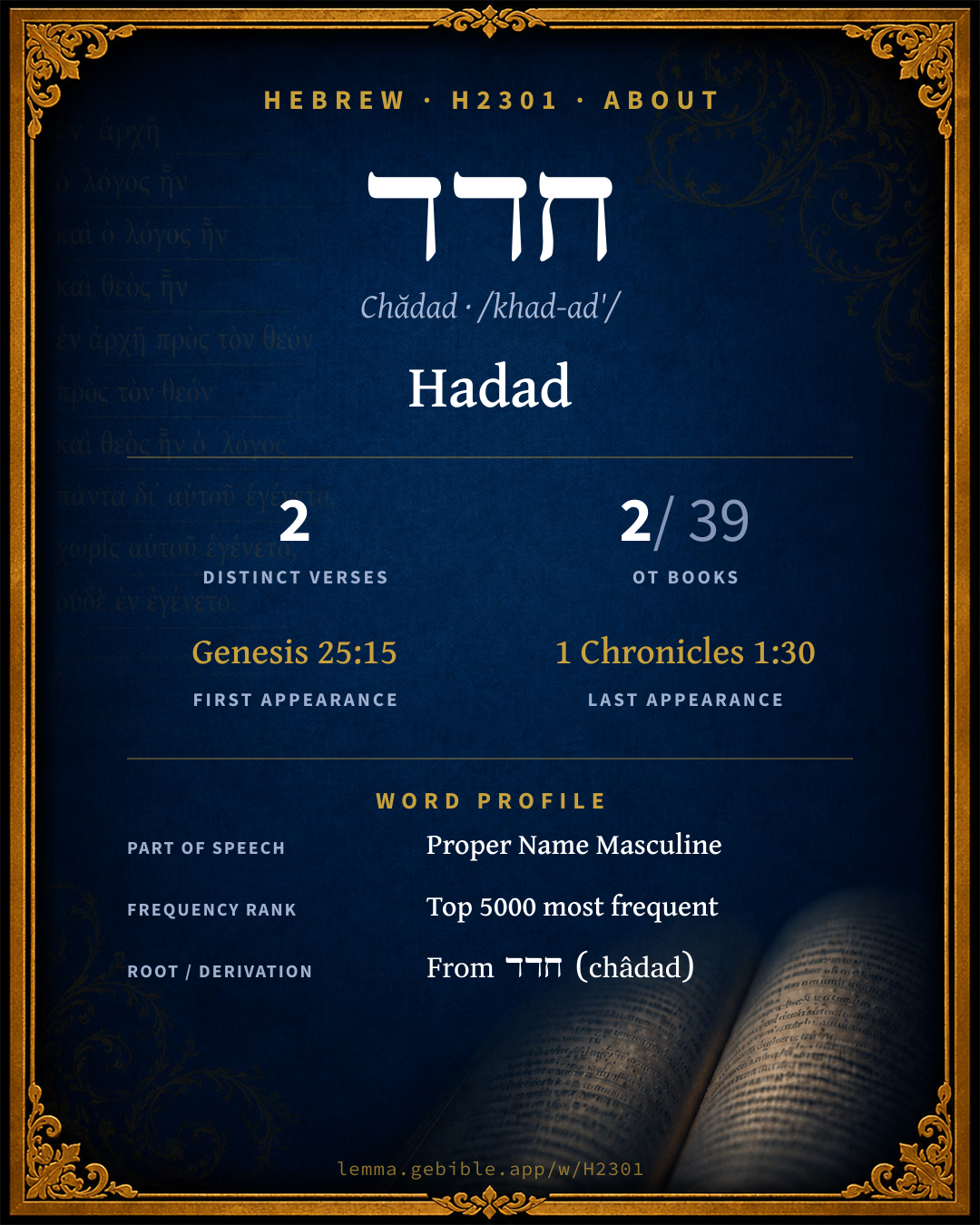
חֲדַד
Hadad
BDB lists 2 entries for ‘Hadad’ fuller range ↓
Full lexicon entry — Brown-Driver-Briggs (BDB)
From Brown-Driver-Briggs (BDB)
Where this word appears
Grammar key — what these labels mean
Part of speech
- Noun
- A naming word — a person, place, thing, or idea.
Noun type
- Proper
- A name of a specific person, place, or people (e.g. Abraham, Zion, Israel).
Every verse where H2301 appears — 2 distinct verses across 2 books. Click any verse to open its interlinear word-by-word view. Verse text shown in the World English Bible for context — . Each verse’s Hebrew form is shown with its reference; the English is not keyword-highlighted, since the data carries no word-level English alignment. Use “Compare translations” on any verse to read it across multiple English versions. This concordance covers the Hebrew Bible; Septuagint (Greek Old Testament) occurrences are not indexed here.
Genesis 1 verse
1 Chronicles 1 verse
About this entry
At a glance — auto-summarized from this page’s data, not written by a person. Every figure links to its source below. This summary describes the numbers; it doesn’t interpret them.
“Hadad” is the headline sense of the Hebrew name חדד (Chădad). With only 2 verses it sits in the long tail of Hebrew Bible vocabulary. More than half of its appearances fall in Genesis. Scripture first uses it in Genesis 25:15. See 2-verse concordance and the renderings breakdown below.
Gloss history
Strong's 1890 vs modern scholarship
About this word
Strong's H2301 catalogs a Hebrew word from the Hebrew Old Testament.
These counts are not copied from any lexicon or concordance. They are computed here, from the morphology-tagged Hebrew Old Testament. What Lemma adds →
- 2
- distinct verses
- The word appears in 2 distinct verses.
- 2 / 39
- OT books
- The word appears in 2 of 39 Old Testament books.
- #4,807
- by frequency
- Top 5000 most frequent Hebrew words (rank 4,807 of 8,640 Hebrew words by occurrence).
View all 2 occurrences in the concordance →
Most concentrated in
- Genesis 1 verse 50%
- 1 Chronicles 1 verse 50%
By section of the Old Testament
By traditional corpus
Conventional, traditional groupings — biblical authorship is debated, so this is a traditional corpus grouping, not an authorship claim. Each share is this word’s portion of its verses in that division of the Hebrew canon. Each figure is a share of the word’s 2 distinct verses.
- Torah (Pentateuch) 1 verse · 50%
- Writings (Ketuvim) 1 verse · 50%
How translations render this word
Counts come from each version’s own published word-to-Strong’s tagging or interlinear alignment — an approximate guide to how each version renders this word, not a word-level alignment the data otherwise carries. Because each total is that version’s own tagged count, the per-version totals vary from one another and need not match the appearance or distinct-verse counts above. These counts may also differ from a printed concordance because Lemma counts each distinctly tagged rendering and does not collapse phrase taggings into a single head-word total. This is a fixed set of word-tagged versions (KJV, ASV, BSB, ULT) and does not change with the reading translation you choose elsewhere. Each version’s license is shown beside its name below (and on Sources).
- King James Version: Hadad 1×
- American Standard Version: Hadad 1×
- Berean Standard Bible: Hadad 2×
- unfoldingWord Literal Text: Hadad 2×
King James Version Public Domain
Renders H2301 across 1 tagged occurrence — most commonly:
American Standard Version Public Domain
Renders H2301 across 1 tagged occurrence — most commonly:
Berean Standard Bible Public Domain
Renders H2301 across 2 tagged occurrences — most commonly:
unfoldingWord Literal Text CC BY-SA 4.0
Renders H2301 across 2 tagged occurrences — most commonly:
Senses in BDB
The 2 senses BDB distinguishes for this word, in lexicon order (not ranked by frequency or importance). The full entry — with sub-senses — is in the Lexicon Entry tab.
- Hadad = "mighty"
- a son of Ishmael
Word origin
n.pr.m. (on this and foll. cf. Palm. n.pr. חדודן VogNo. 96, Sab. חדד Hal27);—a son of Ishmael Gn 25:15 (cf. Baer’s n.; van d. H. חֲדַר) 𝔊 Χοδδαν, 𝔊L Χοδδαδ; = 1 Ch 1:30 𝔊 Χονδαν, A Χοδδαδ, 𝔊L Αδαδ.
— Brown-Driver-Briggs (Oxford 1906, public domain), digitized via Sefaria, supplemented by the OpenScriptures HebrewLexicon (CC BY 4.0). See Sources.
Derived from חדד (châdad) (H2300) — to sharpen.
Jastrow Dictionary
A second Hebrew/Aramaic lexicon for comparison, covering Aramaic and post-biblical (Talmudic, Targumic, Midrashic) usage that the biblical-Hebrew BDB does not. Matched by lemma rather than by Strong’s number, so a lemma may carry more than one Jastrow headword (shown separately below), and the entries cover usage well beyond the Bible.
חָדַד
- (b. h.) [to cut, point,] to be sharp, pointed.
- to sharpen, whet, point. Y. Bets. V, 63ᵇ top לחַדֵּד ראשו וכ׳ they differ as to pointing the top of the spit (on the Holy Day)—Trnsf. to whet the mind, to try somebody’s acumen, to puzzle. Taan. 7ᵃ (ref. to Prov. XXVII, 17) אף … מְחַדְּדִין וכ׳ so do two scholars whet each other’s mind &c. Naz. 59ᵇ, a. e. לא אמר … לחַדֵּד בה וכ׳ R. J. said it only in order to encourage the students in raising points; a. e.—Part. pass. מְחוּדָּד sharpened, well discussed, clear and ready. Kidd. 30ᵃ (ref. to ושננתם, Deut. VI, 7) שיהו ד"ת מְחוּדָּדִים בפיך that the words of the Law be ever ready in thy mouth (Sifré Deut. 34 מְסוּדָּרִים), v. גִּמְגֵּם. e.g. Proverbs 27:17
- to be whetted. Gen. R. s. 69 אין סכין מִתְחַדֶּדֶת וכ׳ a knife is whetted on the broad side of another, כך אין ת"ח מִתְחַדֵּד וכ׳ so is a student’s mind whetted by a fellow-student, v. supra.
חֲדַד
- Targ. Job XLI, 22. [Targ. Y. I Deut. I, 44 דחַדְדָן which sting; some ed. דחדרן, v. חֲדַר.]
- 1. as preced. Pi. Sabb. 32ᵃ (prov.) נפל תורא חַדְּדֵיה לסכינא Ms. M. (ed. חדד, Ms. O. חַדְּדוּ) when the ox is thrown down, sharpen the knife (in critical moments man’s sins are visited, v. חִגְּרָא). Ḥull. 43ᵇ, a. fr. לחַדּוּדֵי וכ׳ to try Abbayis’ acumen.—Part. pass. מְחַדַּד ready in answering questions, well-versed, quick (v. preced.). Erub. 13ᵇ האי דמְחַדַּדְנָא מחבירי Ms. M. (ed. מחבריא) the reason that I am readier than my fellow-students. Yeb. 14ᵃ ב"ש מְחַדְּדֵי טפי those of the school of Sh. were more acute. Nidd. 14ᵇ מחדדי שמעתתיה (read: מְחַדְּדָן), v. infra.
- 2. to cheer up, entertain. Gitt. 68ᵇ, v. חַדְוְותָא.
- to be well studied, ready at hand. Keth. 62ᵇ [read:] מִתְחַדְּדָן שמעתתיה (Rashi: מחדדן) he recited his lessons (traditions) well.
A Dictionary of the Targumim, the Talmud Babli and Yerushalmi, and the Midrashic Literature (Marcus Jastrow; London, Luzac, 1903) — Public Domain. Digitized via Sefaria. Digitized via Sefaria. Full attribution on Sources.
Forms in the corpus
The 2 distinct written forms H2301 takes in the Hebrew Bible, most frequent first — each parse links to that state’s occurrences in the concordance. Hebrew forms include their vowel points and cantillation, so a single lemma takes many written forms.
| Form | Parsing | Example | Uses |
|---|---|---|---|
| חֲדַ֣ד | Noun, Proper | Genesis 25:15 | 1 |
| חֲדַ֥ד | Noun, Proper | 1 Chronicles 1:30 | 1 |
Same root — word family
Other BDB entries built from the same root as H2301, grouped by Strong’s listed origin. These share a root / origin per the lexicon — not necessarily a shared meaning. Each links to that word’s own entry.
Derives from
Shares the same root
Proper names from this root
People and places named from this root — a name, not an additional meaning of the word.
Compare all same-root words → Showing 4 of 6 — not the complete family. 2 of the same-root words are proper names (people or places). They share a root, not necessarily a meaning.
Bible dictionary
Public-domain dictionary articles matched to this entry by name (Hadad). A biblical name can be shared by more than one person or place, so an article may treat several.
Easton's Bible Dictionary · M. G. Easton, 1897
Adod, brave(?), the name of a Syrian god. (1.) An Edomite king who defeated the Midianites (Gen. 36:35; 1 Chr. 1:46).
(2.) Another Edomite king (1 Chr. 1:50, 51), called also Hadar (Gen. 36:39; 1 Chr. 1:51).
(3.) One of "the king's seed in Edom." He fled into Egypt, where he married the sister of Pharaoh's wife (1 Kings 11:14-22). He became one of Solomon's adversaries.
Hadad, sharp, (a different name in Hebrew from the preceding), one of the sons of Ishmael (1 Chr. 1:30). Called also Hadar (Gen. 25:15).
Smith's Bible Dictionary · William Smith, 1863
(mighty), originally the indigenous appellation of the sun among the Syrians, and thence transferred to the king as the highest of earthly authorities. The title appears to have been an official one, like Pharaoh. It is found occasionally in the altered form Hadar. (Genesis 25:15; 36:39) compared with 1Chr 1:30,50
+ Son of Ishmael. (Genesis 25:15; 1 Chronicles 1:30) + A king of Edom who gained an important victory over the Midianites on the field of Moab. (Genesis 36:35; 1 Chronicles 1:46) + Also a king of Edom, with Pau for his capital. (1 Chronicles 1:50) + A member of the royal house Or Edom. (1 Kings 11:14) ff. In his childhood he escaped the massacre under Joab, and fled with a band of followers into Egypt. Pharaoh, the predecessor of Solomon's father-in-law, treated him kindly, and gave him his sister-in-law in marriage. After David's death Hadad resolved to attempt the recovery of his dominion. He left Egypt and returned to his own country.
Hitchcock's Bible Names Dictionary · Roswell D. Hitchcock, 1869
joy; noise; clamor
Classic public-domain reference works; full attribution on Sources.
Septuagint verse parallels
This word appears in 2 verses that also exist in the Greek Old Testament (Septuagint), out of the 2 Hebrew verses it occurs in. You can read those verses in Greek by switching the Old Testament edition to the Septuagint.
Read these verses in the Septuagint
This is a verse-level parallel only — the same verses exist in both the Hebrew and Greek Old Testaments. No word-level Hebrew↔Greek correspondence is claimed: the data carries no such alignment, so no Greek word is shown as this Hebrew word’s translation. Coverage is not total — the Septuagint omits the deuterocanon and renumbers the Psalms, so some Hebrew verses have no direct Greek parallel.