1 Chronicles 4:20

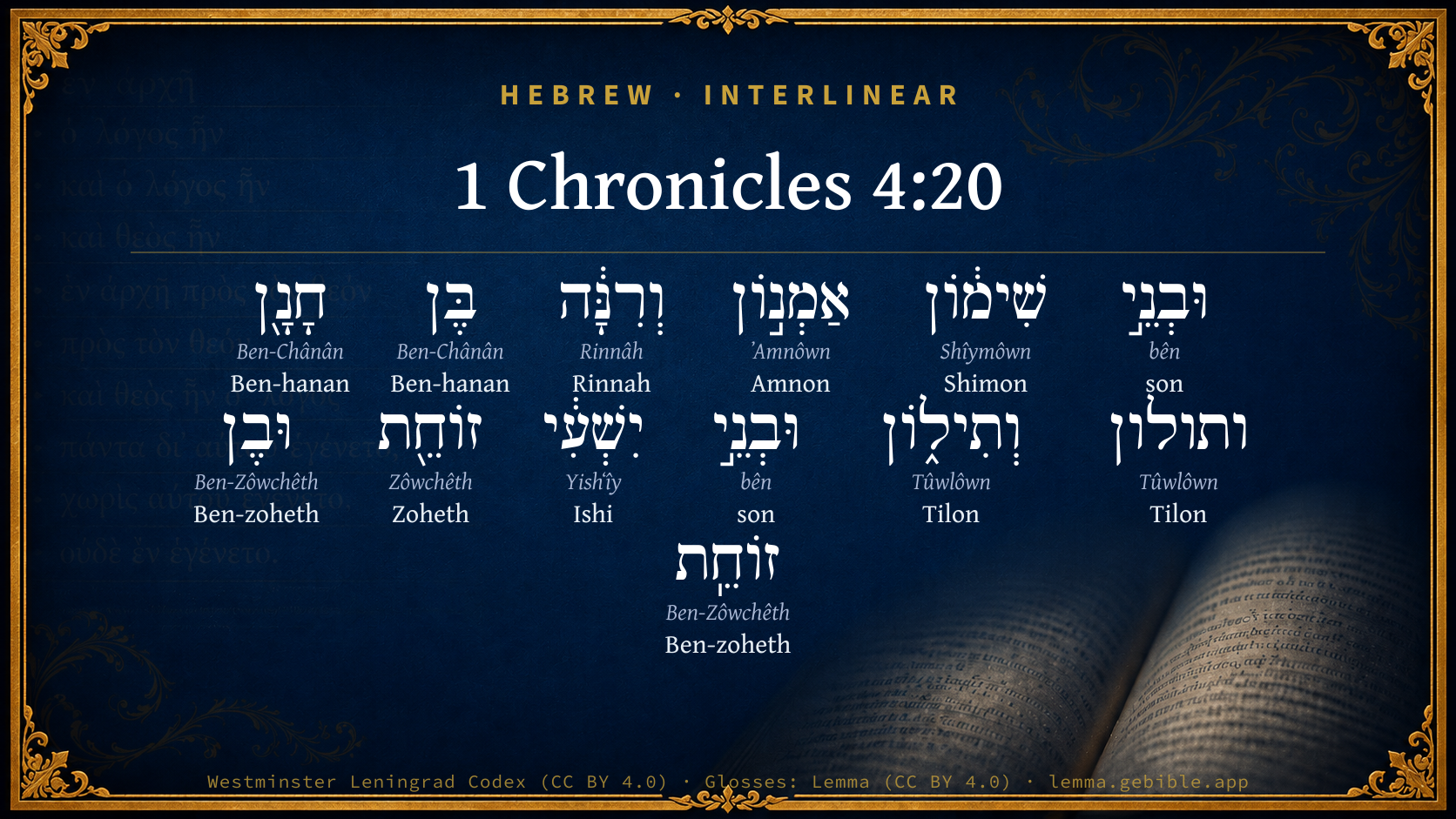
Hebrew (Westminster Leningrad Codex) 1 Chronicles 4:20 appears in the Hebrew Old Testament. The text above is from the Westminster Leningrad Codex. Each word links to its Strong’s number, a concise gloss, and parsing drawn from the Open Scriptures Hebrew Bible morphology. Click any word for its full Brown-Driver-Briggs (BDB) entry.
Download image
Cite this verse

1 Chronicles 4:20 (World English Bible). Public Domain. Lemma interlinear Bible study tool, https://lemma.gebible.app/v/1-chronicles/4/20.

Show BibTeX & RIS
BibTeX
RIS
English Translation
The sons of Shimon: Amnon, and Rinnah, Ben Hanan, and Tilon. The sons of Ishi: Zoheth, and Ben Zoheth.
World English Bible · Public Domain
Highlights
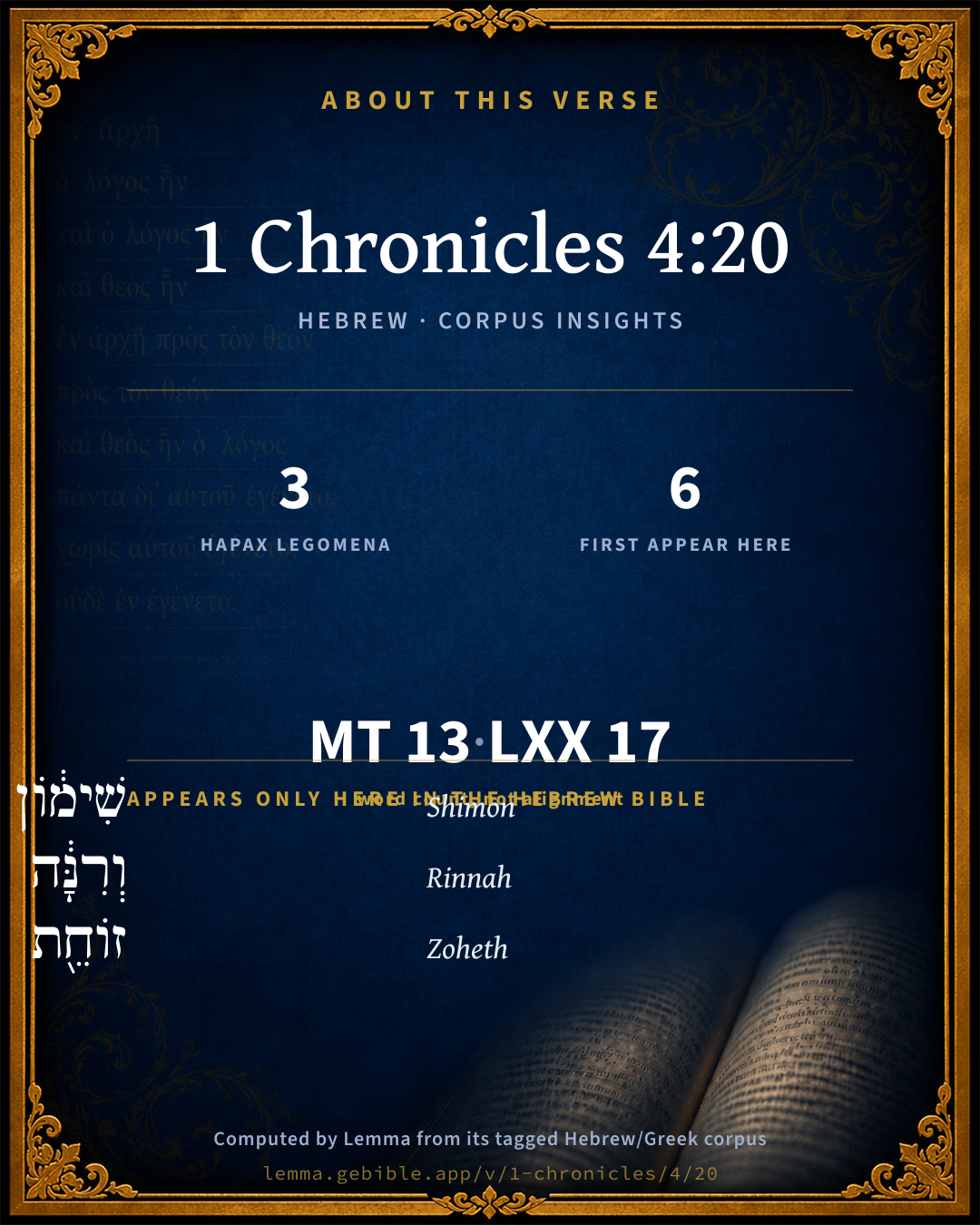
  • 3 hapax legomena — only here in the Hebrew Bible
  • 6 first appearances in the Hebrew Bible
Full analysis ↓
Download a study sheet

One document with this verse’s original text, its word-by-word gloss line, the meaning frame, cross-references with their text, attributed commentary, and full source and license credits — printable, and it pastes into notes with its structure intact.

This verse Autodidact and up

Study sheet (.html) Plain text (.txt)

A passage Seminary Student

Up to 50 verses in one chapter. A passage sheet keeps up to 6 commentary sources and 12 cross-references per verse, in the order this page ranks them, and says so on the sheet whenever that leaves anything out. Ask for a single verse and you get the Autodidact verse sheet above.

Everything on this page stays free to read, with no account — the sheet is a download of what is already on screen, not access to it.

Want to remove ads? Support Godless Engineer
Compare translations 3

The same verse in 3 English versions, stacked beneath the original-language interlinear above. Click any original word for its lexicon entry.

Each is an independent rendering of the whole verse — the interlinear is not word-aligned to these translations.

Highlighted words mark where these versions differ — a whole-verse word diff, not a word-by-word alignment.

  • World English Bible Public Domain
    The sons of Shimon: Amnon, and Rinnah, Ben Hanan, and Tilon. The sons of Ishi: Zoheth, and Ben Zoheth.
  • King James Version Public Domain
    And the sons of Shimon were, Amnon, and Rinnah, Benhanan, and Tilon. And the sons of Ishi were, Zoheth, and Benzoheth.
  • unfoldingWord Literal Text CC BY-SA 4.0
    And the sons of Shimon: Amnon and Rinnah, Ben Hanan and Tilon. And the sons of Ishi: Zoheth and Ben Zoheth.

unfoldingWord Literal Text — © unfoldingWord, licensed CC BY-SA 4.0. Word-aligned USFM3 via Door43 (git.door43.org/unfoldingWord/en_ult).

Versions to compare (up to 4)

3 of 4 selected

Show all 18 translations

Every available English version of this verse, each an independent rendering of the whole verse.

  • World English Bible Public Domain
    The sons of Shimon: Amnon, and Rinnah, Ben Hanan, and Tilon. The sons of Ishi: Zoheth, and Ben Zoheth.
  • Berean Standard Bible Public Domain
    The sons of Shimon: Amnon, Rinnah, Ben-hanan, and Tilon. The descendants of Ishi: Zoheth and Ben-zoheth.
  • Majority Standard Bible Public Domain
    The sons of Shimon: Amnon, Rinnah, Ben-hanan, and Tilon. The descendants of Ishi: Zoheth and Ben-zoheth.
  • King James Version Public Domain
    And the sons of Shimon were, Amnon, and Rinnah, Benhanan, and Tilon. And the sons of Ishi were, Zoheth, and Benzoheth.
  • American Standard Version (1901) Public Domain
    And the sons of Shimon: Amnon, and Rinnah, Ben-hanan, and Tilon. And the sons of Ishi: Zoheth, and Ben-zoheth.
  • Revised Version (1885) Public Domain
    And the sons of Shimon; Amnon, and Rinnah, Ben-hanan, and Tilon. And the sons of Ishi; Zoheth, and Ben-zoheth.
  • Geneva Bible (1599) Public Domain
    And the sonnes of Shimon were Amnon and Rinnah, Ben-hanam and Tilon. And the sonnes of Ishi were Zoheth, and Benzoheth.
  • Douay-Rheims (1899) Public Domain
    The sons also of Simon, Amnon, and Rinna the son of Hanan, and Thilon. And the sons of Jesi Zoheth, and Benzoheth.
  • Young's Literal Translation Public Domain
    And sons of Shimon `are' Amnon, and Rinnah, Ben-Hanon, and Tilon; and sons of Ishi: Zoheth, and Ben-Zoheth.
  • Literal Standard Version CC BY-SA 4.0
    And sons of Shimon: Amnon, and Rinnah, Ben-Hanon, and Tilon; and sons of Ishi: Zoheth, and Ben-Zoheth.
  • Unlocked Literal Bible CC BY-SA 4.0
    The sons of Shimon were Amnon, Rinnah, Ben-Hanan, and Tilon. The sons of Ishi were Zoheth and Ben-Zoheth.
  • unfoldingWord Literal Text CC BY-SA 4.0
    And the sons of Shimon: Amnon and Rinnah, Ben Hanan and Tilon. And the sons of Ishi: Zoheth and Ben Zoheth.
  • Darby Bible Public Domain
    -- And the sons of Shimon: Amnon and Rinnah, Ben-hanan and Tilon. -- And the sons of Jishi: Zoheth and Ben-Zoheth.
  • World Messianic Bible Public Domain
    The sons of Shimon: Amnon, Rinnah, Ben Hanan, and Tilon. The sons of Ishi: Zoheth, and Ben Zoheth.
  • Webster's Bible Public Domain
    And the sons of Shimon were, Amnon, and Rinnah, Ben-hanan, and Tilon. And the sons of Ishi were, Zoheth, and Benzoheth.
  • Free Bible Version CC BY-SA 4.0
    The sons of Shimon: Amnon, Rinnah, Ben-Hanan, and Tilon. The sons of Ishi: Zoheth and Ben-Zoheth.
  • Bible in Basic English Public Domain
    And the sons of Shimon: Amnon and Rinnah, Ben-hanan and Tilon. And the sons of Ishi: Zoheth; and the son of Zoheth....
  • JPS Tanakh (1917) Public Domain
    And the sons of Shimon: Amnon, and Rinnah, Ben-hanan, and Tilon. And the sons of Ishi: Zoheth, and Ben-zoheth.

Literal Standard Version (2020), Covenant Press — licensed CC BY-SA 4.0. Text via the HelloAO Bible API (eBible.org). Unlocked Literal Bible (unfoldingWord) — licensed CC BY-SA 4.0. Text via the HelloAO Bible API (eBible.org). unfoldingWord Literal Text — © unfoldingWord, licensed CC BY-SA 4.0. Word-aligned USFM3 via Door43 (git.door43.org/unfoldingWord/en_ult). Free Bible Version, Dr. Jonathan Gallagher — licensed CC BY-SA 4.0. Text via the HelloAO Bible API (eBible.org).

Word by word

More ways to search: Search by grammar → Find every occurrence → Compare this word →

Practice this passage: Drill this verse → Learn its vocabulary →

About this verse

These counts appear in no published source. They are computed here, from the morphology-tagged text and Lemma’s own curated glosses. What Lemma adds →

13
words
9
distinct lemmas
Historical
section

Notable vocabulary

3 hapax legomena — words that appear only here in the entire Hebrew Bible:

  • שִׁימ֔וֹן Shimon H7889
  • וְרִנָּ֔ה Rinnah H7441
  • זוֹחֵ֖ת Zoheth H2105

First appearance in Scripture

These words make their first canonical appearance in the Hebrew Bible here:

  • שִׁימ֔וֹן Shimon H7889
  • וְרִנָּ֔ה Rinnah H7441
  • בֶּן Ben-hanan H1135
  • ותולון Tilon H8436
  • זוֹחֵ֖ת Zoheth H2105
  • וּבֶן Ben-zoheth H1132

Grammatical profile

  • 13 nouns

Repetition

Words recur within this verse — often emphatic in Hebrew:

  • וּבְנֵ֣י son H1121 ×2
  • בֶּן Ben-hanan H1135 ×2
  • ותולון Tilon H8436 ×2
  • וּבֶן Ben-zoheth H1132 ×2

Hebrew & Septuagint length

In English translation the verse runs 19 words from the Hebrew and 25 from the Septuagint (LXX English) — closely comparable.

A rough comparison of the two English renderings, which tokenize alike — not a word-level alignment.

Word counts can differ between the Hebrew and the Greek without any difference in meaning — e.g. the Hebrew direct-object marker אֵת has no separate Greek word, and Greek often adds the article ὁ.

In the original languages it is 13 Hebrew tokens and 17 Greek tokens — but the two are counted differently (Hebrew bundles its prefixes and suffixes into one token; the Greek is in lemma form), so that isn’t a like-for-like length.

Hebrew and Greek witnesses Masoretic Hebrew ↔ Greek Septuagint

The same verse in the two great witnesses to the Old Testament, shown verse-for-verse.

These are two independent witnesses, not word-aligned to each other, and the Septuagint is shown in lemma (dictionary) form.

Hebrew 1 Chronicles 4:20 Masoretic · Westminster Leningrad Codex

וּבְנֵ֣י שִׁימ֔וֹן אַמְנ֣וֹן וְרִנָּ֔ה בֶּן חָנָ֖ן ותולון וְתִיל֑וֹן וּבְנֵ֣י יִשְׁעִ֔י זוֹחֵ֖ת וּבֶן זוֹחֵֽת

The sons of Shimon: Amnon, and Rinnah, Ben Hanan, and Tilon. The sons of Ishi: Zoheth, and Ben Zoheth.

World English Bible · Public Domain

Greek LXX 1 Chronicles 4:20 Septuagint · lemma form

καί υἱός σεμιων αμνων καί ρανα υἱός αναν καί θιλων καί υἱός ισεϊ ζωαθ καί υἱός ζωαθ

And the sons of Semon; Amnon, and Ana the son of Phana, and Inon: and the sons of Sei, Zoan, and the sons of Zoab.

LXX2012 (modern English Septuagint) · Public Domain

On this verse, The Pulpit Commentary discusses the Septuagint’s reading. Read the note in Commentary ↓

Hebrew: Westminster Leningrad Codex (CC BY 4.0). Greek: Septuagint (public domain); English from LXX2012 (modern English Septuagint) (Public Domain). How the Septuagint differs from the Hebrew →

Commentary

Notes on 1 Chronicles 4:20 from classic Christian and Jewish commentators (each source and its license shown beneath its notes). The classic Christian expositions comment on the surrounding passage and are grouped to its opening verse, so a note may address several verses; the Jewish commentaries on the Tanakh (Rashi and others) are per-verse, so they appear only where the commentator wrote on this verse.

Lemma curates 59 commentaries, every one of them public domain or Creative Commons licensed, each selected and text-cleaned for this edition rather than reprinted as found. About our sources →

Ellicott's Commentary for English Readers

(20) The Sons of Shimon.—Nothing is said elsewhere of them, or of the sons of Ishi. Ishi (1Ch_2:31) is a Jerahmeelite name; but/as throughout tho section (1Ch_4:2-19) we have found indications that the ramifications of the house of Caleb are the principal subject, and as 1Ch_4:20 is appended to the rest, without any opposing remark, it, is highly probable that it also refers to some Calebite clans and towns.

A Bible Commentary for English Readers, edited by Charles John Ellicott (1878–1897) — public domain. Text from a community e-Sword module.

John Gill's Exposition

And the sons of Shimon,.... Perhaps another son of Mered by his last wife, or the same with Shammai, Ch1 4:17 were

Amnon, and Rinnah, Benhanan, and Tilon; nowhere else mentioned:

and the sons of Ishi: who it may be was the brother of Shimon or Tilon: were

Zoheth, and Benzoheth; of whom we know no more than their names.

John Gill's Exposition of the Whole Bible (1746–1763) — public domain (CC PDM 1.0). Text via the HelloAO Bible API.

Matthew Poole's English Annotations

Shimon; another son of the father of Keilah, mentioned 1Ch 4:19.

Ishi; son of Tilon last mentioned.

Matthew Poole's English Annotations on the Holy Bible (1683–1685) — public domain. Text from a community e-Sword/MySword module.

The Pulpit Commentary

The names of this verse obtain no light from other passages. The Septuagint (Alexandrian), in loc., speaks of "Someion, the father of Jomam," in the former verse which probably stands for this Shimon. Also the Septuagint for Vulgate, instead of counting Ben-hanan as the name of a third son, translate it, as of Rinnah "son of Hanan." Ishi; not to be confused with ch. 2:31, son of Appaim. Our Authorized Version, following the Vulgate, does not translate Ben-zoheth, while the Hebrew would read naturally "Zoheth, and the son of Zoheth."

The Pulpit Commentary (1880–1919), ed. H.D.M. Spence-Jones & Joseph S. Exell — public domain. Text from a community e-Sword module.

Keil & Delitzsch

C. F. Keil & F. Delitzsch

And the sons of Shimon,.... Perhaps another son of Mered by his last wife, or the same with Shammai, Ch1 4:17 were

Amnon, and Rinnah, Benhanan, and Tilon; nowhere else mentioned:

and the sons of Ishi: who it may be was the brother of Shimon or Tilon: were

Zoheth, and Benzoheth; of whom we know no more than their names.

Keil & Delitzsch — Biblical Commentary on the Old Testament (1861–1891) — public domain (CC PDM 1.0). Text via the HelloAO Bible API. (Old Testament only.)

Lesson kit

Teaching starters — assembled from the data on this page, not authored interpretation. Every prompt links to the verse data it draws on. Edit before teaching.

1 Chronicles, in the Historical, opens this verse with 13 words (9 distinct Hebrew lemmas). Its most distinctive word is Shîymôwn (“Shimon”). A historical commentator’s framing appears above. Read the whole chapter for the surrounding context.

Discussion questions

  1. The word Shîymôwn carries the sense “Shimon.” How does it shape the verse?
  2. 3 words here appear nowhere else in the Hebrew Bible. Why might the author reach for such rare wording?
  3. 6 words make their first appearance in Scripture here. What does this debut establish?
  4. What does the repetition of “son” (2× in this one verse) do in this verse?
  5. These translations render this verse differently. What is at stake in choosing one wording over another?
  6. Compare how Ellicott's Commentary for English Readers and John Gill's Exposition read this verse. Where do they agree or differ?

Things to notice

  • 3 words in this verse appear nowhere else in the Hebrew Bible.
  • 6 words make their first canonical appearance in Scripture here.
  • This verse counts 13 Hebrew ↔ 17 Greek words.
  • These translations choose different wording for 4 words in this verse.
  • “son” occurs 2× in this single verse.

Reading settings

Reading text

Shown beneath each verse's original-language words.

Old Testament
Old Testament edition

Read the OT as the Masoretic Hebrew (MT) or the Greek Septuagint (LXX).

English shown for the Greek Septuagint (in the Hebrew ↔ Greek comparison).

Comparing translations? Open the Compare panel on any verse page to stack up to four side by side.