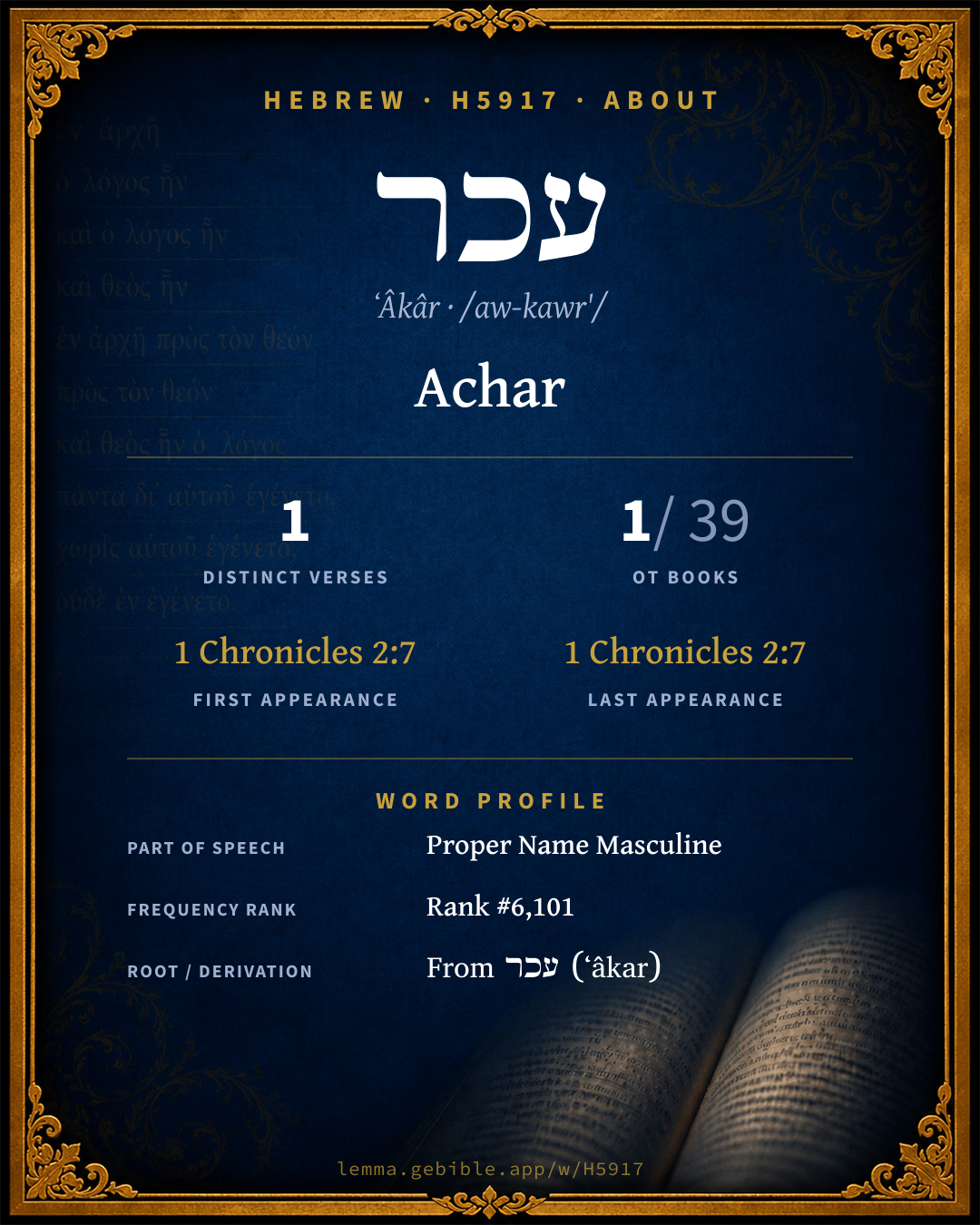
עָכָר
Achar
BDB lists 2 entries for ‘Achar’ fuller range ↓
Full lexicon entry — Brown-Driver-Briggs (BDB)
From Brown-Driver-Briggs (BDB)
Where this word appears
Grammar key — what these labels mean
Part of speech
- Noun
- A naming word — a person, place, thing, or idea.
Noun type
- Proper
- A name of a specific person, place, or people (e.g. Abraham, Zion, Israel).
Every verse where H5917 appears — 1 distinct verse across 1 book. Click any verse to open its interlinear word-by-word view. Verse text shown in the World English Bible for context — . Each verse’s Hebrew form is shown with its reference; the English is not keyword-highlighted, since the data carries no word-level English alignment. Use “Compare translations” on any verse to read it across multiple English versions. This concordance covers the Hebrew Bible; Septuagint (Greek Old Testament) occurrences are not indexed here.
1 Chronicles 1 verse
About this entry
At a glance — auto-summarized from this page’s data, not written by a person. Every figure links to its source below. This summary describes the numbers; it doesn’t interpret them.
At its core, עכר (ʻÂkâr) means “Achar.” With only 1 verse it sits in the long tail of Hebrew Bible vocabulary. Its uses cluster heavily in 1 Chronicles (100% of all occurrences). A true hapax — its single appearance is 1 Chronicles 2:7. Each statement above links to its evidence; the full detail follows below.
Gloss history
Strong's 1890 vs modern scholarship
About this word
Strong's H5917 catalogs a Hebrew word from the Hebrew Old Testament.
These counts are not copied from any lexicon or concordance. They are computed here, from the morphology-tagged Hebrew Old Testament. What Lemma adds →
- 1
- distinct verses
- The word appears in 1 distinct verse.
- 1 / 39
- OT books
- The word appears in 1 of 39 Old Testament books.
- #6,101
- by frequency
- Rank #6,101 (rank 6,101 of 8,640 Hebrew words by occurrence).
View all 1 occurrence in the concordance →
Most concentrated in
- 1 Chronicles 1 verse 100%
By section of the Old Testament
By traditional corpus
Conventional, traditional groupings — biblical authorship is debated, so this is a traditional corpus grouping, not an authorship claim. Each share is this word’s portion of its verses in that division of the Hebrew canon. Each figure is a share of the word’s 1 distinct verse.
- Writings (Ketuvim) 1 verse · 100%
How translations render this word
Counts come from each version’s own published word-to-Strong’s tagging or interlinear alignment — an approximate guide to how each version renders this word, not a word-level alignment the data otherwise carries. Because each total is that version’s own tagged count, the per-version totals vary from one another and need not match the appearance or distinct-verse counts above. These counts may also differ from a printed concordance because Lemma counts each distinctly tagged rendering and does not collapse phrase taggings into a single head-word total. This is a fixed set of word-tagged versions (KJV, ASV, BSB, ULT) and does not change with the reading translation you choose elsewhere. Each version’s license is shown beside its name below (and on Sources).
- King James Version: Achar 1×
- American Standard Version: Achar 1×
- Berean Standard Bible: Achar 1×
- unfoldingWord Literal Text: Achar 1×
King James Version Public Domain
Renders H5917 across 1 tagged occurrence — most commonly:
American Standard Version Public Domain
Renders H5917 across 1 tagged occurrence — most commonly:
Berean Standard Bible Public Domain
Renders H5917 across 1 tagged occurrence — most commonly:
unfoldingWord Literal Text CC BY-SA 4.0
Renders H5917 across 1 tagged occurrence — most commonly:
Senses in BDB
The 2 senses BDB distinguishes for this word, in lexicon order (not ranked by frequency or importance). The full entry — with sub-senses — is in the Lexicon Entry tab.
- Achar = "troubler"
- a Judaite who violated God's specific ban on taking any loot from the captured city of Jericho and was stoned to death…
Word origin
Derived from עכר (ʻâkar) (H5916) — to trouble.
Jastrow Dictionary
A second Hebrew/Aramaic lexicon for comparison, covering Aramaic and post-biblical (Talmudic, Targumic, Midrashic) usage that the biblical-Hebrew BDB does not. Matched by lemma rather than by Strong’s number, so a lemma may carry more than one Jastrow headword (shown separately below), and the entries cover usage well beyond the Bible.
עָכַר
- (b. h.) to stir up, disturb; to trouble, make turbid; to sadden. Sot. 5ᵃ כל אדם … עוֹכַרְתּוֹ if a man has swelling of wind (haughtiness) in him, the slightest breeze will trouble him (the slightest adversity will upset him); מה ים … עוכרתו וכ׳ if the sea … is stirred up by the slightest breeze &c. Y. Keth. I, 25ᵇ bot. לעוֹכֵר את העין וכ׳ (not לעובר) like one troubling the eye, which becomes clear again. Ber. 25ᵇ עוֹכְרָן ברגלו he must stir them up with his foot. Gen. R. s. 80, end (ref. to עכרתם, Gen. XXXIV, 30) צלולה היתה החבית ועֲכַרְתֶּם אותה the wine in the cask was clear, and you have troubled it; Yalk. ib. 135 ועֲכַרְתּוּהָ. Nidd. 20ᵃ צללו חוזר ועוכרן if the mixture became clear (the earth settled), he must stir it again; a. fr.—Part. pass. עָכוּר; f. עֲכוּרָה; pl. עֲכוּרִים, עֲכוּרִין; עֲכוּרוֹת. Ib. אין … צלולין אלא ע׳ you must not examine the mixture when it is clear, but when it is turbid; Tosef. ib. III, 11. Gen. R. l. c. ע׳ היתה … וצללנו אותה the wine was turbid, and we cleared it (we redeemed our honor). Snh. 44ᵇ; Lev. R. s. 9 (ref. to Josh. VII, 25) היום הזה אתה ע׳ ואי אתה ע׳ וכ׳ thou art troubled (punished) this day, but thou shalt not be troubled in the hereafter. Sifré Deut. 48 שתה ממים של בוראך … מים ע׳ וכ׳ drink of the water of thy Creator’s well, and drink not muddy water, nor be attracted by the words of the heretics; Yalk. Prov. 937; a. fr.—Ex. R. s. 22 (ref. to Job XVI, 17) וכי יש תפלה ע׳ is there also a turbid prayer? Ib. מנין … שתפלתו ע׳ where is it intimated that the prayer of him in whose hand is robbery, is turbid (rejected)? e.g. Genesis 34:30
- to be stirred up; to become turbid, dreggy, foul. Nidd. 9ᵃ דם נ׳ ונעשה חלב the blood (of a pregnant animal) is disturbed (decomposed), and turns into milk. Y. Sot. IV, 19ᶜ bot. אין החלב נ׳ וכ׳ the milk (of a nursing woman) becomes turbid only after three months (after conception). Y. Nidd. II, end, 50ᵇ יצללו ולא יֵעָכְרוּ the water mixed with earth must settle and not be stirred up again; a. fr.—Men. IX, 5 (90ᵃ) הלח נ׳ היבש אינו נ׳ (Bab. ed. נעקר; Ms. M. נעבר, corr. acc.; v. Rabb. D. S. a. l. note) liquid emptied from a large measure into a smaller one is stirred up (and what remains in the large measure partakes of the sacred character of the liquid in the smaller, sacred vessels), whereas dry objects are not stirred up.
עֲכַר
- Targ. Gen. XXXIV, 30; a. fr.—Nidd. 20ᵃ דלא לרמיה … ולִיעַכְרִינְהוּ אבל במנא כי ע׳ וכ׳ that he must not throw the earth in with his hands to make the water turbid, but when the earth is in the vessel, and he stirs with his hands, it is right. Y. ib. II, end, 50ᵇ ר׳ … ע׳ R. Ḥ. stirred the mixture up (in order to examine the color); a. e.—Part. pass. עָכִיר; f. עֲכִירָא; pl. עֲכִירֵי; עֲכִירָן. Ḥull. 55ᵇ. Men. 53ᵃ דהוה ע׳ דעתיה (Ms. M. בדחא) that his mind was troubled; Yalk. Ex. 166; Yalk. Ps. 667 (not עבידא; v. Rabb. D. S. to Men. l. c. note 50).
- to be disturbed, spoiled. Targ. Prov. XV, 6.
A Dictionary of the Targumim, the Talmud Babli and Yerushalmi, and the Midrashic Literature (Marcus Jastrow; London, Luzac, 1903) — Public Domain. Digitized via Sefaria. Digitized via Sefaria. Full attribution on Sources.
Same root — word family
Other BDB entries built from the same root as H5917, grouped by Strong’s listed origin. These share a root / origin per the lexicon — not necessarily a shared meaning. Each links to that word’s own entry.
Derives from
Proper names from this root
People and places named from this root — a name, not an additional meaning of the word.
Compare all same-root words → 2 of the same-root words are proper names (people or places). They share a root, not necessarily a meaning.
Septuagint verse parallels
This word appears in 1 verse that also exists in the Greek Old Testament (Septuagint), out of the 1 Hebrew verse it occurs in. You can read those verses in Greek by switching the Old Testament edition to the Septuagint.
Read these verses in the Septuagint
This is a verse-level parallel only — the same verses exist in both the Hebrew and Greek Old Testaments. No word-level Hebrew↔Greek correspondence is claimed: the data carries no such alignment, so no Greek word is shown as this Hebrew word’s translation. Coverage is not total — the Septuagint omits the deuterocanon and renumbers the Psalms, so some Hebrew verses have no direct Greek parallel.