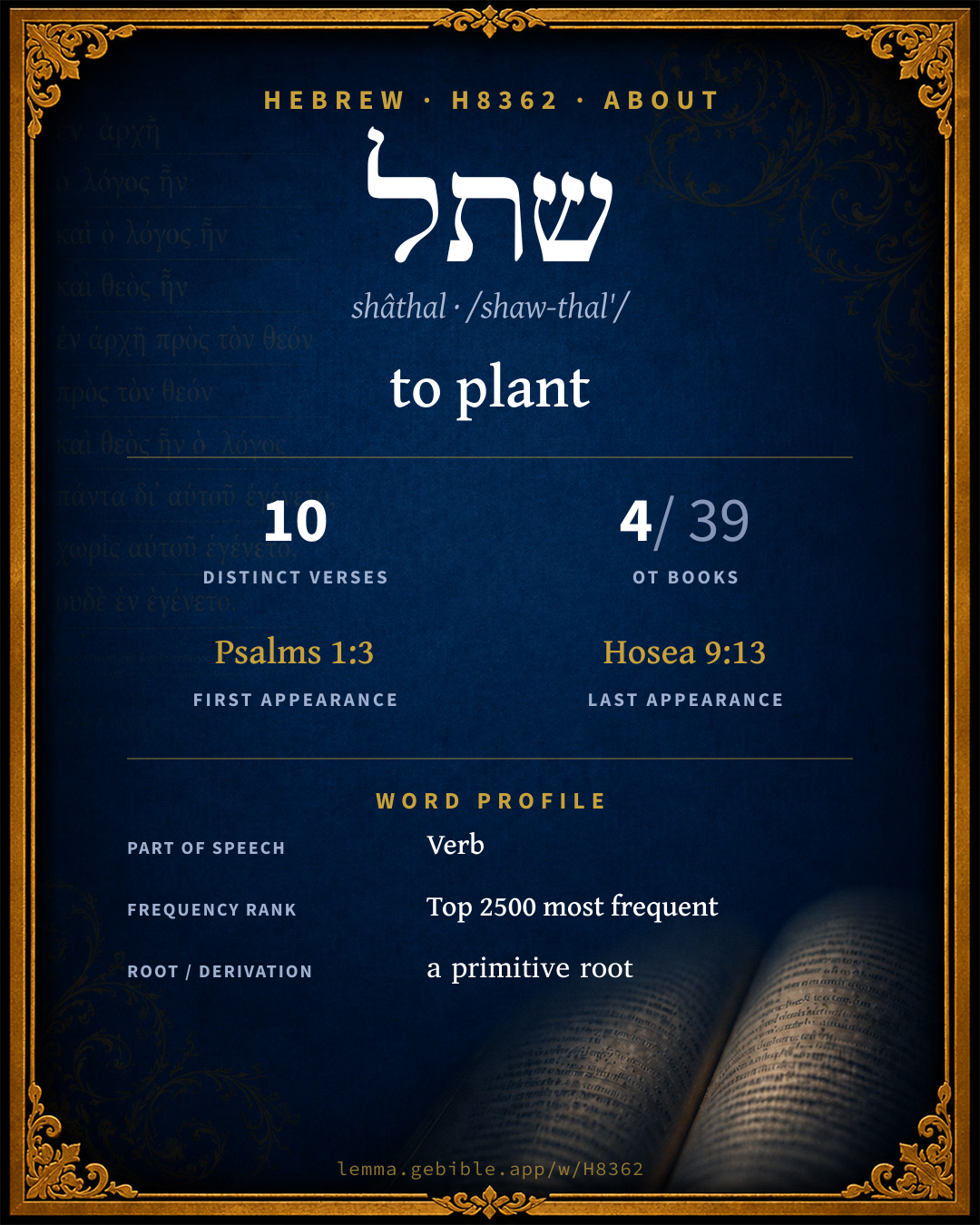
שָׁתַל
to plant
Full lexicon entry — Brown-Driver-Briggs (BDB)
From Brown-Driver-Briggs (BDB)
Where this word appears
Grammar key — what these labels mean
Part of speech
- Verb
- An action or state-of-being word.
Stem
- Qal
- The basic, simple active stem — the plain form of the verb (“he wrote”).
Form
- Participle Passive
- A verbal adjective expressing action received (“written”).
- Sequential Perfect
- A perfect with prefixed waw continuing a preceding imperfect or command (waw-consecutive perfect).
- Imperfect
- An incomplete, ongoing, or future action (“he will / would write”).
State
- Absolute
- The independent form of a noun, not bound to a following word.
Person
- 1st Person
- The speaker (“I / we”).
Gender
- Feminine
- Grammatically feminine.
- Masculine
- Grammatically masculine.
- Common
- Either gender — not distinguished for this form.
Number
- Singular
- One.
- Plural
- More than one (in Hebrew, generally three or more).
Every verse where H8362 appears in the Book of Ezekiel — 6 distinct verses. Click any verse to open its interlinear word-by-word view. Verse text shown in the World English Bible for context — . Each verse’s Hebrew form is shown with its reference; the English is not keyword-highlighted, since the data carries no word-level English alignment. Use “Compare translations” on any verse to read it across multiple English versions. This concordance covers the Hebrew Bible; Septuagint (Greek Old Testament) occurrences are not indexed here.
Ezekiel
- Ezekiel 17:8 שְׁתוּלָ֑ה Qal ptcp.pass fs It was planted in a good soil by many waters, that it might bring forth branches, and that it might bear fruit, that it might be a goodly vine.
- Ezekiel 17:10 שְׁתוּלָ֖ה Qal ptcp.pass fs Yes, behold, being planted, shall it prosper? shall it not utterly wither, when the east wind touches it? it shall wither in the beds where it grew.
- Ezekiel 17:22 וְ/שָׁתַ֣לְתִּי conj + Qal wpf 1cs Thus says the Lord Yahweh: I will also take of the lofty top of the cedar, and will set it; I will crop off from the topmost of its young twigs a tender one, and I will plant it on a high and lofty mountain:
- Ezekiel 17:23 אֶשְׁתֳּלֶ֔/נּוּ Qal impf 1cs + sfx pers 3ms in the mountain of the height of Israel will I plant it; and it shall bring forth boughs, and bear fruit, and be a goodly cedar: and under it shall dwell all birds of every wing; in the shade of the branches of it shall they dwell.
- Ezekiel 19:10 שְׁתוּלָ֑ה Qal ptcp.pass fs Your mother was like a vine, in your blood, planted by the waters: it was fruitful and full of branches by reason of many waters.
- Ezekiel 19:13 שְׁתוּלָ֣ה Qal ptcp.pass fs Now it is planted in the wilderness, in a dry and thirsty land.
About this entry
At a glance — auto-summarized from this page’s data, not written by a person. Every figure links to its source below. This summary describes the numbers; it doesn’t interpret them.
שתל (shâthal) is a Hebrew verb most often rendered “to plant.” Ezekiel dominates its distribution — 6 of 10 verses. Spanning 10 verses in 4 books, it ranks among the uncommon words of the Hebrew Bible. Scripture first uses it in Psalms 1:3. Sharing its root, it stands alongside שתל. For the data behind this summary, explore the sense tree and the renderings breakdown below.
Gloss history
Strong's 1890 vs modern scholarship
About this word
Strong's H8362 catalogs a Hebrew word from the Hebrew Old Testament.
These counts are not copied from any lexicon or concordance. They are computed here, from the morphology-tagged Hebrew Old Testament. What Lemma adds →
- 10
- distinct verses
- The word appears in 10 distinct verses.
- 4 / 39
- OT books
- The word appears in 4 of 39 Old Testament books.
- #2,342
- by frequency
- Top 2500 most frequent Hebrew words (rank 2,342 of 8,640 Hebrew words by occurrence).
View all 10 occurrences in the concordance →
By section of the Old Testament
By traditional corpus
Conventional, traditional groupings — biblical authorship is debated, so this is a traditional corpus grouping, not an authorship claim. Each share is this word’s portion of its verses in that division of the Hebrew canon. Each figure is a share of the word’s 10 distinct verses.
- Prophets (Nevi'im) 8 verses · 80%
- Writings (Ketuvim) 2 verses · 20%
How translations render this word
Counts come from each version’s own published word-to-Strong’s tagging or interlinear alignment — an approximate guide to how each version renders this word, not a word-level alignment the data otherwise carries. Because each total is that version’s own tagged count, the per-version totals vary from one another and need not match the appearance or distinct-verse counts above. These counts may also differ from a printed concordance because Lemma counts each distinctly tagged rendering and does not collapse phrase taggings into a single head-word total. This is a fixed set of word-tagged versions (KJV, ASV, BSB, ULT) and does not change with the reading translation you choose elsewhere. Each version’s license is shown beside its name below (and on Sources).
- King James Version: Planted 3×
- American Standard Version: Planted 3×
- Berean Standard Bible: Planted 5×
- unfoldingWord Literal Text: Is planted 2×, Planted 2×
King James Version Public Domain
Renders H8362 across 10 tagged occurrences — most commonly:
Plus 7 renderings that appear only once — usually multi-word phrases or single function words the recovered tagging swept in, not distinct renderings.
American Standard Version Public Domain
Renders H8362 across 10 tagged occurrences — most commonly:
Plus 7 renderings that appear only once — usually multi-word phrases or single function words the recovered tagging swept in, not distinct renderings.
Berean Standard Bible Public Domain
Renders H8362 across 10 tagged occurrences — most commonly:
Plus 5 renderings that appear only once — usually multi-word phrases or single function words the recovered tagging swept in, not distinct renderings.
unfoldingWord Literal Text CC BY-SA 4.0
Renders H8362 across 10 tagged occurrences — most commonly:
Plus 6 renderings that appear only once — usually multi-word phrases or single function words the recovered tagging swept in, not distinct renderings.
Senses in BDB
The 1 sense BDB distinguishes for this word, in lexicon order (not ranked by frequency or importance). The full entry — with sub-senses — is in the Lexicon Entry tab.
- (Qal) to plant, transplant
Word origin
Origin: a primitive root
Jastrow Dictionary
A second Hebrew/Aramaic lexicon for comparison, covering Aramaic and post-biblical (Talmudic, Targumic, Midrashic) usage that the biblical-Hebrew BDB does not. Matched by lemma rather than by Strong’s number, so a lemma may carry more than one Jastrow headword (shown separately below), and the entries cover usage well beyond the Bible.
שָׁתַל
- to set, plant. Yoma 38ᵇ ראה … עמד ושְׁתָלָן בכל דור ודור the Lord saw that the righteous men were few, so he planted them in every generation (distributed them &c., ref. to I Sam. II, 8; cmp. שָׁתַת II). Gen. R. s. 26; Yalk. Ps. 845 (ref. to Ps. XCII, 14) זה נח ששְׁתָלוֹ וכ׳ this refers to Noah whom the Lord planted in the ark. Gen. R. s. 61 (ref. to Ps. I, 3) ששתלו הקב"ה וכ׳ (Abraham) whom the Lord planted in the land of Israel. Snh. 37ᵇ (play on שׁלֹתֹיאֹלֹ, I Chr. III, 17 שאלת׳) ששׂתֹלוֹ אֹלֹ שלא כדרך הנִשְׁתָּלִין whom the Lord planted (caused to be begotten) not in the ordinary way of those that are planted (he having been begotten in prison); a. fr.—Part. pass. שָׁתוּל; f. שְׁתוּלָה; pl. שְׁתוּלִים &c. Yalk. l. c. כגן … ש׳ מערוגה וכ׳ like a garden that is planted bed by bed; (Midr. Till. to Ps. XCII, 14 נטוע). Num. R. s. 31 עד שהם ש׳ הם בבית וכ׳ so long as they are planted (seated in rows), they are in the house of God, that is to say, the children at school; a. e. e.g. 1 Samuel 2:8
- (of roots) to spread. Pesik. R. s. 3 (ref. to Koh. XII, 11) כשם ששרשיו … מַשְׁתִּילִים לכל מקום כך … נכנסים ומשתילים וכ׳ as the roots of a tree spread in all directions, so the words of the Law enter and penetrate the whole body (Num. R. s. 144 משתרשים). e.g. Ecclesiastes 12:11
- ; Hof. הוּשְׁתָּל to be planted. Snh. l. c., v. supra. Lev. R. s. 10; Cant. R. to VIII, 6 (ref. to שאלׄתׄיאל, v. supra) שממנו הוּשְׁ֗תְּ֗לָ֗ה מלכות וכ׳ from him was the dynasty of the house of David planted (procreated). Midr. Till. to Ps. IV מה היה … נִשְׁתְּלָה מבת שבע did David think that royalty would be planted from Bathsheba (that through her son the dynasty would be continued)?; a. e.
שְׁתַל
- Taan. 23ᵃ כי היכי דשַׁתְלֵי … שַׁתְלִי וכ׳ as my ancestors planted for me, so I plant for my son; Yalk. Ps. 880 דשַׁתְלוּ … אִישְׁתִּיל וכ׳. Ib. אנת הוא דשתילתא (read: דשְׁתִילְתֵּיה) art thou he that planted it?; Taan. l. c. דשְׁתַלְתֵּיה; a. e.—Part. pass. שָׁתִיל; f. שְׁתִילָא; pl. שְׁתִילִין; שְׁתִילָן. Targ. Ez. XVII, 8; 10. Targ. Ps. XCII, 14; a. e.—V. שְׁתִילָא.
שֹׁתֶל
- (preced.) set, plant. — Pl. שֳׁתָלִים, שֳתָלִין, שׁוֹתָ׳. Maasr. V, 1 חעוקר ש׳ מתוך שלו וכ׳ if one takes plants out of his own garden to set them in his own, he is exempt from tithes; Tosef. ib. III, 8 שות׳ ed. Zuck. (Var. שת׳). Ib. שְׁתִילִין ועטינין sets or young herbs; Y. ib. V, beg. 51ᶜ עטנין ושתלין. Ib. מה בין חטים מה בין ש׳ what is the difference between wheat (used for seed) and sets (with regard to tithes)? חטים גמר מלאכה ש׳ וכ׳ wheat is a finished object, sets are not; a. e.
A Dictionary of the Targumim, the Talmud Babli and Yerushalmi, and the Midrashic Literature (Marcus Jastrow; London, Luzac, 1903) — Public Domain. Digitized via Sefaria. Digitized via Sefaria. Full attribution on Sources.
Forms in the corpus
The 8 distinct written forms H8362 takes in the Hebrew Bible, most frequent first — each parse links to that stem’s occurrences in the concordance. Hebrew forms include their vowel points and cantillation, so a single lemma takes many written forms.
| Form | Parsing | Example | Uses |
|---|---|---|---|
| שְׁתוּלָ֑ה | Verb, Qal, Participle Passive, Feminine, Singular, Absolute | Ezekiel 17:8 | 2 |
| שְׁתוּלָ֣ה | Verb, Qal, Participle Passive, Feminine, Singular, Absolute | Ezekiel 19:13 | 2 |
| אֶשְׁתֳּלֶ֔/נּוּ | Verb, Qal, Imperfect, 1st Person, Common, Singular | Ezekiel 17:23 | 1 |
| וְ/שָׁתַ֣לְתִּי | Verb, Qal, Sequential Perfect, 1st Person, Common, Singular | Ezekiel 17:22 | 1 |
| שְׁ֭תוּלִים | Verb, Qal, Participle Passive, Masculine, Plural, Absolute | Psalms 92:13 | 1 |
| שְׁתוּלָ֖ה | Verb, Qal, Participle Passive, Feminine, Singular, Absolute | Ezekiel 17:10 | 1 |
| שָׁת֣וּל | Verb, Qal, Participle Passive, Masculine, Singular, Absolute | Jeremiah 17:8 | 1 |
| שָׁת֪וּל | Verb, Qal, Participle Passive, Masculine, Singular, Absolute | Psalms 1:3 | 1 |
Same root — word family
Other BDB entries built from the same root as H8362, grouped by Strong’s listed origin. These share a root / origin per the lexicon — not necessarily a shared meaning. Each links to that word’s own entry.
Derived from this word
Compare all same-root words → They share a root, not necessarily a meaning.
Septuagint verse parallels
This word appears in 9 verses that also exist in the Greek Old Testament (Septuagint), out of the 10 Hebrew verses it occurs in. You can read those verses in Greek by switching the Old Testament edition to the Septuagint.
Read these verses in the Septuagint
This is a verse-level parallel only — the same verses exist in both the Hebrew and Greek Old Testaments. No word-level Hebrew↔Greek correspondence is claimed: the data carries no such alignment, so no Greek word is shown as this Hebrew word’s translation. Coverage is not total — the Septuagint omits the deuterocanon and renumbers the Psalms, so some Hebrew verses have no direct Greek parallel.