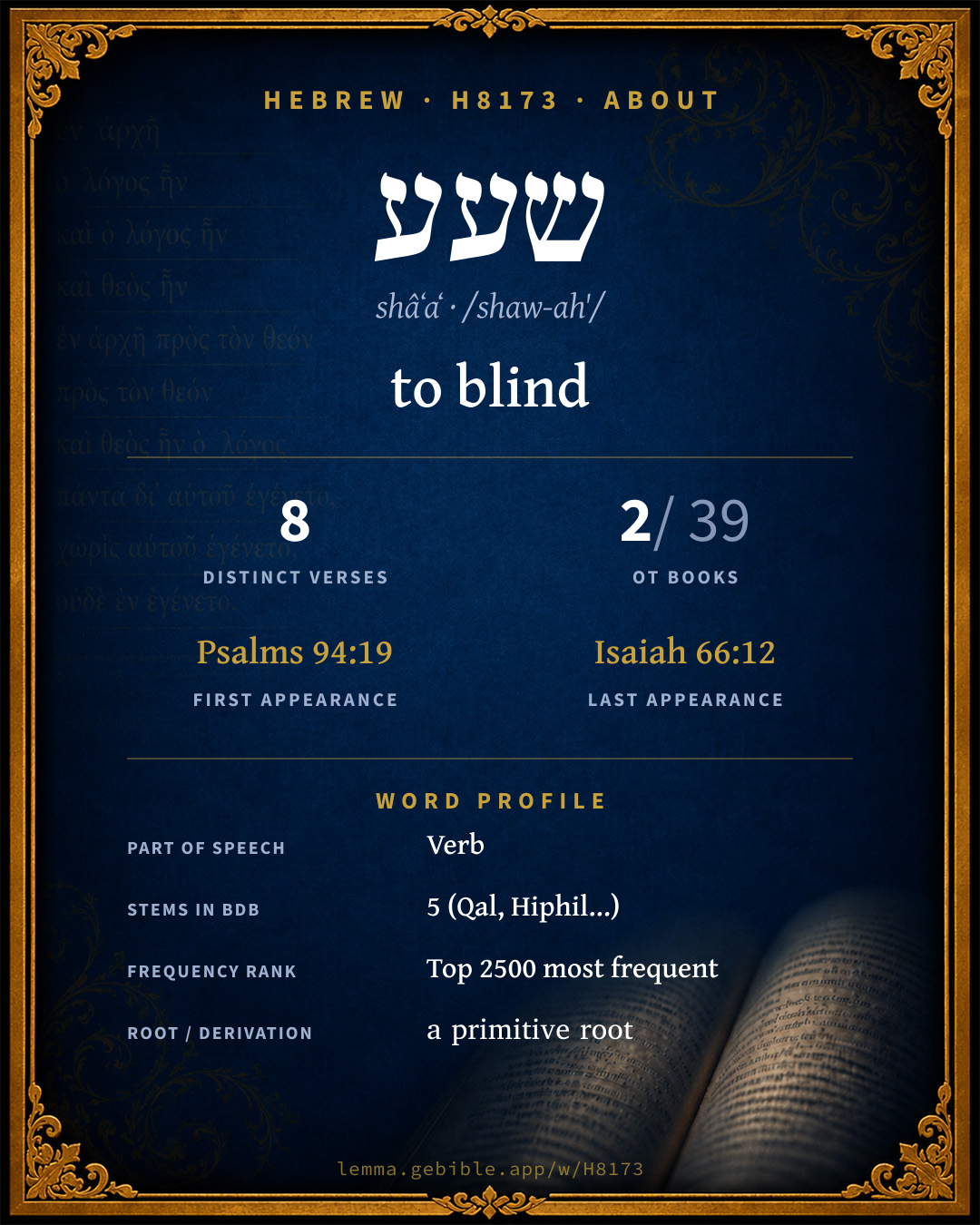
שָׁעַע
to blind
‘to blind’ is one of 2 main senses fuller range ↓
Full lexicon entry — Brown-Driver-Briggs (BDB)
From Brown-Driver-Briggs (BDB)
Where this word appears
See every Hiphil verb in the Hebrew Bible →
Grammar key — what these labels mean
Part of speech
- Verb
- An action or state-of-being word.
Stem
- Pilpel
- A reduplicated intensive stem of two-letter or hollow roots.
- Qal
- The basic, simple active stem — the plain form of the verb (“he wrote”).
- Hiphil
- The causative active stem (“he caused / brought about”).
Form
- Imperfect
- An incomplete, ongoing, or future action (“he will / would write”).
- Sequential Perfect
- A perfect with prefixed waw continuing a preceding imperfect or command (waw-consecutive perfect).
- Imperative
- A direct command (“write!”).
- Perfect
- A completed action or state — Hebrew marks aspect (completeness) more than strict tense (“he wrote”).
Person
- 1st Person
- The speaker (“I / we”).
- 3rd Person
- The one spoken about (“he / she / it / they”).
- 2nd Person
- The one addressed (“you”).
Gender
- Common
- Either gender — not distinguished for this form.
- Masculine
- Grammatically masculine.
Number
- Singular
- One.
- Plural
- More than one (in Hebrew, generally three or more).
Every verse where H8173 appears in the Book of Isaiah — 4 distinct verses. Click any verse to open its interlinear word-by-word view. Verse text shown in the World English Bible for context — . Each verse’s Hebrew form is shown with its reference; the English is not keyword-highlighted, since the data carries no word-level English alignment. Use “Compare translations” on any verse to read it across multiple English versions. This concordance covers the Hebrew Bible; Septuagint (Greek Old Testament) occurrences are not indexed here.
Isaiah
- Isaiah 6:10 הָשַׁ֑ע Hiphil impv 2ms Make the heart of this people fat; Make their ears heavy, and shut their eyes; Lest they see with their eyes, And hear with their ears, And understand with their heart, And turn again, and be healed."
- Isaiah 11:8 וְ/שִֽׁעֲשַׁ֥ע conj + Pilpel wpf 3ms The sucking child shall play on the hole of the asp, and the weaned child shall put his hand on the adder's den.
- Isaiah 29:9 הִשְׁתַּֽעַשְׁע֖וּ וָ/שֹׁ֑עוּ Hithpalpel impv 2mp conj + Qal impv 2mp Stay you and wonder; take your pleasure and be blind: they are drunken, but not with wine; they stagger, but not with strong drink.
- Isaiah 66:12 תְּשָׁעֳשָֽׁעוּ Polpal impf 2mp For thus says Yahweh, Behold, I will extend peace to her like a river, and the glory of the nations like an overflowing stream: and you shall suck [of it]; you shall be borne on the side, and shall be dandled on the knees.
About this entry
At a glance — auto-summarized from this page’s data, not written by a person. Every figure links to its source below. This summary describes the numbers; it doesn’t interpret them.
The Hebrew verb שעע centers on the idea of “to blind.” The word gravitates to Psalms (50%), then Isaiah. It appears 8 verses across 2 books of the Hebrew Bible, among its uncommon vocabulary. Its earliest occurrence is Psalms 94:19. Read the stem: it spans 5 stems, including Qal and Hiphil. Dig into 8-verse concordance and the renderings breakdown below.
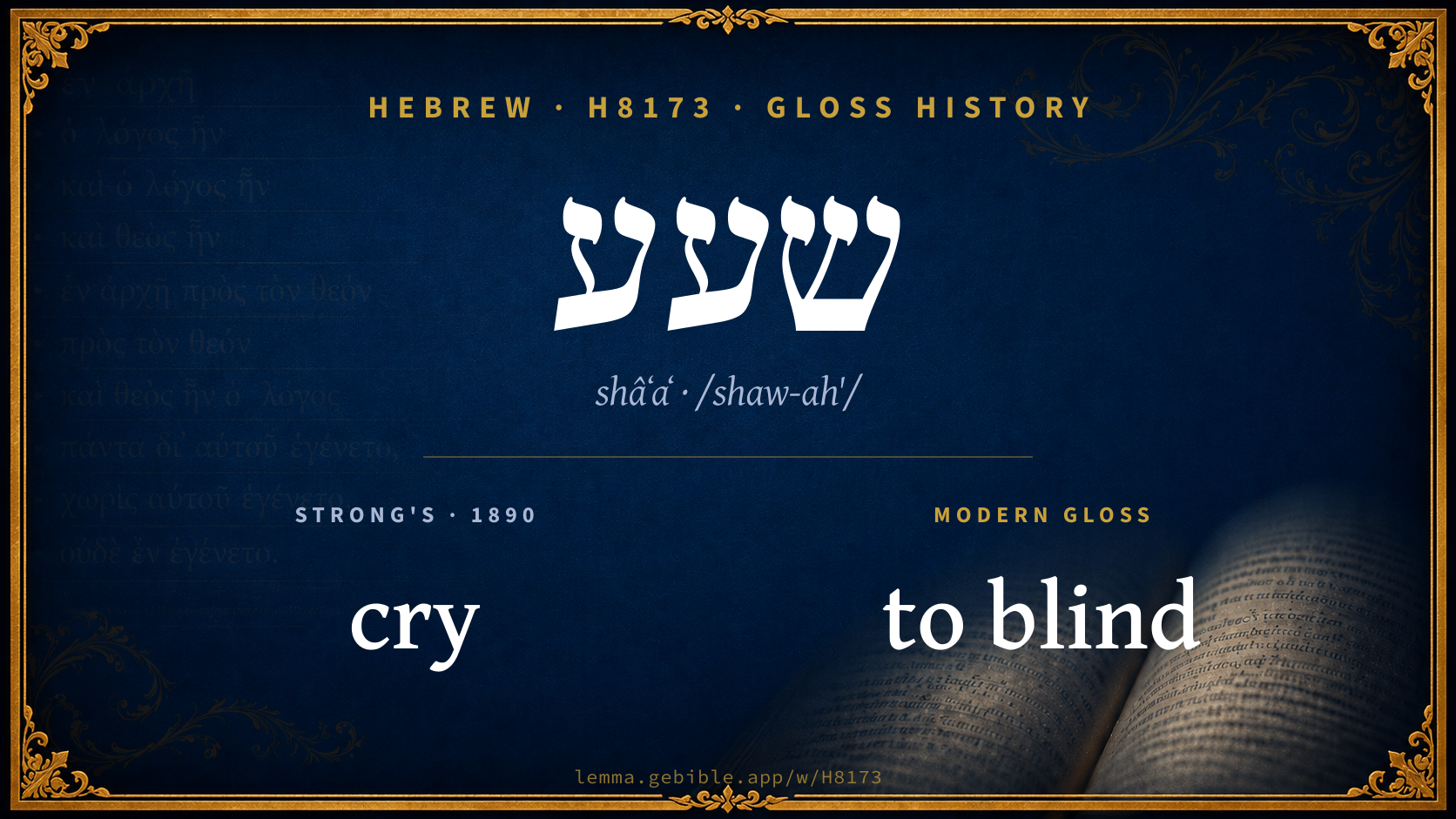
Gloss history
Strong's 1890 vs modern scholarship
About this word
Strong's H8173 catalogs a Hebrew word from the Hebrew Old Testament.
These counts are not copied from any lexicon or concordance. They are computed here, from the morphology-tagged Hebrew Old Testament. What Lemma adds →
- 8
- distinct verses
- The word appears in 8 distinct verses.
- 2 / 39
- OT books
- The word appears in 2 of 39 Old Testament books.
- #2,481
- by frequency
- Top 2500 most frequent Hebrew words (rank 2,481 of 8,640 Hebrew words by occurrence).
View all 8 occurrences in the concordance →
By traditional corpus
Conventional, traditional groupings — biblical authorship is debated, so this is a traditional corpus grouping, not an authorship claim. Each share is this word’s portion of its verses in that division of the Hebrew canon. Each figure is a share of the word’s 8 distinct verses.
- Prophets (Nevi'im) 4 verses · 50%
- Writings (Ketuvim) 4 verses · 50%
How translations render this word
Counts come from each version’s own published word-to-Strong’s tagging or interlinear alignment — an approximate guide to how each version renders this word, not a word-level alignment the data otherwise carries. Because each total is that version’s own tagged count, the per-version totals vary from one another and need not match the appearance or distinct-verse counts above. These counts may also differ from a printed concordance because Lemma counts each distinctly tagged rendering and does not collapse phrase taggings into a single head-word total. This is a fixed set of word-tagged versions (KJV, ASV, BSB, ULT) and does not change with the reading translation you choose elsewhere. Each version’s license is shown beside its name below (and on Sources).
BDB lists this Strong’s number as 2 distinct words (homographs). Each count above pools all of them and is not split by sense — see the Senses section below. A low-frequency rendering may belong to a different one of those words, not the primary meaning.
- King James Version†: I will delight 2×
- American Standard Version†: I will delight 2×
- Berean Standard Bible†: Be sightless 1×, Blind yourselves 1×, Bounced 1×
- unfoldingWord Literal Text†: I delight 3×
King James Version Public Domain
Renders H8173 across 9† tagged occurrences — most commonly:
Plus 7 renderings that appear only once — usually multi-word phrases or single function words the recovered tagging swept in, not distinct renderings.
American Standard Version Public Domain
Renders H8173 across 9† tagged occurrences — most commonly:
Plus 7 renderings that appear only once — usually multi-word phrases or single function words the recovered tagging swept in, not distinct renderings.
Berean Standard Bible Public Domain
Renders H8173 across 9† tagged occurrences — most commonly:
unfoldingWord Literal Text CC BY-SA 4.0
Renders H8173 across 11† tagged occurrences — most commonly:
Plus 8 renderings that appear only once — usually multi-word phrases or single function words the recovered tagging swept in, not distinct renderings.
Senses in the full BDB
Hebrew verbs can shift meaning by stem (binyan): Qal is the basic action, Niphal is often passive or reflexive, Piel often intensifies or makes it factitive, and Hiphil is typically causative. The senses below are grouped under the stem BDB assigns to each. This entry also uses one or more reduplicated stems (the Pōlēl/Pilpēl type), which for hollow or geminate roots behave much like Piel — often intensive or iterative.
What do BDB’s symbols mean?
BDB uses these scholarly abbreviations:
| Symbol | Meaning |
|---|---|
| 𝔊 | the Septuagint (the ancient Greek translation, LXX) |
| 𝔙 | the Vulgate (the Latin translation) |
| 𝔖 | the Syriac version (the Peshitta) |
| 𝔗 | the Targum (the Aramaic translation) |
| ψ | the Psalms |
| √ | root (the underlying root or stem) |
| ‖ | parallel passage (a synonymous or contrasted parallel) |
| † | the dagger: every passage where the word occurs is cited |
The 5 senses and sub-senses the full Brown-Driver-Briggs lexicon distinguishes for this word, in lexicon order (not ranked by frequency), with BDB’s own verbatim wording and sub-sense lettering. Shown in Hebrew script with BDB’s own scholarly abbreviations. The condensed entry is in the Lexicon Entry tab. See also the Forms in the corpus table below.
שעע I be smeared over, blinded
Qal
- Hithpalp. blind yourselves and be blind!
Hiphil
- . and its eyes besmear!
שעע II sport, take delight in, delight
Pilp
- . the suckling shall sport on the cobra’s hole
Palp
- . upon the knees shall ye be fondled.
Hithpalp
- . in thy statutes will I delight myself
Senses from the full Brown-Driver-Briggs lexicon (Brown, Driver, Briggs; Oxford 1906 — public domain), digitized via Sefaria, supplemented by the OpenScriptures HebrewLexicon (CC BY 4.0). Full attribution on Sources.
Word origin
I. [ שָׁעַע ] vb. be smeared over, blinded
II. [ שָׁעַע ] vb. Pilp., etc., sport, take delight in, delight
— Brown-Driver-Briggs (Oxford 1906, public domain), digitized via Sefaria, supplemented by the OpenScriptures HebrewLexicon (CC BY 4.0). See Sources.
Origin: a primitive root
Jastrow Dictionary
A second Hebrew/Aramaic lexicon for comparison, covering Aramaic and post-biblical (Talmudic, Targumic, Midrashic) usage that the biblical-Hebrew BDB does not. Matched by lemma rather than by Strong’s number, so a lemma may carry more than one Jastrow headword (shown separately below), and the entries cover usage well beyond the Bible.
שָׁעַע
- to smooth, paste.
- 1. to smooth, paste over. Y. Kil. I, 27ᵃ top מְשׁעֲשֶׁעֶת את הלב, v. שְׁעוּעִית.
- 2. to appease, console. Pesik. Naḥămu, p. 126ᵇ ומְשַׁעְשְׁעָהּ בזו, v. פִּיד; ib. ושִׁיעְשְׁעָהּ במצרים consoled her (Assyria) with Egypt; ib. ושיעשעה באשור (not לאשור); Yalk. Job 918; Pesik. R. s. 33 ואם הביא עליהם שבר הוא מְשַׁעֲשֵׁעַ וכ׳ when he brings misfortune upon them, he consoles them one with the other.
- 1. to be appeased, enjoy one’s self. Ex. R. s. 5 (ref. to ישעו, Ex. V, 9) שהיו בידן … מִשְׁתַּעְשְׁעִין בהן וכ׳ they had scrolls with them, in reading which they consoled themselves from Sabbath to Sabbath; אל יהו משתעשעין וכ׳ they shall not enjoy themselves, and they shall not rest on the Sabbath; Tanḥ. Vaëra 6; a. e. e.g. Exodus 5:9
- 2. to be a pleasure. Tanḥ. T’tsavveh 1 (ref. to Jer. XXXI, 19) מהו ילד שעשועים … ומִשְׁתַּעְשֵׁעַ לאביו what is ‘a child of delight’? Three or four years old, when it begins to talk and becomes a pleasure to his father. e.g. Jeremiah 31:19
שְׁעַע
- 1. to smooth, paste over, daub. Targ. Ez. XIII, 10, sq. Ib. 12 שַׁעְתּוּן (some ed. שַׁעִיתוּן, Pa. of שְׁעֵי). Ib. XXII, 28; a. e.
- 2. to make smooth, flatter. Targ. Ps. XXXVI, 3.
- 3. (of skin) to be smooth, bright. Targ. Lam. IV, 7 (h. text צחו).
- to smooth. Targ. Ps. V, 10 (v. שְׁעֵי).
- to be pasted, daubed, v. שׁוּעַ ch.
A Dictionary of the Targumim, the Talmud Babli and Yerushalmi, and the Midrashic Literature (Marcus Jastrow; London, Luzac, 1903) — Public Domain. Digitized via Sefaria. Digitized via Sefaria. Full attribution on Sources.
Forms in the corpus
The 9 distinct written forms H8173 takes in the Hebrew Bible, most frequent first — each parse links to that stem’s occurrences in the concordance. Hebrew forms include their vowel points and cantillation, so a single lemma takes many written forms.
| Form | Parsing | Example | Uses |
|---|---|---|---|
| אֶֽשְׁתַּעֲשָׁ֑ע | Verb, Hithpalpel, Imperfect, 1st Person, Common, Singular | Psalms 119:16 | 1 |
| הִשְׁתַּֽעַשְׁע֖וּ | Verb, Hithpalpel, Imperative, 2nd Person, Masculine, Plural | Isaiah 29:9 | 1 |
| הָשַׁ֑ע | Verb, Hiphil, Imperative, 2nd Person, Masculine, Singular | Isaiah 6:10 | 1 |
| וְ/אֶשְׁתַּֽעֲשַׁ֥ע | Verb, Hithpalpel, Imperfect, 1st Person, Common, Singular | Psalms 119:47 | 1 |
| וְ/שִֽׁעֲשַׁ֥ע | Verb, Pilpel, Sequential Perfect, 3rd Person, Masculine, Singular | Isaiah 11:8 | 1 |
| וָ/שֹׁ֑עוּ | Verb, Qal, Imperative, 2nd Person, Masculine, Plural | Isaiah 29:9 | 1 |
| יְֽשַׁעַשְׁע֥וּ | Verb, Pilpel, Imperfect, 3rd Person, Masculine, Plural | Psalms 94:19 | 1 |
| שִֽׁעֲשָֽׁעְתִּי | Verb, Pilpel, Perfect, 1st Person, Common, Singular | Psalms 119:70 | 1 |
| תְּשָׁעֳשָֽׁעוּ | Verb, Polpal, Imperfect, 2nd Person, Masculine, Plural | Isaiah 66:12 | 1 |
Same root — word family
Other BDB entries built from the same root as H8173, grouped by Strong’s listed origin. These share a root / origin per the lexicon — not necessarily a shared meaning. Each links to that word’s own entry.
Derived from this word
Compare all same-root words → They share a root, not necessarily a meaning.
Septuagint verse parallels
This word appears in 4 verses that also exist in the Greek Old Testament (Septuagint), out of the 8 Hebrew verses it occurs in. You can read those verses in Greek by switching the Old Testament edition to the Septuagint.
Read these verses in the Septuagint
This is a verse-level parallel only — the same verses exist in both the Hebrew and Greek Old Testaments. No word-level Hebrew↔Greek correspondence is claimed: the data carries no such alignment, so no Greek word is shown as this Hebrew word’s translation. Coverage is not total — the Septuagint omits the deuterocanon and renumbers the Psalms, so some Hebrew verses have no direct Greek parallel.