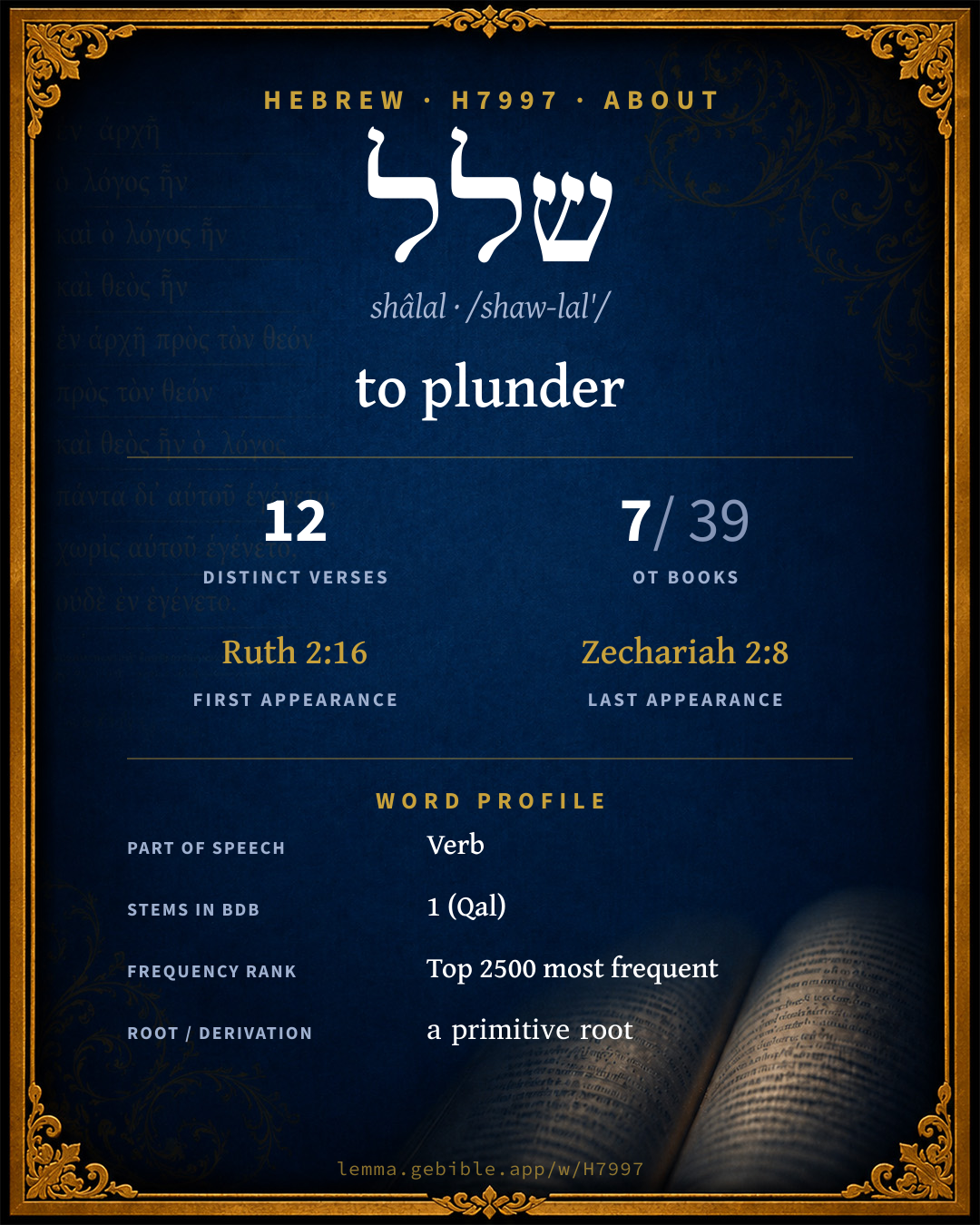
שָׁלַל
to plunder
‘to plunder’ is one of 2 main senses fuller range ↓
Full lexicon entry — Brown-Driver-Briggs (BDB)
From Brown-Driver-Briggs (BDB)
Where this word appears
Grammar key — what these labels mean
Part of speech
- Verb
- An action or state-of-being word.
Stem
- Qal
- The basic, simple active stem — the plain form of the verb (“he wrote”).
- Hithpolel
- The reflexive counterpart of the Polel.
Form
- Infinitive Construct
- A bound verbal noun, frequently with prepositions (“to write / in writing”).
- Sequential Perfect
- A perfect with prefixed waw continuing a preceding imperfect or command (waw-consecutive perfect).
- Participle Active
- A verbal adjective expressing ongoing or characteristic action (“writing / one who writes”).
- Infinitive Absolute
- An unbound verbal noun, often intensifying or standing in for a finite verb.
- Imperfect
- An incomplete, ongoing, or future action (“he will / would write”).
- Perfect
- A completed action or state — Hebrew marks aspect (completeness) more than strict tense (“he wrote”).
State
- Absolute
- The independent form of a noun, not bound to a following word.
- Construct
- A noun bound to a following noun in a possessive / “of” relationship (the construct chain).
Person
- 3rd Person
- The one spoken about (“he / she / it / they”).
- 2nd Person
- The one addressed (“you”).
Gender
- Common
- Either gender — not distinguished for this form.
- Masculine
- Grammatically masculine.
Number
- Plural
- More than one (in Hebrew, generally three or more).
- Singular
- One.
Every verse where H7997 appears in the Book of Ezekiel — 5 distinct verses. Click any verse to open its interlinear word-by-word view. Verse text shown in the World English Bible for context — . Each verse’s Hebrew form is shown with its reference; the English is not keyword-highlighted, since the data carries no word-level English alignment. Use “Compare translations” on any verse to read it across multiple English versions. This concordance covers the Hebrew Bible; Septuagint (Greek Old Testament) occurrences are not indexed here.
Ezekiel
- Ezekiel 26:12 וְ/שָׁלְל֣וּ conj + Qal wpf 3cp They shall make a spoil of your riches, and make a prey of your merchandise; and they shall break down your walls, and destroy your pleasant houses; and they shall lay your stones and your timber and your dust in the midst of the waters.
- Ezekiel 29:19 וְ/שָׁלַ֤ל conj + Qal wpf 3ms Therefore thus says the Lord Yahweh: Behold, I will give the land of Egypt to Nebuchadrezzar king of Babylon; and he shall carry off her multitude, and take her spoil, and take her prey; and it shall be the wages for his army.
- Ezekiel 38:12 לִ/שְׁלֹ֥ל prep + Qal inf.cs to take the spoil and to take the prey; to turn your hand against the waste places that are [now] inhabited, and against the people who are gathered out of the nations, who have gotten cattle and goods, who dwell in the middle of the earth.
- Ezekiel 38:13 הֲ/לִ/שְׁלֹ֤ל לִ/שְׁלֹ֖ל ptcl inter + prep + Qal inf.cs prep + Qal inf.cs Sheba, and Dedan, and the merchants of Tarshish, with all the young lions of it, shall tell you, Are you come to take the spoil? have you assembled your company to take the prey? to carry away silver and gold, to take away cattle and goods, to take great spoil?
- Ezekiel 39:10 וְ/שָׁלְל֣וּ שֹׁלְלֵי/הֶ֗ם conj + Qal wpf 3cp Qal ptcp.act mp cs + sfx pers 3mp so that they shall take no wood out of the field, neither cut down any out of the forests; for they shall make fires of the weapons; and they shall plunder those who plundered them, and rob those who robbed them, says the Lord Yahweh.
About this entry
At a glance — auto-summarized from this page’s data, not written by a person. Every figure links to its source below. This summary describes the numbers; it doesn’t interpret them.
At its core, שלל (shâlal) means “to plunder.” Scripture first uses it in Ruth 2:16. It turns up in 12 verses across 7 books, an uncommon footprint. The word gravitates to Ezekiel (42%), then Isaiah and Ruth. Carrying more than one sense, it rewards its full sense range. Each statement above links to its evidence; the full detail follows below.
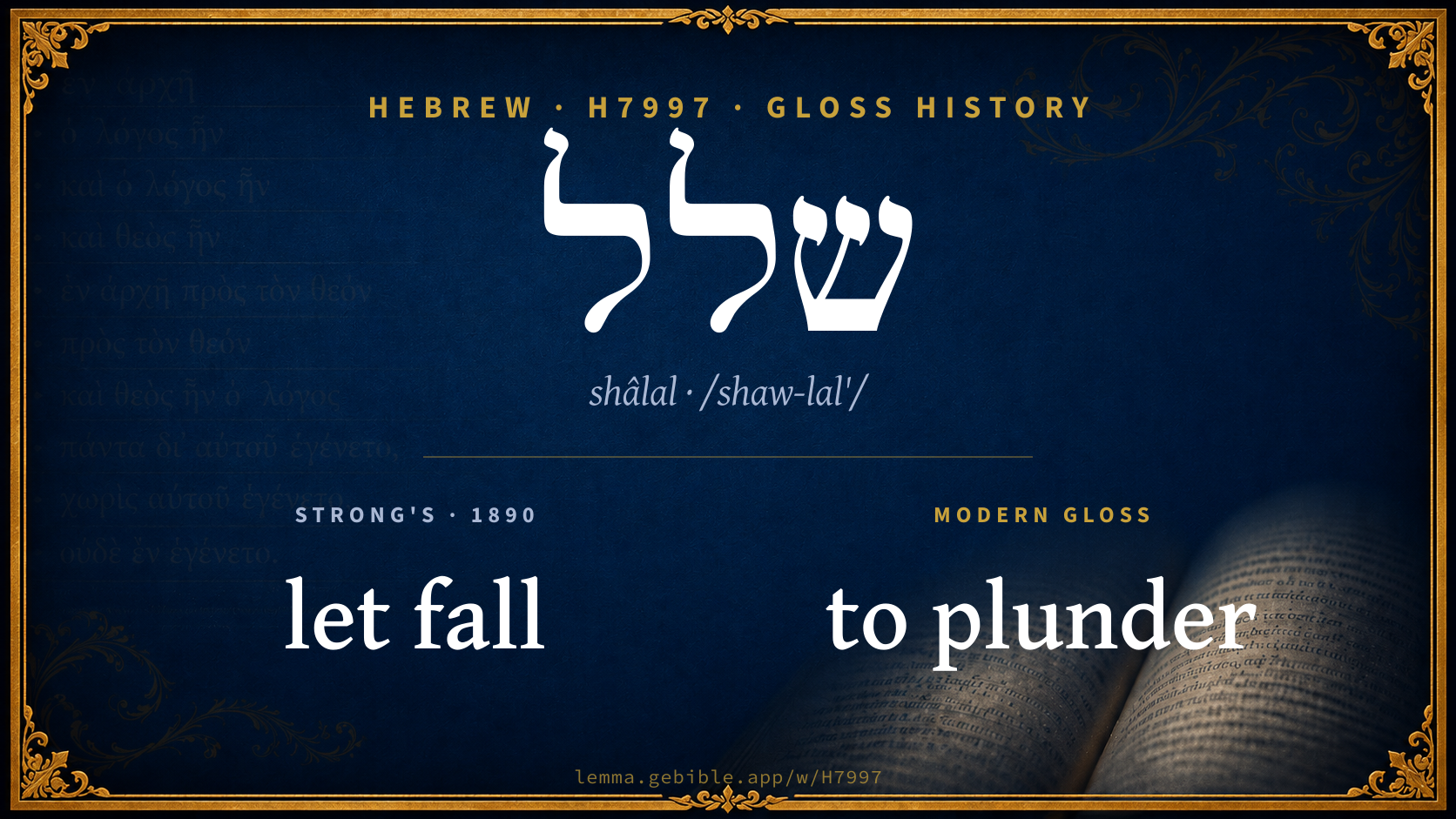
Gloss history
Strong's 1890 vs modern scholarship
About this word
Strong's H7997 catalogs a Hebrew word from the Hebrew Old Testament.
These counts are not copied from any lexicon or concordance. They are computed here, from the morphology-tagged Hebrew Old Testament. What Lemma adds →
- 12
- distinct verses
- The word appears in 12 distinct verses.
- 7 / 39
- OT books
- The word appears in 7 of 39 Old Testament books.
- #1,752
- by frequency
- Top 2500 most frequent Hebrew words (rank 1,752 of 8,640 Hebrew words by occurrence).
View all 12 occurrences in the concordance →
By section of the Old Testament
By traditional corpus
Conventional, traditional groupings — biblical authorship is debated, so this is a traditional corpus grouping, not an authorship claim. Each share is this word’s portion of its verses in that division of the Hebrew canon. Each figure is a share of the word’s 12 distinct verses.
- Prophets (Nevi'im) 10 verses · 83%
- Writings (Ketuvim) 2 verses · 17%
How translations render this word
Counts come from each version’s own published word-to-Strong’s tagging or interlinear alignment — an approximate guide to how each version renders this word, not a word-level alignment the data otherwise carries. Because each total is that version’s own tagged count, the per-version totals vary from one another and need not match the appearance or distinct-verse counts above. These counts may also differ from a printed concordance because Lemma counts each distinctly tagged rendering and does not collapse phrase taggings into a single head-word total. This is a fixed set of word-tagged versions (KJV, ASV, BSB, ULT) and does not change with the reading translation you choose elsewhere. Each version’s license is shown beside its name below (and on Sources).
BDB lists this Strong’s number as 2 distinct words (homographs). Each count above pools all of them and is not split by sense — see the Senses section below. A low-frequency rendering may belong to a different one of those words, not the primary meaning.
- King James Version†: Take 5×, Spoiled 2×
- American Standard Version†: Take 4×, Plundered 2×
- Berean Standard Bible†: Seize 2×
- unfoldingWord Literal Text†: To 3×, Be sure to pull some out 2×, They will plunder 2×
King James Version Public Domain
Renders H7997 across 16† tagged occurrences — most commonly:
Plus 9 renderings that appear only once — usually multi-word phrases or single function words the recovered tagging swept in, not distinct renderings.
American Standard Version Public Domain
Renders H7997 across 16† tagged occurrences — most commonly:
Plus 10 renderings that appear only once — usually multi-word phrases or single function words the recovered tagging swept in, not distinct renderings.
Berean Standard Bible Public Domain
Renders H7997 across 15† tagged occurrences — most commonly:
Plus 13 renderings that appear only once — usually multi-word phrases or single function words the recovered tagging swept in, not distinct renderings. Not rendered by a distinct English word in 1 further occurrence.
unfoldingWord Literal Text CC BY-SA 4.0
Renders H7997 across 16† tagged occurrences — most commonly:
Plus 9 renderings that appear only once — usually multi-word phrases or single function words the recovered tagging swept in, not distinct renderings.
Senses in the full BDB
What do BDB’s symbols mean?
BDB uses these scholarly abbreviations:
| Symbol | Meaning |
|---|---|
| 𝔊 | the Septuagint (the ancient Greek translation, LXX) |
| 𝔙 | the Vulgate (the Latin translation) |
| 𝔖 | the Syriac version (the Peshitta) |
| 𝔗 | the Targum (the Aramaic translation) |
| ψ | the Psalms |
| √ | root (the underlying root or stem) |
| ‖ | parallel passage (a synonymous or contrasted parallel) |
| † | the dagger: every passage where the word occurs is cited |
The 1 sense the full Brown-Driver-Briggs lexicon distinguishes for this word, in lexicon order (not ranked by frequency), with BDB’s own verbatim wording and sub-sense lettering. Shown in Hebrew script with BDB’s own scholarly abbreviations. The condensed entry is in the Lexicon Entry tab. See also the Forms in the corpus table below.
Qal
- Pf. 3 ms. consec. וְשׁ׳ Ez 26:12; 2 ms. שַׁלּוֹתָ Hb 2:8, etc.; Impf. 3 mpl. sf. יְשָׁלּוּךָ v 8; cstr. לִשְׁלֹל Is 10:6 +; Pt. pl. שֹׁלְלִים Zc 2:12, etc.;—spoil, plunder (usually ‖ בָּזַז), c. acc. cogn. שָׁלָל Is 10:6; Ez 29:19; 38:12, 13(×2), acc. חַיִל wealth 26:12; acc. pers., שֹׁלְלִים Je 50:10; Hb 2:8; Ez 39:10, גּוֹיִם רַבִּים Hb 2:8, cf. Zc 2:12. Hithpōʿ. Pf. 3 pl. אֶשְׁתּוֹלְלוּ אַבִּירֵי לֵב (א in אֶשְׁתּ׳ is Aramaic, or scribal error: Ges§ 54 a n., cf. 53 k) ψ 76:6 the stout of heart are spoiled; Pt. מִשְׁתּוֹלֵל Is 59:15 he that departs from evil is one despoiled. e.g. Ezekiel 26:12
Senses from the full Brown-Driver-Briggs lexicon (Brown, Driver, Briggs; Oxford 1906 — public domain), digitized via Sefaria, supplemented by the OpenScriptures HebrewLexicon (CC BY 4.0). Full attribution on Sources.
Word origin
I. vb. draw out (Arabic سَلَّ draw, especially sword from scabbard, سَلِيلٌ drawn sword, new born child (cf. Frä 75, but also SchulthHom. Wurz. 80 f.); Talm. שָׁלִיל, 𝔗 שְׁלִילָא embryo or abortion);—Impf. 2 mpl. + Inf. abs. שֹׁל־תָּשֹׁלּוּ לָהּ מִן וגו׳ Ru 2:16 ye shall by all means draw out for her from the sheaves.
II. vb. spoil, plunder (usually identif. with I. שׁ׳; NH id. (Jastr, cf. Dalm); Assyrian šalâlu id.; HomChr 33 cp. Sab. תֿלל plunder, connecting this with Arabic ثَلَّةٌ a flock of sheep (or goats); then 𝔗 שְׁלָלָא booty, and (rare) Syriac ܫܶܠܳܠ are loan-words);—
— Brown-Driver-Briggs (Oxford 1906, public domain), digitized via Sefaria, supplemented by the OpenScriptures HebrewLexicon (CC BY 4.0). See Sources.
Origin: a primitive root
Jastrow Dictionary
A second Hebrew/Aramaic lexicon for comparison, covering Aramaic and post-biblical (Talmudic, Targumic, Midrashic) usage that the biblical-Hebrew BDB does not. Matched by lemma rather than by Strong’s number, so a lemma may carry more than one Jastrow headword (shown separately below), and the entries cover usage well beyond the Bible.
שָׁלַל I
- [to hang down, be loose,]
- 1. to hang on, to chain. Part. pass. שָׁלוּל. Lam. R. introd. (R. Z’ʿera) כת … שְׁלוּלִים בשלשלאות a troop of old men chained with chains.
- 2. to make chain-stitches, to baste, opp. אחה to sew together with fine stitches. Y. M. Kat. III, 82ᵇ top על כל המתים הוא שׁוֹלֵל … ומאחה וכ׳ for all deceased relatives one may baste the rent after seven days, and sew it after thirty days; ויִשְׁלוֹל יום שביעי וכ׳ let him be permitted to baste it on the seventh day &c.; Treat. S’maḥ. ch. IX; M. Kat. 22ᵇ. Ib. האשה שׁוֹלַלְתּוֹ וכ׳ a woman may baste it immediately (after rending), out of regard for her dignity; ib. 26ᵇ. Ib. דלא ניתן לשׁוֹלְלוֹ because it is not to be basted (during the seven days); a. e.
- to hang with, decorate with.—Part. pass. מְשׁוּלָּל. Mekh. B’shall., s. 1 מְשׁוּלָּלִין בזיין, v. שָׁלִישׁ.
שָׁלַל II
- (b. h.) to draw, capture; to carry off. Pirké d’R. El. ch. XXXVIII; Yalk. Gen. 134 שְׁלָלָהּ וכ׳ he (Shechem) carried her off and slept with her.—Trnsf. (of water) to make inroads. B. Kam. 61ᵃ, a. e. שׁוֹלְלִין, v. שְׁלוּלִית.
- to be bereft (of reason), be senseless. Snh. 97ᵃ (expl. Is. LIX, 15) וסר מרע מִשְׁתּוֹלֵל על הבריות he that departs from evil is considered by people as senseless. e.g. Isaiah 59:15
שָׁלָל I
- preced.) booty, gain. B. Kam. 61ᵃ, v. אֲגַף. Ex. R. s. 18 (ref. to Is. VIII, 3) ומיהר לבוז שְׁלָלָם (ed. Leipz. שלול, read: שְׁלָלוֹ) and he shall hasten to plunder their (his) booty. Mekh. B’shall., Shir., s. 7 [read:] מוחלק אני להם שְׁלָלִי וממוני להם I am assigned to them, my booty and my own property shall be theirs; Yalk. Ex. 249; a. e. e.g. Isaiah 8:3
שָׁלָל II
- (שָׁלַל 1) chain, loose stitch, baste. M. Kat. 26ᵇ הקורע מתוך הש׳ he who rends his garment (in mourning) where it has been stitched; Y. ib. III, 83ᵇ top מן הש׳. Ukts. II, 6 שְׁלַל הכובסין the washers’ materials loosely stitched together; Sabb. 48ᵇ ש׳ של כובסים.—Trnsf. ש׳ של ביצים embryonic eggs laced together with veins; ovary of birds. Tosef. Zab. V, 9; Bets. 7ᵃ
A Dictionary of the Targumim, the Talmud Babli and Yerushalmi, and the Midrashic Literature (Marcus Jastrow; London, Luzac, 1903) — Public Domain. Digitized via Sefaria. Digitized via Sefaria. Full attribution on Sources.
Forms in the corpus
The 15 distinct written forms H7997 takes in the Hebrew Bible, most frequent first — each parse links to that stem’s occurrences in the concordance. Hebrew forms include their vowel points and cantillation, so a single lemma takes many written forms.
Same root — word family
Other BDB entries built from the same root as H7997, grouped by Strong’s listed origin. These share a root / origin per the lexicon — not necessarily a shared meaning. Each links to that word’s own entry.
Derived from this word
Compare all same-root words → They share a root, not necessarily a meaning.
Septuagint verse parallels
This word appears in 12 verses that also exist in the Greek Old Testament (Septuagint), out of the 12 Hebrew verses it occurs in. You can read those verses in Greek by switching the Old Testament edition to the Septuagint.
Read these verses in the Septuagint
This is a verse-level parallel only — the same verses exist in both the Hebrew and Greek Old Testaments. No word-level Hebrew↔Greek correspondence is claimed: the data carries no such alignment, so no Greek word is shown as this Hebrew word’s translation. Coverage is not total — the Septuagint omits the deuterocanon and renumbers the Psalms, so some Hebrew verses have no direct Greek parallel.