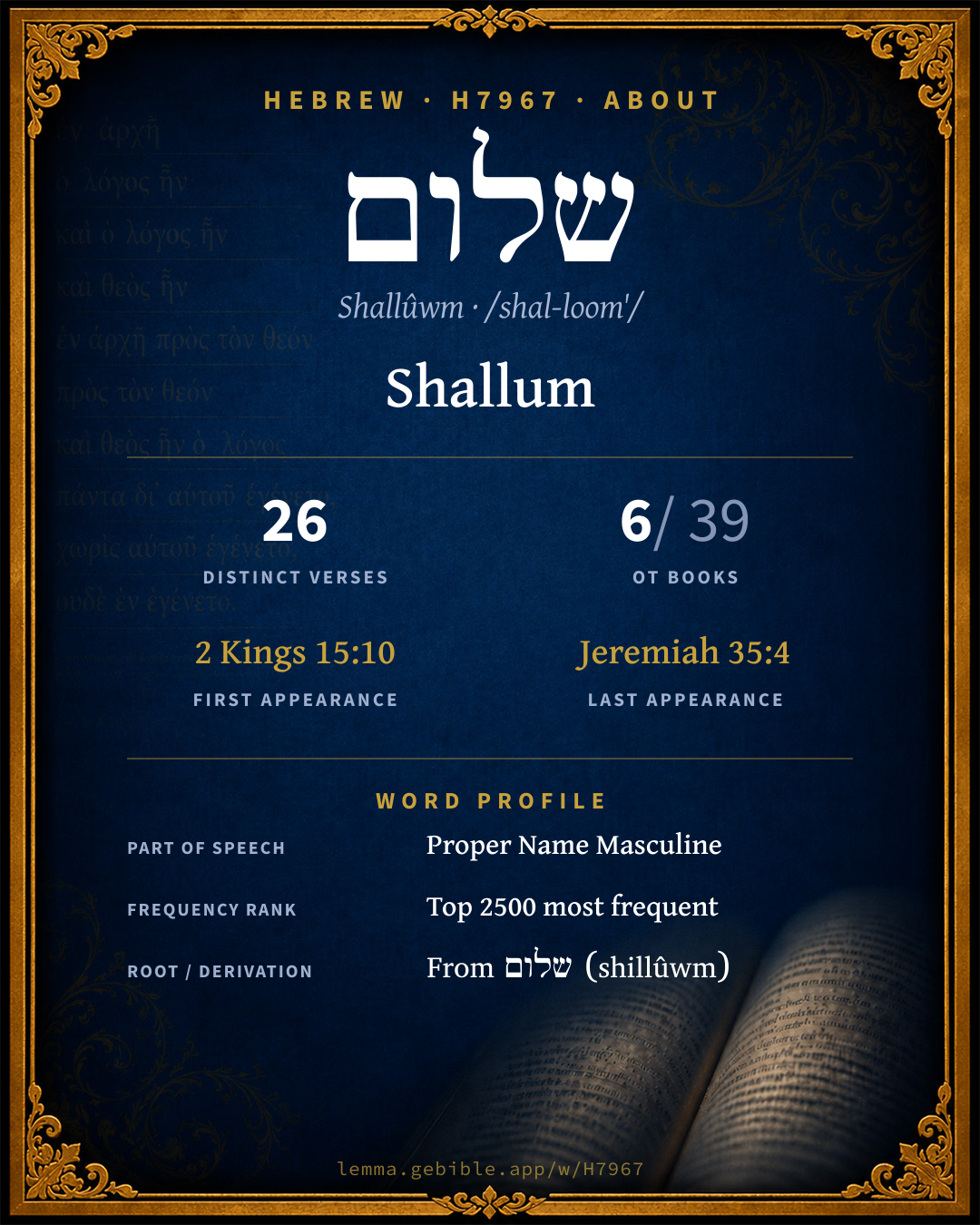
שַׁלּוּם
Shallum
BDB lists 10 entries for ‘Shallum’ fuller range ↓
Full lexicon entry — Brown-Driver-Briggs (BDB)
From Brown-Driver-Briggs (BDB)
Where this word appears
Grammar key — what these labels mean
Part of speech
- Noun
- A naming word — a person, place, thing, or idea.
Noun type
- Proper
- A name of a specific person, place, or people (e.g. Abraham, Zion, Israel).
Every verse where H7967 appears in the Book of Nehemiah — 2 distinct verses. Click any verse to open its interlinear word-by-word view. Verse text shown in the World English Bible for context — . Each verse’s Hebrew form is shown with its reference; the English is not keyword-highlighted, since the data carries no word-level English alignment. Use “Compare translations” on any verse to read it across multiple English versions. This concordance covers the Hebrew Bible; Septuagint (Greek Old Testament) occurrences are not indexed here.
Nehemiah
- Nehemiah 3:12 שַׁלּוּם֙ n Proper Next to him repaired Shallum the son of Hallohesh, the ruler of half the district of Jerusalem, he and his daughters.
- Nehemiah 7:45 שַׁלּ֤וּם n Proper The porters: the children of Shallum, the children of Ater, the children of Talmon, the children of Akkub, the children of Hatita, the children of Shobai, one hundred thirty-eight.
About this entry
At a glance — auto-summarized from this page’s data, not written by a person. Every figure links to its source below. This summary describes the numbers; it doesn’t interpret them.
The Hebrew name שלום centers on the idea of “Shallum.” Its earliest occurrence is 2 Kings 15:10. Spanning 26 verses in 6 books, it ranks among the moderately common words of the Hebrew Bible. 1 Chronicles dominates its distribution — 10 of 26 verses. Dig into 26-verse concordance and the renderings breakdown below.
Gloss history
Strong's 1890 vs modern scholarship
About this word
Strong's H7967 catalogs a Hebrew word from the Hebrew Old Testament.
These counts are not copied from any lexicon or concordance. They are computed here, from the morphology-tagged Hebrew Old Testament. What Lemma adds →
- 26
- distinct verses
- The word appears in 26 distinct verses.
- 6 / 39
- OT books
- The word appears in 6 of 39 Old Testament books.
- #1,226
- by frequency
- Top 2500 most frequent Hebrew words (rank 1,226 of 8,640 Hebrew words by occurrence).
View all 26 occurrences in the concordance →
Most concentrated in
- 1 Chronicles 10 verses 38%
- 2 Kings 5 verses 19%
- Ezra 4 verses 15%
By section of the Old Testament
By traditional corpus
Conventional, traditional groupings — biblical authorship is debated, so this is a traditional corpus grouping, not an authorship claim. Each share is this word’s portion of its verses in that division of the Hebrew canon. Each figure is a share of the word’s 26 distinct verses.
- Writings (Ketuvim) 18 verses · 69%
- Prophets (Nevi'im) 8 verses · 31%
How translations render this word
Counts come from each version’s own published word-to-Strong’s tagging or interlinear alignment — an approximate guide to how each version renders this word, not a word-level alignment the data otherwise carries. Because each total is that version’s own tagged count, the per-version totals vary from one another and need not match the appearance or distinct-verse counts above. These counts may also differ from a printed concordance because Lemma counts each distinctly tagged rendering and does not collapse phrase taggings into a single head-word total. This is a fixed set of word-tagged versions (KJV, ASV, BSB, ULT) and does not change with the reading translation you choose elsewhere. Each version’s license is shown beside its name below (and on Sources).
- King James Version: Shallum 26×
- American Standard Version: Shallum 27×
- Berean Standard Bible: Shallum 27×
- unfoldingWord Literal Text: Shallum 24×
King James Version Public Domain
Renders H7967 across 27 tagged occurrences — most commonly:
Plus 1 rendering that appears only once — usually multi-word phrases or single function words the recovered tagging swept in, not distinct renderings.
American Standard Version Public Domain
Renders H7967 across 27 tagged occurrences — most commonly:
Berean Standard Bible Public Domain
Renders H7967 across 27 tagged occurrences — most commonly:
unfoldingWord Literal Text CC BY-SA 4.0
Renders H7967 across 25 tagged occurrences — most commonly:
Plus 1 rendering that appears only once — usually multi-word phrases or single function words the recovered tagging swept in, not distinct renderings.
15 senses and sub-senses in the full BDB
What do BDB’s symbols mean?
BDB uses these scholarly abbreviations:
| Symbol | Meaning |
|---|---|
| 𝔊 | the Septuagint (the ancient Greek translation, LXX) |
| 𝔙 | the Vulgate (the Latin translation) |
| 𝔖 | the Syriac version (the Peshitta) |
| 𝔗 | the Targum (the Aramaic translation) |
| ψ | the Psalms |
| √ | root (the underlying root or stem) |
| ‖ | parallel passage (a synonymous or contrasted parallel) |
| † | the dagger: every passage where the word occurs is cited |
The 15 senses and sub-senses the full Brown-Driver-Briggs lexicon distinguishes for this word, in lexicon order (not ranked by frequency), with BDB’s own verbatim wording and sub-sense lettering. Shown in Hebrew script with BDB’s own scholarly abbreviations. The condensed entry is in the Lexicon Entry tab. See also the Forms in the corpus table below.
- 1. king of N. Israel 2 K 15:10, 13, 14, 15. e.g. 2 Kings 15:10
- 2. son of Josiah, and king of Judah Je 22:11; 1 Ch 3:15 = יְהוֹאָחָז 1, v. p. 219. e.g. Jeremiah 22:11
- 3. husband of Huldah 2 K 22:14 = 2 Ch 34:22, B 𝔊L Σελλημ, A -λουμ. e.g. 2 Kings 22:14
- 4. uncle of Jeremiah Je 32:7. e.g. Jeremiah 32:7
- 5. in Simeon 1 Ch 4:25. e.g. 1 Chronicles 4:25
- 6. in Jerahmeel 2:40, 41. e.g. 1 Chronicles 2:40
- 7. in Ephr. 2 Ch 28:12. e.g. 2 Chronicles 28:12
- 8. in Napht. 1 Ch 7:13. e.g. 1 Chronicles 7:13
- 9. father of a threshold keeper Je 35:4. e.g. Jeremiah 35:4
- 10. wall-builder Ne 3:12. e.g. Nehemiah 3:12
- 11. priests 1 Ch 5:38, 39; Ezr 7:2 (ancestor of Ezra, perhaps = מְשֻׁלָּם 7 a). e.g. 1 Chronicles 5:38
- 12. Levits:
- a. 1 Ch 9:17(×2), perhaps = v 19, 31, and Ezr 2:42 ‖ Ne 7:45 (= שֶׁלֶמְיָה 2, מְשֻׁלָּם 8 c, (מְשֶׁלֶמְיָה(וּ)). e.g. 1 Chronicles 9:17
- b. Ezr 10:24. e.g. Ezra 10:24
- 13. v 42 below. e.g. Ezra 10:42
Senses from the full Brown-Driver-Briggs lexicon (Brown, Driver, Briggs; Oxford 1906 — public domain), digitized via Sefaria, supplemented by the OpenScriptures HebrewLexicon (CC BY 4.0). Full attribution on Sources.
Word origin
(less often שַׁלֻּם) n.pr.m. Σελ(λ)ουμ, Σαλ(λ)ουμ, Σελλημ, etc.;—
— Brown-Driver-Briggs (Oxford 1906, public domain), digitized via Sefaria, supplemented by the OpenScriptures HebrewLexicon (CC BY 4.0). See Sources.
Derived from שלום (shillûwm) (H7966) — reward.
Jastrow Dictionary
A second Hebrew/Aramaic lexicon for comparison, covering Aramaic and post-biblical (Talmudic, Targumic, Midrashic) usage that the biblical-Hebrew BDB does not. Matched by lemma rather than by Strong’s number, so a lemma may carry more than one Jastrow headword (shown separately below), and the entries cover usage well beyond the Bible.
שָׁלוֹם I
- 1. peace, salvation; salutation. Lev. R. s. 9 גדול ש׳ … חותמין בש׳ peace is something great, for all benedictions, good tidings, and consolations … close with peace. Num. R. s. 21, beg. אין כלי … אלא ש׳ no vessel contains blessing but peace; Ukts. III, 12, a. e., v. חָזַק. Ber. 14ᵃ משיב ש׳ וכ׳ may return a salutation to any person. Ib. כל הנותן ש׳ וכ׳ he who offers salutation to his neighbor before prayer, is considered as if he made him a highplace (worshipping man before God). Shebi. IV, 3 ושואלין בשְׁלוֹמָן מפני דרכי ש׳ and you must salute them (gentiles in the field) &c., v. דֶּרֶךְ; Y. ib. 35ᵇ מהו שואלין בשלומן בשְׁלוֹם ישראל ש׳ עליכם how must we salute them? As we salute Israelites, ‘peace be upon you.’ Tam. I, 3 הגיעו … אמרו ש׳ הכל ש׳ when they (the two parties patrolling the Temple) met, they said, ‘peace?’ (answer) ‘all peace’ (everything is in good order); Lev. R. l. c. Sifra Vayikra, Par. 13, ch. XVI מי שהוא ש׳ וכ׳ he who is at peace offers peace-offerings, opp. אונן; v. שָׁלֵם. Ib. the peace-offerings are called sh’lamim, שהכל ש׳ בהן because everything in them is at peace (is turned to use; Yalk. Lev. 458 מְשׁוּלָּמִים). Ber. 39ᵇ (play on the name שלמן) ש׳ אתה וכ׳ thou art peace (perfection), and thy teaching is perfect (v. שָׁלֵם); a. v. fr.—חס וש׳, v. חַס.
- 2. (adv.) safely, unimpaired. T’bul Yom IV, 7, a. e. שתעלה ש׳ that it will be brought up safely, v. שֶׁבֶר I.—Pl. שְׁלוֹמוֹת. Num. R. s. 1316 עושה שני ש׳ וכ׳ produces two conditions of peace, peace above and peace below. Yalk. Is. 340 ארבעה רוב ש׳ וכ׳ (not שלומית) four times in the Scriptures ‘peace’ appears in connection with ‘abundance.’—Ch. v. שְׁלָמָא.
שָׁלוֹם II
- אִימָּא ש׳ Imma (Mother) Shalom, wife of R. Eliezer. Y. Shebi. VI, 36ᶜ top. Erub. 63ᵃ; a. fr.
שִׁלּוּם
- , v. שִׁילּוּם
שַׁלּוּם
- (b. h.) pr. n. m. Shallum,
- 1. husband of Huldah the prophetess. Meg. 14ᵇ (counted among the prophets). Yalk. Kings 233.
- 2. name of several Amoraim. Lev. R. s. 26 רב ש׳. Pesik. R. s. 3 יהודה הלוי ברבי ש׳; ib. s. 5; a. fr.
A Dictionary of the Targumim, the Talmud Babli and Yerushalmi, and the Midrashic Literature (Marcus Jastrow; London, Luzac, 1903) — Public Domain. Digitized via Sefaria. Digitized via Sefaria. Full attribution on Sources.
Forms in the corpus
The 17 distinct written forms H7967 takes in the Hebrew Bible, most frequent first — each parse links to that state’s occurrences in the concordance. Hebrew forms include their vowel points and cantillation, so a single lemma takes many written forms.
| Form | Parsing | Example | Uses |
|---|---|---|---|
| שַׁלּ֤וּם | Noun, Proper | Ezra 2:42 | 3 |
| שַׁלּ֥וּם | Noun, Proper | Ezra 7:2 | 3 |
| שַׁלֻּ֣ם | Noun, Proper | 2 Chronicles 34:22 | 3 |
| שַׁלּֽוּם | Noun, Proper | 1 Chronicles 2:40 | 3 |
| וְ/שַׁלּוּם֙ | Noun, Proper | 1 Chronicles 2:41 | 2 |
| שַׁלֻּ֥ם | Noun, Proper | Ezra 10:24 | 2 |
| וְ/שַׁלּ֖וּם | Noun, Proper | 1 Chronicles 7:13 | 1 |
| וְ/שַׁלּ֣וּם | Noun, Proper | 1 Chronicles 9:19 | 1 |
| לְ/שַׁלֻּ֣ם | Noun, Proper | 1 Chronicles 9:31 | 1 |
| שַׁלּ֔וּם | Noun, Proper | 2 Kings 15:15 | 1 |
| שַׁלּ֖וּם | Noun, Proper | 1 Chronicles 9:17 | 1 |
| שַׁלּ֣וּם | Noun, Proper | 1 Chronicles 9:17 | 1 |
| שַׁלֻּ֔ם | Noun, Proper | 2 Chronicles 28:12 | 1 |
| שַׁלֻּ֖ם | Noun, Proper | Jeremiah 35:4 | 1 |
| שַׁלֻּ֨ם | Noun, Proper | Jeremiah 22:11 | 1 |
| שַׁלֻּם֙ | Noun, Proper | Jeremiah 32:7 | 1 |
| שַׁלּוּם֙ | Noun, Proper | Nehemiah 3:12 | 1 |
Same root — word family
Other BDB entries built from the same root as H7967, grouped by Strong’s listed origin. These share a root / origin per the lexicon — not necessarily a shared meaning. Each links to that word’s own entry.
Derives from
Shares the same root
Proper names from this root
People and places named from this root — a name, not an additional meaning of the word.
Compare all same-root words → 1 of the same-root words is a proper name (a person or place). They share a root, not necessarily a meaning.
Bible dictionary
Public-domain dictionary articles matched to this entry by name (Shallum). A biblical name can be shared by more than one person or place, so an article may treat several.
Easton's Bible Dictionary · M. G. Easton, 1897
Retribution. (1.) The son of Jabesh, otherwise unknown. He "conspired against Zachariah, and smote him before the people, and slew him, and reigned in his stead" (2 Kings 15:10). He reigned only "a month of days in Samaria" (15:13, marg.). Menahem rose up against Shallum and put him to death (2 Kings 15:14, 15, 17), and became king in his stead.
(2.) Keeper of the temple vestments in the reign of Josiah (2 Kings 22:14).
(3.) One of the posterity of Judah (1 Chr. 2:40, 41).
(4.) A descendant of Simeon (1 Chr. 4:25).
(5.) One of the line of the high priests (1 Chr. 6:13).
(6.) 1 Chr. 7:13.
(7.) A keeper of the gate in the reign of David (1 Chr. 9:17).
(8.) A Levite porter (1 Chr. 9:19, 31; Jer. 35:4).
(9.) An Ephraimite chief (2 Chr. 28:12).
(10.) The uncle of the prophet Jeremiah (Jer. 32:7).
(11.) A son of king Josiah (1 Chr. 3:15; Jer. 22:11), who was elected to succeed his father on the throne, although he was two years younger than his brother Eliakim. He assumed the crown under the name of Jehoahaz (q.v.). He did not imitate the example of his father (2 Kings 23:32), but was "a young lion, and it learned to catch the prey; it devoured men" (Ezek. 19:3). His policy was anti-Egyptian therefore. Necho, at that time at Riblah, sent an army against Jerusalem, which at once yielded, and Jehoahaz was carried captive to the Egyptian camp, Eliakim being appointed king in his stead. He remained a captive in Egypt till his death, and was the first king of Judah that died in exile.
Smith's Bible Dictionary · William Smith, 1863
(retribution).
+ The fifteenth king of Israel, son of Jabesh, conspired against Zachariah, killed him, and brought the dynasty of Jehu to a close, B.C. 770. Shallum, after reigning in Samaria for a month only, was in his turn dethroned and killed by Menahem. (2 Kings 15:10-14) + The husband of Huldah the prophetess, (2 Kings 22:14; 2 Chronicles 34:23) in the reign of Josiah. (B.C. 830.) + A descendant of Shesham. (1 Chronicles 2:40,41) + The third son of Josiah king of Judah, known in the books of Kings and Chronicles as Jehoahaz. (1 Chronicles 3:15; Jeremiah 22:11) [Jehoahaz] (B.C. 610.) + Son of Shaul the son of Simeon. (1 Chronicles 4:25) + A high priest. (1 Chronicles 6:12,13; Ezra 7:2) + A son of Naphtali. (1 Chronicles 7:13) + The chief of a family of porters or gate-keepers of the east gate of the temple. (1 Chronicles 9:17) (B.C. 1050.) + Son of Kore, a Korahite. (1 Chronicles 9:19,31) + Father of Jehizkiah, an Ephraimite. (2 Chronicles 28:12) + One of the porters of the temple who had married a foreign wife. (Ezra 10:24) + One of the sons of Bani. (Ezra 10:42) + The son of Halohesh and ruler of a district of Jerusalem. (Nehemiah 3:12) + The uncle of Jeremiah, (Jeremiah 32:7) perhaps the same as 2. + Father or ancestor of Maaseiah (Jeremiah 35:4) perhaps the same as 9. (B.C. 630.)
Hitchcock's Bible Names Dictionary · Roswell D. Hitchcock, 1869
perfect; agreeable
Classic public-domain reference works; full attribution on Sources.
Septuagint verse parallels
This word appears in 24 verses that also exist in the Greek Old Testament (Septuagint), out of the 26 Hebrew verses it occurs in. You can read those verses in Greek by switching the Old Testament edition to the Septuagint.
Read these verses in the Septuagint
This is a verse-level parallel only — the same verses exist in both the Hebrew and Greek Old Testaments. No word-level Hebrew↔Greek correspondence is claimed: the data carries no such alignment, so no Greek word is shown as this Hebrew word’s translation. Coverage is not total — the Septuagint omits the deuterocanon and renumbers the Psalms, so some Hebrew verses have no direct Greek parallel.