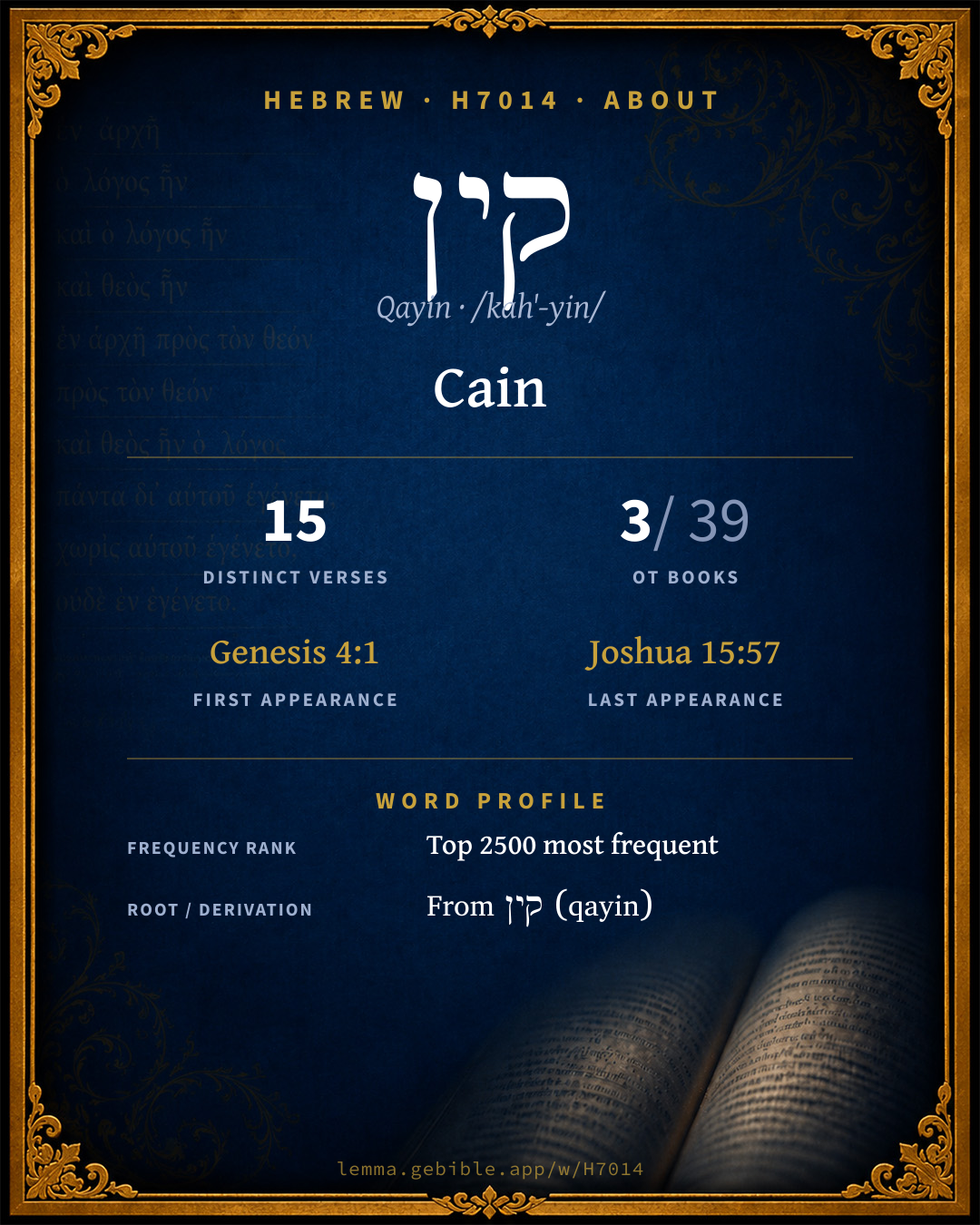
קַ֫יִן
Cain
BDB lists 3 entries for ‘Cain’ fuller range ↓
Full lexicon entry — Brown-Driver-Briggs (BDB)
From Brown-Driver-Briggs (BDB)
Where this word appears
Grammar key — what these labels mean
Part of speech
- Noun
- A naming word — a person, place, thing, or idea.
Noun type
- Proper
- A name of a specific person, place, or people (e.g. Abraham, Zion, Israel).
Every verse where H7014 appears in the Book of Genesis — 13 distinct verses. Click any verse to open its interlinear word-by-word view. Verse text shown in the World English Bible for context — . Each verse’s Hebrew form is shown with its reference; the English is not keyword-highlighted, since the data carries no word-level English alignment. Use “Compare translations” on any verse to read it across multiple English versions. This concordance covers the Hebrew Bible; Septuagint (Greek Old Testament) occurrences are not indexed here.
Genesis
- Genesis 4:1 קַ֔יִן n Proper The man knew Eve his wife. She conceived, and gave birth to Cain, and said, "I have gotten a man with Yahweh's help."
- Genesis 4:2 וְ/קַ֕יִן conj + n Proper Again she gave birth, to Cain's brother Abel. Abel was a keeper of sheep, but Cain was a tiller of the ground.
- Genesis 4:3 קַ֜יִן n Proper As time passed, it happened that Cain brought an offering to Yahweh from the fruit of the ground.
- Genesis 4:5 קַ֥יִן לְ/קַ֨יִן֙ n Proper prep + n Proper but he didn't respect Cain and his offering. Cain was very angry, and the expression on his face fell.
- Genesis 4:6 קָ֑יִן n Proper Yahweh said to Cain, "Why are you angry? Why has the expression of your face fallen?
- Genesis 4:8 קַ֖יִן קַ֛יִן n Proper n Proper Cain said to Abel, his brother, "Let's go into the field." It happened, when they were in the field, that Cain rose up against Abel, his brother, and killed him.
- Genesis 4:9 קַ֔יִן n Proper Yahweh said to Cain, "Where is Abel, your brother?" He said, "I don't know. Am I my brother's keeper?"
- Genesis 4:13 קַ֖יִן n Proper Cain said to Yahweh, "My punishment is greater than I can bear.
- Genesis 4:15 קַ֔יִן לְ/קַ֨יִן֙ n Proper prep + n Proper Yahweh said to him, "Therefore whoever slays Cain, vengeance will be taken on him sevenfold." Yahweh appointed a sign for Cain, lest any finding him should strike him.
- Genesis 4:16 קַ֖יִן n Proper Cain went out from Yahweh's presence, and dwelt in the land of Nod, on the east of Eden.
- Genesis 4:17 קַ֨יִן֙ n Proper Cain knew his wife. She conceived, and gave birth to Enoch. He built a city, and called the name of the city, after the name of his son, Enoch.
- Genesis 4:24 קָ֑יִן n Proper If Cain will be avenged seven times, Truly Lamech seventy-seven times."
- Genesis 4:25 קָֽיִן n Proper Adam knew his wife again. She gave birth to a son, and named him Seth. For, she said, "God has appointed me another child instead of Abel, for Cain killed him."
About this entry
At a glance — auto-summarized from this page’s data, not written by a person. Every figure links to its source below. This summary describes the numbers; it doesn’t interpret them.
קין (Qayin) is a Hebrew name most often rendered “Cain.” Genesis dominates its distribution — 13 of 15 verses. The Hebrew Bible uses it across 15 verses — uncommon. Debuting at Genesis 4:1, it then recurs through the corpus. For the data behind this summary, explore 15-verse concordance and the renderings breakdown below.
Gloss history
Strong's 1890 vs modern scholarship
About this word
Strong's H7014 catalogs a Hebrew word from the Hebrew Old Testament.
These counts are not copied from any lexicon or concordance. They are computed here, from the morphology-tagged Hebrew Old Testament. What Lemma adds →
- 15
- distinct verses
- The word appears in 15 distinct verses.
- 3 / 39
- OT books
- The word appears in 3 of 39 Old Testament books.
- #1,612
- by frequency
- Top 2500 most frequent Hebrew words (rank 1,612 of 8,640 Hebrew words by occurrence).
View all 15 occurrences in the concordance →
By section of the Old Testament
By traditional corpus
Conventional, traditional groupings — biblical authorship is debated, so this is a traditional corpus grouping, not an authorship claim. Each share is this word’s portion of its verses in that division of the Hebrew canon. Each figure is a share of the word’s 15 distinct verses.
- Torah (Pentateuch) 14 verses · 93%
- Prophets (Nevi'im) 1 verse · 7%
How translations render this word
Counts come from each version’s own published word-to-Strong’s tagging or interlinear alignment — an approximate guide to how each version renders this word, not a word-level alignment the data otherwise carries. Because each total is that version’s own tagged count, the per-version totals vary from one another and need not match the appearance or distinct-verse counts above. These counts may also differ from a printed concordance because Lemma counts each distinctly tagged rendering and does not collapse phrase taggings into a single head-word total. This is a fixed set of word-tagged versions (KJV, ASV, BSB, ULT) and does not change with the reading translation you choose elsewhere. Each version’s license is shown beside its name below (and on Sources).
BDB lists this Strong’s number as 3 distinct words (homographs). Each count above pools all of them and is not split by sense — see the Senses section below. A low-frequency rendering may belong to a different one of those words, not the primary meaning.
- King James Version†: Cain 16×
- American Standard Version†: Cain 14×
- Berean Standard Bible†: Cain 16×, Kain 2×
- unfoldingWord Literal Text†: Cain 16×
King James Version Public Domain
Renders H7014 across 18† tagged occurrences — most commonly:
Plus 2 renderings that appear only once — usually multi-word phrases or single function words the recovered tagging swept in, not distinct renderings.
American Standard Version Public Domain
Renders H7014 across 18† tagged occurrences — most commonly:
Plus 4 renderings that appear only once — usually multi-word phrases or single function words the recovered tagging swept in, not distinct renderings.
Berean Standard Bible Public Domain
Renders H7014 across 19† tagged occurrences — most commonly:
Plus 1 rendering that appears only once — usually multi-word phrases or single function words the recovered tagging swept in, not distinct renderings.
unfoldingWord Literal Text CC BY-SA 4.0
Renders H7014 across 18† tagged occurrences — most commonly:
Plus 2 renderings that appear only once — usually multi-word phrases or single function words the recovered tagging swept in, not distinct renderings.
Senses in the full BDB
What do BDB’s symbols mean?
BDB uses these scholarly abbreviations:
| Symbol | Meaning |
|---|---|
| 𝔊 | the Septuagint (the ancient Greek translation, LXX) |
| 𝔙 | the Vulgate (the Latin translation) |
| 𝔖 | the Syriac version (the Peshitta) |
| 𝔗 | the Targum (the Aramaic translation) |
| ψ | the Psalms |
| √ | root (the underlying root or stem) |
| ‖ | parallel passage (a synonymous or contrasted parallel) |
| † | the dagger: every passage where the word occurs is cited |
The 2 senses and sub-senses the full Brown-Driver-Briggs lexicon distinguishes for this word, in lexicon order (not ranked by frequency), with BDB’s own verbatim wording and sub-sense lettering. Shown in Hebrew script with BDB’s own scholarly abbreviations. The condensed entry is in the Lexicon Entry tab. See also the Forms in the corpus table below.
קין I [m.] spear 𝔊 and most
קין II
- 1. gent. (v. StaG i. 131 f. MeyEntstehung 115; cf. Arabic n.pr.fam. قَيْن; Nab. Sin. n.pr.m. et. f. קינו; tribe of smiths?);—tribe of Moses’ father-in-law Ju 4:11 (cf. קֵינִי 1:16), Καινα, 𝔊L Κειν; akin to Midian (Nu 10:29 P), settled among Amal. in S. of Canaan (v. קֵינִי); prophesied against by Balaam Nu 24:22 (קָ֑יִן; JE);—v. also קֵינִי. e.g. Judges 4:11
- 2. loc. הַקַּ֫יִן, in S. Judah (a settlement of ii. ק׳ 1?);—Jos 15:57, [Ζακαν]αειμ, A [Ζανω] Ακειμ, 𝔊L [Ζανου] Ακεν; poss. = Ẏŭḳîn SE. from Hebron [RobBR ii. 85] (v. BuhlGeogr. 162 f. who, however, cp. קִינָה v 22). e.g. Joshua 15:57
קין III m. Cain, Καιν, eldest son of Adam and Eve (expl. Gn 4
Senses from the full Brown-Driver-Briggs lexicon (Brown, Driver, Briggs; Oxford 1906 — public domain), digitized via Sefaria, supplemented by the OpenScriptures HebrewLexicon (CC BY 4.0). Full attribution on Sources.
Word origin
I. n.[m.] spear 𝔊 and most;—sf. קֵינוֹ 2 S 21:16; קוֹבָעוֹ (cf. 1 S 17:38) Klo Bu HPS al.
III. n.pr.m. Cain, Καιν, eldest son of Adam and Eve (expl. Gn 4:1 from קָנָה acquire; but in fact = ii. ק׳, as heros eponymos, according to WeComp. 11 StaG 285 ff. BuUrg. 193 Holz Gn 50 f. especially StaZAW xiv (1894), 250 ff.; xv (1895), 157 ff., CheEncy. Bib. cain);—ק׳ Gn 4:1, 2, 3, 5(×2), 8(×2), 9, 13, 15(×2), 16, 17, קָ֑יִן v 6, 24, 25 (all J).
— Brown-Driver-Briggs (Oxford 1906, public domain), digitized via Sefaria, supplemented by the OpenScriptures HebrewLexicon (CC BY 4.0). See Sources.
Derived from קין (qayin) (H7013) — spear.
Jastrow Dictionary
A second Hebrew/Aramaic lexicon for comparison, covering Aramaic and post-biblical (Talmudic, Targumic, Midrashic) usage that the biblical-Hebrew BDB does not. Matched by lemma rather than by Strong’s number, so a lemma may carry more than one Jastrow headword (shown separately below), and the entries cover usage well beyond the Bible.
קוּן
- to arrange, order, plan (applied to art, cmp. חָרַשׁ; to music, v. קִינָה).
- to arrange a song of lamentation (ḳinah, cmp. קשר הספד, v. הֶסְפֵּד). Gitt. 58ᵃ עליה ק׳ ירמיהו וכ׳ on her account Jeremiah sang &c. Ib. ועליהן קינה וכ׳ (corr. acc.; v. En Yaʿăḳob). Lam. R. introd. (R. Naḥman) התחיל … מְקוֹנֵן עליהם איכה Jeremiah began to sing Ekhah (Lam. I, 1) over them. Ib. (R. Pinḥas) הרי … מקונן עליכם קינות וכ׳ behold, Jeremiah will sing lamentations of seven alphabets (of) Ekhah over you. M. Kat. III, 9 אבל לא מְקוֹנְנוֹת but they (the lamenting women) must not sing dirges, v. קִינָה a. עִינּוּי I; a. fr. e.g. Lamentations 1:1
קַיִן
- (b. h.) Cain, son of Adam. Snh. IV, 5 שכן מצינו בק׳ וכ׳ for so we find with reference to Cain when he had killed his brother &c. Ib. 37ᵇ מלמד שעשה ק׳ וכ׳ this use of the plural (דמי, Gen. IV, 10) shows that C. inflicted many wounds and bruises on his brother &c. Gen. R. s. 2 ובהו זה ק׳ וכ׳ ‘and void’ (Gen. I, 2), this refers to Cain who intended to reduce the world to waste and voidness; a. v. fr. e.g. Genesis 4:10
*קִין
- , Pa. קַיֵּין (v. קוּן) to arrange, shape. Gen. R. s. 23 קַיְּנָן קנתורין Ar., v. קִינְטוֹר.
קתליכוס
- , v. קָתוֹלִיקוֹס
A Dictionary of the Targumim, the Talmud Babli and Yerushalmi, and the Midrashic Literature (Marcus Jastrow; London, Luzac, 1903) — Public Domain. Digitized via Sefaria. Digitized via Sefaria. Full attribution on Sources.
Forms in the corpus
The 11 distinct written forms H7014 takes in the Hebrew Bible, most frequent first — each parse links to that state’s occurrences in the concordance. Hebrew forms include their vowel points and cantillation, so a single lemma takes many written forms.
| Form | Parsing | Example | Uses |
|---|---|---|---|
| קַ֔יִן | Noun, Proper | Genesis 4:1 | 3 |
| קַ֖יִן | Noun, Proper | Genesis 4:8 | 3 |
| קָ֑יִן | Noun, Proper | Genesis 4:6 | 3 |
| לְ/קַ֨יִן֙ | Noun, Proper | Genesis 4:5 | 2 |
| הַ/קַּ֖יִן | Noun, Proper | Joshua 15:57 | 1 |
| וְ/קַ֕יִן | Noun, Proper | Genesis 4:2 | 1 |
| קַ֛יִן | Noun, Proper | Genesis 4:8 | 1 |
| קַ֜יִן | Noun, Proper | Genesis 4:3 | 1 |
| קַ֥יִן | Noun, Proper | Genesis 4:5 | 1 |
| קַ֨יִן֙ | Noun, Proper | Genesis 4:17 | 1 |
| קָֽיִן | Noun, Proper | Genesis 4:25 | 1 |
Same root — word family
Other BDB entries built from the same root as H7014, grouped by Strong’s listed origin. These share a root / origin per the lexicon — not necessarily a shared meaning. Each links to that word’s own entry.
Derives from
Proper names from this root
People and places named from this root — a name, not an additional meaning of the word.
Compare all same-root words → 2 of the same-root words are proper names (people or places). They share a root, not necessarily a meaning.
Bible dictionary
Public-domain dictionary articles matched to this entry by name (Cain). A biblical name can be shared by more than one person or place, so an article may treat several.
Easton's Bible Dictionary · M. G. Easton, 1897
A possession; a spear. (1.) The first-born son of Adam and Eve (Gen. 4). He became a tiller of the ground, as his brother Abel followed the pursuits of pastoral life. He was "a sullen, self-willed, haughty, vindictive man; wanting the religious element in his character, and defiant even in his attitude towards God." It came to pass "in process of time" (marg. "at the end of days"), i.e., probably on the Sabbath, that the two brothers presented their offerings to the Lord. Abel's offering was of the "firstlings of his flock and of the fat," while Cain's was "of the fruit of the ground." Abel's sacrifice was "more excellent" (Heb. 11:4) than Cain's, and was accepted by God. On this account Cain was "very wroth," and cherished feelings of murderous hatred against his brother, and was at length guilty of the desperate outrage of putting him to death (1 John 3:12). For this crime he was expelled from Eden, and henceforth led the life of an exile, bearing upon him some mark which God had set upon him in answer to his own cry for mercy, so that thereby he might be protected from the wrath of his fellow-men; or it may be that God only gave him some sign to assure him that he would not be slain (Gen. 4:15). Doomed to be a wanderer and a fugitive in the earth, he went forth into the "land of Nod", i.e., the land of "exile", which is said to have been in the "east of Eden," and there he built a city, the first we read of, and called it after his son's name, Enoch. His descendants are enumerated to the sixth generation. They gradually degenerated in their moral and spiritual condition till they became wholly corrupt before God. This corruption prevailed, and at length the Deluge was sent by God to prevent the final triumph of evil. (See ABEL.)
(2.) A town of the Kenites, a branch of the Midianites (Josh. 15:57), on the east edge of the mountain above Engedi; probably the "nest in a rock" mentioned by Balaam (Num. 24:21). It is identified with the modern Yekin, 3 miles south-east of Hebron.
Smith's Bible Dictionary · William Smith, 1863
one of the cities in the low country of Judah, named with Zanoah and Gibeah. (Joshua 15:57)
(possession). Gen. 4. He was the eldest son of Adam and Eve; he followed the business of agriculture. In a fit of jealousy, roused by the rejection of his own sacrifice and the acceptance of Abel's, he committed the crime of murder, for which he was expelled from Eden, and led the life of an exile. He settled in the land of Nod, and built a city, which he named after his son Enoch. His descendants are enumerated together with the inventions for which they were remarkable. (B.C. 4000.)
Hitchcock's Bible Names Dictionary · Roswell D. Hitchcock, 1869
possession, or possessed
Classic public-domain reference works; full attribution on Sources.
Septuagint verse parallels
This word appears in 15 verses that also exist in the Greek Old Testament (Septuagint), out of the 15 Hebrew verses it occurs in. You can read those verses in Greek by switching the Old Testament edition to the Septuagint.
Read these verses in the Septuagint
This is a verse-level parallel only — the same verses exist in both the Hebrew and Greek Old Testaments. No word-level Hebrew↔Greek correspondence is claimed: the data carries no such alignment, so no Greek word is shown as this Hebrew word’s translation. Coverage is not total — the Septuagint omits the deuterocanon and renumbers the Psalms, so some Hebrew verses have no direct Greek parallel.