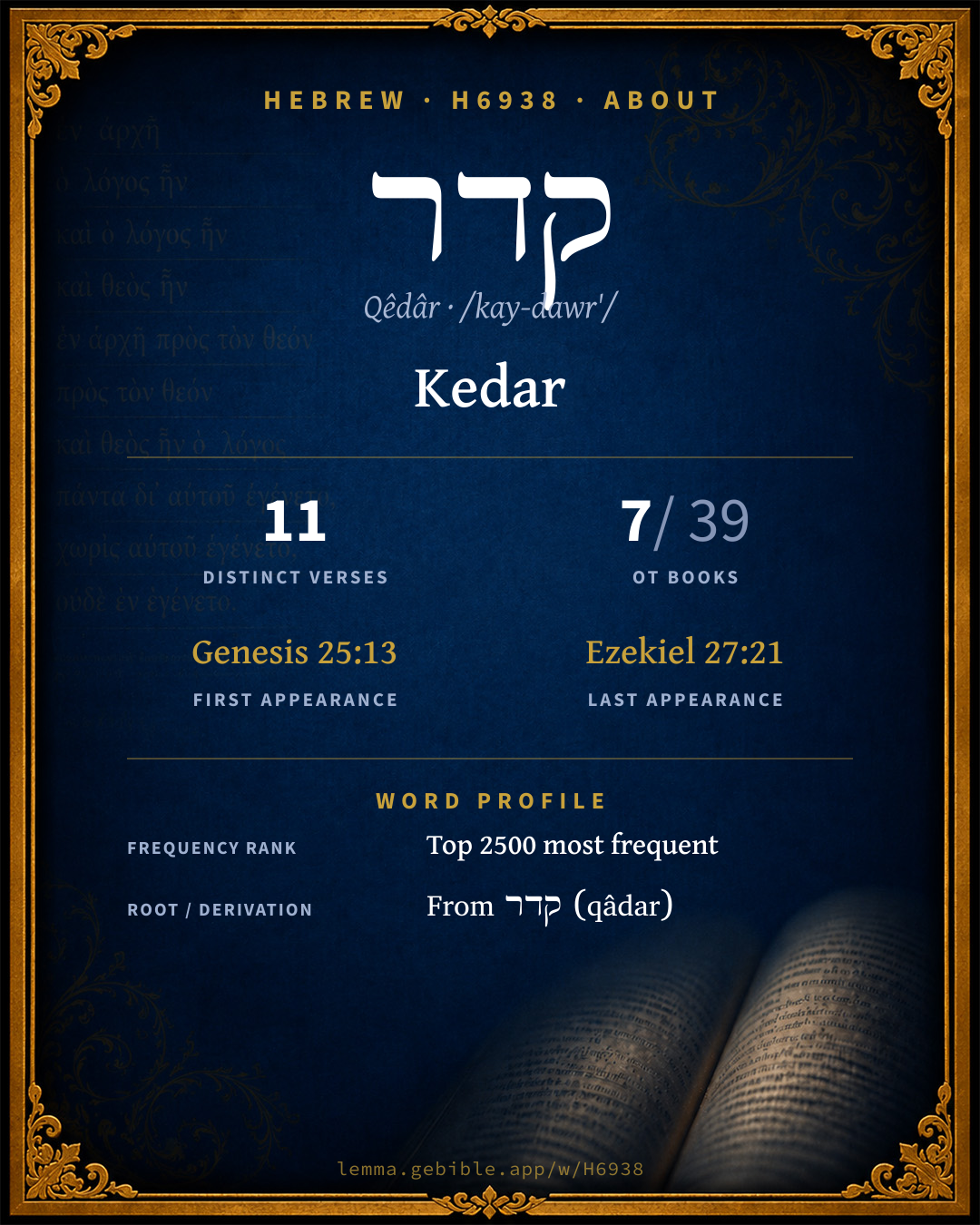
קֵדָר
Kedar
BDB lists 3 entries for ‘Kedar’ fuller range ↓
Full lexicon entry — Brown-Driver-Briggs (BDB)
From Brown-Driver-Briggs (BDB)
Where this word appears
Grammar key — what these labels mean
Part of speech
- Noun
- A naming word — a person, place, thing, or idea.
Noun type
- Proper
- A name of a specific person, place, or people (e.g. Abraham, Zion, Israel).
Every verse where H6938 appears in the Book of Song of Solomon — 1 distinct verse. Click any verse to open its interlinear word-by-word view. Verse text shown in the World English Bible for context — . Each verse’s Hebrew form is shown with its reference; the English is not keyword-highlighted, since the data carries no word-level English alignment. Use “Compare translations” on any verse to read it across multiple English versions. This concordance covers the Hebrew Bible; Septuagint (Greek Old Testament) occurrences are not indexed here.
Song of Solomon
About this entry
At a glance — auto-summarized from this page’s data, not written by a person. Every figure links to its source below. This summary describes the numbers; it doesn’t interpret them.
“Kedar” is the headline sense of the Hebrew name קדר (Qêdâr). Scripture first uses it in Genesis 25:13. With 11 verses in 7 books, it is an uncommon word in the Hebrew Bible. It concentrates in Isaiah, which alone accounts for 36% of its uses. See 11-verse concordance and the renderings breakdown below.
Gloss history
Strong's 1890 vs modern scholarship
About this word
Strong's H6938 catalogs a Hebrew word from the Hebrew Old Testament.
These counts are not copied from any lexicon or concordance. They are computed here, from the morphology-tagged Hebrew Old Testament. What Lemma adds →
- 11
- distinct verses
- The word appears in 11 distinct verses.
- 7 / 39
- OT books
- The word appears in 7 of 39 Old Testament books.
- #2,101
- by frequency
- Top 2500 most frequent Hebrew words (rank 2,101 of 8,640 Hebrew words by occurrence).
View all 11 occurrences in the concordance →
By section of the Old Testament
By traditional corpus
Conventional, traditional groupings — biblical authorship is debated, so this is a traditional corpus grouping, not an authorship claim. Each share is this word’s portion of its verses in that division of the Hebrew canon. Each figure is a share of the word’s 11 distinct verses.
- Prophets (Nevi'im) 7 verses · 64%
- Writings (Ketuvim) 3 verses · 27%
- Torah (Pentateuch) 1 verse · 9%
How translations render this word
Counts come from each version’s own published word-to-Strong’s tagging or interlinear alignment — an approximate guide to how each version renders this word, not a word-level alignment the data otherwise carries. Because each total is that version’s own tagged count, the per-version totals vary from one another and need not match the appearance or distinct-verse counts above. These counts may also differ from a printed concordance because Lemma counts each distinctly tagged rendering and does not collapse phrase taggings into a single head-word total. This is a fixed set of word-tagged versions (KJV, ASV, BSB, ULT) and does not change with the reading translation you choose elsewhere. Each version’s license is shown beside its name below (and on Sources).
- King James Version: Kedar 11×
- American Standard Version: Kedar 10×
- Berean Standard Bible: Kedar 11×
- unfoldingWord Literal Text: Kedar 10×
King James Version Public Domain
Renders H6938 across 12 tagged occurrences — most commonly:
Plus 1 rendering that appears only once — usually multi-word phrases or single function words the recovered tagging swept in, not distinct renderings.
American Standard Version Public Domain
Renders H6938 across 12 tagged occurrences — most commonly:
Plus 2 renderings that appear only once — usually multi-word phrases or single function words the recovered tagging swept in, not distinct renderings.
Berean Standard Bible Public Domain
Renders H6938 across 12 tagged occurrences — most commonly:
Plus 1 rendering that appears only once — usually multi-word phrases or single function words the recovered tagging swept in, not distinct renderings.
unfoldingWord Literal Text CC BY-SA 4.0
Renders H6938 across 11 tagged occurrences — most commonly:
Plus 1 rendering that appears only once — usually multi-word phrases or single function words the recovered tagging swept in, not distinct renderings.
Senses in the full BDB
What do BDB’s symbols mean?
BDB uses these scholarly abbreviations:
| Symbol | Meaning |
|---|---|
| 𝔊 | the Septuagint (the ancient Greek translation, LXX) |
| 𝔙 | the Vulgate (the Latin translation) |
| 𝔖 | the Syriac version (the Peshitta) |
| 𝔗 | the Targum (the Aramaic translation) |
| ψ | the Psalms |
| √ | root (the underlying root or stem) |
| ‖ | parallel passage (a synonymous or contrasted parallel) |
| † | the dagger: every passage where the word occurs is cited |
The 2 senses and sub-senses the full Brown-Driver-Briggs lexicon distinguishes for this word, in lexicon order (not ranked by frequency), with BDB’s own verbatim wording and sub-sense lettering. Shown in Hebrew script with BDB’s own scholarly abbreviations. The condensed entry is in the Lexicon Entry tab. See also the Forms in the corpus table below.
- 1. tribe of nomads in Arabic desert Is 21:16; 42:11 (c. vb. fem.), 60:7, Je 2:10; 49:28(×2); Ez 27:21; בְּנֵי־ק׳ Is 21:17; אָהֳלֵי ק׳ ψ 120:5 Ct 1:5 (made of black goat-skins JacobBeduinenleben (2), 41 or black woven stuff DoughtyArab. Des. i. 224 f.; sim. of swarthy hue). e.g. Isaiah 21:16
- 2. ancestor of 1, son of Ishmael, Gn 25:13 = 1 Ch 1:29.—Cf. Assyrian Ḳidru COT Gn 25:13, PlinNH v. 11 (12) Cedrei; also Sab. tribename קדר Hal623 (cf. DHMZMG xxxvii (1883), 14). e.g. Genesis 25:13
Senses from the full Brown-Driver-Briggs lexicon (Brown, Driver, Briggs; Oxford 1906 — public domain), digitized via Sefaria, supplemented by the OpenScriptures HebrewLexicon (CC BY 4.0). Full attribution on Sources.
Word origin
n.pr.gent. (swarthy? black-tented?); Κηδαρ:
— Brown-Driver-Briggs (Oxford 1906, public domain), digitized via Sefaria, supplemented by the OpenScriptures HebrewLexicon (CC BY 4.0). See Sources.
Derived from קדר (qâdar) (H6937) — to mourn.
Jastrow Dictionary
A second Hebrew/Aramaic lexicon for comparison, covering Aramaic and post-biblical (Talmudic, Targumic, Midrashic) usage that the biblical-Hebrew BDB does not. Matched by lemma rather than by Strong’s number, so a lemma may carry more than one Jastrow headword (shown separately below), and the entries cover usage well beyond the Bible.
קָדַר I
- (cmp. כָּדַר, גָּדַר, גָּדַד) to cut around, perforate, cut out. Sabb. 116ᵃ; Y. ib. XVI, 15ᶜ bot. קוֹדֵר (Ar. קוֹדֵד), v. אַזְכָּרָה. Snh. 103ᵇ מנשה ק׳ וכ׳ (Ar. קדר) Manasseh cut the divine names out (of the Scriptures). Kidd. 22ᵇ קוֹדֵד ויורד וכ׳ Ar. (ed. דוקד והולך) one must bore (through the slave’s ear) until the door is reached. Ḥull. 77ᵃ כל שהרופא קוֹדְרוֹ (Ar. a. Ms. M. correct. קוֹדְדוֹ, v. Rabb. D. S. a. l. note) such flesh as the physician cuts out; a. e.—Part. pass. (קָדוּד) קָדוּר. Ab. Zar. 32ᵃ (expl. עור לבוב) כל שקרוע … וק׳ וכ׳ a hide which is slit open opposite the heart and cut out like an air-hole; Tosef. ib. IV (V), 7 כל שק׳ כנגד לבו Var. ed. Zuck. (text שנקוב, oth. ed. שקרוע). Ukts. II, 4 קְדוּרָה (ed. Dehr. קְדוּדָה) cut into, opp. שלמה.
- 1. to cut through; (in measuring distances) to estimate the level distance between two places separated by mountains. Erub. V, 4 (58ᵃ) שמעתי שמְקַדְּרִין בהרים (Y. ed. Ven. שמְקַדְּדִין; v. Rabb. D. S. a. l. note 90) I have heard a tradition that in measuring Sabbath distances elevations are considered as cut through. Ib. 58ᵇ כיצד מְקַדְּרִין וכ׳ how is the measuring done to obtain the tunnel distance? He who stands below holds the rope against his heart, while he who stands above holds the other end of the rope against his feet. Ib. אין מקדרין אלא בחבל וכ׳ only a rope of four cubits can be used for measuring &c. Ib. אין מקדרין לא בעגלה וכ׳ this method of measuring distances is not applied in the case of a slain body found in the field (v. עֶגְלָה), or for cities of refuge. Tosef. ib. VI (V), 11 מְקַדֵּר ועולה מק׳ ויורד וכ׳ we go up measuring the air-line and down again (on the other side), and consider the elevation as if it were cut through before us. Erub. 58ᵃ מַקְדִּיר ועולה וכ׳; Tosef. l. c. 12 מקדר. Y. ib. V, 22ᵈ (repeatedly מְקַדְּדִין). Ib. מקדימין (corr. acc.). Y. Sot. V, 20ᵇ bot. מקדדין; Y. Macc. II, end, 32ᵃ מקדרין; a. fr.—Y. Keth. XIII, 36ᵇ top מקדר ויוצא וכ׳ he may cut his way through the vines and get out (v. פָּסַג).—[Pes. 11ᵇ מקדרין, read: מקרדין, v. קָרַד.]
- 2. (denom. of קָדֵר or קַדָּר) to make pots, pretend to be a potter. Ruth R. to I, 1 (s. 2), v. קַדָּרוּת.
- to cut through; to penetrate. Erub. 58ᵃ, v. supra. Nidd. 56ᵇ; Tosef. ib. VI, 13 מַקְדִּיר, v. גָּלַד; [perh. fr. קָדַר II, becomes dull].
- to be cut out. Ḥull. 77ᵃ נ׳ כמין טבעת (Ar. נִקְדַּד) if the flesh over a fracture is cut out like a ring. Ib. 57ᵇ רחל … שנ׳ קנה שלה וכ׳ a lamb … whose windpipe was perforated, and they inserted a tube of reed, and it recovered.
קְדַר
- , to penetrate. Men. 83ᵃ בשר אגב דשמין קָדֵיר (Ms. M. קריר, v. Rabb. D. S. a. l. note) meat being fat penetrates (the fat is communicated to an object with which it comes in contact); Zeb. 98ᵃ משום דקריר (Ms. K. דקדיר; Ms. R. 1 דקריד; v. Rabb. D. S. a. l. note 6). Ib. 79ᵇ שאני רוק דקדיר Ms. M. (ed. דקריר; Ms. R. 2 a. Ms. K. דקריד; Ms. R. 1 דקרור) it is different with saliva, because it penetrates.
- to measure level distances. Y. Bicc. I, end, 64ᵇ מאן דמְקַדֵּר וכ׳, v. שִׁגְרוֹנַיָּיה.
- to be caved or arched. Targ. Esth. VIII, 10 אִתְקַדְּרוּ פיסת וכ׳ (ed. Lag. אתקדדו) the soles of their feet were arched (so that they, in running, touched the ground only with their toes).
קָדַר II
- cmp. Arab. ḳaḍar) [to be soiled,] to be dull black; trnsf. to be sad.
- to become, or be black. Y. Nidd. II, 50ᵇ top שחור מַקְדִּיר a dull black color, opp. מצחצח shining. Y. Sabb. X, 12ᶜ bot. היו פניו של ר׳ מַקְדִּירוֹת Rabbi’s face darkened (he grew sad). Gen. R. s. 12 הרשעים … ופניהם מקדירות וכ׳ in the future world the statures of the wicked shall be bent (their pride broken), and their faces shall be sad.
קְדַר ²
- Targ. Y. Deut. XXVIII, 15.—[Yalk. Job 901 וקדיר יתיה, read as Lev. R. s. 22: ומקים.]
- to become black. Targ. Cant. I, 5. Targ. Lam. V, 10. Targ. Koh. XII, 2.
קֵדָר
- (b. h.) pr. n. Kedar, name of a tribe of Arabs. Cant. R. to I, 5 (Ex. R. s. 23 ישמעאלים). Bets. 20ᵇ צאן ק׳ sheep from Kedar; a. e.—Denom. קִדְרִי; pl. קִדְרִיִּים. Taan. 5ᵇ ק׳ עובדין למים the Kedarites worship water.
קַדָּר
- (v. next w.)
- 1. (cmp. כַּדָּר) potter. Toh. VII, 1.—Pl. קַדָּרִים, קַדָּרִין. Num. R. s. 16, beg. (ref. to חרש, Josh. II, 1, v. חֶרֶס I) עשו עצמן ק׳ וכ׳ they pretended to be potters and called out, who wants pots?; Tanḥ. Sh’laḥ 1; Yalk. Josh. 7; [Ruth R. to I, 1 (s. 2), v. קַדָּרוּת]. Gen. R. s. 86 ק׳ בכפר וכ׳ (Ar. קרוזים) will you import potters to K’far Ḥanina? (Matt. K. קְדֵרִים pots); v. גַּזָּז. e.g. Joshua 2:1
קָדֵר
- (קָדֵר I) pot. Pes. 41ᵃ צלי ק׳ roasted through the heat of the pot. Meg. 7ᵇ, v. צָלִי; a. e.—Pl. קְדֵרִים, v. preced.
קְדַר ³
- Targ. O. Num. XI, 8 (h. text פרור). Targ. Mic. III, 3 (h. text קלחת); a. fr.—Targ. Joel II, 6; Targ. Jer. VIII, 21, a. e., v. אִכְרוּם.—Lev. R. s. 19, beg. יהבינון בקי׳ חדתא he put them (the young ravens) into a new pot. Esth. R. to III, 6 (prov.) נפלה כיפה ק׳ ווי לק׳ וכ׳ if the stone falls on the pot, woe to the pot; if the pot falls on the stone, woe to the pot; (Yalk. Esth. 1054 נפל קופה לקדרה וכ׳). Erub. 3ᵃ, a. e. ק׳ דשותפי, v. חַמִּים; a. fr.—Trnsf. intestines, rectum, bladder. Ber. 62ᵇ עד דרתחא קִדְרָךְ וכ׳ while thy pot is hot, empty it (do not delay discharge). Sabb. 33ᵃ נפישי קטילי קדר וכ׳ more numerous are those killed by the pot (by delay of discharge) than those killed by starvation.—[Num. R. s. 7; Lev. R. s. 18 לקדרא some ed., v. קַרְדָּא.]—Pl. קִדְרִין, קִדְרַיָּא, קִי׳, קְדֵירָתָא. Targ. II Chr. XXXV, 13. Targ. Y. Num. XXXI, 23.—Y. Ḥag. II, 77ᵈ bot.; Y. Snh. VI, 23ᶜ bot.; a. e.
A Dictionary of the Targumim, the Talmud Babli and Yerushalmi, and the Midrashic Literature (Marcus Jastrow; London, Luzac, 1903) — Public Domain. Digitized via Sefaria. Digitized via Sefaria. Full attribution on Sources.
Forms in the corpus
The 8 distinct written forms H6938 takes in the Hebrew Bible, most frequent first — each parse links to that state’s occurrences in the concordance. Hebrew forms include their vowel points and cantillation, so a single lemma takes many written forms.
| Form | Parsing | Example | Uses |
|---|---|---|---|
| קֵדָ֔ר | Noun, Proper | Ezekiel 27:21 | 3 |
| וְ/קֵדָ֥ר | Noun, Proper | Genesis 25:13 | 2 |
| קֵדָֽר | Noun, Proper | Isaiah 21:16 | 2 |
| וְ/קֵדָ֛ר | Noun, Proper | Jeremiah 2:10 | 1 |
| לְ/קֵדָ֣ר | Noun, Proper | Jeremiah 49:28 | 1 |
| קֵדָ֑ר | Noun, Proper | Isaiah 42:11 | 1 |
| קֵדָ֖ר | Noun, Proper | Isaiah 21:17 | 1 |
| קֵדָר֙ | Noun, Proper | Isaiah 60:7 | 1 |
Same root — word family
Other BDB entries built from the same root as H6938, grouped by Strong’s listed origin. These share a root / origin per the lexicon — not necessarily a shared meaning. Each links to that word’s own entry.
Derives from
Shares the same root
Proper names from this root
People and places named from this root — a name, not an additional meaning of the word.
Compare all same-root words → Showing 4 of 5 — not the complete family. 1 of the same-root words is a proper name (a person or place). They share a root, not necessarily a meaning.
Bible dictionary
Public-domain dictionary articles matched to this entry by name (Kedar). A biblical name can be shared by more than one person or place, so an article may treat several.
Easton's Bible Dictionary · M. G. Easton, 1897
Dark-skinned, the second son of Ishmael (Gen. 25:13).
It is the name for the nomadic tribes of Arabs, the Bedouins generally (Isa. 21:16; 42:11; 60:7; Jer. 2:10; Ezek. 27:21), who dwelt in the north-west of Arabia. They lived in black hair-tents (Cant. 1:5). To "dwell in the tents of Kedar" was to be cut off from the worship of the true God (Ps. 120:5). The Kedarites suffered at the hands of Nebuchadnezzar (Jer. 49:28, 29).
Smith's Bible Dictionary · William Smith, 1863
(dark-skinned), the second in order of the sons of Ishmael, (Genesis 25:13; 1 Chronicles 1:29) and the name of a great tribe of Arabs settled on the northwest of the peninsula and on the confines of Palestine. The "glory of Kedar" is recorded by the prophet Isaiah, (Isaiah 21:13-17) in the burden upon Arabia; and its importance may also be inferred from the "princes of Kedar" mentioned by Ezekiel, (Ezekiel 27:21) as well as the pastoral character of the tribe. They appear also to have been, like the wandering tribes of the present day, "archers" and "mighty men." (Isaiah 21:17) comp. Psal 120:5 That they also settled in villages or towns we find from Isaiah. (Isaiah 42:11) The tribe seems to have been one of the most conspicuous of all the Ishmaelite tribes, and hence the rabbins call the Arabians universally by this name.
Hitchcock's Bible Names Dictionary · Roswell D. Hitchcock, 1869
blackness; sorrow
Classic public-domain reference works; full attribution on Sources.
Septuagint verse parallels
This word appears in 10 verses that also exist in the Greek Old Testament (Septuagint), out of the 11 Hebrew verses it occurs in. You can read those verses in Greek by switching the Old Testament edition to the Septuagint.
Read these verses in the Septuagint
- Genesis 25:13
- 1 Chronicles 1:29
- Psalms 120:5
- Song of Solomon 1:5
- Isaiah 21:16
- Jeremiah 2:10
- Ezekiel 27:21
This is a verse-level parallel only — the same verses exist in both the Hebrew and Greek Old Testaments. No word-level Hebrew↔Greek correspondence is claimed: the data carries no such alignment, so no Greek word is shown as this Hebrew word’s translation. Coverage is not total — the Septuagint omits the deuterocanon and renumbers the Psalms, so some Hebrew verses have no direct Greek parallel.