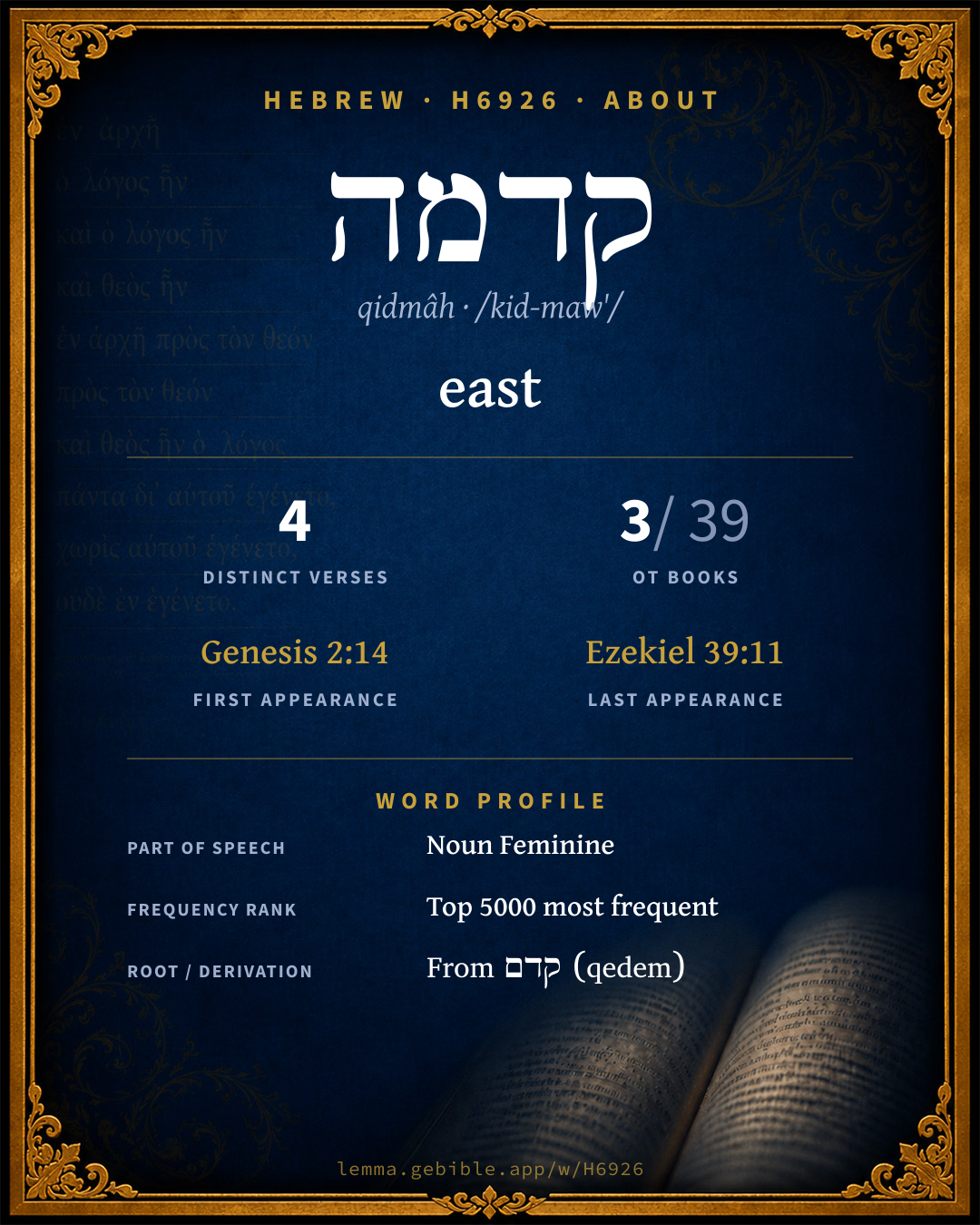
קִדְמָה
east
also: forward, front, antiquity fuller range ↓
Full lexicon entry — Brown-Driver-Briggs (BDB)
From Brown-Driver-Briggs (BDB)
Where this word appears
Grammar key — what these labels mean
Part of speech
- Noun
- A naming word — a person, place, thing, or idea.
Noun type
- Common
- A common noun — a general class of person, place, or thing (“king,” “city,” “water”), not a specific name.
State
- Construct
- A noun bound to a following noun in a possessive / “of” relationship (the construct chain).
Gender
- Feminine
- Grammatically feminine.
Number
- Singular
- One.
Every verse where H6926 appears in the Book of Genesis — 2 distinct verses. Click any verse to open its interlinear word-by-word view. Verse text shown in the World English Bible for context — . Each verse’s Hebrew form is shown with its reference; the English is not keyword-highlighted, since the data carries no word-level English alignment. Use “Compare translations” on any verse to read it across multiple English versions. This concordance covers the Hebrew Bible; Septuagint (Greek Old Testament) occurrences are not indexed here.
Genesis
About this entry
At a glance — auto-summarized from this page’s data, not written by a person. Every figure links to its source below. This summary describes the numbers; it doesn’t interpret them.
At its core, קדמה (qidmâh) means “east.” A scarce word — 4 verses in all of the Hebrew Bible. Its uses cluster heavily in Genesis (50% of all occurrences). Scripture first uses it in Genesis 2:14. Beyond its headline sense, its full sense range takes in “forward”, “front”, and “antiquity”. Dig into 4-verse concordance and the renderings breakdown below.
Gloss history
Strong's 1890 vs modern scholarship
About this word
Strong's H6926 catalogs a Hebrew word from the Hebrew Old Testament.
These counts are not copied from any lexicon or concordance. They are computed here, from the morphology-tagged Hebrew Old Testament. What Lemma adds →
- 4
- distinct verses
- The word appears in 4 distinct verses.
- 3 / 39
- OT books
- The word appears in 3 of 39 Old Testament books.
- #3,696
- by frequency
- Top 5000 most frequent Hebrew words (rank 3,696 of 8,640 Hebrew words by occurrence).
View all 4 occurrences in the concordance →
By section of the Old Testament
By traditional corpus
Conventional, traditional groupings — biblical authorship is debated, so this is a traditional corpus grouping, not an authorship claim. Each share is this word’s portion of its verses in that division of the Hebrew canon. Each figure is a share of the word’s 4 distinct verses.
- Torah (Pentateuch) 2 verses · 50%
- Prophets (Nevi'im) 2 verses · 50%
How translations render this word
Counts come from each version’s own published word-to-Strong’s tagging or interlinear alignment — an approximate guide to how each version renders this word, not a word-level alignment the data otherwise carries. Because each total is that version’s own tagged count, the per-version totals vary from one another and need not match the appearance or distinct-verse counts above. These counts may also differ from a printed concordance because Lemma counts each distinctly tagged rendering and does not collapse phrase taggings into a single head-word total. This is a fixed set of word-tagged versions (KJV, ASV, BSB, ULT) and does not change with the reading translation you choose elsewhere. Each version’s license is shown beside its name below (and on Sources).
- King James Version: East 3×
- American Standard Version: East 2×
- Berean Standard Bible: East 3×
- unfoldingWord Literal Text: East of 4×
King James Version Public Domain
Renders H6926 across 4 tagged occurrences — most commonly:
Plus 1 rendering that appears only once — usually multi-word phrases or single function words the recovered tagging swept in, not distinct renderings.
American Standard Version Public Domain
Renders H6926 across 4 tagged occurrences — most commonly:
Plus 2 renderings that appear only once — usually multi-word phrases or single function words the recovered tagging swept in, not distinct renderings.
Berean Standard Bible Public Domain
Renders H6926 across 4 tagged occurrences — most commonly:
Plus 1 rendering that appears only once — usually multi-word phrases or single function words the recovered tagging swept in, not distinct renderings.
unfoldingWord Literal Text CC BY-SA 4.0
Renders H6926 across 4 tagged occurrences — most commonly:
9 senses and sub-senses in the full BDB
What do BDB’s symbols mean?
BDB uses these scholarly abbreviations:
| Symbol | Meaning |
|---|---|
| 𝔊 | the Septuagint (the ancient Greek translation, LXX) |
| 𝔙 | the Vulgate (the Latin translation) |
| 𝔖 | the Syriac version (the Peshitta) |
| 𝔗 | the Targum (the Aramaic translation) |
| ψ | the Psalms |
| √ | root (the underlying root or stem) |
| ‖ | parallel passage (a synonymous or contrasted parallel) |
| † | the dagger: every passage where the word occurs is cited |
The 9 senses and sub-senses the full Brown-Driver-Briggs lexicon distinguishes for this word, in lexicon order (not ranked by frequency), with BDB’s own verbatim wording and sub-sense lettering. Shown in Hebrew script with BDB’s own scholarly abbreviations. The condensed entry is in the Lexicon Entry tab. See also the Forms in the corpus table below.
- 1. loc.
- a. front, מִקּ׳ Is 9:11 from the front (i.e. East), in front (opp. מֵאָחוֹר), אָחוֹר וָק׳ ψ 139:5 behind and before; ק׳ אֶהֱלֹךְ Jb 23:8 I go forward (opp. אָחוֹר). e.g. Isaiah 9:11
- b. East: הַר־הַקּ׳ Gn 10:30 (J) mount of the East; בְּנֵי־ק׳ = dwellers in the E., tribes E. or NE. of Canaan Gn 29:1 (E), Ju 6:3, 33; 7:12; 8:10; 1 K 5:10; Is 11:14; Je 49:28; Ez 25:4, 10; Jb 1:3; הַרְרֵי ק׳ Nu 23:7, v. Di SachauReise (1883), 159 ff. 165 ff. Dr in Hastpethor; אֶרֶץ ק׳ Gn 25:6 (J); מָֽלְאוּ מִקֶּדֶם Is 2:6 they are full from the E. (ins. prob. קֶסֶם, מִקְסָם, or קֹסְמִים before מִקּ׳, cf. Lo De Du CheHpt. Di-Kit); elsewhere מִקּ׳ = eastward: (1) in the E. Gn 2:8; (2) on the E. (side) 12:8 (J) Zc 14:4; מִקּ׳ לְ on the E. of Gn 3:24 (J), 12:8 (J), Nu 34:11 (P), Jos 7:2 (JE), Ju 8:11; Ez 11:23; Jon 4:5; (3) eastward, c. vb. of motion Gn 11:2; 13:11 (both J). e.g. Genesis 10:30
- 2. temp., ancient time, aforetime:
- a. הַרְרֵי ק׳ Dt 33:15 ancient mts., cf. אֱלֹהֵי ק׳ v 27, מַלְכֵי־ק׳ Is 19:11, בִּשְׁמֵי שְׁמֵי־ק׳ ψ 68:34. e.g. Deuteronomy 33:15
- b. בִּימֵי ק׳ ψ 44:2 in ancient days; cf. מִימֵי ק׳ from of old Is 23:7; Mi 7:20; La 1:7; 2:17, Is 37:26 = לְמִימֵי ק׳ 2 K 19:25 (v. מִן 9 b (2)); כִּימֵי ק׳ Is 51:9; Je 46:26; יַרְחֵי קֹ Jb 29:2 months of old. e.g. Psalms 44:2
- c. מִקּ׳ from of old Mi 5:1; Is 45:21; 46:10; Hb 1:12; Ne 12:46 ψ 74:12; 77:12; מִנִּי־ק׳ 78:2 springing out of, derived from, ancient times (cf. Dr); יָמִים מִקּ׳ 77:6; 143:5 days from of old. e.g. Micah 5:1
- d. ק׳ alone, as adv. anciently, of old ψ 74:2; 119:152; כְּק׳ Je 30:20; La 5:21; ישֵׁב ק׳ ψ 55:20 he that sitteth (enthroned from) of old. e.g. Psalms 74:2
- e. beginning, מִקַּדְמֵי־אָ֑רֶץ Pr 8:23 from the beginnings of the earth; ק׳ מִפְעָלָיו Pr 8:22 the beginning of his works (‖ רֵאשִׁית). e.g. Proverbs 8:23
Senses from the full Brown-Driver-Briggs lexicon (Brown, Driver, Briggs; Oxford 1906 — public domain), digitized via Sefaria, supplemented by the OpenScriptures HebrewLexicon (CC BY 4.0). Full attribution on Sources.
Word origin
n.[m.] front, east, aforetime;—abs. ק׳ Dt 33:27 +, קֶ֑דֶם Ju 8:10 +, cstr. קֶדֶם Pr 8:22; once pl. cstr. קַדְמֵי v 23;—
— Brown-Driver-Briggs (Oxford 1906, public domain), digitized via Sefaria, supplemented by the OpenScriptures HebrewLexicon (CC BY 4.0). See Sources.
Derived from קדם (qedem) (H6924) — east.
Forms in the corpus
The 3 distinct written forms H6926 takes in the Hebrew Bible, most frequent first — each parse links to that state’s occurrences in the concordance. Hebrew forms include their vowel points and cantillation, so a single lemma takes many written forms.
| Form | Parsing | Example | Uses |
|---|---|---|---|
| קִדְמַ֣ת | Noun, Common, Feminine, Singular, Construct | Ezekiel 39:11 | 2 |
| קִדְמַ֖ת | Noun, Common, Feminine, Singular, Construct | 1 Samuel 13:5 | 1 |
| קִדְמַת | Noun, Common, Feminine, Singular, Construct | Genesis 4:16 | 1 |
Same root — word family
Other BDB entries built from the same root as H6926, grouped by Strong’s listed origin. These share a root / origin per the lexicon — not necessarily a shared meaning. Each links to that word’s own entry.
Derives from
Shares the same root
Proper names from this root
People and places named from this root — a name, not an additional meaning of the word.
Compare all same-root words → 1 of the same-root words is a proper name (a person or place). They share a root, not necessarily a meaning.
Septuagint verse parallels
This word appears in 4 verses that also exist in the Greek Old Testament (Septuagint), out of the 4 Hebrew verses it occurs in. You can read those verses in Greek by switching the Old Testament edition to the Septuagint.
Read these verses in the Septuagint
This is a verse-level parallel only — the same verses exist in both the Hebrew and Greek Old Testaments. No word-level Hebrew↔Greek correspondence is claimed: the data carries no such alignment, so no Greek word is shown as this Hebrew word’s translation. Coverage is not total — the Septuagint omits the deuterocanon and renumbers the Psalms, so some Hebrew verses have no direct Greek parallel.