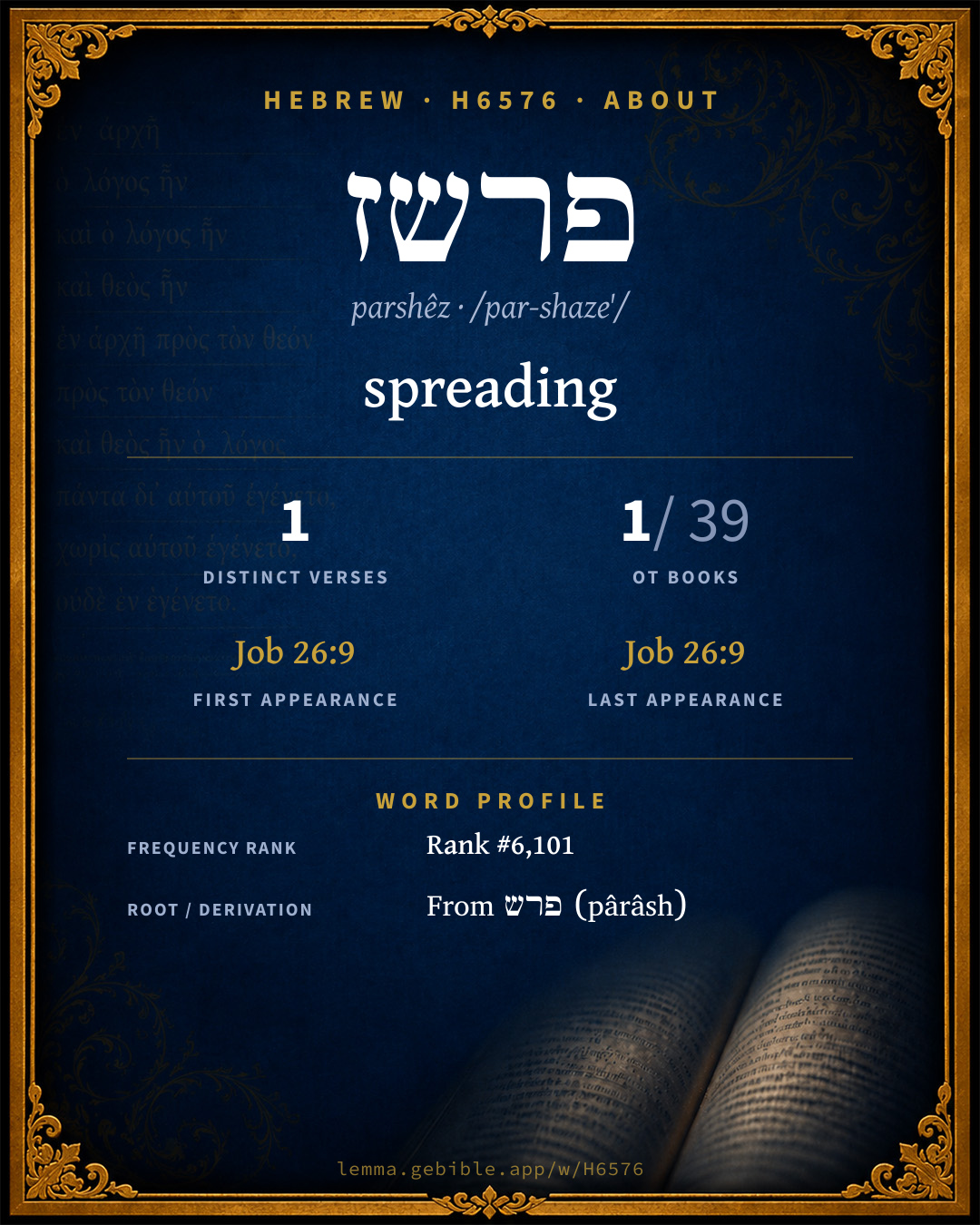
פַּרְשֵׁז
spreading
Full lexicon entry — Brown-Driver-Briggs (BDB)
From Brown-Driver-Briggs (BDB)
Where this word appears
Grammar key — what these labels mean
Part of speech
- Verb
- An action or state-of-being word.
Form
- Infinitive Absolute
- An unbound verbal noun, often intensifying or standing in for a finite verb.
Every verse where H6576 appears — 1 distinct verse across 1 book. Click any verse to open its interlinear word-by-word view. Verse text shown in the World English Bible for context — . Each verse’s Hebrew form is shown with its reference; the English is not keyword-highlighted, since the data carries no word-level English alignment. Use “Compare translations” on any verse to read it across multiple English versions. This concordance covers the Hebrew Bible; Septuagint (Greek Old Testament) occurrences are not indexed here.
Job 1 verse
About this entry
At a glance — auto-summarized from this page’s data, not written by a person. Every figure links to its source below. This summary describes the numbers; it doesn’t interpret them.
The Hebrew word פרשז centers on the idea of “spreading.” It is rare — just 1 verse in the entire Hebrew Bible. Job dominates its distribution — 1 of 1 verses. Scripture uses it exactly once, at Job 26:9. Sharing its root, it stands alongside פרש, פרש and פרש. For the data behind this summary, explore the sense tree and the renderings breakdown below.
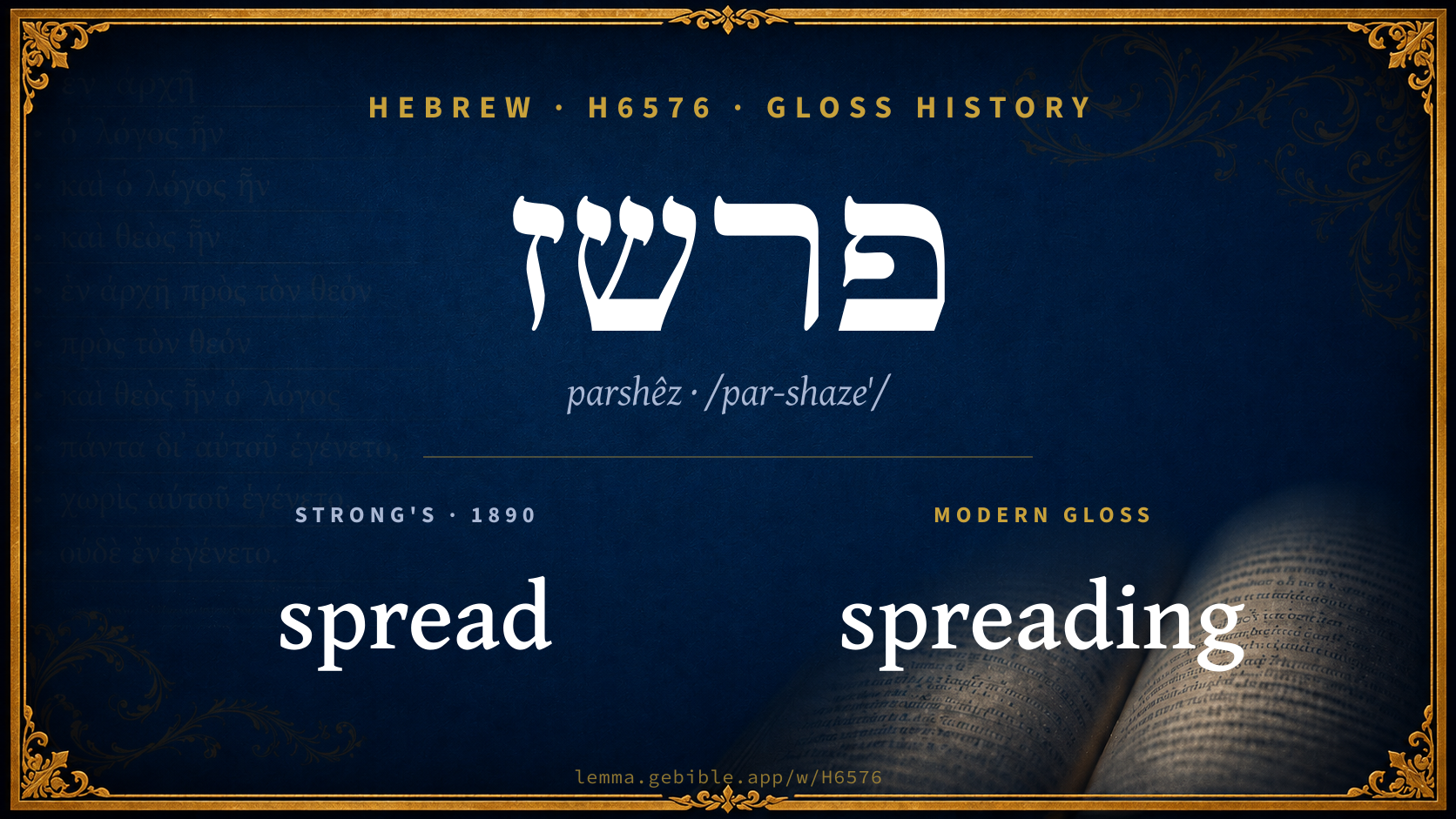
Gloss history
Strong's 1890 vs modern scholarship
About this word
Strong's H6576 catalogs a Hebrew word from the Hebrew Old Testament.
These counts are not copied from any lexicon or concordance. They are computed here, from the morphology-tagged Hebrew Old Testament. What Lemma adds →
- 1
- distinct verses
- The word appears in 1 distinct verse.
- 1 / 39
- OT books
- The word appears in 1 of 39 Old Testament books.
- #6,101
- by frequency
- Rank #6,101 (rank 6,101 of 8,640 Hebrew words by occurrence).
View all 1 occurrence in the concordance →
Most concentrated in
- Job 1 verse 100%
By section of the Old Testament
By traditional corpus
Conventional, traditional groupings — biblical authorship is debated, so this is a traditional corpus grouping, not an authorship claim. Each share is this word’s portion of its verses in that division of the Hebrew canon. Each figure is a share of the word’s 1 distinct verse.
- Writings (Ketuvim) 1 verse · 100%
How translations render this word
Counts come from each version’s own published word-to-Strong’s tagging or interlinear alignment — an approximate guide to how each version renders this word, not a word-level alignment the data otherwise carries. Because each total is that version’s own tagged count, the per-version totals vary from one another and need not match the appearance or distinct-verse counts above. These counts may also differ from a printed concordance because Lemma counts each distinctly tagged rendering and does not collapse phrase taggings into a single head-word total. This is a fixed set of word-tagged versions (KJV, ASV, BSB, ULT) and does not change with the reading translation you choose elsewhere. Each version’s license is shown beside its name below (and on Sources).
BDB lists this Strong’s number as 3 distinct words (homographs). Each count above pools all of them and is not split by sense — see the Senses section below. A low-frequency rendering may belong to a different one of those words, not the primary meaning.
- King James Version†: Spreadeth 1×
- American Standard Version†: Spreadeth 1×
- Berean Standard Bible†: Spreading 1×
- unfoldingWord Literal Text†: Spreading 1×
King James Version Public Domain
Renders H6576 across 1† tagged occurrence — most commonly:
American Standard Version Public Domain
Renders H6576 across 1† tagged occurrence — most commonly:
Berean Standard Bible Public Domain
Renders H6576 across 1† tagged occurrence — most commonly:
unfoldingWord Literal Text CC BY-SA 4.0
Renders H6576 across 1† tagged occurrence — most commonly:
11 senses and sub-senses in the full BDB
Hebrew verbs can shift meaning by stem (binyan): Qal is the basic action, Niphal is often passive or reflexive, Piel often intensifies or makes it factitive, and Hiphil is typically causative. The senses below are grouped under the stem BDB assigns to each.
What do BDB’s symbols mean?
BDB uses these scholarly abbreviations:
| Symbol | Meaning |
|---|---|
| 𝔊 | the Septuagint (the ancient Greek translation, LXX) |
| 𝔙 | the Vulgate (the Latin translation) |
| 𝔖 | the Syriac version (the Peshitta) |
| 𝔗 | the Targum (the Aramaic translation) |
| ψ | the Psalms |
| √ | root (the underlying root or stem) |
| ‖ | parallel passage (a synonymous or contrasted parallel) |
| † | the dagger: every passage where the word occurs is cited |
The 11 senses and sub-senses the full Brown-Driver-Briggs lexicon distinguishes for this word, in lexicon order (not ranked by frequency), with BDB’s own verbatim wording and sub-sense lettering. Shown in Hebrew script with BDB’s own scholarly abbreviations. The condensed entry is in the Lexicon Entry tab.
פרשז I erron. פָּרַשׂ NöZA j, 417] vb. break in two, divide (NH in der. forms
- 1. c. acc. פַּרְסָה divide hoof, i.e. have divided hoof (> denom. have hoofs), Dt 14:6, 7, 8 and ‖ Lv 11:3, 4, 5, 6, 7, so also Lv 11:26; מַפְרִיסֵי הַפּ׳ Dt 14:7 = מַפְרִסֵי הַפּ׳ Lv 11:4 (H). e.g. Deuteronomy 14:6
- 2. pt. abs. denom. ψ 69:32 having hoofs (+ מַקְרִן). e.g. Psalms 69:32
פרשז II spread out, spread (NH id.
Qal
- Pf. 3 ms. פ׳ La 1:10 +; 2 ms. וּפָרַשְׂתָּ֫ Jb 11:13; Ru 3:9, etc.; Impf. 3 ms. יִפְרשֹׁ Dt 32:11 +; 3 fs. וַתִּפְרשֹׁ 2 S 17:19, etc.; Pt. act. פּוֹרֵשׂ Pr 29:5, etc.; pass. פָּרֻשׂ Jo 2:2; fs. פְּרוּשָׂה Ho 5:1; pl. פְּרֻשׂוֹת 1 K 8:54;— e.g. Lamentations 1:10
- 1. spread out a garment (שִׂמְלָה) Ju 8:25, + לִפְנֵי pers. Dt 22:17;—wings 32:11; 1 K 6:27 (read כַּנְפֵיהֶם 𝔊 Sta Kmp Kit Benz), + עַל Je 49:22 (fig.), + אֶל 48:40 1 K 8:7 = 2 Ch 5:8 (עַל), + ל Jb 39:26, לְמַעְלָה Ex 25:20; 37:9; wings om. 1 Ch 28:18 and perhaps 2 Ch 3:13 (del. כַּנְפֵי Be); of י׳, פ׳ עָלָיו אוֹרוֹ Jb 36:30; spread out writing, לִפְנֵי pers. 2 K 19:14 = Is 37:14, Ez 2:10; sail Is 33:23; fishing-net, מִכְמֶרֶת Is 19:8 (עַל loc.); net (רֶשֶׁת) as snare, fig. Ho 5:1 (עַל loc.), ψ 140:6, לְרַגְלַי La 1:13, c. עַל pers. Ho 7:12 (of י׳), Ez 12:13 = 17:20, 19:8; 32:3, עַל־פְּעָמָיו Pr 29:5; פ׳ כַּפַּיִם in prayer, + אֶל Ex 9:29,33 (J), 1 K 8:38 = 2 Ch 6:29, Ezr 9:5; Jb 11:13, + ל ψ 44:21, + הַשָּׁמַיִם 1 K 8:22 = 2 Ch 6:13 (הַשָּׁמָ֑יְמָה), 1 K 8:54, no complem. 2 Ch 6:12; of almsgiving, כַּפָּהּ פָּֽרְשָׂה לֶעָנִי Pr 31:20; פ׳ יַד, c. עַל rei, La 1:10 of enemy’s greed (si vera l., v. Bu); spread out = display וּכְסִיל יִפְרשֹׁ אִוֶּלֶת Pr 13:16. e.g. Judges 8:25
- 2. spread covering over 2 S 17:19 (מָסָךְ + עַל־פְּנֵי rei), הַמַּכְבֵּר over (עַל) face of another 2 K 8:15, כָּנָף skirt, עַל pers. Ru 3:9 Ez 16:8 (fig. of י׳); בֶּגֶד c. עַל rei Nu 4:7,8,11,13, c. מִלְמָ֑עְלָה v 6; כְּסוּי c. עַל rei v 14; אֶת־הָאֹהֶל, c. עַל־הַמִּשְׁכָּן Ex 40:19; שַׁחַר פָּרֻשׂ עַל־הֶהָרִים Jo 2:2; of י׳, פ׳ עָנָן לְמָסָךְ ψ 105:39.—Mi 3:3 La 4:4 v. פָּרַס. e.g. 2 Samuel 17:19
Niphal
- Impf. 3 mpl. יִכָרְ֑שׂזּ Ez 17:21 they shall be scattered לְכָל־רוּחַ; 34:12 read prob. Pt. צֹאן נִפְרָשׂוֹת (for -שׂוֹת, Hä Krae; on emend. of context v. especially Toy Krae). e.g. Ezekiel 17:21
Piel
- Pf. 3 ms. consec. וּפֵרַשׂ Is 25:11, etc.; Impf. 3 ms. יְפָרֵשׂ v 11, 3 fs. תְּפָרֵשׂ Je 4:31; Inf. cstr. פָּרֵשׂ ψ 68:15, sf. פָּרִשְׂכֶם Is 1:15;— e.g. Isaiah 25:11
- 1. spread out:
- a. c. acc. כַּפַּיִם in prayer Is 1:15; Je 4:31, so c. יָדַיִם ψ 143:6 (אֶל־י׳), and of י׳ entreating people Is 65:2 (אֶל); פ׳ צִיּוֹן בְּיָדֶיהָ La 1:17. e.g. Isaiah 1:15
- b. spread out hands as in swimming Is 25:11, and (יָדַיִם om.) v 11. e.g. Isaiah 25:11
- 2. = scatter, (?) subj. י׳, c. acc. pers. Zc 2:10 (𝔊 We Now קִבַּצְתִּי מִן, yet v. GASm); ψ 68:15, in doubtful connexion. e.g. Zechariah 2:10
פרשז III (Baer, -שֵׁז van d. H. Gi), Inf. abs. Piʿlēl (Ges§ 56) from פָּרַשׂ (si vera l.), פ׳ עָלָיו עֲנָנוֹ Jb 26
Senses from the full Brown-Driver-Briggs lexicon (Brown, Driver, Briggs; Oxford 1906 — public domain), digitized via Sefaria, supplemented by the OpenScriptures HebrewLexicon (CC BY 4.0). Full attribution on Sources.
Word origin
II. erron. פָּרַשׂ NöZA j, 417] vb. break in two, divide (NH in der. forms; Assyrian parâsu, divide, hinder; Arabic فَرَسَ break neck, etc.; Syriac ܦܰܪܣܳܐ hoof, 𝔗 פַּרְסְתָא (v. פַּרְסָה infr.); cf. NöZA i. 417 f.);—Qal Pf. 3 pl. וּפָֽרְשׂוּ Mi 3:3 they have broken up bones, as in kettle (? read Impf. וַיִּפְרְשׂוּ Nöl.c.); Inf. abs. פָּרֹס לָרָעֵב לַחְמֶ֑ךָ Is 58:7 a breaking for the hungry thy bread, so Impf. 3 mpl. יִפְרְסוּ לָהֶם Je 16:7 (לֶחֶם om.; but read יִפ׳ לֶחֶם אֶל־אָבֵל Gie, cf. [in part] 𝔊 𝔙 Gf); Pt. פֹרֵשׂ לָהֶם La 4:4 (acc. לֶחֶם om.). Hiph. Pf. 3 fs. הִפְרִיסָה Lv 11:6, etc.; Impf. 3 ms. יַפְרִיס v 5; Pt. מַפְרִיס v 4 +, מַפְרֶסֶת v 3 +, etc.;—
I. vb. spread out, spread (NH id.; Arabic فَرَشَ; 𝔗 פְּרַס (rare), Syriac ܦܪܰܣ; cf. Assyrian parašu, fly (der. spec.; proposes spread [wings]); v. also NöZA i. 417);—
I. (Baer, -שֵׁז van d. H. Gi), Inf. abs. Piʿlēl (Ges§ 56) from פָּרַשׂ (si vera l.), פ׳ עָלָיו עֲנָנוֹ Jb 26:9 a spreading his cloud upon it (but Bu Du al. read פֹּרֵשׂ, פָּרַשׂ, or פָרשֹׁ).
— Brown-Driver-Briggs (Oxford 1906, public domain), digitized via Sefaria, supplemented by the OpenScriptures HebrewLexicon (CC BY 4.0). See Sources.
Derived from פרש (pârâsh) (H6567) — to declare.
Same root — word family
Other BDB entries built from the same root as H6576, grouped by Strong’s listed origin. These share a root / origin per the lexicon — not necessarily a shared meaning. Each links to that word’s own entry.
Derives from
Shares the same root
- פרש pᵉrash H6568 to distinguish
- פרש peresh H6569 dung
- פרש pârâsh H6571 horse
- פרשדן parshᵉdôn H6574 excrement
- פרשה pârâshâh H6575 declaration
Compare all same-root words → Showing 4 of 7 — not the complete family. They share a root, not necessarily a meaning.
Septuagint verse parallels
This word appears in 1 verse that also exists in the Greek Old Testament (Septuagint), out of the 1 Hebrew verse it occurs in. You can read those verses in Greek by switching the Old Testament edition to the Septuagint.
Read these verses in the Septuagint
This is a verse-level parallel only — the same verses exist in both the Hebrew and Greek Old Testaments. No word-level Hebrew↔Greek correspondence is claimed: the data carries no such alignment, so no Greek word is shown as this Hebrew word’s translation. Coverage is not total — the Septuagint omits the deuterocanon and renumbers the Psalms, so some Hebrew verses have no direct Greek parallel.