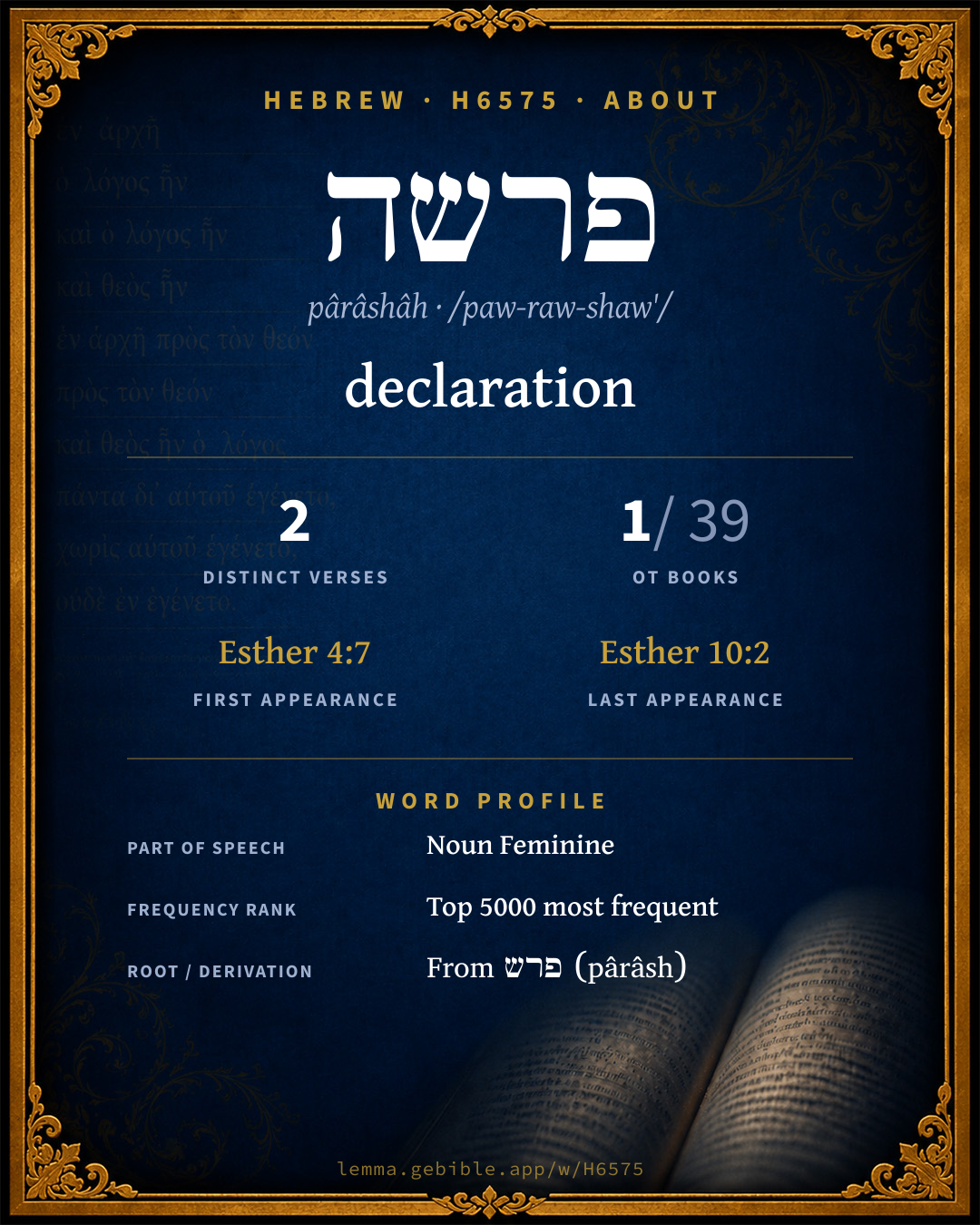
פָּרָשָׁה
declaration
Full lexicon entry — Brown-Driver-Briggs (BDB)
From Brown-Driver-Briggs (BDB)
Where this word appears
Grammar key — what these labels mean
Part of speech
- Noun
- A naming word — a person, place, thing, or idea.
Noun type
- Common
- A common noun — a general class of person, place, or thing (“king,” “city,” “water”), not a specific name.
State
- Construct
- A noun bound to a following noun in a possessive / “of” relationship (the construct chain).
Gender
- Feminine
- Grammatically feminine.
Number
- Singular
- One.
Every verse where H6575 appears — 2 distinct verses across 1 book. Click any verse to open its interlinear word-by-word view. Verse text shown in the World English Bible for context — . Each verse’s Hebrew form is shown with its reference; the English is not keyword-highlighted, since the data carries no word-level English alignment. Use “Compare translations” on any verse to read it across multiple English versions. This concordance covers the Hebrew Bible; Septuagint (Greek Old Testament) occurrences are not indexed here.
Esther 2 verses
- Esther 4:7 פָּרָשַׁ֣ת n c fs cs Mordecai told him of all that had happened to him, and the exact sum of the money that Haman had promised to pay to the king's treasuries for the Jews, to destroy them.
- Esther 10:2 וּ/פָרָשַׁת֙ conj + n c fs cs All the acts of his power and of his might, and the full account of the greatness of Mordecai, whereunto the king advanced him, aren't they written in the book of the chronicles of the kings of Media and Persia?
About this entry
At a glance — auto-summarized from this page’s data, not written by a person. Every figure links to its source below. This summary describes the numbers; it doesn’t interpret them.
The Hebrew noun פרשה centers on the idea of “declaration.” A scarce word — 2 verses in all of the Hebrew Bible. The word gravitates to Esther (100%). Its earliest occurrence is Esther 4:7. It clusters with פרש, פרש and פרש under a shared root. Dig into 2-verse concordance and the renderings breakdown below.
Gloss history
Strong's 1890 vs modern scholarship
About this word
Strong's H6575 catalogs a Hebrew word from the Hebrew Old Testament.
These counts are not copied from any lexicon or concordance. They are computed here, from the morphology-tagged Hebrew Old Testament. What Lemma adds →
- 2
- distinct verses
- The word appears in 2 distinct verses.
- 1 / 39
- OT books
- The word appears in 1 of 39 Old Testament books.
- #4,807
- by frequency
- Top 5000 most frequent Hebrew words (rank 4,807 of 8,640 Hebrew words by occurrence).
View all 2 occurrences in the concordance →
Most concentrated in
- Esther 2 verses 100%
By section of the Old Testament
By traditional corpus
Conventional, traditional groupings — biblical authorship is debated, so this is a traditional corpus grouping, not an authorship claim. Each share is this word’s portion of its verses in that division of the Hebrew canon. Each figure is a share of the word’s 2 distinct verses.
- Writings (Ketuvim) 2 verses · 100%
How translations render this word
Counts come from each version’s own published word-to-Strong’s tagging or interlinear alignment — an approximate guide to how each version renders this word, not a word-level alignment the data otherwise carries. Because each total is that version’s own tagged count, the per-version totals vary from one another and need not match the appearance or distinct-verse counts above. These counts may also differ from a printed concordance because Lemma counts each distinctly tagged rendering and does not collapse phrase taggings into a single head-word total. This is a fixed set of word-tagged versions (KJV, ASV, BSB, ULT) and does not change with the reading translation you choose elsewhere. Each version’s license is shown beside its name below (and on Sources).
- King James Version: Declaration 1×, Sum 1×
- American Standard Version: Full account 1×, Him 1×
- Berean Standard Bible: Exact amount 1×, Together with the full account 1×
- unfoldingWord Literal Text: Exact amount of 1×, Full account of 1×
King James Version Public Domain
Renders H6575 across 2 tagged occurrences — most commonly:
American Standard Version Public Domain
Renders H6575 across 2 tagged occurrences — most commonly:
Berean Standard Bible Public Domain
Renders H6575 across 2 tagged occurrences — most commonly:
unfoldingWord Literal Text CC BY-SA 4.0
Renders H6575 across 2 tagged occurrences — most commonly:
Senses in BDB
The 1 sense BDB distinguishes for this word, in lexicon order (not ranked by frequency or importance). The full entry — with sub-senses — is in the Lexicon Entry tab.
- exact statement, declaration
Word origin
[ פָּרָשָׁה ] n.f. exact statement
— Brown-Driver-Briggs (Oxford 1906, public domain), digitized via Sefaria, supplemented by the OpenScriptures HebrewLexicon (CC BY 4.0). See Sources.
Derived from פרש (pârâsh) (H6567) — to declare.
Jastrow Dictionary
A second Hebrew/Aramaic lexicon for comparison, covering Aramaic and post-biblical (Talmudic, Targumic, Midrashic) usage that the biblical-Hebrew BDB does not. Matched by lemma rather than by Strong’s number, so a lemma may carry more than one Jastrow headword (shown separately below), and the entries cover usage well beyond the Bible.
פָּרָשָׁה I
- (פָּרַשׁ)
- 1. separation, branching off.—פָּרָשַׁת דרכים, פרשת עיבור, cross-road. Ber. IV, 4, v. עִיבּוּר. Sot. 21ᵃ הגיע לפ׳ דרכים וכ׳ when the traveller reaches the cross-road (where there is a guide-post), he is saved from all dangers. Ib. מהו פ׳ ד׳ וכ׳ what is meant by cross-road (in this parable)? A scholar on his dying day.—Ḥull. 46ᵃ פ׳ ראשונה the first branching off of the spinal column towards the legs, שניה the second branching off in the prolongation which forms the tail. Ib. פי פ׳ the starting point of the branching off; פ׳ עצמה the branch itself; a. e.—Pl. פָּרָשׁוֹת. Ib. 45ᵇ עד היכך חוט השדרה … עד בין הפ׳ how far does the spinal cord go (the severance of which causes the animal to be ṭ’refah)?… To ‘between the ramifications’; ליחוי לן מר בין הפ׳ show us the place called ‘between the ramifications’; a. e.
- 2. crossing the ocean, sea-voyage. Lev. R. s. 35, v. אַפְרָשָׁה.
- 3. (in writing) division, section, Parashah, the weekly Scripture lesson. Ber. 9ᵇ אשרי … חדא פ׳ היא Ashré (Ps. I) and Lammah rag’shu (Ps. II) are one section (psalm). Ib. 63ᵃ איזוהי פ׳ קטנה שכל וכ׳ which is the small section (verse) on which all essentials of the Law depend? (Answ. Prov. III, 6) ‘In all thy ways &c.’ Ib. II, 2 (13ᵃ) למה קדמה פרשת שמע וכ׳ Bab. ed. (Mish. a. Y. ed. only שמע) why is the section Sh’mʿa (Deut. VI, 4-9) recited before V’hayah (ib. XI, 13-21)? B. Bath. 14ᵇ פרשת בלעם the section treating of Balaam (Num. XXII, 2-XXIV, 25); a. v. fr.—Pl. פָּרָשִׁיּוֹת (fr. פָּרָשׁוּת). Ber. 9ᵇ י"ה פ׳ eighteen psalms. Gen. R. s. 90. Lev. R. s. 24. Tosef. Sabb. I, 12 תינוקות … פָּרָשִׁיּוֹתֵיהֶן children and teacher may prepare their verses by lamp-light &c.; (Y. ib. I, 3ᵇ bot. ראשי פסוקיהן). Ber. 8ᵇ המשלים פָּרָשִׁיּוֹתָיו עם הצבור he who finishes the reading of the weekly lessons so as to keep up with the public reading in the synagogue. Meg. 29ᵇ לסדר פ׳ הוא חוזר the interrupted order of Scriptural reading is taken up again; a. v. fr. e.g. Proverbs 3:6
פָּרָשָׁה II
- (preced.) pr. n. pl. Parashah (Crossing); פָּרָשַׁת אשקלון the Crossing of Ashkalon. Tosef. Shebi. IV, 11; Y. ib. VI, 36ᶜ פ׳ חומות וכ׳ (insert אשקלון); Sifré Deut. 51; Yalk. ib. 874.
A Dictionary of the Targumim, the Talmud Babli and Yerushalmi, and the Midrashic Literature (Marcus Jastrow; London, Luzac, 1903) — Public Domain. Digitized via Sefaria. Digitized via Sefaria. Full attribution on Sources.
Forms in the corpus
The 2 distinct written forms H6575 takes in the Hebrew Bible, most frequent first — each parse links to that state’s occurrences in the concordance. Hebrew forms include their vowel points and cantillation, so a single lemma takes many written forms.
| Form | Parsing | Example | Uses |
|---|---|---|---|
| וּ/פָרָשַׁת֙ | Noun, Common, Feminine, Singular, Construct | Esther 10:2 | 1 |
| פָּרָשַׁ֣ת | Noun, Common, Feminine, Singular, Construct | Esther 4:7 | 1 |
Same root — word family
Other BDB entries built from the same root as H6575, grouped by Strong’s listed origin. These share a root / origin per the lexicon — not necessarily a shared meaning. Each links to that word’s own entry.
Derives from
Shares the same root
- פרש pᵉrash H6568 to distinguish
- פרש peresh H6569 dung
- פרש pârâsh H6571 horse
- פרשדן parshᵉdôn H6574 excrement
- פרשז parshêz H6576 spreading
Compare all same-root words → Showing 4 of 7 — not the complete family. They share a root, not necessarily a meaning.
Septuagint verse parallels
This word appears in 2 verses that also exist in the Greek Old Testament (Septuagint), out of the 2 Hebrew verses it occurs in. You can read those verses in Greek by switching the Old Testament edition to the Septuagint.
Read these verses in the Septuagint
This is a verse-level parallel only — the same verses exist in both the Hebrew and Greek Old Testaments. No word-level Hebrew↔Greek correspondence is claimed: the data carries no such alignment, so no Greek word is shown as this Hebrew word’s translation. Coverage is not total — the Septuagint omits the deuterocanon and renumbers the Psalms, so some Hebrew verses have no direct Greek parallel.