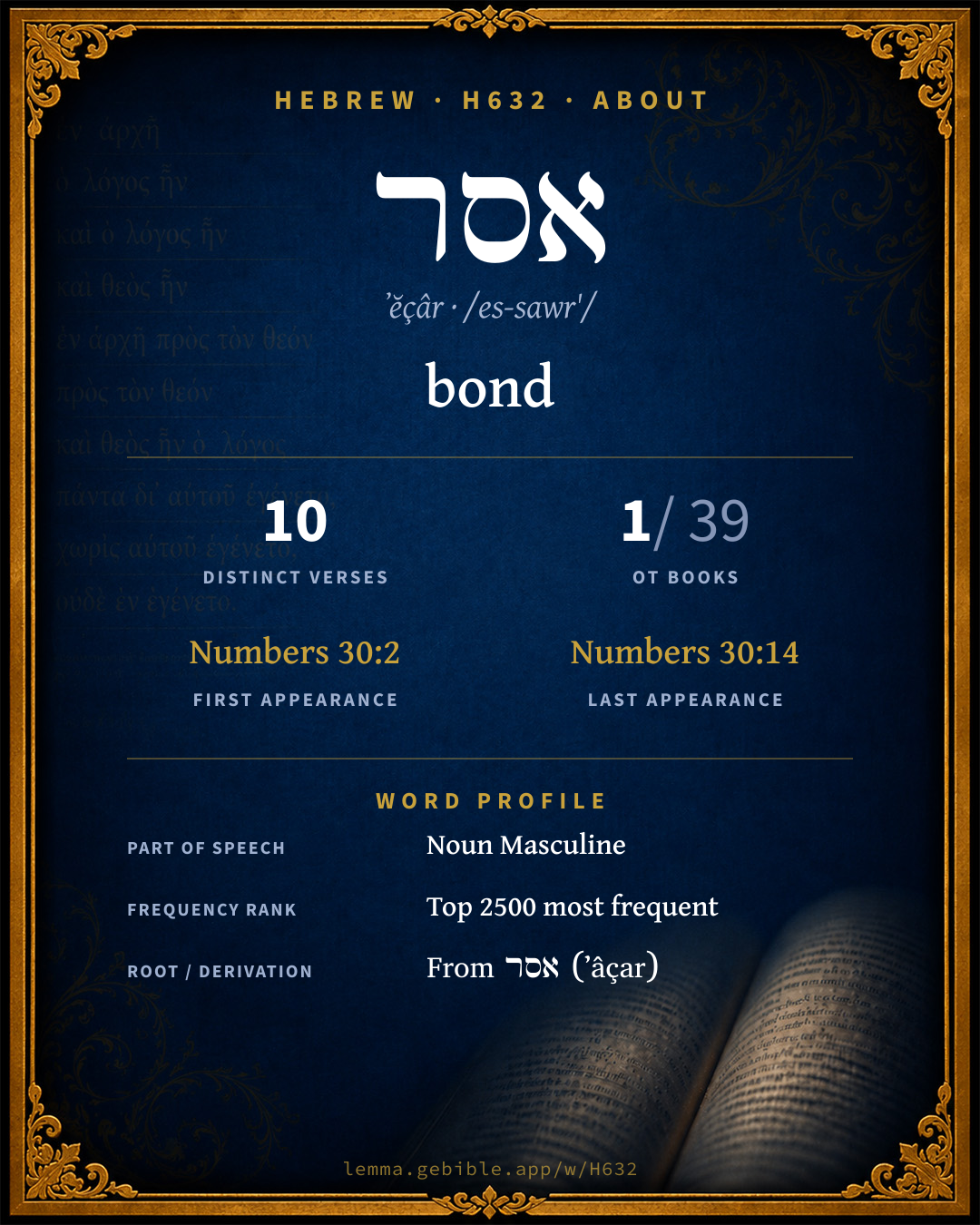
אִסָּר
bond
Full lexicon entry — Brown-Driver-Briggs (BDB)
From Brown-Driver-Briggs (BDB)
Where this word appears
See every Absolute-state word in the Hebrew Bible →
Grammar key — what these labels mean
Part of speech
- Noun
- A naming word — a person, place, thing, or idea.
Noun type
- Common
- A common noun — a general class of person, place, or thing (“king,” “city,” “water”), not a specific name.
State
- Absolute
- The independent form of a noun, not bound to a following word.
- Construct
- A noun bound to a following noun in a possessive / “of” relationship (the construct chain).
Gender
- Masculine
- Grammatically masculine.
Number
- Singular
- One.
- Plural
- More than one (in Hebrew, generally three or more).
6 distinct verses where H632 appears in the Absolute state, across 1 book. Filtered view — show all forms. Click any verse to open its interlinear word-by-word view. Verse text shown in the World English Bible for context — . Each verse’s Hebrew form is shown with its reference; the English is not keyword-highlighted, since the data carries no word-level English alignment. Use “Compare translations” on any verse to read it across multiple English versions. This concordance covers the Hebrew Bible; Septuagint (Greek Old Testament) occurrences are not indexed here.
Numbers 6 verses
- Numbers 30:2 אִסָּר֙ n c ms When a man vows a vow to Yahweh, or swears an oath to bind his soul with a bond, he shall not break his word; he shall do according to all that proceeds out of his mouth.
- Numbers 30:3 אִסָּ֛ר n c ms Also when a woman vows a vow to Yahweh, and binds herself by a bond, being in her father's house, in her youth,
- Numbers 30:4 וֶֽ/אֱסָרָ/הּ֙ אִסָּ֛ר conj + n c ms cs + sfx pers 3fs n c ms and her father hears her vow, and her bond with which she has bound her soul, and her father holds his peace at her; then all her vows shall stand, and every bond with which she has bound her soul shall stand.
- Numbers 30:10 אִסָּ֛ר n c ms If she vowed in her husband's house, or bound her soul by a bond with an oath,
- Numbers 30:11 אִסָּ֛ר n c ms and her husband heard it, and held his peace at her, and didn't disallow her; then all her vows shall stand, and every bond with which she bound her soul shall stand.
- Numbers 30:13 אִסָּ֖ר n c ms Every vow, and every binding oath to afflict the soul, her husband may establish it, or her husband may make it void.
About this entry
At a glance — auto-summarized from this page’s data, not written by a person. Every figure links to its source below. This summary describes the numbers; it doesn’t interpret them.
The Hebrew noun אסר centers on the idea of “bond.” The word gravitates to Numbers (100%). It appears 10 verses across 1 book of the Hebrew Bible, among its uncommon vocabulary. Its earliest occurrence is Numbers 30:2. It clusters with אסר, אסור and אסיר under a shared root. For the data behind this summary, explore the sense tree and the renderings breakdown below.
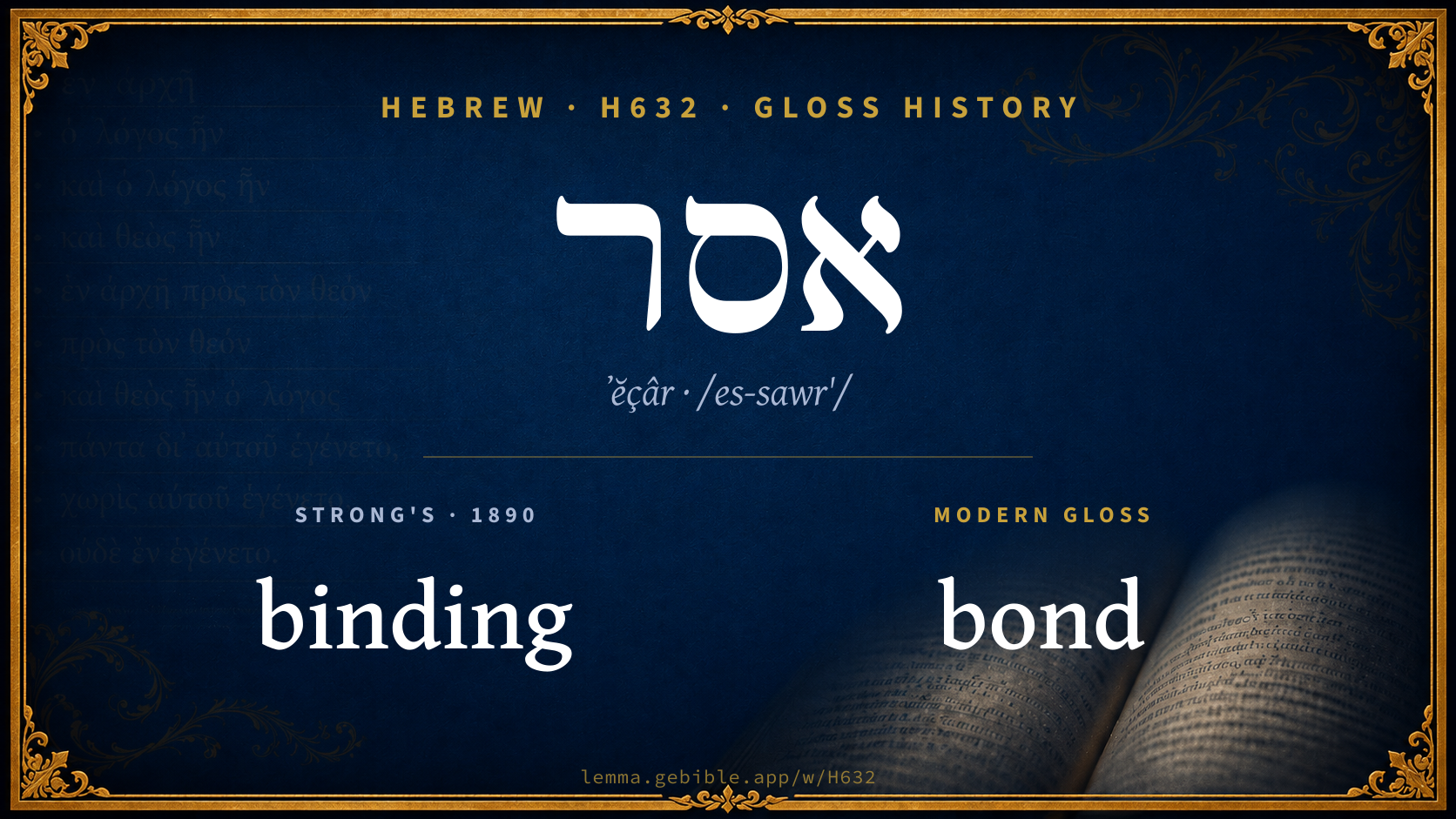
Gloss history
Strong's 1890 vs modern scholarship
About this word
Strong's H632 catalogs a Hebrew word from the Hebrew Old Testament.
These counts are not copied from any lexicon or concordance. They are computed here, from the morphology-tagged Hebrew Old Testament. What Lemma adds →
- 10
- distinct verses
- The word appears in 10 distinct verses.
- 1 / 39
- OT books
- The word appears in 1 of 39 Old Testament books.
- #2,210
- by frequency
- Top 2500 most frequent Hebrew words (rank 2,210 of 8,640 Hebrew words by occurrence).
View all 10 occurrences in the concordance →
Most concentrated in
- Numbers 10 verses 100%
By section of the Old Testament
By traditional corpus
Conventional, traditional groupings — biblical authorship is debated, so this is a traditional corpus grouping, not an authorship claim. Each share is this word’s portion of its verses in that division of the Hebrew canon. Each figure is a share of the word’s 10 distinct verses.
- Torah (Pentateuch) 10 verses · 100%
How translations render this word
Counts come from each version’s own published word-to-Strong’s tagging or interlinear alignment — an approximate guide to how each version renders this word, not a word-level alignment the data otherwise carries. Because each total is that version’s own tagged count, the per-version totals vary from one another and need not match the appearance or distinct-verse counts above. These counts may also differ from a printed concordance because Lemma counts each distinctly tagged rendering and does not collapse phrase taggings into a single head-word total. This is a fixed set of word-tagged versions (KJV, ASV, BSB, ULT) and does not change with the reading translation you choose elsewhere. Each version’s license is shown beside its name below (and on Sources).
- King James Version: Bond 3×, Every bond 2×
- American Standard Version: Bond 3×, Every bond 2×
- Berean Standard Bible: Or pledges 3×, Pledge 3×, Pledges 3×
- unfoldingWord Literal Text: Binding vow 7×, Binding vows 3×
King James Version Public Domain
Renders H632 across 11 tagged occurrences — most commonly:
Plus 6 renderings that appear only once — usually multi-word phrases or single function words the recovered tagging swept in, not distinct renderings.
American Standard Version Public Domain
Renders H632 across 11 tagged occurrences — most commonly:
Plus 6 renderings that appear only once — usually multi-word phrases or single function words the recovered tagging swept in, not distinct renderings.
Berean Standard Bible Public Domain
Renders H632 across 10 tagged occurrences — most commonly:
Plus 1 rendering that appears only once — usually multi-word phrases or single function words the recovered tagging swept in, not distinct renderings. Not rendered by a distinct English word in 1 further occurrence.
unfoldingWord Literal Text CC BY-SA 4.0
Renders H632 across 11 tagged occurrences — most commonly:
Plus 1 rendering that appears only once — usually multi-word phrases or single function words the recovered tagging swept in, not distinct renderings.
Senses in BDB
The 1 sense BDB distinguishes for this word, in lexicon order (not ranked by frequency or importance). The full entry — with sub-senses — is in the Lexicon Entry tab.
- bond, binding obligation, obligation
Word origin
n.m. Nu 30:8 bond, binding obligation (cf. Biblical Aramaic אֱבָר, Syriac ܐܶܣܳܪ; so forms with suff. infr. v. BaNB62 cf. Sta§ 208a; but perhaps Aramaic loanword v. LagBN 175)—א׳ abs. Nu 30:3 +; cstr. אִסַּר v 13; sf. אֱסָרָהּ v 5; pl. sf. אֱסָרֶיהָ v 6, 15, אֱסָרֶהָ v 8—only Nu 30 (P), binding obligation of oath or vow; mostly acc. cogn. with אָסַר (q.v.); Nu 30:3, 4, 5(×2), 6, 8, 11, 12; אִסַּר נַפְשָׁהּ v 13; שְׁבֻעַת אִסָּר binding oath v 14.
— Brown-Driver-Briggs (Oxford 1906, public domain), digitized via Sefaria, supplemented by the OpenScriptures HebrewLexicon (CC BY 4.0). See Sources.
Derived from אסר (ʼâçar) (H631) — to bind.
Jastrow Dictionary
A second Hebrew/Aramaic lexicon for comparison, covering Aramaic and post-biblical (Talmudic, Targumic, Midrashic) usage that the biblical-Hebrew BDB does not. Matched by lemma rather than by Strong’s number, so a lemma may carry more than one Jastrow headword (shown separately below), and the entries cover usage well beyond the Bible.
אָסַר
- to surround, enclose (v. Schr. KAT Gloss. II, s. v.)—whence
- 1. to chain, imprison; to sentence to prison. Ber. 28ᵇ, v. אֵיסוּר.
- 2. to harness, put the horses to. Mekh. B’shall. 1. Gen. R. s. 55, v. אֲסָרָה.
- 3. to bind, obligate. Lev. R. s. 23 אילולי שא׳ וכ׳ had not the Lord bound himself by an oath; a. e.
- 4. to interdict, to declare a thing forbidden according to ritual law, opp. הִתִּיר to loosen the tie, to allow. Ḥag. 3ᵇ הללו אוֹסְרִין והללו מתירין the ones declare forbidden what the others allow. Lev. R. s. 22 מה שאָסַרְתִּי לך התרתי לך of whatever I have forbidden thee (as a class) I have allowed thee (a specimen). Erub. VIII, 4 אוֹסַר עליו he (by residing there) restricts the other (debarring him from carrying things around on the Sabbath).—Part. pass. אָסוּר, f. אֲסוּרָה (it is) forbidden. Ber. 35ᵃ א׳ לו לאדם ש׳ וכ׳ one must not &c.; a. v. fr.—Pl. אֲסוּרִים, אֲסוּרִין; f. אֲסוּרוֹת. Ter. X, 12; a. v. fr. V. אָסוּר.
- to be forbidden, to become subject to ritual prohibition. Ib. 11 אוֹסֶרֶת ואינה נֶאֱסָרֶת affects other things which come in contact with it, but is not affected; a. fr.
אֲסַר
- 1. to chain, imprison. Targ. II Kings XVII, 4; a. fr.
- 2. to bind by spell, charm. Targ. Ps. LVIII, 6; a. e.
- 3. to tie up, put on &c. Targ. Y. Gen. XLIX, 11; a. e.—B. Mets. 86ᵇ דקא א׳ ושרי that he tied up (his wound) and untied it. Sabb. 81ᵇ אֲסַרְתָּהּ לארבא she tied (stopped) the ship (by magic spell).
- 4. to bind the bowels, check diarrhœa. Gitt. 69ᵇ למֵיסַר.
- 5. to forbid. Ḥull. 109ᵇ כל דא׳ לן וכ׳, v. preced.; a. v. fr. Ib. 111ᵇ; 112ᵃ, a. fr. אָסִיר, אֲסִירֵי it is, they are, forbidden.—Ab. Zar. 37ᵇ יוסף אָסְרָא מיבעי ליה he ought to be called, ‘Joseph the forbidder.’—Y. Meg. I, 70ᶜ bot. לוֹסַר לפניו to forbid fasting on the day preceding.
- 6. *to bind one’s self by vowing a fast (cmp. Num. XXX, 3), or to be bound. Meg. Taan. XII, end, quoted and discussed Taan. 12ᵃ (v. Var. lect. in Rabb. D. S. a. l. a. notes). e.g. Numbers 30:3
- to tie (sheaves). Targ. O. Gen. XXXVII, 7.
- 1. to be imprisoned. Targ. Gen. XLII, 19; a. e.
- 2. (in Talm.) Ithpe. אִיתְּסַר to be forbidden. Targ. Y. Num. XI, 10.—Ḥull. 101ᵇ ליתסר let it be forbidden. Ib. 115ᵃ מעשה שבת ליתסרו what has been prepared on the Sabbath ought to be forbidden. Yeb. 33ᵃ קא מיתסר במלאכה he is forbidden from doing labor; a. fr.
אֱסָר
- , v. אֵיסָר
אֵסַר
- , v. אֵיסַר, אִיסְרָא I
A Dictionary of the Targumim, the Talmud Babli and Yerushalmi, and the Midrashic Literature (Marcus Jastrow; London, Luzac, 1903) — Public Domain. Digitized via Sefaria. Digitized via Sefaria. Full attribution on Sources.
Forms in the corpus
The 8 distinct written forms H632 takes in the Hebrew Bible, most frequent first — each parse links to that state’s occurrences in the concordance. Hebrew forms include their vowel points and cantillation, so a single lemma takes many written forms.
| Form | Parsing | Example | Uses |
|---|---|---|---|
| אִסָּ֛ר | Noun, Common, Masculine, Singular, Absolute | Numbers 30:3 | 4 |
| אֱסָרֶ֖י/הָ | Noun, Common, Masculine, Plural, Construct | Numbers 30:14 | 1 |
| אִסָּ֖ר | Noun, Common, Masculine, Singular, Absolute | Numbers 30:13 | 1 |
| אִסָּר֙ | Noun, Common, Masculine, Singular, Absolute | Numbers 30:2 | 1 |
| וֶֽ/אֱסָרֶ֛/הָ | Noun, Common, Masculine, Plural, Construct | Numbers 30:7 | 1 |
| וּ/לְ/אִסַּ֥ר | Noun, Common, Masculine, Singular, Construct | Numbers 30:12 | 1 |
| וֶֽ/אֱסָרֶ֛י/הָ | Noun, Common, Masculine, Plural, Construct | Numbers 30:5 | 1 |
| וֶֽ/אֱסָרָ/הּ֙ | Noun, Common, Masculine, Singular, Construct | Numbers 30:4 | 1 |
Same root — word family
Other BDB entries built from the same root as H632, grouped by Strong’s listed origin. These share a root / origin per the lexicon — not necessarily a shared meaning. Each links to that word’s own entry.
Derives from
Shares the same root
Derived from this word
Compare all same-root words → Showing 4 of 6 — not the complete family. They share a root, not necessarily a meaning.
Septuagint verse parallels
This word appears in 10 verses that also exist in the Greek Old Testament (Septuagint), out of the 10 Hebrew verses it occurs in. You can read those verses in Greek by switching the Old Testament edition to the Septuagint.
Read these verses in the Septuagint
This is a verse-level parallel only — the same verses exist in both the Hebrew and Greek Old Testaments. No word-level Hebrew↔Greek correspondence is claimed: the data carries no such alignment, so no Greek word is shown as this Hebrew word’s translation. Coverage is not total — the Septuagint omits the deuterocanon and renumbers the Psalms, so some Hebrew verses have no direct Greek parallel.