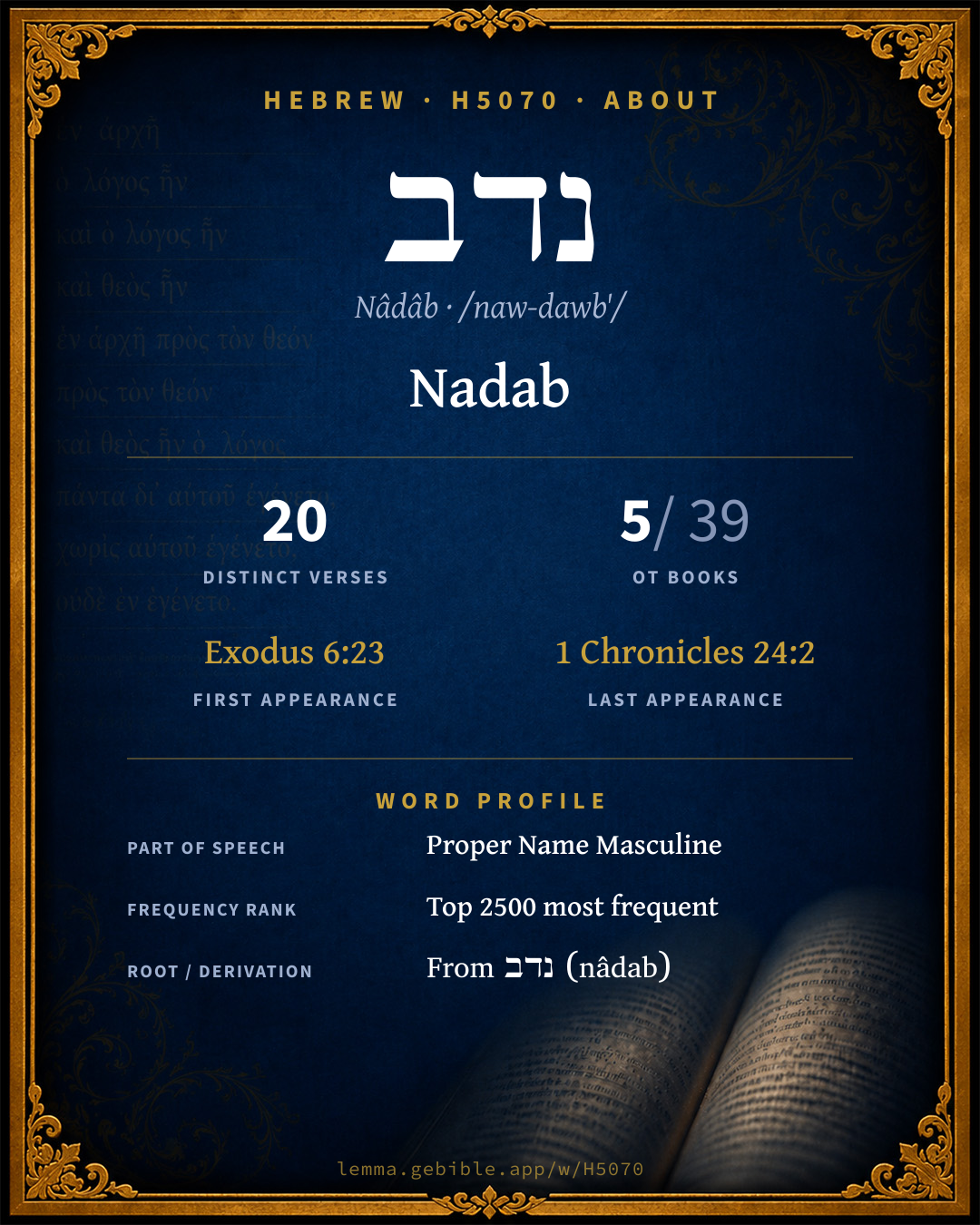
נָדָב
Nadab
BDB lists 5 entries for ‘Nadab’ fuller range ↓
Full lexicon entry — Brown-Driver-Briggs (BDB)
From Brown-Driver-Briggs (BDB)
Where this word appears
Grammar key — what these labels mean
Part of speech
- Noun
- A naming word — a person, place, thing, or idea.
Noun type
- Proper
- A name of a specific person, place, or people (e.g. Abraham, Zion, Israel).
Every verse where H5070 appears — 20 distinct verses across 5 books. Click any verse to open its interlinear word-by-word view. Verse text shown in the World English Bible for context — . Each verse’s Hebrew form is shown with its reference; the English is not keyword-highlighted, since the data carries no word-level English alignment. Use “Compare translations” on any verse to read it across multiple English versions. This concordance covers the Hebrew Bible; Septuagint (Greek Old Testament) occurrences are not indexed here.
Exodus 4 verses
- Exodus 6:23 נָדָב֙ n Proper Aaron took Elisheba, the daughter of Amminadab, the sister of Nahshon, as his wife; and she bore him Nadab and Abihu, Eleazar and Ithamar.
- Exodus 24:1 נָדָ֣ב n Proper He said to Moses, "Come up to Yahweh, you, and Aaron, Nadab, and Abihu, and seventy of the elders of Israel; and worship from a distance.
- Exodus 24:9 נָדָב֙ n Proper Then Moses, Aaron, Nadab, Abihu, and seventy of the elders of Israel went up.
- Exodus 28:1 נָדָ֧ב n Proper "Bring Aaron your brother, and his sons with him, near to you from among the children of Israel, that he may minister to me in the priest's office, even Aaron, Nadab and Abihu, Eleazar and Ithamar, Aaron's sons.
Leviticus 1 verse
Numbers 4 verses
- Numbers 3:2 נָדָ֑ב n Proper These are the names of the sons of Aaron: Nadab the firstborn, and Abihu, Eleazar, and Ithamar.
- Numbers 3:4 נָדָ֣ב n Proper Nadab and Abihu died before Yahweh, when they offered strange fire before Yahweh, in the wilderness of Sinai, and they had no children. Eleazar and Ithamar ministered in the priest's office in the presence of Aaron their father.
- Numbers 26:60 נָדָ֖ב n Proper To Aaron were born Nadab and Abihu, Eleazar and Ithamar.
- Numbers 26:61 נָדָ֖ב n Proper Nadab and Abihu died, when they offered strange fire before Yahweh.
1 Kings 4 verses
- 1 Kings 14:20 נָדָ֥ב n Proper The days which Jeroboam reigned were two and twenty years: and he slept with his fathers, and Nadab his son reigned in his place.
- 1 Kings 15:25 וְ/נָדָ֣ב conj + n Proper Nadab the son of Jeroboam began to reign over Israel in the second year of Asa king of Judah; and he reigned over Israel two years.
- 1 Kings 15:27 וְ/נָדָב֙ conj + n Proper Baasha the son of Ahijah, of the house of Issachar, conspired against him; and Baasha struck him at Gibbethon, which belonged to the Philistines; for Nadab and all Israel were laying siege to Gibbethon.
- 1 Kings 15:31 נָדָ֖ב n Proper Now the rest of the acts of Nadab, and all that he did, aren't they written in the book of the chronicles of the kings of Israel?
1 Chronicles 7 verses
- 1 Chronicles 2:28 נָדָ֖ב n Proper The sons of Onam were Shammai, and Jada. The sons of Shammai: Nadab, and Abishur.
- 1 Chronicles 2:30 נָדָ֖ב n Proper The sons of Nadab: Seled, and Appaim; but Seled died without children.
- 1 Chronicles 6:3 נָדָב֙ n Proper The children of Amram: Aaron, and Moses, and Miriam. The sons of Aaron: Nadab, and Abihu, Eleazar, and Ithamar.
- 1 Chronicles 8:30 וְ/נָדָֽב conj + n Proper and his firstborn son Abdon, and Zur, and Kish, and Baal, and Nadab,
- 1 Chronicles 9:36 וְ/נָדָֽב conj + n Proper and his firstborn son Abdon, and Zur, and Kish, and Baal, and Ner, and Nadab,
- 1 Chronicles 24:1 נָדָב֙ n Proper Thes were the divisions of the sons of Aaron. The sons of Aaron: Nadab and Abihu, Eleazar and Ithamar.
- 1 Chronicles 24:2 נָדָ֤ב n Proper But Nadab and Abihu died before their father, and had no children: therefore Eleazar and Ithamar executed the priest's office.
About this entry
At a glance — auto-summarized from this page’s data, not written by a person. Every figure links to its source below. This summary describes the numbers; it doesn’t interpret them.
“Nadab” is the headline sense of the Hebrew name נדב (Nâdâb). Scripture first uses it in Exodus 6:23. With 20 verses in 5 books, it is an uncommon word in the Hebrew Bible. It concentrates in 1 Chronicles, which alone accounts for 35% of its uses. See 20-verse concordance and the renderings breakdown below.
Gloss history
Strong's 1890 vs modern scholarship
About this word
Strong's H5070 catalogs a Hebrew word from the Hebrew Old Testament.
These counts are not copied from any lexicon or concordance. They are computed here, from the morphology-tagged Hebrew Old Testament. What Lemma adds →
- 20
- distinct verses
- The word appears in 20 distinct verses.
- 5 / 39
- OT books
- The word appears in 5 of 39 Old Testament books.
- #1,513
- by frequency
- Top 2500 most frequent Hebrew words (rank 1,513 of 8,640 Hebrew words by occurrence).
View all 20 occurrences in the concordance →
Most concentrated in
- 1 Chronicles 7 verses 35%
- Exodus 4 verses 20%
- Numbers 4 verses 20%
By section of the Old Testament
By traditional corpus
Conventional, traditional groupings — biblical authorship is debated, so this is a traditional corpus grouping, not an authorship claim. Each share is this word’s portion of its verses in that division of the Hebrew canon. Each figure is a share of the word’s 20 distinct verses.
- Torah (Pentateuch) 9 verses · 45%
- Writings (Ketuvim) 7 verses · 35%
- Prophets (Nevi'im) 4 verses · 20%
How translations render this word
Counts come from each version’s own published word-to-Strong’s tagging or interlinear alignment — an approximate guide to how each version renders this word, not a word-level alignment the data otherwise carries. Because each total is that version’s own tagged count, the per-version totals vary from one another and need not match the appearance or distinct-verse counts above. These counts may also differ from a printed concordance because Lemma counts each distinctly tagged rendering and does not collapse phrase taggings into a single head-word total. This is a fixed set of word-tagged versions (KJV, ASV, BSB, ULT) and does not change with the reading translation you choose elsewhere. Each version’s license is shown beside its name below (and on Sources).
- King James Version: Nadab 20×
- American Standard Version: Nadab 19×
- Berean Standard Bible: Nadab 19×
- unfoldingWord Literal Text: Nadab 18×, Now nadab 2×
King James Version Public Domain
Renders H5070 across 20 tagged occurrences — most commonly:
American Standard Version Public Domain
Renders H5070 across 20 tagged occurrences — most commonly:
Plus 1 rendering that appears only once — usually multi-word phrases or single function words the recovered tagging swept in, not distinct renderings.
Berean Standard Bible Public Domain
Renders H5070 across 20 tagged occurrences — most commonly:
Plus 1 rendering that appears only once — usually multi-word phrases or single function words the recovered tagging swept in, not distinct renderings.
unfoldingWord Literal Text CC BY-SA 4.0
Renders H5070 across 20 tagged occurrences — most commonly:
Senses in the full BDB
What do BDB’s symbols mean?
BDB uses these scholarly abbreviations:
| Symbol | Meaning |
|---|---|
| 𝔊 | the Septuagint (the ancient Greek translation, LXX) |
| 𝔙 | the Vulgate (the Latin translation) |
| 𝔖 | the Syriac version (the Peshitta) |
| 𝔗 | the Targum (the Aramaic translation) |
| ψ | the Psalms |
| √ | root (the underlying root or stem) |
| ‖ | parallel passage (a synonymous or contrasted parallel) |
| † | the dagger: every passage where the word occurs is cited |
The 4 senses and sub-senses the full Brown-Driver-Briggs lexicon distinguishes for this word, in lexicon order (not ranked by frequency), with BDB’s own verbatim wording and sub-sense lettering. Shown in Hebrew script with BDB’s own scholarly abbreviations. The condensed entry is in the Lexicon Entry tab. See also the Forms in the corpus table below.
- 1. eldest son of Aaron Ex 6:23; 24:1, 9; 28:1 Lv 10:1 Nu 3:2, 4; 26:60, 61 1 Ch 5:29; 24:1. 𝔊 Ναδαβ (so 3, 4). e.g. Exodus 6:23
- 2. son of Jeroboam I 1 K 14:20; 15:25, 27; 31. 𝔊 Ναβατ, Ναβαθ, 𝔊L Ναδαβ. e.g. 1 Kings 14:20
- 3. a Jerahmeelite 1 Ch 2:28, 30. e.g. 1 Chronicles 2:28
- 4. a Gibeonite 1 Ch 8:30; 9:36. e.g. 1 Chronicles 8:30
Senses from the full Brown-Driver-Briggs lexicon (Brown, Driver, Briggs; Oxford 1906 — public domain), digitized via Sefaria, supplemented by the OpenScriptures HebrewLexicon (CC BY 4.0). Full attribution on Sources.
Word origin
n.pr.m. (generous, noble)—
— Brown-Driver-Briggs (Oxford 1906, public domain), digitized via Sefaria, supplemented by the OpenScriptures HebrewLexicon (CC BY 4.0). See Sources.
Derived from נדב (nâdab) (H5068) — to incite.
Jastrow Dictionary
A second Hebrew/Aramaic lexicon for comparison, covering Aramaic and post-biblical (Talmudic, Targumic, Midrashic) usage that the biblical-Hebrew BDB does not. Matched by lemma rather than by Strong’s number, so a lemma may carry more than one Jastrow headword (shown separately below), and the entries cover usage well beyond the Bible.
נָדַב
- (b. h.)
- 1. to make willing, to prompt. Tanḥ. T’rum. 3 (ref. to Ex. XXV, 2) יצא … שאין לבו נוֹדְבוֹ this excludes the insane whom his heart (reason) cannot prompt; (Tanḥ. ed. Bub. ib. 2 שאינו מתנדב בלבו).—2) (denom. of נְדָבָה) to offer willingly, donate, consecrate, contrad. to נָדַר (v. נְדָבָה). Ned. 9ᵇ (ref. to Mish. ib. I, 1) תני נ׳ בנזיר וכ׳ read nadab (in place of nadar), he made a noble vow &c. Ib. 10ᵃ תני נוֹדֵב וכ׳ read nodeb (in place of נודר), he dedicates the sacrifice and fulfills (offers it). e.g. Exodus 25:2
- to be donated, dedicated. Meg. I, 10 כל שהוא נידר ונ׳ whatever sacrifice is dependent on vow or dedication; Zeb. 117ᵃ כל הנדר ונ׳ Ms. M.; Sifré Deut. 65; Tem. 14ᵇ. Ib. נזיר לאו נדר ונ׳ הוא the sacrifices of the Nazarite are not to be classified among the vowed or free-will offerings; a. e.
- to be prompted; to vow a free-will offering; to donate. Tosef. Ned. I, 1 אין הרשעים מִתְנַדְּבִים wicked men do not vow offerings. Ib. מתנדבים נזירות used to vow to be Nazarites. Men. XII, 3 לא ה׳ כדרך המתנדבים he did not make his vow in the ordinary way of vowing people. Ib. 4 מִתְנַדֵּב אדם וכ׳ a man may vow a meal offering of sixty &c. Tanḥ. ed. Bub. l. c. מתנדב בלבו is prompted by his heart, v. supra. Arakh. 6ᵇ עכו"ם שה׳ מנורה וכ׳ if a gentile donated a lamp to a synagogue. Sifra Tsav, Milluim, Par. 1 בשעה שצוה … להִתְנַדֵּב וכ׳ when the Lord of the world ordered free-will donations for the sanctuary; שלא יִתְנַדֵּב אדם גזל וכ׳ that no man must donate what is forced out of him, i.e. no pressure may be used for contributions for a sacred purpose; Yalk. Lev. 515. Snh. 43ᵃ נשים … מִתְנַדְּבוֹת וכ׳ worthy women … volunteered their services and brought them (benumbing drinks for the culprits); a. fr.
נְדַב
- , ch. Pa. נַדֵּב, Ithpa. אִתְנַדֵּב, אִינַּ׳ same, to donate; to be devoted to. Targ. Is. XIII, 2 מְנַדְּבִין ed. Lag. (oth. ed. מִתְנַ׳; h. text נדיבים). Targ. Ps. CX, 3.—Pes. 50ᵃ מתעתרי … ומִתְנַדְּבֵי Israelites will grow rich and offer donations. Arakh. 6ᵇ אינ׳ שרגא וכ׳ donated a lamp &c.
A Dictionary of the Targumim, the Talmud Babli and Yerushalmi, and the Midrashic Literature (Marcus Jastrow; London, Luzac, 1903) — Public Domain. Digitized via Sefaria. Digitized via Sefaria. Full attribution on Sources.
Forms in the corpus
The 11 distinct written forms H5070 takes in the Hebrew Bible, most frequent first — each parse links to that state’s occurrences in the concordance. Hebrew forms include their vowel points and cantillation, so a single lemma takes many written forms.
| Form | Parsing | Example | Uses |
|---|---|---|---|
| נָדָ֖ב | Noun, Proper | 1 Chronicles 2:28 | 5 |
| נָדָב֙ | Noun, Proper | Exodus 6:23 | 4 |
| וְ/נָדָֽב | Noun, Proper | 1 Chronicles 8:30 | 2 |
| נָדָ֣ב | Noun, Proper | Exodus 24:1 | 2 |
| וְ/נָדָ֣ב | Noun, Proper | 1 Kings 15:25 | 1 |
| וְ/נָדָב֙ | Noun, Proper | 1 Kings 15:27 | 1 |
| נָדָ֑ב | Noun, Proper | Numbers 3:2 | 1 |
| נָדָ֤ב | Noun, Proper | 1 Chronicles 24:2 | 1 |
| נָדָ֥ב | Noun, Proper | 1 Kings 14:20 | 1 |
| נָדָ֧ב | Noun, Proper | Exodus 28:1 | 1 |
| נָדָ֨ב | Noun, Proper | Leviticus 10:1 | 1 |
Same root — word family
Other BDB entries built from the same root as H5070, grouped by Strong’s listed origin. These share a root / origin per the lexicon — not necessarily a shared meaning. Each links to that word’s own entry.
Derives from
Shares the same root
Proper names from this root
People and places named from this root — a name, not an additional meaning of the word.
Compare all same-root words → Showing 4 of 7 — not the complete family. 2 of the same-root words are proper names (people or places). They share a root, not necessarily a meaning.
Bible dictionary
Public-domain dictionary articles matched to this entry by name (Nadab). A biblical name can be shared by more than one person or place, so an article may treat several.
Easton's Bible Dictionary · M. G. Easton, 1897
Liberal, generous. (1.) The eldest of Aaron's four sons (Ex. 6:23; Num. 3:2). He with his brothers and their father were consecrated as priests of Jehovah (Ex. 28:1). He afterwards perished with Abihu for the sin of offering strange fire on the altar of burnt-offering (Lev. 10:1, 2; Num. 3:4; 26:60).
(2.) The son and successor of Jeroboam, the king of Israel (1 Kings 14:20). While engaged with all Israel in laying siege to Gibbethon, a town of southern Dan (Josh. 19:44), a conspiracy broke out in his army, and he was slain by Baasha (1 Kings 15:25-28), after a reign of two years (B.C. 955-953). The assassination of Nadab was followed by that of his whole house, and thus this great Ephraimite family became extinct (1 Kings 15:29).
(3.) One of the sons of Shammai in the tribe of Judah (1 Chr. 2:28, 30).
Smith's Bible Dictionary · William Smith, 1863
(liberal).
+ The eldest son of Aaron and Elisheba. Exod 8 13 Numb 3:2. (B.C. 1490.) He, his father and brother, and seventy old men of Israel were led out from the midst of the assembled people, (Exodus 24:1) and were commended to stay and worship God "afar off," below the lofty summit of Sinai, where Moses alone was to come near to the Lord. Subsequently, (Leviticus 10:1) Nadab and his brother were struck dead before the sanctuary by fire from the Lord. Their offence was kindling the incense in their censers with "strange" fire, i.e. not taken from that which burned perpetually, (Leviticus 6:13) on the altar. + King Jeroboam's son, who succeeded to the throne of Israel B.C. 954, and reigned two years. (1 Kings 15:25-31) At the siege of Gibbethon a conspiracy broke out in the midst of the army, and the king was slain by Baasha, a man of Issachar. + A son of Shammai (1 Chronicles 2:28) of the tribe of Judah. + A son of Gibeon, (1 Chronicles 8:30; 9:36) of the tribe of Benjamin.
Hitchcock's Bible Names Dictionary · Roswell D. Hitchcock, 1869
free and voluntary gift; prince
Classic public-domain reference works; full attribution on Sources.
Septuagint verse parallels
This word appears in 19 verses that also exist in the Greek Old Testament (Septuagint), out of the 20 Hebrew verses it occurs in. You can read those verses in Greek by switching the Old Testament edition to the Septuagint.
Read these verses in the Septuagint
This is a verse-level parallel only — the same verses exist in both the Hebrew and Greek Old Testaments. No word-level Hebrew↔Greek correspondence is claimed: the data carries no such alignment, so no Greek word is shown as this Hebrew word’s translation. Coverage is not total — the Septuagint omits the deuterocanon and renumbers the Psalms, so some Hebrew verses have no direct Greek parallel.