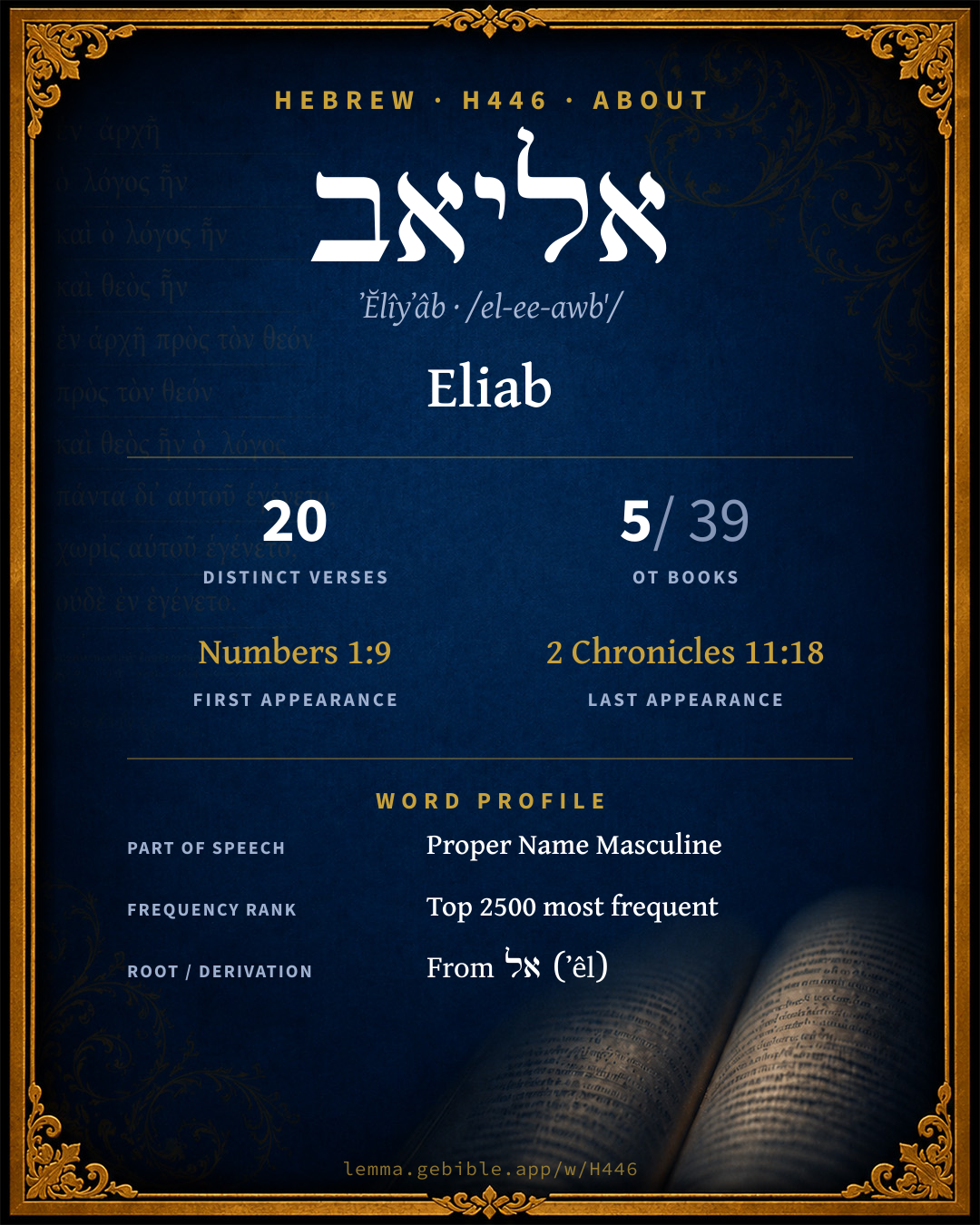
אֱלִיאָב
Eliab
BDB lists 7 entries for ‘Eliab’ fuller range ↓
Full lexicon entry — Brown-Driver-Briggs (BDB)
From Brown-Driver-Briggs (BDB)
Where this word appears
Grammar key — what these labels mean
Part of speech
- Noun
- A naming word — a person, place, thing, or idea.
Noun type
- Proper
- A name of a specific person, place, or people (e.g. Abraham, Zion, Israel).
Every verse where H446 appears in the Book of 2 Chronicles — 1 distinct verse. Click any verse to open its interlinear word-by-word view. Verse text shown in the World English Bible for context — . Each verse’s Hebrew form is shown with its reference; the English is not keyword-highlighted, since the data carries no word-level English alignment. Use “Compare translations” on any verse to read it across multiple English versions. This concordance covers the Hebrew Bible; Septuagint (Greek Old Testament) occurrences are not indexed here.
2 Chronicles
About this entry
At a glance — auto-summarized from this page’s data, not written by a person. Every figure links to its source below. This summary describes the numbers; it doesn’t interpret them.
אליאב — transliterated ʼĔlîyʼâb — is a Hebrew name carrying the sense “Eliab.” Debuting at Numbers 1:9, it then recurs through the corpus. Spanning 20 verses in 5 books, it ranks among the uncommon words of the Hebrew Bible. Its uses concentrate in Numbers (45% of all occurrences). See 20-verse concordance and the renderings breakdown below.
Gloss history
Strong's 1890 vs modern scholarship
About this word
Strong's H446 catalogs a Hebrew word from the Hebrew Old Testament.
These counts are not copied from any lexicon or concordance. They are computed here, from the morphology-tagged Hebrew Old Testament. What Lemma adds →
- 20
- distinct verses
- The word appears in 20 distinct verses.
- 5 / 39
- OT books
- The word appears in 5 of 39 Old Testament books.
- #1,462
- by frequency
- Top 2500 most frequent Hebrew words (rank 1,462 of 8,640 Hebrew words by occurrence).
View all 20 occurrences in the concordance →
Most concentrated in
- Numbers 9 verses 45%
- 1 Chronicles 6 verses 30%
- 1 Samuel 3 verses 15%
By section of the Old Testament
By traditional corpus
Conventional, traditional groupings — biblical authorship is debated, so this is a traditional corpus grouping, not an authorship claim. Each share is this word’s portion of its verses in that division of the Hebrew canon. Each figure is a share of the word’s 20 distinct verses.
- Torah (Pentateuch) 10 verses · 50%
- Writings (Ketuvim) 7 verses · 35%
- Prophets (Nevi'im) 3 verses · 15%
How translations render this word
Counts come from each version’s own published word-to-Strong’s tagging or interlinear alignment — an approximate guide to how each version renders this word, not a word-level alignment the data otherwise carries. Because each total is that version’s own tagged count, the per-version totals vary from one another and need not match the appearance or distinct-verse counts above. These counts may also differ from a printed concordance because Lemma counts each distinctly tagged rendering and does not collapse phrase taggings into a single head-word total. This is a fixed set of word-tagged versions (KJV, ASV, BSB, ULT) and does not change with the reading translation you choose elsewhere. Each version’s license is shown beside its name below (and on Sources).
- King James Version: Eliab 18×
- American Standard Version: Eliab 17×
- Berean Standard Bible: Eliab 18×
- unfoldingWord Literal Text: Eliab 17×, Was eliab 2×
King James Version Public Domain
Renders H446 across 21 tagged occurrences — most commonly:
Plus 3 renderings that appear only once — usually multi-word phrases or single function words the recovered tagging swept in, not distinct renderings.
American Standard Version Public Domain
Renders H446 across 21 tagged occurrences — most commonly:
Plus 4 renderings that appear only once — usually multi-word phrases or single function words the recovered tagging swept in, not distinct renderings.
Berean Standard Bible Public Domain
Renders H446 across 20 tagged occurrences — most commonly:
Plus 2 renderings that appear only once — usually multi-word phrases or single function words the recovered tagging swept in, not distinct renderings. Not rendered by a distinct English word in 1 further occurrence.
unfoldingWord Literal Text CC BY-SA 4.0
Renders H446 across 21 tagged occurrences — most commonly:
Plus 2 renderings that appear only once — usually multi-word phrases or single function words the recovered tagging swept in, not distinct renderings.
Senses in the full BDB
What do BDB’s symbols mean?
BDB uses these scholarly abbreviations:
| Symbol | Meaning |
|---|---|
| 𝔊 | the Septuagint (the ancient Greek translation, LXX) |
| 𝔙 | the Vulgate (the Latin translation) |
| 𝔖 | the Syriac version (the Peshitta) |
| 𝔗 | the Targum (the Aramaic translation) |
| ψ | the Psalms |
| √ | root (the underlying root or stem) |
| ‖ | parallel passage (a synonymous or contrasted parallel) |
| † | the dagger: every passage where the word occurs is cited |
The 6 senses and sub-senses the full Brown-Driver-Briggs lexicon distinguishes for this word, in lexicon order (not ranked by frequency), with BDB’s own verbatim wording and sub-sense lettering. Shown in Hebrew script with BDB’s own scholarly abbreviations. The condensed entry is in the Lexicon Entry tab. See also the Forms in the corpus table below.
- a. prince of Zebulon Nu 1:9; 2:7; 7:24, 29; 10:16. e.g. Numbers 1:9
- b. prince of Reuben Nu 16:1, 12; 26:8, 9 Dt 11:6. e.g. Numbers 16:1
- c. brother of David 1 S 16:6; 17:13, 28(×2) 1 Ch 2:13 2 Ch 11:18 (cf. אֱלִיהוּ 1 Ch 27:18). e.g. 1 Samuel 16:6
- d. a Kohathite 1 Ch 6:12 = אֱלִיאֵל v 19 cf. אֱלִיהוּ 1 S 1:1. e.g. 1 Chronicles 6:12
- e. a Gadite 1 Ch 12:9. e.g. 1 Chronicles 12:9
- f. Levite singer 1 Ch 15:18, 20; 16:5. e.g. 1 Chronicles 15:18
Senses from the full Brown-Driver-Briggs lexicon (Brown, Driver, Briggs; Oxford 1906 — public domain), digitized via Sefaria, supplemented by the OpenScriptures HebrewLexicon (CC BY 4.0). Full attribution on Sources.
Word origin
n.pr.m. (God is father, cf. אֲבִיאֵל)
— Brown-Driver-Briggs (Oxford 1906, public domain), digitized via Sefaria, supplemented by the OpenScriptures HebrewLexicon (CC BY 4.0). See Sources.
Derived from אל (ʼêl) (H410) — God.
Forms in the corpus
The 13 distinct written forms H446 takes in the Hebrew Bible, most frequent first — each parse links to that state’s occurrences in the concordance. Hebrew forms include their vowel points and cantillation, so a single lemma takes many written forms.
| Form | Parsing | Example | Uses |
|---|---|---|---|
| אֱלִיאָ֖ב | Noun, Proper | 1 Chronicles 12:9 | 7 |
| אֱלִיאָ֑ב | Noun, Proper | 1 Chronicles 2:13 | 3 |
| אֱלִיאָ֔ב | Noun, Proper | Numbers 26:9 | 1 |
| אֱלִיאָ֛ב | Noun, Proper | Numbers 16:1 | 1 |
| אֱלִיאָ֡ב | Noun, Proper | 1 Chronicles 15:18 | 1 |
| אֱלִיאָ֣ב | Noun, Proper | 1 Samuel 17:13 | 1 |
| אֱלִיאָ֥ב | Noun, Proper | 1 Chronicles 6:27 | 1 |
| אֱלִיאָ֨ב | Noun, Proper | 1 Samuel 17:28 | 1 |
| אֱלִיאָֽב | Noun, Proper | Numbers 26:8 | 1 |
| אֱלִיאָב֙ | Noun, Proper | 1 Samuel 17:28 | 1 |
| אֱלִיאָב֮ | Noun, Proper | Deuteronomy 11:6 | 1 |
| וֶ/אֱלִיאָ֡ב | Noun, Proper | 1 Chronicles 16:5 | 1 |
| וֶֽ/אֱלִיאָ֔ב | Noun, Proper | 1 Chronicles 15:20 | 1 |
Same root — word family
Other BDB entries built from the same root as H446, grouped by Strong’s listed origin. These share a root / origin per the lexicon — not necessarily a shared meaning. Each links to that word’s own entry.
Derives from
Shares the same root
Proper names from this root
People and places named from this root — a name, not an additional meaning of the word.
- אל אלהי ישראל ʼÊl ʼĕlôhêy Yisrâʼêl H415 Elelohe-israel
- אל ביתאל ʼÊl Bêyth-ʼÊl H416 El-beth-el
- אלדד ʼEldâd H419 Eldad
- אלדעה ʼEldâʻâh H420 Eldaah
- אלוה ʼĕlôwahh H433 God
- אלזבד ʼElzâbâd H443 Elzabad
- אלחנן ʼElchânân H445 Elhanan
- אליאל ʼĔlîyʼêl H447 Eliel
- אליאתה ʼĔlîyʼâthâh H448 Eliathah
- אלידע ʼElyâdâʻ H450 Eliada
- אליה ʼÊlîyâh H452 Elijah
- אליהו ʼĔlîyhûw H453 Elihu
- אליחבא ʼElyachbâʼ H455 Eliahba
- אליחרף ʼĔlîychôreph H456 Elihoreph
- אלימלך ʼĔlîymelek H458 Elimelech
- אליסף ʼElyâçâph H460 Eliasaph
- אליעזר ʼĔlîyʻezer H461 Eliezer
- אליעם ʼĔlîyʻâm H463 Eliam
- אליפז ʼĔlîyphaz H464 Eliphaz
- אליפל ʼĔlîyphâl H465 Eliphal
- אליפלהו ʼĔlîyphᵉlêhûw H466 Elipheleh
- אליפלט ʼĔlîypheleṭ H467 Eliphelet
- אליצור ʼĔlîytsûwr H468 Elizur
- אליצפן ʼĔlîytsâphân H469 Elizaphan
+24 more proper names from this root (not shown).
Compare all same-root words → Showing 4 of 51 — not the complete family. 49 of the same-root words are proper names (people or places). They share a root, not necessarily a meaning.
Bible dictionary
Public-domain dictionary articles matched to this entry by name (Eliab). A biblical name can be shared by more than one person or place, so an article may treat several.
Easton's Bible Dictionary · M. G. Easton, 1897
To whom God is father. (1.) A Reubenite, son of Pallu (Num. 16:1, 12; 26:8, 9; Deut. 11:6).
(2.) A son of Helon, and chief of the tribe of Zebulun at the time of the census in the wilderness (Num. 1:9; 2:7).
(3.) The son of Jesse, and brother of David (1 Sam. 16:6). It was he who spoke contemptuously to David when he proposed to fight Goliath (1 Sam. 17:28).
(4.) One of the Gadite heroes who joined David in his stronghold in the wilderness (1 Chr. 12:9).
Smith's Bible Dictionary · William Smith, 1863
(God is my father).
+ Son of Helon and leader of the tribe of Zebulun at the time of the census in the wilderness of Sinai. (Numbers 1:9; 2:7; 7:24,29; 10:16) (B.C. 1490.) + A Reubenite, father of Dathan and Abiram. (Numbers 16:1,12; 26:8,9; 11:6) + One of David's brothers, the eldest of the family. (1 Samuel 16:6; 17:13,28; 1 Chronicles 2:13) (B.C. 1063.) + A Levite in the time of David, who was both a "porter" and a musician on the "psaltery." (1 Chronicles 15:18,20; 16:5) + One of the warlike Gadite leaders who came over to David when he was in the wilderness taking refuge from Saul. (1 Chronicles 12:9) (B.C. 1061.) + An ancestor of Samuel the prophet; a Kohathite Levite, son of Nahath. (1 Chronicles 6:27) (B.C. 1250). + Son of Nathanael, one of the fore-fathers of Judith, and therefore belonging to the tribe of Simeon. Judith 8:1.
Hitchcock's Bible Names Dictionary · Roswell D. Hitchcock, 1869
God is my father; God is the father
Classic public-domain reference works; full attribution on Sources.
Septuagint verse parallels
This word appears in 20 verses that also exist in the Greek Old Testament (Septuagint), out of the 20 Hebrew verses it occurs in. You can read those verses in Greek by switching the Old Testament edition to the Septuagint.
Read these verses in the Septuagint
This is a verse-level parallel only — the same verses exist in both the Hebrew and Greek Old Testaments. No word-level Hebrew↔Greek correspondence is claimed: the data carries no such alignment, so no Greek word is shown as this Hebrew word’s translation. Coverage is not total — the Septuagint omits the deuterocanon and renumbers the Psalms, so some Hebrew verses have no direct Greek parallel.