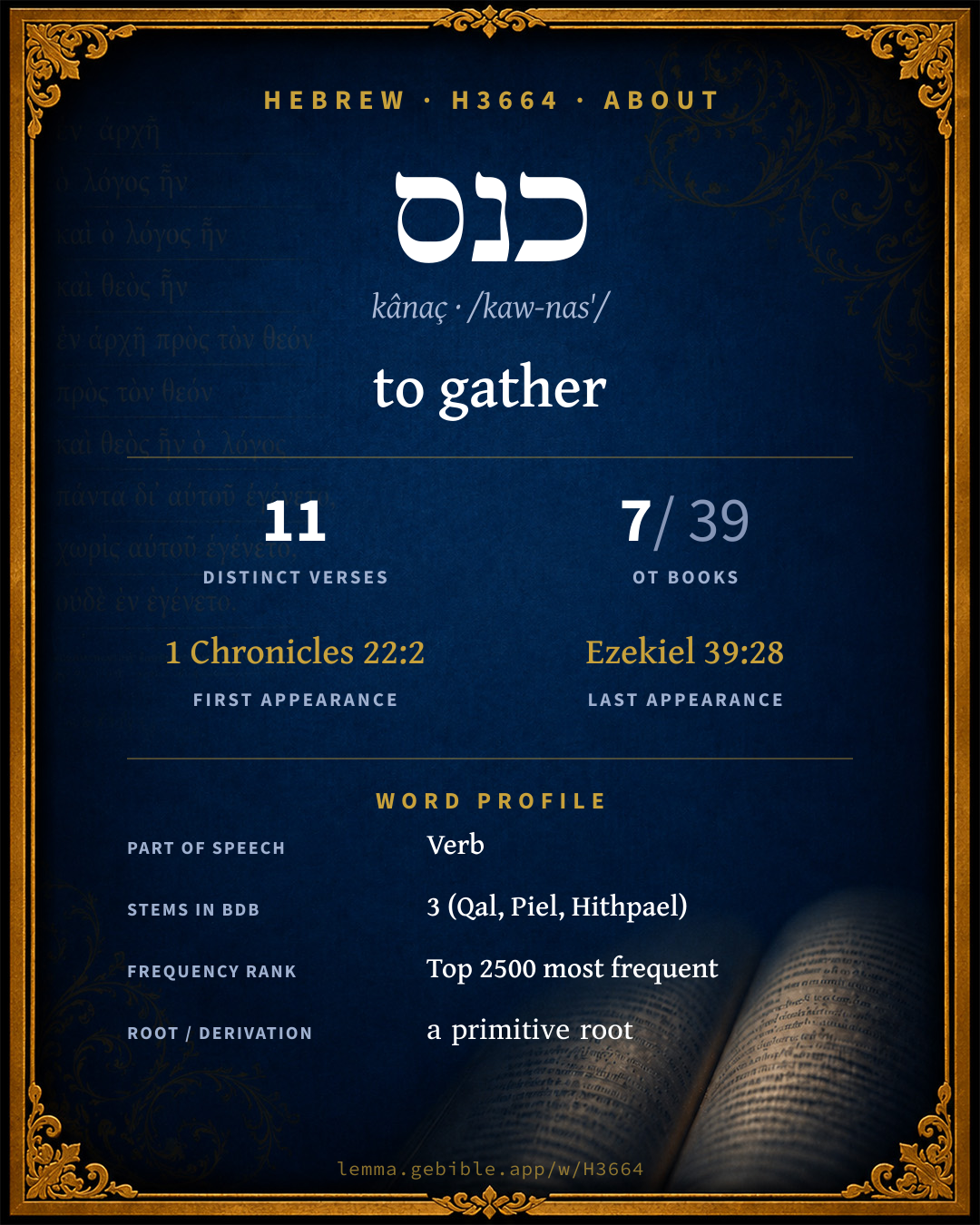
כָּנַס
to gather
also: collect, wrap fuller range ↓
Full lexicon entry — Brown-Driver-Briggs (BDB)
From Brown-Driver-Briggs (BDB)
Where this word appears
Grammar key — what these labels mean
Part of speech
- Verb
- An action or state-of-being word.
Stem
- Qal
- The basic, simple active stem — the plain form of the verb (“he wrote”).
- Piel
- An intensive or resultative active stem.
- Hithpael
- The reflexive or reciprocal stem (the subject acts on itself).
Form
- Infinitive Construct
- A bound verbal noun, frequently with prepositions (“to write / in writing”).
- Sequential Perfect
- A perfect with prefixed waw continuing a preceding imperfect or command (waw-consecutive perfect).
- Imperfect
- An incomplete, ongoing, or future action (“he will / would write”).
- Perfect
- A completed action or state — Hebrew marks aspect (completeness) more than strict tense (“he wrote”).
- Participle Active
- A verbal adjective expressing ongoing or characteristic action (“writing / one who writes”).
- Imperative
- A direct command (“write!”).
State
- Absolute
- The independent form of a noun, not bound to a following word.
Person
- 1st Person
- The speaker (“I / we”).
- 3rd Person
- The one spoken about (“he / she / it / they”).
- 2nd Person
- The one addressed (“you”).
Gender
- Common
- Either gender — not distinguished for this form.
- Masculine
- Grammatically masculine.
Number
- Singular
- One.
Every verse where H3664 appears in the Book of 1 Chronicles — 1 distinct verse. Click any verse to open its interlinear word-by-word view. Verse text shown in the World English Bible for context — . Each verse’s Hebrew form is shown with its reference; the English is not keyword-highlighted, since the data carries no word-level English alignment. Use “Compare translations” on any verse to read it across multiple English versions. This concordance covers the Hebrew Bible; Septuagint (Greek Old Testament) occurrences are not indexed here.
1 Chronicles
About this entry
At a glance — auto-summarized from this page’s data, not written by a person. Every figure links to its source below. This summary describes the numbers; it doesn’t interpret them.
כנס — transliterated kânaç — is a Hebrew verb carrying the sense “to gather.” It first appears in 1 Chronicles 22:2. With 11 verses in 7 books, it is an uncommon word in the Hebrew Bible. Its uses concentrate in Ecclesiastes (27% of all occurrences). Read the stem: it spans 3 stems, including Qal and Piel. See the sense tree, 11-verse concordance, and the renderings breakdown below.
Gloss history
Strong's 1890 vs modern scholarship
About this word
Strong's H3664 catalogs a Hebrew word from the Hebrew Old Testament.
These counts are not copied from any lexicon or concordance. They are computed here, from the morphology-tagged Hebrew Old Testament. What Lemma adds →
- 11
- distinct verses
- The word appears in 11 distinct verses.
- 7 / 39
- OT books
- The word appears in 7 of 39 Old Testament books.
- #2,210
- by frequency
- Top 2500 most frequent Hebrew words (rank 2,210 of 8,640 Hebrew words by occurrence).
View all 11 occurrences in the concordance →
Most concentrated in
- Ecclesiastes 3 verses 27%
- Psalms 2 verses 18%
- Ezekiel 2 verses 18%
By section of the Old Testament
By traditional corpus
Conventional, traditional groupings — biblical authorship is debated, so this is a traditional corpus grouping, not an authorship claim. Each share is this word’s portion of its verses in that division of the Hebrew canon. Each figure is a share of the word’s 11 distinct verses.
- Writings (Ketuvim) 8 verses · 73%
- Prophets (Nevi'im) 3 verses · 27%
How translations render this word
Counts come from each version’s own published word-to-Strong’s tagging or interlinear alignment — an approximate guide to how each version renders this word, not a word-level alignment the data otherwise carries. Because each total is that version’s own tagged count, the per-version totals vary from one another and need not match the appearance or distinct-verse counts above. These counts may also differ from a printed concordance because Lemma counts each distinctly tagged rendering and does not collapse phrase taggings into a single head-word total. This is a fixed set of word-tagged versions (KJV, ASV, BSB, ULT) and does not change with the reading translation you choose elsewhere. Each version’s license is shown beside its name below (and on Sources).
- King James Version: Gather 2×, Gather together 2×
- American Standard Version: Gather 2×, Gather together 2×
- Berean Standard Bible: Gather 2×
- unfoldingWord Literal Text: Gather 4×
King James Version Public Domain
Renders H3664 across 12 tagged occurrences — most commonly:
Plus 8 renderings that appear only once — usually multi-word phrases or single function words the recovered tagging swept in, not distinct renderings.
American Standard Version Public Domain
Renders H3664 across 12 tagged occurrences — most commonly:
Plus 8 renderings that appear only once — usually multi-word phrases or single function words the recovered tagging swept in, not distinct renderings.
Berean Standard Bible Public Domain
Renders H3664 across 11 tagged occurrences — most commonly:
Plus 9 renderings that appear only once — usually multi-word phrases or single function words the recovered tagging swept in, not distinct renderings.
unfoldingWord Literal Text CC BY-SA 4.0
Renders H3664 across 12 tagged occurrences — most commonly:
Plus 8 renderings that appear only once — usually multi-word phrases or single function words the recovered tagging swept in, not distinct renderings.
Senses in the full BDB
Hebrew verbs can shift meaning by stem (binyan): Qal is the basic action, Niphal is often passive or reflexive, Piel often intensifies or makes it factitive, and Hiphil is typically causative. The senses below are grouped under the stem BDB assigns to each. This entry also uses Hithpael (reflexive or reciprocal).
What do BDB’s symbols mean?
BDB uses these scholarly abbreviations:
| Symbol | Meaning |
|---|---|
| 𝔊 | the Septuagint (the ancient Greek translation, LXX) |
| 𝔙 | the Vulgate (the Latin translation) |
| 𝔖 | the Syriac version (the Peshitta) |
| 𝔗 | the Targum (the Aramaic translation) |
| ψ | the Psalms |
| √ | root (the underlying root or stem) |
| ‖ | parallel passage (a synonymous or contrasted parallel) |
| † | the dagger: every passage where the word occurs is cited |
The 3 senses and sub-senses the full Brown-Driver-Briggs lexicon distinguishes for this word, in lexicon order (not ranked by frequency), with BDB’s own verbatim wording and sub-sense lettering. Shown in Hebrew script with BDB’s own scholarly abbreviations. The condensed entry is in the Lexicon Entry tab. See also the Forms in the corpus table below.
Qal
- (late) Pf. 1 s. כָּנַסְתִּי Ec 2:8; Imv. כְּנוֹס Est 4:16; Inf. cstr. 1 Ch 22:2 + 3 times; Pt. כֹּנֵס ψ 33:7;—gather people 1 Ch 22:2 Est 4:16; כ׳ כַּנֵּד מֵי הַיָּ֑ם נֹתֵן בְּאוֹצָרוֹת תְּהוֹמוֹת ψ 33:7 (read perhaps, for כַּנֵּד, כַּנֹּאד as in a wine skin, v. נאד, נד); gather, collect portions of harvest for priests and Levites Ne 12:44; stones Ec 3:5 (opp. השׁליך); silver and gold = amass wealth Ec 2:8; abs. v 26 (‖ אסף). e.g. Ecclesiastes 2:8
Piel
- Pf. 1 s. וְכִנַּסְתִּ֫י אֶתְכֶם Ez 22:21 and I will gather you together (for punishment; Co tr. to v 20 and reads for וְהִנַּחְתִּ֫י; ‖ קבץ v 19, 20); of restoration וְכִנַּסְתִּים אֶל־אַדְמָתָם 39:28, and יְכַנֵּס ψ 147:2. e.g. Ezekiel 22:21
Hithpael
- Inf. cstr. וְהַמַּסֵּכָה צָרָה כְּהִתְכַּנֵּס Is 28:20 and the covering is (too) narrow when one gathers oneself together (‖ קָצַר הַמַּצָּע מֵהִשְׂתַּרֵעַ), i.e. the bed is too short to stretch one-self at full length, and when one (perforce) draws up the feet, the covering becomes too narrow. e.g. Isaiah 28:20
Senses from the full Brown-Driver-Briggs lexicon (Brown, Driver, Briggs; Oxford 1906 — public domain), digitized via Sefaria, supplemented by the OpenScriptures HebrewLexicon (CC BY 4.0). Full attribution on Sources.
Word origin
vb. gather, collect (NH id. brought in; Aramaic כְּנַס (v. כנשׁ); Ethiopic ከነሰ in der. conj. assemble for worship, etc.; Arabic كَنَسَ is sweep, sweep away, destroy)—
— Brown-Driver-Briggs (Oxford 1906, public domain), digitized via Sefaria, supplemented by the OpenScriptures HebrewLexicon (CC BY 4.0). See Sources.
Origin: a primitive root
Jastrow Dictionary
A second Hebrew/Aramaic lexicon for comparison, covering Aramaic and post-biblical (Talmudic, Targumic, Midrashic) usage that the biblical-Hebrew BDB does not. Matched by lemma rather than by Strong’s number, so a lemma may carry more than one Jastrow headword (shown separately below), and the entries cover usage well beyond the Bible.
כָּנַס
- v. כּוֹס I)
- 1. to collect, gather; to cover, shelter, bring home. B. Kam. VI, 1 הכּוֹנס צאן לדיר he who takes the flock into the stall; a. fr.—כ׳ משקה to absorb liquids through pores, opp. to הוציא to let liquids escape through pores. Nidd. 49ᵃ יביא … אם כָּנְסָה וכ׳ get a tub full of water and put the pot in, if it draws water &c. Kel. X, 8 היו בכוֹנֵס משקה (sub. נקובין) if the vessels were so porous as to be called absorbers of liquids. Nidd. l. c. כיצד … לידע אם ניקב בכונס משקה how do we examine to find out whether a vessel is porous to the extent of absorbing liquids? (v. supra); a. fr.—Esp. to take a woman home, to consummate a marriage by conducting a woman to one’s house, to wed, v. אֵירוּסִין a. נִישּׂוּאִין. Keth. 3ᵇ וברביעי כּוֹנְסָהּ and on the fourth day of the week he weds her. Ib. ומסכנה ואילך נהגו … לִכְנוֹס וכ׳ and from the days of persecution … the people adopted the custom to wed on the third day; … ובשני לא יִכְנוֹס but on the second day one must not marry. Y. Yeb. IV, 6ᵇ כְּנָסָהּ ולא וכ׳ he took her to his home but did not touch her &c.; a. fr.—Part. pass. כְּנוּסָה. Y. Sot. II, 18ᵇ top שומרת יבם וכ׳ neither while waiting for the yabam nor after having been taken to his house.
- 2. (of a sore) [to gather,] to grow smaller, to contract, opp. פשה. Neg. IV, 7; Tosef. ib. II, 6; Sifra Thazr., Neg., Par. 2, ch. II; a. e.
- 3. (archit.) to recede, to form a settle or recess in a wall. Midd. III, 1 עלה אמה וכ׳ אמה (the altar) rose one cubit and then receded one cubit; Men. 97ᵇ.—Y. Erub. VII, 24ᵇ bot. (of an inclined plane) עולה אמה וכוֹנֵס שלש it rises vertically one cubit, while the incline measures three cubits, v. כִּיבּוּשׁ.—Part. pass. כָּנוּס, f. כְּנוּסָה. Tosef. Erub. I, 10 כותל שצידו אחד כ׳ מחבירו וכ׳ a wall which is more receding on one side than on the other, either the inner wall being even &c.; Erub. 9ᵇ; 15ᵃ; (Y. ib. 19ᵇ top כותל הנכנס). Y. Succ. I, 52ᵃ אפי׳ כנוסה כמה even if the reduction be ever so large.
- 1. to be brought in, to enter, opp. יצא; to assemble, meet. Erub. 65ᵃ, v. סוֹד. Ib. 15ᵇ נ׳ ויוצא is easily passed in and out. Kel. IX, 7 מלא … נ׳ when a piece of the size … can be passed, לא נ׳ when it cannot pass (exactly fitting in). Y. Erub. I, 18ᶜ bot. אין … לִיכָּנֵס וכ׳ it is not the habit of man to enter through one door and leave through another.—Ḥull. 3ᵃ, a. fr. יוצא ונ׳ superintending by going in and out. Sabb. 137ᵇ כשם שנ׳ … יִכָּנס וכ׳ as he (the child) has been entered into the covenant, so may he be introduced to the study of the Law &c. Snh. 101ᵃ נִכְנְסוּ תלמידיו וכ׳ his pupils came together to visit him. Tosef. Ber. VII (VI), 19, a. e. לא יִכָּנֵס אדם להר וכ׳ one must not enter the Temple mount &c.—Meg. I, 3 מקום שנִכְנָסִין וכ׳ a place where the country people are in the habit of assembling on Mondays &c.; a. fr.
- 2. to form a recess or settle. Y. Erub. I, 19ᵇ top, v. supra.
- 3. to be married, v. supra. Y. Yeb. IV, 6ᵇ הִיכָּנְסִי וכ׳ be my wife and raise thy sister’s children; Koh. R. to IX, 9; a. fr.
- to gather, collect. Tosef. Ber. VII (VI), 24 בשעת המְכַנְּסִין … כַּנֵּס when people collect (learning), scatter, when they scatter (are indifferent), gather in (withdraw); v. בְּדַר; Ber. 63ᵃ המכניסים (read: המְכַנְּ׳, v. Rabb. D. S. a. l. note 9). Ex. R. s. 17, beg. שכִּינְּסָן מעל הארץ which (waters) he gathered from upon the land. Deut. R. s. 3 כִּינְּסָה את בניה she assembled her children; a. fr.—Part. pass. מְכוּנָּס, f. מְכוּנֶּסֶת; pl. מְכוּנָּסִין, מְכוּנָּסוֹת. Erub. 21ᵃ (מים) מ׳ collected water, opp. מים חיים. Midr. Till. to Ps. LXX הרי הצאן מכ׳ the flock is gathered again. Neg. IV, 3 במ׳ when the hairs on the leprous spot are close together, opp. מפוזר; a. fr.
- to bring in, to lay in, store up; to introduce, pass; to initiate. Lev. R. s. 9 הִכְנִיסוֹ לביתו he invited him to his house. Ex. R. s. 20 אם אני מַכְנִיסָן וכ׳ if I lead them now into the land. Ib. ה׳ יינו וכ׳ he stored his wine in the cellar. Men. 97ᵃ ומכניס קנה וכ׳ and passes a tube under it. Sabb. 118ᵇ ה׳ ידו וכ׳ put his hand under his belt. Ib. מַכְנִיסֵי שבת who usher the Sabbath in (with prayer). Ib. 137ᵇ להַכְנִיסוֹ בבריתו וכ׳ to initiate him into the covenant &c. (v. supra). Y. Yeb. I, 3ᵃ bot. הרי אתם מַכְנִיסִין ראשי וכ׳ you want me to put my head between two great mountains. Mekh. B’shall., Shir., s. 6 לא מוציא ולא מַכְנִיס neither lets escape nor receives, v. נוֹד; a. fr.
- 1. to assemble, meet, be reunited. Taan. 27ᵇ מִתְכַּנְּסִין לבה"כ meet at the synagogue. Gen. R. s. 39, a. e. אם מתכנסין כל וכ׳ if all human beings were to join for creating &c.; Cant. R. to I, 3 מִתְכַּנְּשִׁין. Mekh. B’shall. s. 6 אין הגליות מִתְכַּנְּסוֹת וכ׳ the diaspora will be reunited only as a reward for faith; a. fr.—Gen. R. s. 12, beg. מתכנסין ויוצאין; (Koh. R. to II, 12 נכנסין) they go in and out.
- 2. to gather, become closer (v. supra). Neg. I, 6 נִתְכַּנְּסָה the sore gathered.
כְּנַס
- 1. to gather, receive. Targ. Ps. XLI, 7 Ms. (ed. כנף, h. text קבץ). Targ. Esth. IV, 16 (Targ. II Esth. ib. כנוש). Targ. Y. Gen. XVIII, 3 אֵיכְנוֹס וכ׳ I shall receive the passers-by.—V. כְּנַשׁ.
- 2. to marry. Y. Erub. III, 21ᵇ top ומִיכְנַסְנִיךְ ליום פלן and to marry thee before such a date; Y. Gitt. VII, end, 49ᵃ ומנכסיך (corr. acc.). Ib. ולא כְנַסְתִּיךְ and I shall not have married thee. Y. Keth. I, beg. 24ᵈ אילין דכַנְסִין וכ׳ those who marry widows; a. fr.
- 3. to enter. Y. Snh. VI, 23ᶜ bot. כיון דכ׳ when he had entered; a. e.—[Targ. Esth. II, 21; IV, 17, v. בְּנַס.]
- to gather, heap. Targ. Ps. XXXIII, 7 Ms. (ed. מַכְנִיס Af.). Ib. CXLVII, 2 (Ms. Pe.).
- to be gathered, to assemble. Targ. I Chr. XI, 1 (ed. Lag. a. Rahmer אתכניש׳). Targ. Ps. XLVII, 10 Ms. (ed. אתכנש׳).
A Dictionary of the Targumim, the Talmud Babli and Yerushalmi, and the Midrashic Literature (Marcus Jastrow; London, Luzac, 1903) — Public Domain. Digitized via Sefaria. Digitized via Sefaria. Full attribution on Sources.
Forms in the corpus
The 11 distinct written forms H3664 takes in the Hebrew Bible, most frequent first — each parse links to that stem’s occurrences in the concordance. Hebrew forms include their vowel points and cantillation, so a single lemma takes many written forms.
| Form | Parsing | Example | Uses |
|---|---|---|---|
| וְ/כִנַּסְתִּ֖י/ם | Verb, Piel, Sequential Perfect, 1st Person, Common, Singular | Ezekiel 39:28 | 1 |
| וְ/כִנַּסְתִּ֣י | Verb, Piel, Sequential Perfect, 1st Person, Common, Singular | Ezekiel 22:21 | 1 |
| וְ/לִ/כְנ֗וֹס | Verb, Qal, Infinitive Construct | Ecclesiastes 2:26 | 1 |
| יְכַנֵּֽס | Verb, Piel, Imperfect, 3rd Person, Masculine, Singular | Psalms 147:2 | 1 |
| כְּ/הִתְכַּנֵּֽס | Verb, Hithpael, Infinitive Construct | Isaiah 28:20 | 1 |
| כְּנ֣וֹס | Verb, Qal, Infinitive Construct | Ecclesiastes 3:5 | 1 |
| כְּנ֨וֹס | Verb, Qal, Imperative, 2nd Person, Masculine, Singular | Esther 4:16 | 1 |
| כָּנַ֤סְתִּי | Verb, Qal, Perfect, 1st Person, Common, Singular | Ecclesiastes 2:8 | 1 |
| כֹּנֵ֣ס | Verb, Qal, Participle Active, Masculine, Singular, Absolute | Psalms 33:7 | 1 |
| לִ/כְנ֨וֹס | Verb, Qal, Infinitive Construct | Nehemiah 12:44 | 1 |
| לִ/כְנוֹס֙ | Verb, Qal, Infinitive Construct | 1 Chronicles 22:2 | 1 |
Same root — word family
Other BDB entries built from the same root as H3664, grouped by Strong’s listed origin. These share a root / origin per the lexicon — not necessarily a shared meaning. Each links to that word’s own entry.
Derived from this word
Compare all same-root words → They share a root, not necessarily a meaning.
Septuagint verse parallels
This word appears in 10 verses that also exist in the Greek Old Testament (Septuagint), out of the 11 Hebrew verses it occurs in. You can read those verses in Greek by switching the Old Testament edition to the Septuagint.
Read these verses in the Septuagint
This is a verse-level parallel only — the same verses exist in both the Hebrew and Greek Old Testaments. No word-level Hebrew↔Greek correspondence is claimed: the data carries no such alignment, so no Greek word is shown as this Hebrew word’s translation. Coverage is not total — the Septuagint omits the deuterocanon and renumbers the Psalms, so some Hebrew verses have no direct Greek parallel.